Key Takeaways
- Completely different purposes: Searchable monitors brand visibility in AI search engines (ChatGPT, Claude, Perplexity), while AnyTrack tracks ad conversions and attribution across Meta, Google, TikTok
- Pricing overlap but different value: Both start around $100/mo, but Searchable charges per domain/prompts tracked, AnyTrack charges per session volume
- Searchable is for content teams: If you're optimizing for AI citations and organic AI visibility, Searchable is purpose-built for that
- AnyTrack is for paid media teams: If you're running paid ads and need accurate conversion tracking despite iOS privacy changes, AnyTrack solves that
- No direct competition: These tools serve adjacent but non-overlapping needs -- many brands could use both simultaneously
- Integration ecosystems differ: Searchable connects to Google Analytics/Search Console for content insights, AnyTrack connects to ad platforms and affiliate networks for conversion data
Overview
These two platforms occupy completely different spaces in the marketing stack, despite both being tracking tools. Let's look at what each one actually does.
Searchable overview
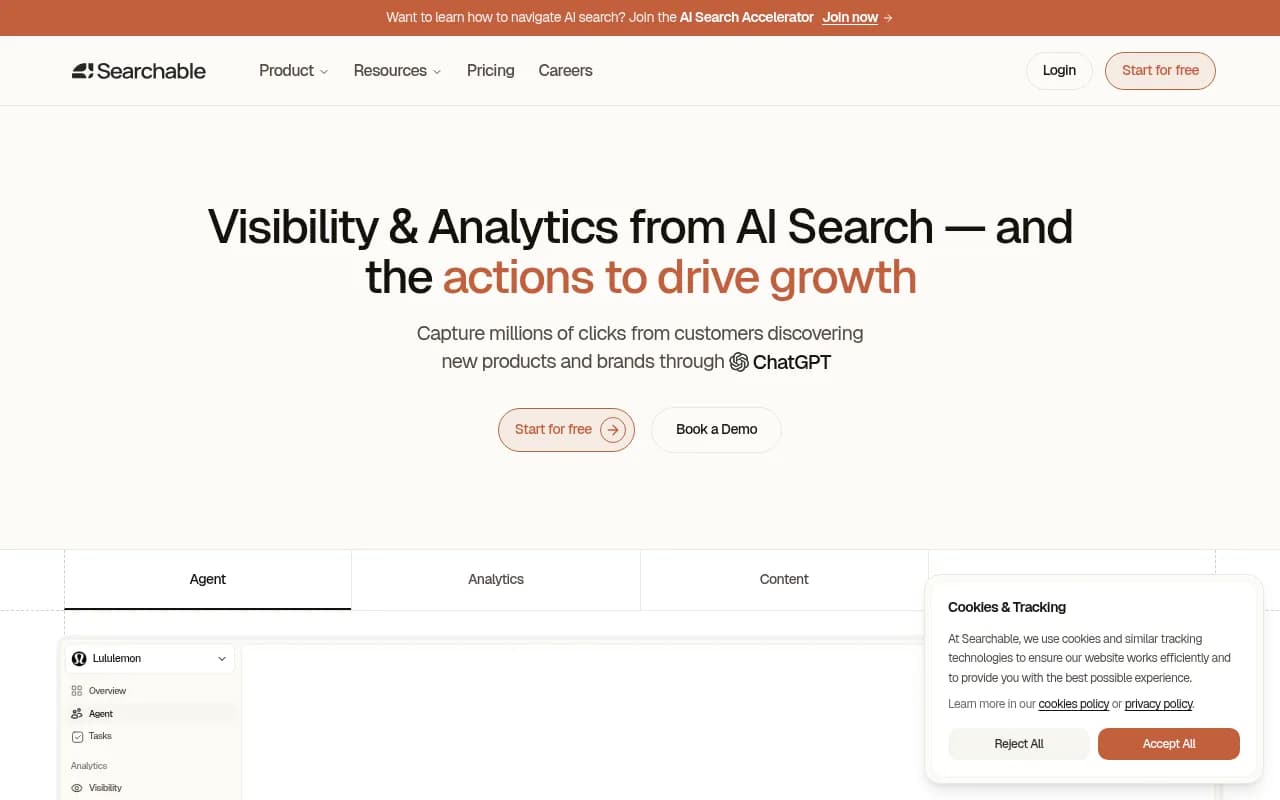
Searchable is an AI search optimization platform that monitors how your brand appears in responses from ChatGPT, Claude, Perplexity, Google AI Overviews, and Microsoft Copilot. It tracks which prompts trigger mentions of your brand, where competitors outrank you, and generates content recommendations to improve AI visibility. The platform includes an AI agent that learns your brand voice and suggests optimizations. Used by 12,000+ marketers focused on emerging AI search channels.
AnyTrack overview
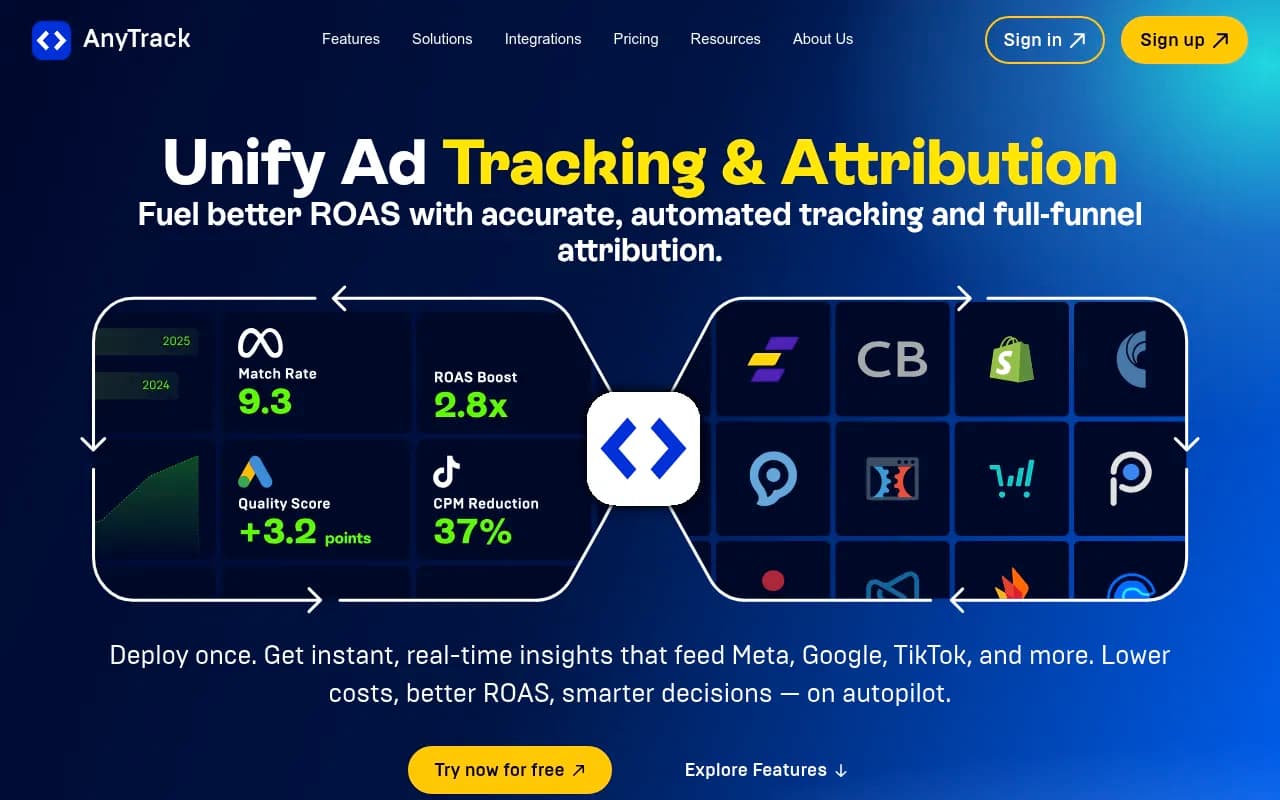
AnyTrack is a server-side conversion tracking platform that captures customer touchpoints across eCommerce, affiliate, and lead-gen funnels. It automatically feeds enriched first-party data to Meta, Google, TikTok, and other ad platforms via their Conversion APIs. The core problem it solves: iOS privacy changes and ad blockers hide 20-30% of conversions from browser pixels, breaking attribution. AnyTrack recovers those lost conversions with server-side tracking, improving match rates and ROAS accuracy.
Side-by-Side Comparison
| Feature | Searchable | AnyTrack |
|---|---|---|
| Primary use case | AI search visibility monitoring | Ad conversion tracking & attribution |
| Data sources | ChatGPT, Claude, Perplexity, Google AI Overviews, Copilot | Ad platforms, affiliate networks, eCommerce stores |
| Starting price | $50/mo (Starter) | $100/mo (Starter) |
| Mid-tier price | $100-125/mo (Professional) | $150/mo (Personal) |
| Free trial | 14 days, no credit card | 14 days |
| Key integrations | Google Analytics, Search Console, HubSpot, Salesforce | Meta, Google Ads, TikTok, ClickBank, Shopify, WooCommerce |
| Content generation | Yes (AI-optimized blog posts, landing pages) | No |
| Technical audits | Yes (schema markup, crawlability for AI) | No |
| Server-side tracking | No | Yes (core feature) |
| Cross-domain tracking | No | Yes |
| Conversion API support | No | Yes (Meta, Google, TikTok) |
| Target audience | Content marketers, SEO teams, brand managers | Paid media buyers, affiliate marketers, eCommerce operators |
| Setup complexity | Low (connect accounts, add prompts) | Medium (requires pixel/tag implementation) |
| Reporting focus | Brand mentions, competitor share of voice, citation opportunities | ROAS, CPA, conversion attribution, campaign profitability |
Head-to-head feature deep-dive
Core tracking capabilities
Searchable monitors AI-generated responses. You define a set of prompts (questions people ask AI engines), and Searchable runs them across ChatGPT, Claude, Perplexity, Google AI Overviews, and Copilot. It captures whether your brand gets mentioned, how prominently, which competitors appear instead, and which sources the AI cites. This is visibility tracking for organic AI search -- the equivalent of rank tracking for traditional SEO.
AnyTrack monitors user behavior and conversions. It captures every click, form submission, purchase, and lead across your marketing funnels. The platform uses server-side tracking to bypass browser limitations (ad blockers, iOS privacy restrictions) that cause 20-30% of conversions to go unreported. It then sends this enriched conversion data to ad platforms via Conversion APIs, so their algorithms can optimize with complete information.
Verdict: These aren't comparable. Searchable tracks what AI says about you. AnyTrack tracks what users do on your site and feeds that data to ad platforms. Different problems entirely.
Content and optimization tools
Searchable includes an AI content engine that generates blog posts, landing pages, and product descriptions optimized for AI citation. The platform analyzes what makes AI engines cite sources (structured data, authoritative tone, comprehensive coverage) and applies those principles. It also provides technical SEO audits focused on schema markup, content structure, and crawlability improvements that help ChatGPT and Claude understand your content better. The AI agent learns your brand voice and generates tailored recommendations.
AnyTrack has no content creation or optimization features. It's purely a data capture and routing platform. You implement tracking, it collects conversion data, and it sends that data to ad platforms. There's no content generation, no SEO audits, no recommendations for improving organic visibility.
Verdict: Searchable wins decisively if content optimization matters to you. AnyTrack doesn't play in this space at all.
Attribution and analytics
Searchable shows you share of voice across AI engines, competitor visibility comparisons, and which prompts drive the most brand mentions. You can correlate AI visibility with traffic and leads by connecting Google Analytics and Search Console. The platform tracks how visibility changes over time and which content improvements move the needle. Customer stories mention 40% visibility increases and £1M+ in qualified pipeline attributed to AI search.
AnyTrack provides true ROAS tracking across all ad platforms. It captures conversions that browser pixels miss, attributes them to the correct campaigns, and calculates actual profitability. You see which campaigns, ad sets, and creatives drive real revenue -- not just the conversions that made it through iOS privacy restrictions. The platform handles cross-domain tracking (landing page → checkout → thank you page), multi-touch attribution, and affiliate conversion tracking. Reports show real-time ROAS, CPA, and conversion paths.
Verdict: AnyTrack wins for paid media attribution. Searchable wins for organic AI visibility tracking. Both provide analytics, but for completely different channels.
Integration ecosystems
Searchable integrations:
- Google Analytics (correlate AI visibility with traffic)
- Google Search Console (understand organic search alongside AI search)
- HubSpot (connect visibility to leads and pipeline)
- Salesforce (track revenue impact)
- Marketing stack tools for proving ROI
AnyTrack integrations:
- Ad platforms: Meta, Google Ads, TikTok, Snapchat, Twitter, Taboola, Outbrain
- Affiliate networks: ClickBank, MaxBounty, CJ Affiliate, ShareASale, Impact
- eCommerce: Shopify, WooCommerce, BigCommerce, Magento
- Lead gen: Unbounce, ClickFunnels, Leadpages
- Advanced: Custom webhooks, API access, GTM integration
Verdict: AnyTrack has a much broader integration catalog because it needs to connect to dozens of ad platforms and affiliate networks. Searchable's integrations are narrower but appropriate for its use case.
Ease of use and setup
Searchable setup is straightforward: connect your Google Analytics and Search Console accounts, add the domains you want to monitor, define the prompts you care about (or use their suggested prompts), and let the platform start tracking. The AI agent provides onboarding guidance. No technical implementation required beyond connecting existing accounts. Most users see initial data within 24 hours.
AnyTrack requires more technical setup. You need to implement their tracking pixel or integrate via Google Tag Manager, configure conversion events, set up cross-domain tracking if you have multiple domains in your funnel, and connect each ad platform's Conversion API. The platform provides step-by-step guides and templates, but there's real implementation work. Expect a few hours to a few days depending on your stack complexity.
Verdict: Searchable is easier to get started. AnyTrack requires technical setup but that's unavoidable given what it does.
Pricing structure
| Plan | Searchable | AnyTrack |
|---|---|---|
| Starter | $50/mo (1 domain, 50 prompts) | $100/mo (100k sessions, 1 site) |
| Mid-tier | $100-125/mo Professional (unlimited domains, 200 prompts) | $150/mo Personal (500k sessions, 3 sites) |
| High-tier | $400/mo Scale | $300/mo Advance (3M sessions, 10 sites) |
| Free trial | 14 days, no credit card required | 14 days |
| Pricing model | Per domain + prompt volume | Per session volume + site count |
Searchable charges based on how many domains you monitor and how many prompts you track. AnyTrack charges based on session volume (traffic) and number of sites. If you have high traffic, AnyTrack gets expensive quickly. If you want to track hundreds of prompts, Searchable's upper tiers kick in.
Verdict: Searchable is cheaper for low-traffic brands focused on AI visibility. AnyTrack is better value for high-traffic sites that need accurate conversion tracking.
Pros and cons
Searchable pros
- Purpose-built for AI search visibility -- no other tool does this as comprehensively
- AI content generation included, not just monitoring
- Technical audits help you fix crawlability and schema issues
- AI agent learns your brand and provides personalized recommendations
- Easy setup, no technical implementation required
- Integrates with Google Analytics and Search Console for unified reporting
- 14-day free trial with no credit card
Searchable cons
- Only tracks five AI engines (ChatGPT, Claude, Perplexity, Google AI Overviews, Copilot) -- doesn't cover emerging models
- Prompt limits on lower tiers can feel restrictive if you want comprehensive coverage
- No server-side tracking or conversion attribution features
- Relatively new category, so ROI measurement is still evolving
- Limited integrations compared to established marketing platforms
AnyTrack pros
- Recovers 20-30% of conversions lost to ad blockers and iOS privacy restrictions
- Server-side tracking via Conversion APIs improves ad platform optimization
- Cross-domain tracking handles complex funnels (landing page → checkout → thank you)
- Broad integration catalog covering major ad platforms and affiliate networks
- True ROAS tracking shows actual campaign profitability
- Handles affiliate marketing use cases that most analytics tools miss
- Real-time conversion data feeds ad platform algorithms immediately
AnyTrack cons
- Requires technical setup (pixel implementation, GTM configuration, Conversion API connections)
- Session-based pricing gets expensive for high-traffic sites
- No content creation or optimization features
- Focused entirely on paid media and affiliate tracking -- doesn't help with organic visibility
- Learning curve for setting up multi-touch attribution models
- Overkill if you're not running significant paid ad spend
Who should pick which tool
Choose Searchable if you:
- Run content marketing and want to understand AI search visibility
- Need to track how ChatGPT, Claude, and Perplexity respond to queries about your industry
- Want AI-optimized content generation and technical SEO audits
- Care about organic brand mentions in AI-generated responses
- Have a content team focused on emerging search channels
- Need to prove AI visibility ROI to stakeholders
- Want an easy-to-use platform with minimal technical setup
Choose AnyTrack if you:
- Spend significant budget on Meta, Google, TikTok, or other paid ads
- Struggle with inaccurate conversion tracking due to iOS privacy changes
- Run affiliate marketing campaigns and need accurate commission tracking
- Have complex funnels spanning multiple domains (landing pages, checkouts, upsells)
- Need to feed complete conversion data to ad platform algorithms for better optimization
- Want true ROAS tracking that accounts for all conversions, not just pixel-visible ones
- Have technical resources to implement server-side tracking
Use both if you:
- Run both paid ads (AnyTrack) and content marketing (Searchable)
- Need comprehensive visibility across paid and organic AI channels
- Have budget for multiple specialized tools in your stack
- Want to correlate AI search visibility with paid campaign performance
Worth noting: if you're tracking AI search visibility and want to go deeper into optimization, Promptwatch offers additional capabilities like AI crawler logs, prompt intelligence with volume estimates, and Reddit/YouTube tracking that influence AI recommendations.

Final verdict
Searchable and AnyTrack solve completely different problems. Searchable is for brands that want to monitor and improve their visibility in AI-generated search responses -- think of it as rank tracking and content optimization for ChatGPT and Claude. AnyTrack is for paid media teams that need accurate conversion tracking and attribution despite iOS privacy restrictions and ad blockers.
If you're choosing between them, you're probably asking the wrong question. These tools don't compete. A content marketer focused on AI search visibility has zero use for AnyTrack's conversion tracking. A performance marketer running Meta ads has zero use for Searchable's AI citation monitoring.
The real decision: Do you need AI search visibility tracking (Searchable) or ad conversion attribution (AnyTrack)? Pick based on which channel you're actually optimizing. Many marketing teams will eventually need both as they expand across paid and organic AI channels.