Key takeaways
- Promptwatch and AnyTrack are not direct competitors. One tracks AI search visibility; the other tracks paid ad conversions. If you're comparing them, you're probably trying to figure out which problem to solve first.
- AnyTrack is the right pick if your main pain is losing conversion data to ad blockers, iOS privacy changes, or cross-domain attribution gaps. It feeds first-party data back to Meta, Google, and TikTok via server-side APIs.
- Promptwatch is the right pick if you want to know how your brand appears in ChatGPT, Perplexity, Claude, and other AI engines -- and actually do something about it with content gap analysis and AI-optimized content generation.
- On pricing, they're nearly identical at entry level ($99-$100/mo), but scale differently. AnyTrack's top public plan is $300/mo; Promptwatch's is $579/mo, reflecting the broader feature set.
- AnyTrack has a 14-day free trial; Promptwatch offers 7 days. Both are no-code friendly for initial setup.
- For most marketing teams, these tools are complementary rather than either/or. But if budget forces a choice, the decision comes down to where your biggest gap is: paid attribution or AI search visibility.
Overview
Promptwatch

Promptwatch is an AI Search Visibility and GEO (Generative Engine Optimization) platform built around a specific idea: knowing you're invisible in AI search is only half the battle. The platform monitors how 10+ AI models (ChatGPT, Claude, Perplexity, Gemini, Grok, DeepSeek, Copilot, Meta AI, Mistral, Google AI Overviews) cite your brand, then helps you close the gaps with content analysis and an AI writing agent that generates content engineered to get cited. It's used by 7,000+ brands including Booking.com, Yelp, and Typeform, and has processed over 1.1 billion citations and prompts.
The core loop is: track which prompts your competitors rank for but you don't, generate content to fill those gaps, then watch your citation counts improve. That cycle is what separates it from monitoring-only tools.
AnyTrack
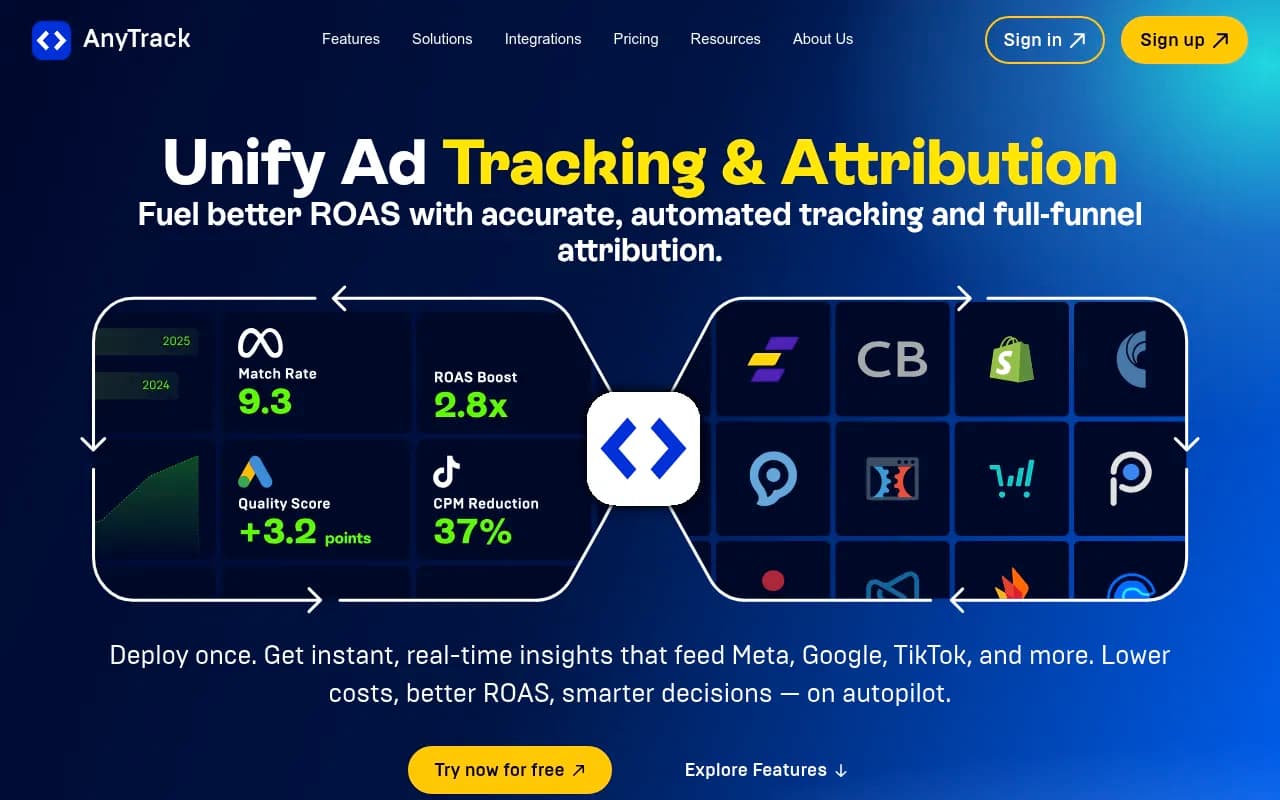
AnyTrack is a server-side conversion tracking and attribution platform. Its job is to make sure your ad platforms (Meta, Google, TikTok, and others) receive accurate, enriched conversion data -- even when browser pixels fail due to ad blockers, iOS privacy restrictions, or cross-domain attribution breaks. It connects affiliate networks, eCommerce stores, and lead-gen funnels into a single data layer, then routes that data to ad platform APIs in real time.
The pitch is straightforward: ad platform AI (like Meta's Advantage+ or Google's Smart Bidding) performs better when it gets more complete conversion signals. AnyTrack recovers the 20-30% of conversions that pixels typically miss and feeds them back as first-party data. No code required for most setups.
Side-by-side comparison
| Feature | Promptwatch | AnyTrack |
|---|---|---|
| Primary use case | AI search visibility & GEO | Paid ad conversion tracking & attribution |
| Target user | SEO/marketing teams, agencies | Performance marketers, eCommerce, affiliates |
| Free trial | 7 days | 14 days |
| Starting price | $99/mo | $100/mo |
| Top public plan | $579/mo (Business) | $300/mo (Advance) |
| No-code setup | Yes | Yes |
| AI model monitoring | 10+ models (ChatGPT, Claude, Perplexity, etc.) | None |
| Content gap analysis | Yes (Answer Gap Analysis) | No |
| AI content generation | Yes (built-in AI writing agent) | No |
| Paid ad integrations | No | Meta, Google, TikTok, and more |
| Server-side tracking | No | Yes (Conversion API) |
| Affiliate network support | No | Yes (100+ networks) |
| Traffic attribution | Yes (AI traffic via snippet/GSC/logs) | Yes (paid ad attribution) |
| Competitor analysis | Yes (AI visibility heatmaps) | No |
| Crawler log monitoring | Yes (AI crawlers) | No |
| Reddit/YouTube insights | Yes | No |
| API access | Yes | Yes |
| G2 rating | 4.7/5 | Not prominently listed |
| Agency/Enterprise plan | Yes (custom pricing) | Yes |
Head-to-head feature deep-dive
Core purpose and philosophy
These two tools are built around fundamentally different problems, which is worth stating plainly before diving into features.
Promptwatch answers the question: "Is my brand showing up when people ask AI engines for recommendations, and how do I improve that?" AnyTrack answers the question: "Are my ad platforms getting accurate conversion data, and am I measuring ROAS correctly?"
The overlap is thin. Both care about traffic and revenue. Both involve tracking and attribution in some sense. But the channels, the data, and the workflows are completely different.
If you're a performance marketer running paid campaigns, AnyTrack is the more immediately relevant tool. If you're an SEO or content team trying to capture the growing share of traffic that comes from AI search, Promptwatch is the one to look at.
Verdict: Neither tool is universally "better" -- they serve different functions. The comparison only makes sense if you're deciding where to allocate budget between two distinct marketing problems.
Tracking and monitoring
Promptwatch monitors AI-generated responses across 10 AI models. You define prompts (the questions your customers ask AI engines), and the platform tracks whether your brand appears in the responses, how often, and in what context. You get citation counts, mention rates, sentiment, and page-level data showing which of your URLs are being cited. Real-time AI crawler logs show when ChatGPT, Claude, or Perplexity's bots visit your site, which pages they read, and any errors they hit.
AnyTrack monitors conversion events across paid channels. It captures every touchpoint in a customer journey -- ad click, landing page visit, form fill, purchase -- and attributes them correctly even when browser-based pixels fail. It uses server-side Conversion APIs to send this data directly to Meta, Google, and TikTok, bypassing the limitations of client-side tracking.
| Tracking dimension | Promptwatch | AnyTrack |
|---|---|---|
| AI model responses | Yes (10+ models) | No |
| Paid ad conversions | No | Yes |
| AI crawler activity | Yes (real-time logs) | No |
| Cross-domain attribution | No | Yes |
| Server-side data capture | No | Yes |
| Affiliate conversion tracking | No | Yes |
Verdict: Completely different tracking domains. Promptwatch owns AI search monitoring; AnyTrack owns paid conversion tracking.
Content and optimization features
This is where Promptwatch has a significant advantage over most tools in its category -- and where AnyTrack simply doesn't play.
Promptwatch's Answer Gap Analysis identifies specific prompts where competitors appear in AI responses but you don't. It shows you the exact content your site is missing -- the topics, angles, and questions that AI models want to answer but can't find on your pages. The built-in AI writing agent then generates articles, listicles, and comparison pages grounded in real citation data (880M+ citations analyzed), prompt volumes, and competitor analysis.
AnyTrack has no content features. It's a data routing and attribution platform. It doesn't tell you what to create or where to publish -- it tells you which of your existing campaigns are converting and how accurately that data is reaching your ad platforms.
Verdict: Promptwatch wins this category by default. If content optimization for AI search is on your roadmap, AnyTrack doesn't address it at all.
Integrations and ecosystem
AnyTrack has a broader integration catalog for paid marketing: Meta Ads, Google Ads, TikTok Ads, Bing Ads, Taboola, Outbrain, and 100+ affiliate networks (ClickBank, ShareASale, Commission Junction, etc.). It connects to eCommerce platforms like Shopify and WooCommerce, and lead-gen tools. For performance marketers, this is a genuinely impressive network.
Promptwatch integrates with Google Search Console for traffic attribution, supports Looker Studio for custom reporting, and has an API for custom workflows. It doesn't integrate with ad platforms because that's not its job. Its "integrations" are more about data export and reporting than connecting to a marketing stack.
| Integration type | Promptwatch | AnyTrack |
|---|---|---|
| Google Ads | No | Yes |
| Meta Ads | No | Yes |
| TikTok Ads | No | Yes |
| Affiliate networks | No | 100+ |
| eCommerce platforms | No | Yes (Shopify, WooCommerce, etc.) |
| Google Search Console | Yes | No |
| Looker Studio | Yes | No |
| API | Yes | Yes |
Verdict: AnyTrack has a much richer integration ecosystem for paid marketing. Promptwatch's integrations are narrower but fit its use case.
Pricing and plans
Both tools start at almost exactly the same price point, which is probably why they sometimes get compared. But the plans scale differently and cover very different session/prompt volumes.
Pricing comparison
| Plan | Promptwatch | AnyTrack |
|---|---|---|
| Entry | $99/mo (Essential: 1 site, 50 prompts, 5 articles/mo) | $100/mo (Starter: 1 site, 100k sessions/mo) |
| Mid-tier | $249/mo (Professional: 2 sites, 150 prompts, 15 articles, crawler logs) | $150/mo (Personal: 3 sites, 500k sessions/mo) |
| Upper tier | $579/mo (Business: 5 sites, 350 prompts, 30 articles) | $300/mo (Advance: 10 sites, 3M sessions/mo) |
| Enterprise/Agency | Custom pricing | Custom pricing |
| Free trial | 7 days | 14 days |
| Annual discount | Yes | Not specified |
AnyTrack's pricing scales primarily on session volume and number of sites. Promptwatch's pricing scales on prompts tracked, articles generated, and sites monitored. These are fundamentally different usage metrics, so direct price comparison is a bit misleading -- you're paying for different things.
AnyTrack's top public plan ($300/mo) is meaningfully cheaper than Promptwatch's Business plan ($579/mo). But again, the feature sets don't overlap, so "cheaper" doesn't mean "better value" -- it depends entirely on what you need.
Verdict: AnyTrack is cheaper at scale for what it does. Promptwatch costs more at the higher tiers but covers a broader set of AI visibility capabilities that AnyTrack doesn't touch.
Ease of use and setup
Both platforms market themselves as no-code or low-code. AnyTrack's setup involves adding a single tracking script and connecting your ad accounts -- most users can get it running in under an hour. The server-side setup is more involved but still manageable without a developer for standard use cases.
Promptwatch's setup is also technically simple (add a snippet or connect GSC), but the strategic setup takes more thought. You need to define which prompts to track, which competitors to monitor, and which personas represent your customers. That's not hard, but it requires knowing your market well. The payoff is a more tailored monitoring setup.
Verdict: AnyTrack is faster to get running. Promptwatch requires more upfront thinking but that investment pays off in more relevant data.
Reporting and analytics
Promptwatch's reporting centers on AI visibility metrics: citation counts by model, mention rates over time, page-level citation data, competitor heatmaps, and traffic attribution from AI sources. You can see which AI models are sending you traffic and which pages are getting cited most.
AnyTrack's reporting focuses on campaign performance: ROAS by channel, conversion rates, cost per acquisition, and attribution paths. It shows you which ad campaigns are actually driving revenue, with accurate data that accounts for the conversions pixels miss.
Both have solid reporting for their respective domains. Neither overlaps with the other.
Pros and cons
Promptwatch
Pros:
- The only platform that combines AI visibility monitoring with content gap analysis and content generation in one workflow
- Monitors 10 AI models including ChatGPT, Claude, Perplexity, Gemini, Grok, and DeepSeek
- AI crawler logs give you a real-time view of how AI bots interact with your site
- Reddit and YouTube insights surface discussions that influence AI recommendations
- ChatGPT Shopping tracking for eCommerce brands
- 880M+ citations analyzed means the content recommendations are grounded in real data
- Trusted by large brands (Booking.com, Yelp, Typeform) and rated 4.7/5 on G2
Cons:
- No paid ad tracking or attribution capabilities
- Higher price at the Business tier ($579/mo) compared to many alternatives
- Requires strategic setup -- defining prompts and personas takes time
- 7-day trial is shorter than AnyTrack's 14 days
- AI search is still a relatively new channel; ROI timelines can be longer than paid ads
AnyTrack
Pros:
- Solves a real, immediate pain: recovering the 20-30% of conversions that pixels miss
- No-code setup that most marketers can handle without developer help
- 100+ affiliate network integrations -- genuinely useful for affiliate marketers
- Feeds enriched first-party data to Meta, Google, and TikTok Conversion APIs
- More affordable at scale (top public plan is $300/mo)
- 14-day free trial gives more time to evaluate
- Covers eCommerce, affiliate, and lead-gen use cases
Cons:
- No AI search visibility features whatsoever
- No content analysis or optimization capabilities
- Doesn't help with organic traffic from AI engines
- Reporting is focused on paid channels -- limited value for SEO or content teams
- Competitor analysis features are minimal compared to Promptwatch
Who should pick which tool
Pick Promptwatch if:
- You want to know how your brand appears in ChatGPT, Perplexity, Claude, or other AI engines
- You're an SEO or content team trying to capture traffic from AI search
- You want to identify content gaps and generate content that gets cited by AI models
- You're running an agency that needs to report AI visibility to clients
- You want to monitor AI crawler activity on your site and fix indexing issues
- You're in a category where AI recommendations drive purchase decisions (travel, SaaS, finance, eCommerce)
Pick AnyTrack if:
- Your main problem is inaccurate conversion data reaching Meta, Google, or TikTok
- You're running paid campaigns and want to improve ROAS measurement
- You're an affiliate marketer who needs to connect network data to ad platform signals
- You're an eCommerce brand losing attribution data to iOS privacy changes or ad blockers
- You need cross-domain tracking across landing pages, checkouts, and affiliate offers
- You want to feed better signals to ad platform AI (Meta Advantage+, Google Smart Bidding)
Consider using both if:
- You're running paid campaigns AND want to grow organic AI search visibility
- You're a digital agency managing both performance marketing and SEO/content for clients
- You want complete attribution across both paid channels and AI-driven organic traffic
For teams tracking AI search visibility alongside paid performance, it's worth knowing that Promptwatch specifically covers the AI traffic attribution side -- connecting AI citations to actual website visits and revenue through GSC integration, a tracking snippet, or server log analysis.
Final verdict
Promptwatch and AnyTrack are tools for different jobs. Comparing them is a bit like comparing a rank tracker to a tag manager -- the surface-level similarity (both involve "tracking") masks the fact that they operate in completely different parts of the marketing stack.
If your problem is paid ad attribution and conversion data accuracy, AnyTrack is the right tool. It's well-built, no-code friendly, and directly addresses the signal loss that hurts campaign performance.
If your problem is AI search visibility -- understanding and improving how ChatGPT, Perplexity, and other AI engines talk about your brand -- Promptwatch is the clear choice. It's the only platform that goes from monitoring to gap analysis to content generation in a single workflow, which is what separates it from the monitoring-only tools that have flooded this space.
For most marketing teams in 2026, the real question isn't which one to pick -- it's which problem is more urgent right now.