Key Takeaways
- Pricing gap: Promptscout starts at $15/mo vs Peec AI's €89/mo -- a 6x difference for basic monitoring
- Language coverage: Peec AI supports multi-language tracking across countries; Promptscout focuses on English-first monitoring
- Feature depth: Peec AI offers sentiment analysis and smart suggestions; Promptscout emphasizes citation tracking and actionable insights
- AI model coverage: Both track ChatGPT and Gemini, but Peec AI adds Perplexity while Promptscout includes Google AI Overviews
- Target audience: Promptscout suits solo founders and small teams; Peec AI targets marketing teams and agencies needing broader coverage
- Free tier: Promptscout offers a genuine free tier; Peec AI provides a free trial only
Overview
Peec AI

Peec AI positions itself as an AI search analytics platform built for marketing teams. It tracks brand performance across ChatGPT, Perplexity, and Gemini with a focus on three core metrics: Visibility (share of chats mentioning your brand), Position (ranking within AI responses), and Sentiment (how AI perceives your brand). The platform supports multi-language tracking, custom prompt organization with tags, and competitor benchmarking. Peec AI's client roster includes both brands and agencies, with 1,500+ marketing teams using the platform.
Promptscout
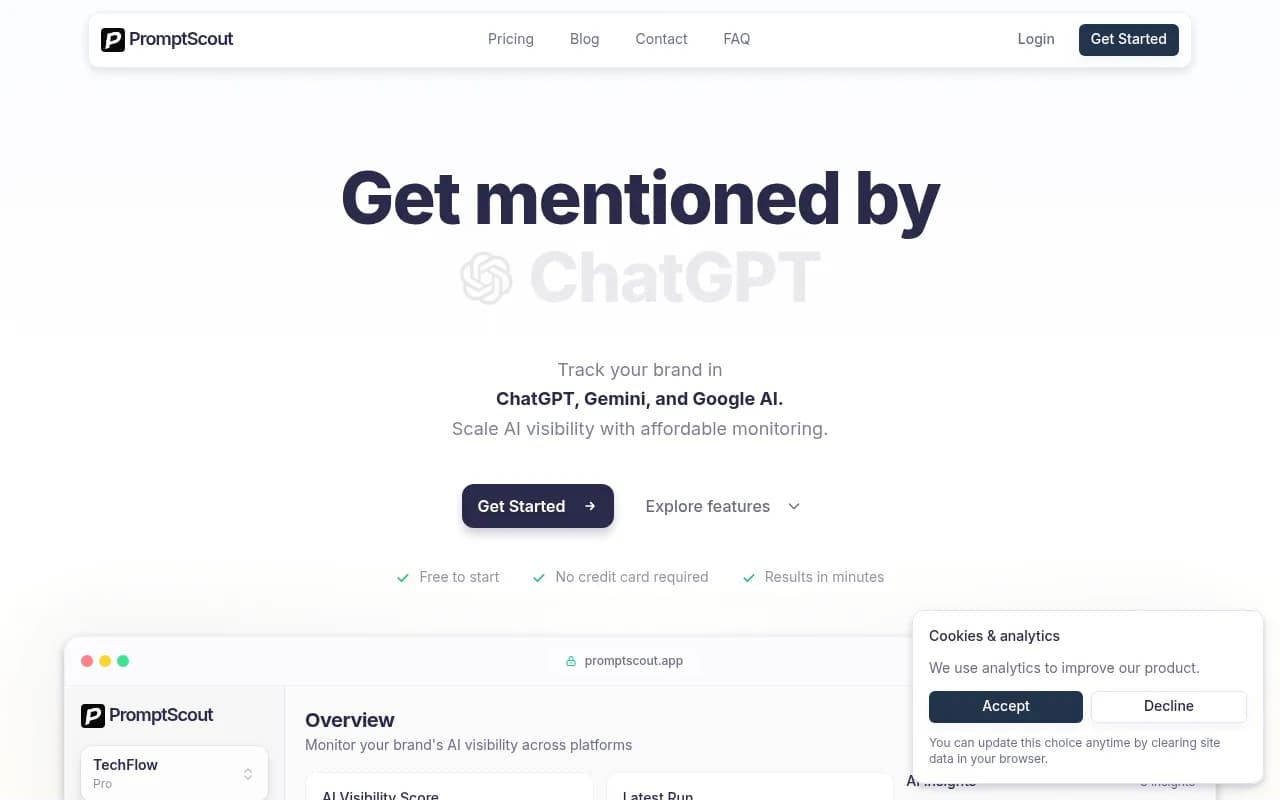
Promptscout takes a more accessible approach to AI visibility tracking. It monitors brand mentions across ChatGPT, Gemini, and Google AI Overviews with an emphasis on citation analysis -- showing which domains (G2, Reddit, TechCrunch, etc.) AI models pull from when mentioning your brand. The platform generates actionable insights like "improve visibility on G2 reviews" or "engage on Reddit r/SaaS community" based on citation patterns. Promptscout's pricing starts at $15/mo, making it one of the most affordable options for founders and small teams.
If you're also looking to go beyond monitoring and actually optimize your content for AI search visibility, Promptwatch covers that angle with content gap analysis and AI-powered content generation.

Side-by-Side Comparison
| Feature | Peec AI | Promptscout |
|---|---|---|
| Starting price | €89/mo (Starter) | $15/mo (Starter) |
| Free tier | Trial only | Yes (limited) |
| AI models tracked | ChatGPT, Perplexity, Gemini | ChatGPT, Gemini, Google AI Overviews |
| Multi-language support | Yes (all countries) | English-focused |
| Sentiment analysis | Yes | No |
| Position tracking | Yes | No |
| Citation/source analysis | Basic | Detailed (domain-level) |
| Competitor benchmarking | Yes | Yes |
| Custom prompts | Yes (with tags) | Yes |
| Actionable insights | Smart suggestions | AI-generated insights |
| Agency pricing | Custom (Enterprise) | Custom |
| Target users | Marketing teams, agencies | Founders, small teams |
Pricing comparison
| Plan | Peec AI | Promptscout |
|---|---|---|
| Free tier | Trial only | Yes (limited features) |
| Starter | €89/mo | $15/mo |
| Mid-tier | €199/mo (Professional) | $39/mo (Growth) |
| Advanced | Custom (Enterprise) | $99/mo (Pro) |
| Agency | Custom | Custom |
| Annual discount | Not specified | Not specified |
The pricing difference is stark. Promptscout's $15/mo entry point is roughly $80 cheaper than Peec AI's €89/mo starter plan. Even Promptscout's Pro tier at $99/mo undercuts Peec AI's Professional plan at €199/mo.
AI model coverage
Peec AI tracks three models: ChatGPT, Perplexity, and Gemini. The inclusion of Perplexity is notable since it's a pure AI search engine (not a chatbot), making it particularly relevant for tracking how your brand shows up in AI-powered search results. Peec AI's multi-language support means you can monitor these models across different countries and languages -- useful if you operate in multiple markets.
Promptscout covers ChatGPT, Gemini, and Google AI Overviews. The Google AI Overviews inclusion is significant because it tracks the AI-generated summaries that appear at the top of traditional Google search results. This bridges the gap between classic SEO and AI visibility. However, Promptscout doesn't track Perplexity, and its multi-language capabilities aren't emphasized.
Verdict: Peec AI wins for global brands needing multi-language coverage and Perplexity tracking. Promptscout wins if Google AI Overviews matter more to your strategy than Perplexity.
Core metrics and tracking
Peec AI structures everything around three metrics:
- Visibility: Percentage of chats where your brand appears (e.g. "3/14 responses")
- Position: Your ranking within AI responses (e.g. "5/14")
- Sentiment: How positively or negatively AI describes your brand (e.g. "2/14")
This three-metric framework is clean and easy to explain to stakeholders. The dashboard shows trending data ("Visibility trending up by 5.2% this month") and competitor comparisons side-by-side.
Promptscout uses a simpler visibility score (e.g. "78% -- 31/40 responses") and focuses heavily on citation analysis. It shows which domains AI models cite when mentioning your brand, categorized by type (Editorial, UGC, Other). The platform then generates specific insights like "Your brand gets cited heavily from G2 reviews. Encourage customers to leave reviews there."
Verdict: Peec AI's three-metric system is more comprehensive for reporting. Promptscout's citation-first approach is more actionable for content strategy.
Competitor analysis
Peec AI shows competitor visibility as percentages in a clean comparison view. You can see how your brand stacks up against competitors across all tracked prompts. The interface displays this as a bar chart with percentages (e.g. "Salesforce 62%, Attio 47%, HubSpot 65%").
Promptscout presents competitors as a leaderboard showing total mentions (e.g. "TechFlow 47, Flowwise 38, StreamAI 32"). It's straightforward but less visual than Peec AI's approach. Promptscout's strength is tying competitor analysis to specific insights -- if a competitor dominates, it suggests creating comparison content against them.
Verdict: Peec AI has a more polished competitor visualization. Promptscout connects competitor data to action items better.
Actionable insights and recommendations
Peec AI offers "smart suggestions" but the website doesn't detail what these look like. Based on the interface, it appears to be pattern-based recommendations tied to visibility, position, and sentiment changes.
Promptscout generates specific, concrete insights:
- "Improve visibility on G2 reviews" (when G2 is a top citation source)
- "Create comparison content vs Flowwise" (when a competitor dominates)
- "Engage on Reddit r/SaaS community" (when Reddit drives citations)
These insights are directly tied to the citation data, making them immediately actionable. You know exactly what to do and why.
Verdict: Promptscout wins here. Its insights are specific, actionable, and grounded in citation data.
Multi-language and geographic coverage
Peec AI explicitly supports multi-language tracking across all countries. You can organize prompts with tags and track them in different languages and regions. This is critical for brands operating in Europe, Asia, or Latin America where English-only monitoring misses the majority of AI interactions.
Promptscout doesn't emphasize multi-language support. The interface and marketing suggest an English-first approach. If you need to track how AI models respond in German, French, Spanish, or Japanese, Promptscout likely won't cut it.
Verdict: Peec AI is the only real option for non-English markets.
User interface and ease of use
Both platforms have clean, modern interfaces. Peec AI's dashboard uses a lot of white space and card-based layouts. The three-metric system (Visibility, Position, Sentiment) is prominently displayed with trend lines. Promptscout's interface is similarly clean, with a focus on the visibility score, competitor leaderboard, and citation sources.
Neither platform has a steep learning curve. You can understand the core metrics within minutes of logging in.
Verdict: Tie. Both are intuitive and well-designed.
Integration and API
Neither platform's website details integration capabilities or API access. This is a gap for both tools -- if you want to pull AI visibility data into your own dashboards (Looker Studio, Tableau, internal BI tools), you'll need to ask sales about API availability.
Verdict: Unclear. Both need better documentation here.
Customer base and social proof
Peec AI claims 1,500+ marketing teams and lists both brands and agencies as clients. The website shows logos but doesn't name specific customers.
Promptscout emphasizes its "early access" positioning with a founder discount code (FOUNDER30 for 30% off 3 months). This suggests a newer, smaller user base -- which isn't necessarily bad, but it means less social proof and potentially fewer battle-tested features.
Verdict: Peec AI has more established traction. Promptscout is earlier-stage.
Pros and cons
Peec AI pros
- Multi-language and multi-country support
- Three-metric framework (Visibility, Position, Sentiment) is comprehensive
- Tracks Perplexity in addition to ChatGPT and Gemini
- 1,500+ teams using it -- more established
- Custom prompt organization with tags
Peec AI cons
- Expensive entry point (€89/mo vs competitors at $15-50/mo)
- No genuine free tier (trial only)
- Doesn't track Google AI Overviews
- Smart suggestions not well-documented
- No clear API or integration details
Promptscout pros
- Extremely affordable ($15/mo starter, $99/mo pro)
- Genuine free tier available
- Detailed citation/source analysis by domain
- Actionable, specific insights tied to citation data
- Tracks Google AI Overviews
- Early adopter pricing (FOUNDER30 code)
Promptscout cons
- No multi-language support emphasized
- Doesn't track Perplexity
- No sentiment or position metrics
- Smaller, less established user base
- No clear agency or enterprise features
Who should pick which tool
Choose Peec AI if:
- You operate in multiple countries or languages
- You need comprehensive metrics (Visibility + Position + Sentiment) for reporting to stakeholders
- Perplexity tracking matters to your strategy
- You're a marketing team or agency with budget for a full-featured platform
- You want an established tool with 1,500+ teams using it
Choose Promptscout if:
- You're a founder, solo marketer, or small team with a tight budget
- You want to understand which domains (G2, Reddit, etc.) drive AI citations
- Google AI Overviews are critical to your visibility strategy
- You value specific, actionable insights over comprehensive metrics
- You're comfortable with a newer, early-stage tool in exchange for lower pricing
Consider both if:
- You're an agency managing multiple clients -- Peec AI for global brands, Promptscout for budget-conscious startups
Final verdict
Peec AI and Promptscout serve different segments. Peec AI is the enterprise-grade option for marketing teams that need multi-language coverage, comprehensive metrics, and Perplexity tracking. It's polished, established, and built for scale -- but you pay for it at €89/mo minimum.
Promptscout is the scrappy, accessible alternative for founders and small teams. At $15/mo, it's 6x cheaper than Peec AI while still delivering the core value: knowing when AI models mention your brand and which sources drive those mentions. The actionable insights ("engage on Reddit", "improve G2 reviews") are more specific than Peec AI's suggestions. The trade-off is no multi-language support and fewer metrics.
If you're a global brand or agency, Peec AI is worth the premium. If you're a startup or solo marketer, Promptscout delivers 80% of the value at 15% of the cost. Neither tool is objectively "better" -- they're optimized for different buyers.