Key Takeaways
- AccuRanker starts at $109/mo (1,000 keywords) vs Searchable at $50/mo (50 prompts) -- Searchable is cheaper for small teams just getting started with AI search monitoring
- AccuRanker's AccuLLM is an add-on to their core rank tracking product, while Searchable is built specifically for AI search optimization from the ground up
- Searchable includes AI content generation and technical SEO audits in all plans; AccuRanker focuses on monitoring and reporting without built-in content creation tools
- AccuRanker tracks 4 AI engines (ChatGPT, Perplexity, Google AI Overviews, AI Mode), Searchable tracks 5 (adds Copilot)
- AccuRanker is better for agencies already using their rank tracker who want to add AI visibility monitoring; Searchable is better for teams prioritizing AI search optimization as a standalone channel
- Both offer unlimited domains on most plans, but AccuRanker's keyword-based pricing scales faster than Searchable's prompt-based model
Overview
AccuRanker: Rank tracking meets AI visibility
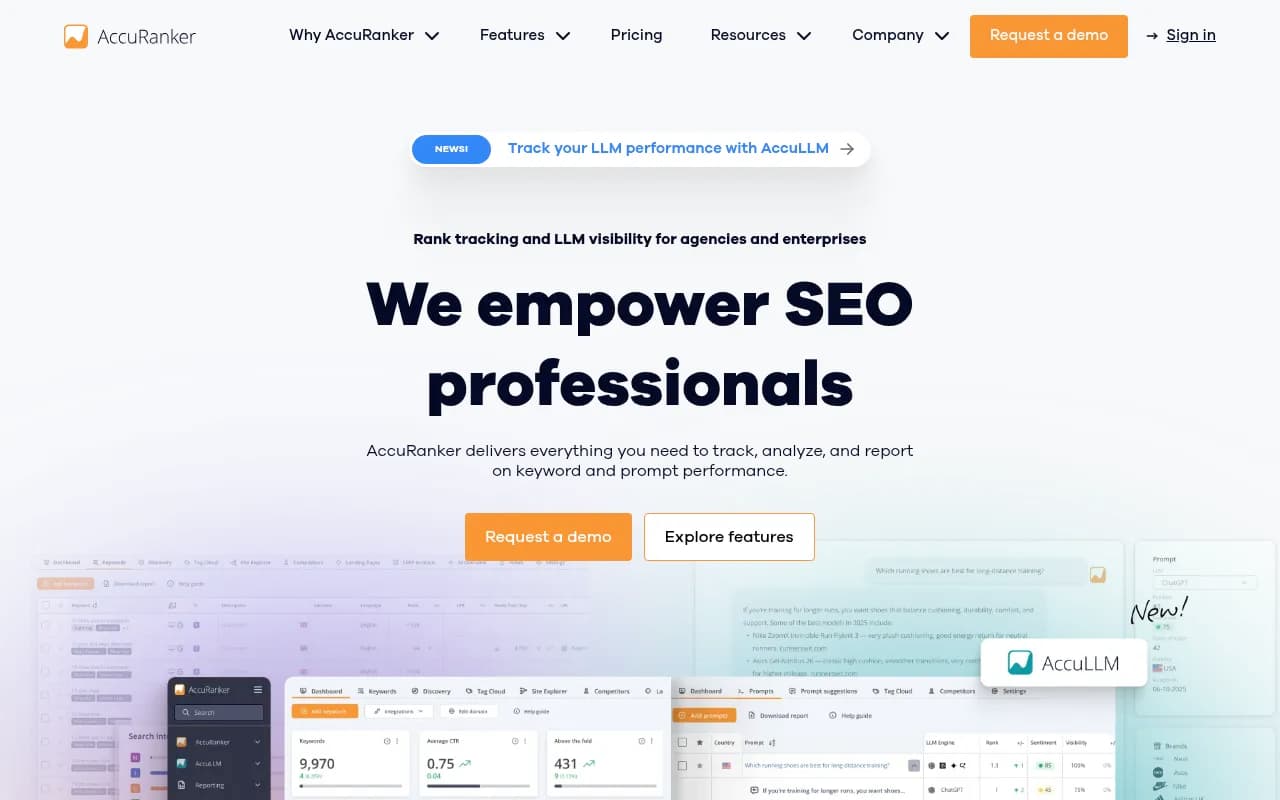
AccuRanker has been a trusted name in SEO rank tracking since 2013, known for fast updates and clean dashboards that agencies and enterprises rely on. Their AccuLLM feature extends this expertise into AI search monitoring, tracking how brands appear across ChatGPT, Perplexity, Google AI Overviews, and AI Mode. The platform maintains its core strength -- real-time rank tracking with unlimited users, domains, and API calls -- while adding AI visibility as a complementary layer. AccuRanker's approach assumes you're already doing traditional SEO and want to understand how AI search fits into that picture.
Searchable: AI search optimization platform
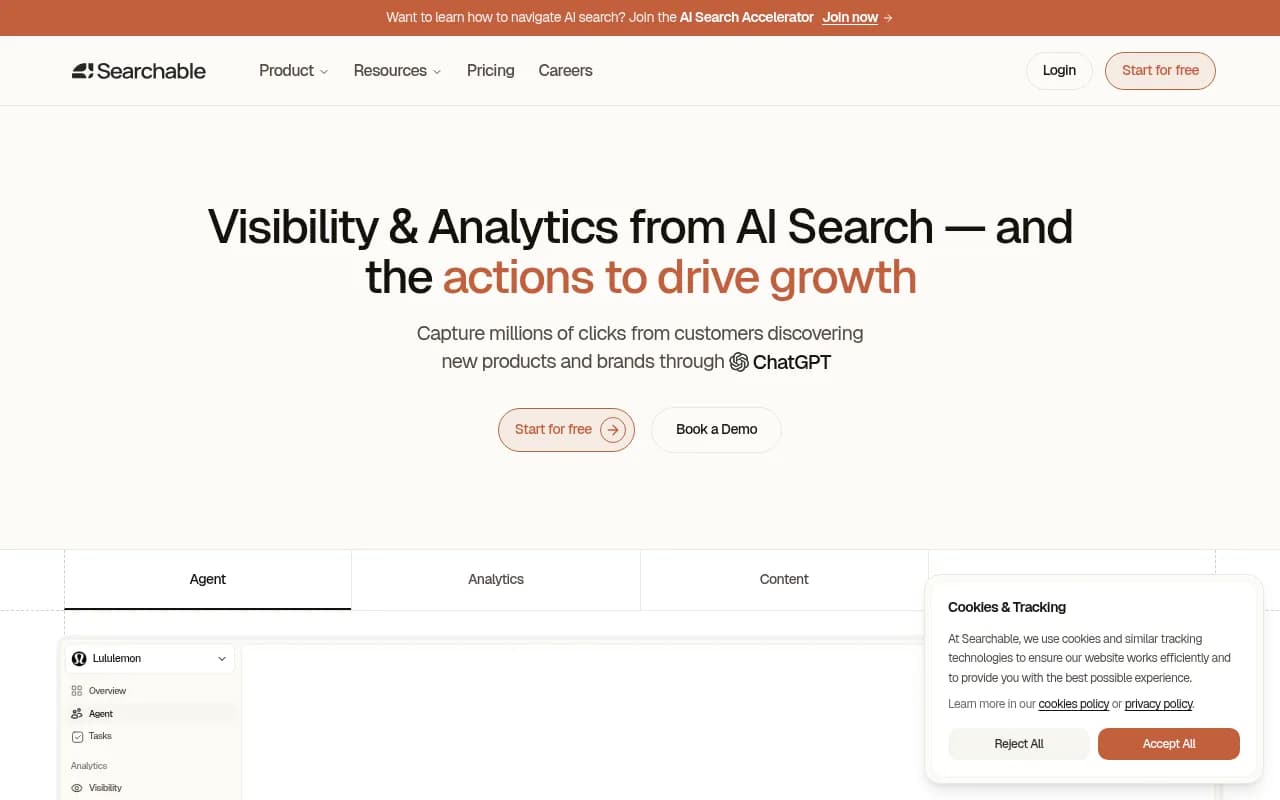
Searchable positions itself as a full-stack AI search optimization platform, not just a monitoring tool. It tracks visibility across ChatGPT, Claude, Perplexity, Google AI Overviews, and Copilot, then goes further with AI-powered content generation, technical audits, and a personal AI agent that learns your brand voice. The platform is used by 12,000+ marketers and agencies who treat AI search as a distinct channel requiring its own strategy. Searchable's pitch is that monitoring alone isn't enough -- you need tools to actually improve your visibility, not just watch it.
Side-by-side comparison
| Feature | AccuRanker | Searchable |
|---|---|---|
| Starting price | $109/mo (1,000 keywords) | $50/mo (50 prompts) |
| AI engines tracked | 4 (ChatGPT, Perplexity, AI Overviews, AI Mode) | 5 (ChatGPT, Claude, Perplexity, AI Overviews, Copilot) |
| Content generation | No | Yes (AI-optimized blog posts, landing pages) |
| Technical SEO audits | No (traditional rank tracking audits only) | Yes (AI search-specific audits) |
| Unlimited domains | Yes (all plans) | Yes (Professional plan and up) |
| Free trial | Yes | 14 days, no credit card |
| Core focus | Rank tracking + AI visibility add-on | AI search optimization platform |
| Competitor analysis | Yes (traditional SERP + AI) | Yes (AI search focused) |
| API access | Yes (unlimited on all plans) | Not specified |
| Best for | Agencies with existing rank tracking needs | Teams focused on AI search as primary channel |
| Annual discount | 10% | Not specified |
| Users included | Unlimited | Not specified |
Pricing comparison
The pricing models reflect different philosophies. AccuRanker charges by keyword volume (their traditional model), while Searchable charges by prompt volume (AI search queries).
| Plan tier | AccuRanker | Searchable |
|---|---|---|
| Entry | $109/mo (1,000 keywords) | $50/mo (1 domain, 50 prompts) |
| Mid-tier | $579/mo (10,000 keywords) | $100-125/mo (unlimited domains, 200 prompts) |
| High-volume | $1,929/mo (50,000 keywords) | $400/mo (Scale plan) |
| Enterprise | Custom (100,000+ keywords) | Custom |
| Free trial | Yes | 14 days, no credit card |
| Annual discount | 10% | Not specified |
Searchable is significantly cheaper at the entry level -- $50/mo vs $109/mo. But the comparison gets tricky because they measure different things. If you're tracking 1,000 traditional keywords plus 50 AI prompts, you'd pay $109/mo for AccuRanker (which includes both) vs $50/mo for Searchable (AI prompts only, no traditional rank tracking). AccuRanker's pricing makes sense if you need both traditional and AI search monitoring in one platform. Searchable's pricing makes sense if AI search is your primary focus and you don't need keyword rank tracking.
AI search monitoring capabilities
Engine coverage
AccuRanker's AccuLLM tracks ChatGPT, Perplexity, Google AI Overviews, and Google AI Mode. That covers the biggest players but misses Claude (Anthropic) and Copilot (Microsoft). Searchable adds both Claude and Copilot to the mix, giving you a more complete picture of the AI search landscape. Claude matters because it powers multiple consumer-facing AI products, and Copilot matters if you're targeting enterprise users who default to Microsoft's ecosystem.
The gap here isn't huge -- both platforms cover the engines that drive the most traffic -- but Searchable's broader coverage means fewer blind spots.
Monitoring depth
AccuRanker shows you where your brand appears in AI responses, tracks sentiment, identifies which sources get cited, and compares your performance against competitors. The interface feels like their traditional rank tracker -- clean tables, clear metrics, easy filtering. You can see visibility trends over time and drill into specific prompts to understand what's working.
Searchable offers similar monitoring but adds more context around why you're appearing (or not appearing). Their AI agent analyzes your visibility data and generates specific recommendations -- not just "you're not showing up for this prompt" but "here's what's missing from your content that would help you rank." The platform also surfaces which competitors are outranking you and what they're doing differently.
Both platforms handle the basics well. Searchable goes further with actionable insights, but AccuRanker's cleaner interface might appeal to teams who prefer to draw their own conclusions from the data.
Competitor analysis
AccuRanker lets you track competitors across both traditional search and AI search, which is useful if you're monitoring the same set of competitors across channels. You can see how your AI visibility compares to theirs and spot patterns in which prompts they dominate.
Searchable's competitor analysis is AI search-specific. You can identify which competitors appear most frequently in AI responses, see their share of voice across different prompt categories, and understand which sources they're getting cited from. The focus is narrower but deeper -- you're not comparing traditional SERP rankings, just AI search performance.
If you want one dashboard for all competitive intelligence, AccuRanker wins. If you want deeper AI search competitor insights, Searchable has the edge.
Content optimization and creation
AccuRanker's approach
AccuRanker doesn't include content creation tools. It's a monitoring and reporting platform. You see the data, you make decisions, you create content elsewhere. This fits their traditional rank tracking model -- they've never positioned themselves as a content platform, and they're not changing that for AI search.
If you already have a content workflow (writers, editors, CMS), this isn't a problem. You export the data from AccuRanker and hand it to your content team. But you're on your own for turning visibility gaps into actual content.
Searchable's content engine
Searchable includes AI-powered content generation as a core feature. The platform analyzes which prompts you're missing, what competitors are doing, and what AI engines want to see, then generates blog posts, landing pages, and product descriptions optimized for AI citation. The content engine understands structured data, authoritative tone, and comprehensive coverage -- the signals that make AI engines cite sources.
This is a big differentiator. Searchable isn't just showing you the problem; it's helping you fix it. The AI agent learns your brand voice over time, so the content it generates feels less generic and more aligned with how you actually communicate.
The trade-off: Searchable's content still needs human review and editing. It's not publish-ready out of the box. But it gives you a strong starting point instead of a blank page.
Technical SEO and optimization
AccuRanker's technical features
AccuRanker's technical SEO features are built for traditional search -- crawl analysis, site audits, performance tracking. These are useful for overall SEO health but don't specifically address how AI engines crawl and process your site. You can track technical SEO metrics alongside your AI visibility data, but the platform doesn't offer AI-specific technical recommendations.
Searchable's AI search audits
Searchable runs technical audits specifically for AI search. AI engines process websites differently than traditional crawlers -- they care more about schema markup, content structure, and crawlability signals that help them understand context. Searchable's audits identify these opportunities and prioritize fixes that improve AI citation rates.
For example, Searchable might flag missing schema markup that would help ChatGPT understand your product catalog, or suggest content structure changes that make it easier for Claude to extract key facts. These recommendations are distinct from traditional SEO audits.
If technical optimization for AI search matters to you, Searchable has a clear advantage here. AccuRanker gives you traditional technical SEO tools but doesn't bridge the gap to AI-specific fixes.
Reporting and integrations
AccuRanker's reporting
AccuRanker's reporting is one of its strongest features. The platform offers white-label reports, customizable dashboards, and automated report scheduling. You can combine traditional rank tracking data with AI visibility metrics in a single report, which is useful for agencies managing multiple channels for clients. The reports look professional and are easy to customize.
API access is unlimited on all plans, so you can pull data into your own systems or build custom integrations. This flexibility matters for larger teams with specific reporting needs.
Searchable's integrations
Searchable integrates with Google Analytics, Google Search Console, HubSpot, and Salesforce. The goal is to correlate AI visibility with actual business outcomes -- traffic, leads, revenue. You can see which AI search improvements are driving real results and optimize based on ROI, not just visibility scores.
The integrations are more marketing-focused than AccuRanker's developer-friendly API approach. If you need to prove AI search ROI to stakeholders, Searchable's integrations make that easier. If you need raw data access for custom workflows, AccuRanker's unlimited API is more flexible.
User experience and learning curve
AccuRanker's interface
AccuRanker's interface is clean and familiar if you've used rank trackers before. The learning curve is minimal -- you add keywords (or prompts for AccuLLM), set up tracking, and start reviewing data. The platform doesn't try to do too much, which keeps it fast and focused.
The downside: if you're new to AI search monitoring, AccuRanker doesn't hold your hand. You're expected to understand what the data means and how to act on it. There's no AI agent suggesting next steps or explaining why certain prompts matter more than others.
Searchable's AI agent approach
Searchable's AI agent is designed to guide you. From day one, it learns your brand voice, products, and goals, then delivers tailored recommendations. The interface is more opinionated -- it tells you what to focus on, which content to create, which technical fixes to prioritize. This is helpful if you're new to AI search optimization but might feel restrictive if you prefer to explore data on your own terms.
The platform also includes educational resources and guides to help marketers understand AI search as an emerging channel. AccuRanker assumes you already know what you're doing; Searchable assumes you might need help getting started.
Customer support and onboarding
AccuRanker offers "thorough onboarding" and has been in the market since 2013, so their support team understands SEO workflows deeply. They're set up to handle agency and enterprise clients who need migration assistance and custom configurations. Support is responsive, but the focus is on helping you use the tool, not teaching you AI search strategy.
Searchable emphasizes customer success stories (40% visibility increases, 206% share of voice improvements) and positions their AI agent as a form of ongoing support. The platform is designed to teach you AI search optimization as you use it. For teams new to this channel, that's valuable. For experienced SEO teams, it might feel like overkill.
Pros and cons
AccuRanker pros
- Combines traditional rank tracking with AI visibility in one platform
- Unlimited users, domains, and API calls on all plans
- Fast, clean interface with minimal learning curve
- Strong reporting and white-label options for agencies
- Trusted by thousands of SEO professionals since 2013
- Real-time data updates
AccuRanker cons
- AccuLLM is an add-on feature, not the core product
- No content generation or AI-specific technical audits
- Tracks fewer AI engines than Searchable (4 vs 5)
- Higher starting price ($109/mo vs $50/mo)
- Less guidance for teams new to AI search optimization
Searchable pros
- Built specifically for AI search optimization, not bolted onto an existing tool
- Includes AI content generation and technical audits
- Tracks 5 AI engines including Claude and Copilot
- Lower starting price ($50/mo)
- AI agent provides tailored recommendations and learns your brand voice
- Integrations with marketing stack (GA, GSC, HubSpot, Salesforce)
- 14-day free trial with no credit card required
Searchable cons
- No traditional keyword rank tracking (AI search only)
- Less mature than AccuRanker (newer platform)
- API access not clearly documented
- Content generation still requires human review and editing
- May feel overly guided for experienced SEO teams who prefer raw data
Who should choose which platform
Choose AccuRanker if:
- You're already using AccuRanker for traditional rank tracking and want to add AI visibility monitoring without switching platforms
- You need one dashboard for both traditional SEO and AI search performance
- You have an established content workflow and just need monitoring data, not content creation tools
- You're an agency managing multiple clients and need white-label reporting across all search channels
- You prefer clean, focused interfaces without AI agents suggesting next steps
- You need unlimited API access for custom integrations
Choose Searchable if:
- AI search optimization is your primary focus and you don't need traditional keyword rank tracking
- You want built-in content generation and technical audits, not just monitoring
- You're new to AI search and want an AI agent to guide your strategy
- You need to track Claude and Copilot in addition to ChatGPT, Perplexity, and Google AI
- You want to prove AI search ROI with integrations to your marketing stack
- Budget is tight and you're starting with a small prompt volume (Searchable's $50/mo entry point is more accessible)
If you're tracking how your brand appears in AI search results and want a platform that helps you optimize for it, Promptwatch is worth considering alongside these options. It tracks 10 AI engines (more than either AccuRanker or Searchable), includes content gap analysis and AI content generation, and adds crawler logs so you can see exactly how AI engines are discovering your site.

Final verdict
AccuRanker and Searchable serve different audiences. AccuRanker is the better choice for agencies and enterprises already invested in traditional SEO who want to add AI visibility monitoring to their existing workflows. It's fast, reliable, and integrates AI search data into a familiar rank tracking interface. But it stops at monitoring -- you're on your own for content creation and AI-specific optimization.
Searchable is the better choice for teams treating AI search as a distinct channel that needs its own strategy. It costs less to start, includes content generation and technical audits, and guides you through optimization with an AI agent that learns your brand. The trade-off is that you lose traditional rank tracking and get a more opinionated platform that might feel restrictive to experienced SEO teams.
If you need both traditional and AI search in one place, go with AccuRanker. If you're prioritizing AI search optimization and want tools to actually improve your visibility (not just monitor it), go with Searchable. Neither is objectively better -- they're solving different problems for different workflows.