Anagram Review 2026
Uses on-site shopper questions to inform AI visibility monitoring and content strategy for startups and growth-stage e-commerce brands.
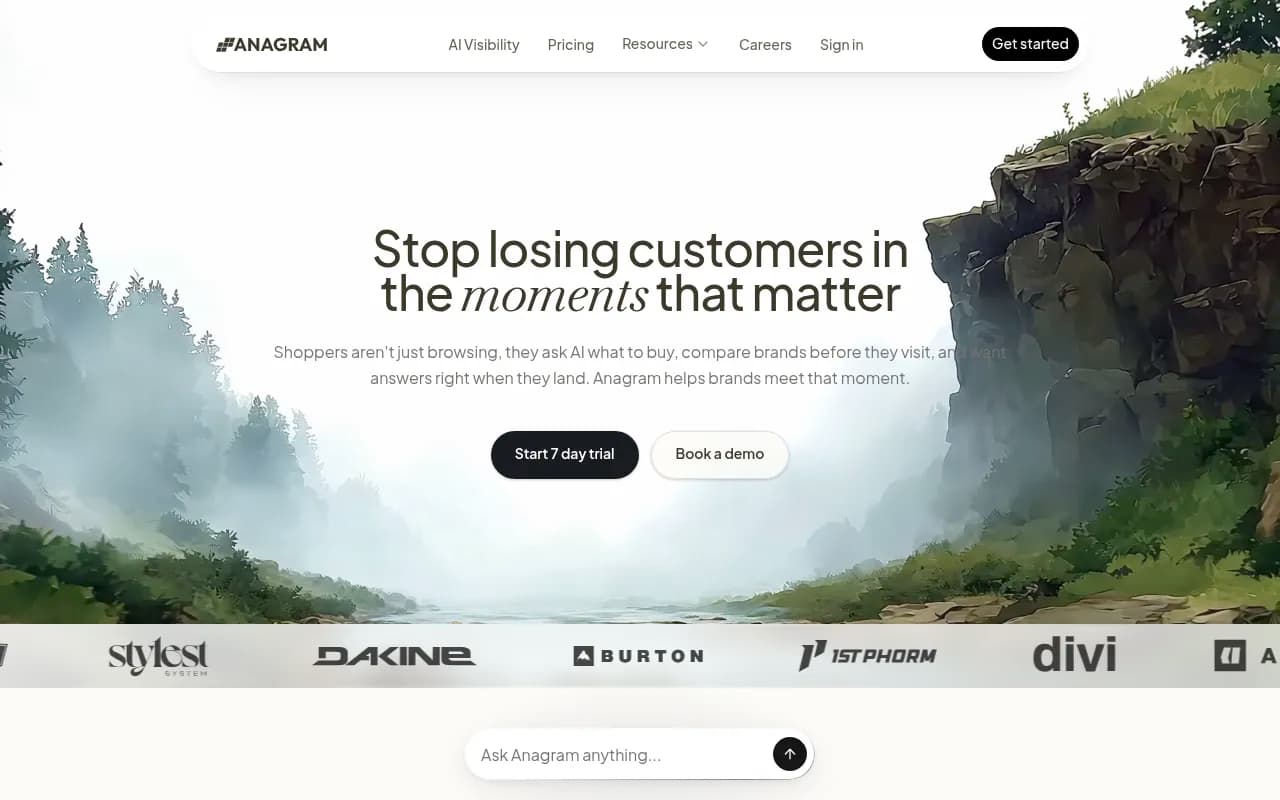
Key takeaways
- Anagram is really two products bundled together: a Shopify-native "Site Agent" chat widget that answers shopper questions, and an AI Visibility dashboard that tracks how brands show up in ChatGPT and other AI engines.
- Its pitch is a closed loop: on-site questions feed visibility monitoring and content strategy, and visibility insights feed back into what the Site Agent should say. Few competitors connect the two sides this way.
- On pure AI visibility monitoring, Anagram is thinner than dedicated GEO platforms. It has no AI crawler logs, no Reddit or YouTube citation tracking, no ChatGPT Shopping or Ads Radar, and no automated content generation pipeline, all of which Promptwatch offers.
- Pricing starts around $299/month for the Site Agent (scaling with traffic) and $99/month for AI Visibility, which is expensive relative to monitoring-only tools but reasonable if you actually use the conversational commerce layer.
- Best suited to DTC brands selling products that need explaining (gear, skincare, outdoor equipment) rather than companies purely chasing AI search rankings.
Anagram is built by a small Utah-based startup that raised a $1.2 million pre-seed round from Kickstart Fund and NextView Ventures in early 2024, founded by Austin Winfield, Bryce DeFigueiredo, and Jeremy Fischer. The company started out describing itself as "simple AI for complicated products," essentially an AI layer for messy ecommerce product data, and has since repositioned around two connected ideas: give shoppers a conversational product expert on your site, and use what you learn from those conversations to improve how your brand shows up when people ask AI chatbots for recommendations.
That repositioning matters because it puts Anagram in an odd middle ground. It's not purely a customer support chatbot, and it's not purely a GEO monitoring tool like Profound or Otterly.ai. It's trying to be both, with the on-site data functioning as a feedback loop for the AI visibility side. Whether that loop is as valuable as the marketing suggests depends heavily on how much traffic a brand already has, since the Site Agent needs real shopper conversations to generate insight.
The tool is aimed squarely at ecommerce brands, specifically DTC companies selling products shoppers have questions about before buying: pizza ovens, backpacks, skis, hair care routines. Case studies on the site (Gozney, Dakine, Divi, Armada, Bote, Elan Pure) all fit that pattern. This isn't a tool built for SaaS companies or B2B marketers trying to track branded prompts.
Key features
- Site Agent: A no-code, branded conversational widget deployed through "Anagram Studio." It answers product questions, recommends items through a short guided quiz (Dakine's backpack finder is the flagship example), and can direct shoppers to store locations (Armada's ski shop finder). No developer time is required to launch it, which is a real differentiator against custom chatbot builds that take six weeks of engineering.
- Learn (shopper insight dashboard): Every question a shopper asks the Site Agent gets logged and aggregated, surfacing what customers actually care about and where they hesitate. Anagram shows this as simple breakdowns, like "37% of shoppers ask what size pizza an oven can cook" for Gozney. This is the most unusual part of the product; it's product-market research generated passively from support interactions.
- AI Visibility dashboard: A separate product tab that tracks mentions per prompt, mentions rank, and share of voice against competitors across AI platforms. It's positioned as a lighter-weight alternative to enterprise AEO tools, with a free visibility report to start.
- Closed-loop content strategy: Anagram's stated differentiator is using the questions and friction points surfaced by the Site Agent to inform what content gets created or updated to improve AI visibility. In practice this means the two products share data, but Anagram doesn't appear to auto-generate or auto-publish content the way more mature GEO platforms do.
- Shopify-native integration: The app is listed on the Shopify App Store with native checkout extension support and admin integration. It can also be embedded on non-Shopify sites, but Shopify is clearly the primary platform it was built for.
- Engagement-based billing: Site Agent plans are metered by "engagements" (shopper interactions), starting with a limited free tier and scaling into paid tiers tied to monthly unique visitors.
Compared to how competitors handle these same jobs: a standalone chatbot tool like Intercom or Gorgias focuses purely on support resolution without the AI-visibility angle. A GEO monitoring platform like Promptwatch focuses purely on tracking and fixing AI search presence, with far deeper citation data, crawler logs, and content generation, but no on-site shopper-question capture. Anagram sits between them, and it shows: neither half is as deep as a dedicated specialist tool in either category.
Who is it for
Anagram fits best for DTC ecommerce brands in the $1M-$50M revenue range selling products that benefit from explanation before purchase: outdoor and sports gear, skincare and haircare, wetsuits, bikes, motorcycles. Its customer list (Gozney, Dakine, Divi, Armada, Bote, Elan Pure, Body Glove, Connelly Skis, Xcel Wetsuits) reflects that pattern closely. A marketing or ecommerce lead at a brand like this, someone managing both customer experience and content strategy, is the core buyer.
It also fits teams that specifically want the on-site data layer, not just visibility numbers. If a brand's priority is simply tracking whether ChatGPT mentions them and fixing content to improve it, Anagram's AI Visibility product alone is a lighter, cheaper option than enterprise GEO suites, but it's also noticeably thinner on data depth.
Brands that should skip Anagram: pre-launch or low-traffic sites, since the Site Agent's value depends on volume of shopper questions to generate useful insight. Anagram's own comparison content admits this limitation directly. SaaS companies, B2B marketers, agencies managing AI visibility across dozens of client sites, and anyone needing deep cross-platform citation analytics (Claude, Gemini, Perplexity breakdowns, crawler logs, content generation at scale) will outgrow it quickly and are better served by a dedicated GEO platform.
Integrations and ecosystem
Anagram is Shopify-first. It's listed on the Shopify App Store with native checkout extension support, admin dashboard integration, and categorization under chat and automated response tools. The site also says the widget can be embedded on non-Shopify sites, which suggests a generic JavaScript embed for brands on other platforms, though the depth of that support beyond Shopify isn't well documented publicly.
No evidence of integrations with Klaviyo, BigCommerce, Google Search Console, Slack, or Zapier was found. There's no public GitHub presence, so it isn't positioning itself as a developer-first or API-driven product the way some AI visibility platforms do. Demo booking runs through Cal.com, and product trials start through a separate "Anagram Studio" sign-up flow.
Pricing and value
Anagram runs two separate pricing structures depending on which product you're buying.
For the Site Agent: a Base plan starts at $299/month ($2,988/year with a discount) for up to 25,000 monthly unique visitors, unlimited data sources, and email support. Pro runs $599/month for up to 50,000 visitors with a dedicated customer success manager. Above that, a Growth tier starts at $799/month and scales with traffic. The live pricing page also shows a newer, smaller free or metered entry tier with limited included engagements before charges kick in, suggesting Anagram is testing a lower-friction way to get brands started.
For AI Visibility: pricing starts at $99/month, with higher tiers unlocking larger engagement volumes, longer data retention, and dedicated onboarding.
A 7-day free trial is available for both products through the Studio sign-up.
Against other GEO or AI visibility tools, $99/month for monitoring is competitive on paper, but the feature set behind that price is noticeably shallower than what Promptwatch, Profound, or Scrunch offer at similar or even lower price points. The Site Agent pricing, on the other hand, is expensive relative to general ecommerce chatbot tools, but the case studies (Bote cutting support contacts by 36%, Elan Pure hitting 13% conversion in assisted sessions) suggest it can pay for itself for brands with the traffic to use it well.
Strengths and limitations
Anagram does a few things genuinely well. The Site Agent is fast to launch without engineering resources, the shopper-question insight dashboard is a clever use of support data that most chatbot tools don't bother surfacing, and its Shopify-native integration makes setup straightforward for the ecommerce brands it targets. Customer reviews on the Shopify App Store are strong, 5.0 stars across 23 reviews, though that sample size is small and entirely positive, which makes it hard to know how it handles edge cases at scale.
On the AI visibility side, the gaps are significant if you're evaluating Anagram as a GEO tool rather than a chatbot with a visibility add-on. It has no AI crawler log tracking, so there's no way to see when ChatGPT, Claude, or Perplexity's bots actually visit and read your pages, something Promptwatch's Agent Analytics covers directly. There's no Reddit or YouTube citation tracking, no ChatGPT Shopping or Ads Radar monitoring, no prompt volume or difficulty scoring, and no automated content generation or CMS publishing pipeline. Anagram's own content acknowledges this gap, pointing out that Profound offers deeper cross-platform citation analytics for executive reporting. In short, Anagram monitors visibility at a surface level and relies on its Site Agent data as the real differentiator, but it doesn't close the loop all the way to actually fixing visibility through generated content the way agentic GEO platforms do.
Bottom line
Anagram makes sense for a DTC ecommerce brand that wants a fast, no-code conversational product expert on its site and is willing to treat AI visibility tracking as a secondary, lighter-touch add-on rather than the main event. If AI search visibility and content optimization are the primary goal, especially for brands tracking visibility across many prompts and models or wanting the system to actually generate and publish fixes, Promptwatch is the stronger choice, with crawler logs, Reddit and YouTube citation data, content gap analysis, and automated content agents that Anagram simply doesn't have.

Frequently asked questions
What is Anagram?
How much does Anagram cost?
Who is Anagram best for?
Does Anagram work outside of Shopify?
How does Anagram compare to dedicated GEO tools like Promptwatch?
Is there a free plan?
Similar and alternative tools to Anagram