Key takeaways
- Adobe Brand Visibility is built for enterprises already on Adobe Experience Manager, with edge-deployed fixes and no published pricing. Most of the alternatives below are cheaper, have a self-serve trial, or don't tie you to Adobe.
- Promptwatch is the strongest pick if you want a tool that tracks, fixes and verifies: content gap analysis, a Content Agent that publishes to your CMS, IP-verified crawler logs and AI traffic attribution.
- Peec AI and Otterly.AI are the easiest low-cost monitoring tools, and Semrush suits teams who want AI data next to SEO data.
- Profound and Conductor are the closest enterprise-to-enterprise swaps, though both are sales-led.
- Pick by what you need to do next: monitor (Otterly, Peec), act (Promptwatch, Profound), or consolidate with an SEO suite (Semrush, Similarweb).
Why people look for Adobe Brand Visibility alternatives
Adobe sold this product as LLM Optimizer until 31 July 2026, when it became Brand Visibility. Adobe describes it as LLM Optimizer combined with Semrush's AI Optimization. It tracks mentions, citations, sentiment and share of voice, then pushes changes out, including an edge-served version of pages aimed at LLM crawlers. It integrates with Adobe Experience Manager Sites, Adobe Commerce, Customer Journey Analytics and Adobe Analytics, and edge deployment works with Fastly, Akamai and Cloudflare.
That's a serious product. It's also a narrow fit. There's no published price. One competitor, LLM Pulse, claims quoted teams report an annual contract with a 1,000-prompt minimum at roughly 60 euros per prompt per year. Adobe hasn't confirmed that, and it's a competitor's claim, so treat it as a rough signal only. Trials are reportedly limited to eligible Adobe customers, with no self-serve checkout.
There are practical catches too. A competing agency, Canlah, notes the Agentic Traffic dashboard stays blank without CDN log forwarding, and that on non-Adobe CDNs the edge routing and bot allowlisting work falls to your IT team. One-click onboarding is documented only for AEM Cloud Service managed Fastly. Canlah is not neutral, but the points match how enterprise rollouts usually go.
So the common reasons to switch: you aren't an Adobe shop, you want a trial before talking to sales, you want transparent pricing, or you want features Adobe reportedly lacks, like query fan-outs, white-label reporting or Looker Studio. Here's how the alternatives compare.
Promptwatch

Promptwatch is the one I'd look at first if your frustration with Adobe is that it's heavy and sales-gated, but you still want a tool that acts rather than just reports. Most trackers answer "was my brand mentioned?" Promptwatch tries to answer "what do I do about it?" and then checks whether it worked.
The loop works like this. Content gap analysis maps your pages against the prompts AI answers. The Content Agent plans, writes and publishes GEO-optimized articles to WordPress, Webflow or Framer, either through a review inbox or hands-off. Published pages are then tracked through crawls, citations and AI-referred visits, and underperformers come back as items on the Action Board. Adobe's equivalent is edge-serving rewritten versions to bots. Promptwatch's approach is to fix the actual content, which is the thing AI systems cite.
Measurement is broad. It monitors real user interfaces of ChatGPT, Google AI Overviews, AI Mode, Gemini, Perplexity, Copilot, Meta AI and Alexa, plus API models like Claude and DeepSeek. IP-verified AI crawler logs show which pages bots read and what errors they hit. Visitor analytics attribute actual traffic and conversions from AI platforms. It also covers Reddit, YouTube and LinkedIn citations, ChatGPT Shopping, AI ads, prompt volumes and difficulty, and query fan-outs. It is ISO/IEC 27001 certified and GDPR compliant, which matters for procurement. It reports 1,840+ customers and 4.7/5 on G2.
What it won't do: edge-serve alternate page versions to LLM crawlers the way Adobe does, and it has no native Adobe Analytics or AEM workflow. If you live inside AEM review and approval, that's a real gap.
Pricing: free Explore tier (10 prompts, ChatGPT only), then Essential at $95/mo, Professional at $245/mo and Business at $579/mo, with a 7-day trial on monthly plans. The Content Agent starts at Business. Agencies have separate plans from $199/mo. Confirm at promptwatch.com/pricing.
Best for: marketing and SEO teams that want monitoring, content creation, crawler data and traffic attribution in one place, without a six-figure contract.
Profound

Profound is the nearest like-for-like swap for an enterprise buyer. It raised a $96M Series C in February 2026 at a reported $1B valuation, and it has moved from pure monitoring toward what it calls an AI marketer: agents that rewrite pages with citation decay and stage them in your CMS, build pages for questions you have no answer for, and draft corrections for publishers repeating wrong claims.
Strengths include prompt volume data, agent analytics from CDN logs, FactCheck for inaccurate AI claims, ChatGPT Shopping tracking and up to nine engines on Enterprise. It has 1,100+ G2 reviews at 4.5.
The downside mirrors Adobe's. There's no paid self-serve plan for brands. The free 7-day trial runs 50 preset prompts you can't edit, on ChatGPT, Gemini and AI Overviews, then it's a custom Enterprise contract. Agencies pay $99/mo plus $399/mo per client workspace. Compared with Promptwatch, it lacks Reddit-level tracking depth and the published price transparency.
Best for: large brands running multi-market programs that are comfortable with a sales-led contract.
Peec AI

Peec AI is a clean, daily prompt-analytics tool built around three metrics: visibility, position and sentiment. It's popular with agencies and European teams, claims 4,000+ brands and agencies, and gives unlimited users, competitors and languages on every plan.
Pricing on the vendor page is Starter $95/mo (50 prompts, 3 chosen models, 1 project, 1 country), Pro $245/mo (150 prompts, 2 projects, 3 countries), Advanced $495/mo (350 prompts, 5 projects, Looker Studio) and custom Enterprise with up to 13 models, API and SSO. Some roundups still list an old 85 euro entry price, which is out of date. All plans include a 1-5 prompt volume score, shopping and SKU-level tracking and an ads library.
The trade-off: it's monitoring first. Recommendations exist, but there's no content generation, no CMS publishing and no edge deployment, so you'd carry the fixes out yourself. Model choice is limited to three on the lower plans.
Best for: agencies and marketing teams that want a readable daily dashboard at a fixed price.
Semrush
Semrush now sits in an odd position relative to Adobe. Adobe's own announcement describes Brand Visibility as incorporating Semrush's AI Optimization, and one source (Canlah, unverified elsewhere) says Adobe has owned Semrush since 28 April 2026. If so, Semrush's AI Visibility Toolkit at $99/mo per domain is the cheapest way to reach data from the same lineage.
The real draw is consolidation: keyword research, backlinks, site audit and rank tracking sit alongside AI visibility. Semrush One starts around $165/mo on annual billing, and a Starter SEO plus AI Search bundle is listed at $199/mo. Prompt tracking covers ChatGPT, Gemini and AI Mode, but no Copilot, and Perplexity and AI Overviews appear only in some reports.
It's thinner on AI-specific depth. Prompt sets are more limited, there's no IP-verified crawler log in the core toolkit, and content generation is a $60/mo add-on. Peec has also been running a comparison campaign challenging Semrush's data accuracy, so test it on your own prompts.
Best for: teams already paying for Semrush who want AI visibility without another vendor.
Otterly.AI

Otterly is the budget option. Lite is $29/mo for 15 prompts checked daily on ChatGPT, AI Overviews, Perplexity and Copilot. Standard is $189/mo for 100 prompts, plus API, MCP server, agent analytics and a Looker Studio connector. Gemini and AI Mode are add-ons starting at $9/mo, and Claude from $29/mo. There's a trial and unlimited brands, countries and seats.
It also has GEO audits and crawlability checks, which is more than a bare tracker. But 15 prompts is a sample, not a program, and recommendations are light compared with an execution platform.
Best for: small teams who want to see what AI says about them this month for the price of a lunch, then decide whether to go deeper.
AthenaHQ
AthenaHQ is a GEO platform with broad model coverage (its Starter lists 11 models) and workflow features: citation source analysis, content optimization recommendations and ROI tracking. Customers shown include Coinbase, SoFi and PagerDuty.
Pricing is $295/mo Starter, with credits and API add-ons that change the real cost. Some roundups mention a free plan while others say no free trial, so check athenahq.ai/plans before assuming either. It leans toward monitoring plus recommendations rather than publishing content for you.
Best for: mid-market and enterprise marketing teams that want wide model coverage and a command-center view.
Conductor
Conductor pitches itself as the enterprise AEO and SEO platform, with a decade of SEO tooling behind it. It covers AI and search visibility across ChatGPT, Gemini, Copilot and Claude, AI content creation and 24/7 technical monitoring of how AI bots crawl your site.
It's sales-led with no public tiers, which puts it in the same procurement category as Adobe. The reasonable case for it is persona, intent, topic and region customization alongside traditional SEO workflows. The reasonable worry is the same as Adobe's: you won't know cost or fit until after a demo, though a three-week trial is offered after it.
Best for: enterprise SEO teams who want one vendor for classic SEO and AEO and don't mind a sales process.
Scrunch AI
Scrunch's angle is why AI misreads your site, not just whether you appear. Core is $250/mo with 125 prompts, five site audits, one brand and five users, covering ChatGPT, Perplexity, AI Overviews and Copilot. Gemini, AI Mode, Claude and Grok are Enterprise only.
Its persona-based prompt testing and site-readiness diagnostics are the interesting part, and probably the closest in spirit to Adobe's focus on what AI agents can access. Bring a page AI describes incorrectly and ask the vendor to show diagnosis and fix. Entry-tier coverage is narrower than some rivals.
Best for: teams whose problem is AI misinterpreting their site.
LLM Pulse
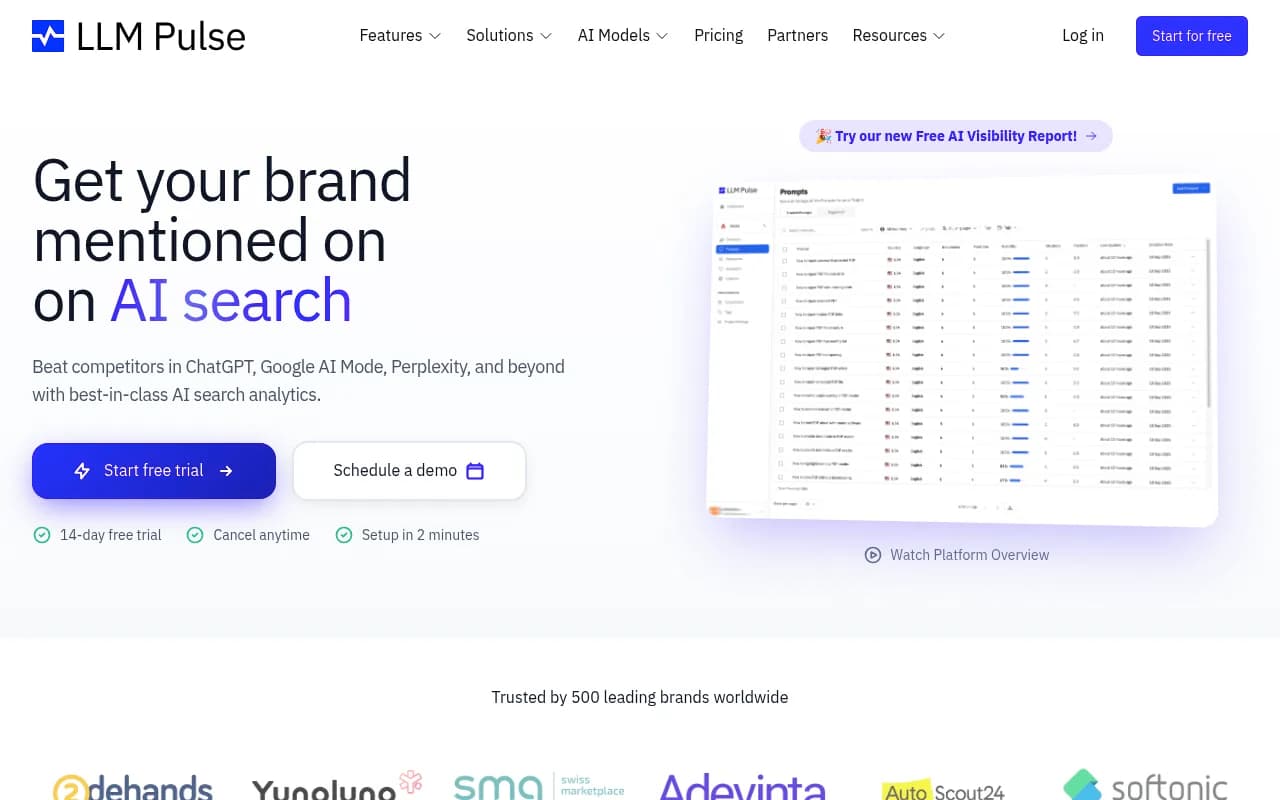
LLM Pulse tracks 18 AI models, including regional ones like Naver, Baidu, Qwen and Doubao, plus Amazon Rufus and Walmart Sparky. It also shows which AI bots crawl your site via CDN and server sources, and the traffic and sales AI sends.
Plans start at 49 euros/mo, with 99 euros for the next tier, month-to-month, and a 14-day trial. It reportedly has query fan-out, white label and a Looker Studio connector, which it says Adobe lacks. Note that LLM Pulse publishes its own Adobe-alternatives page ranking itself first, so its comparison claims are biased. It also doesn't have Adobe's CDN-layer optimization.
Best for: international brands and agencies that need wide model coverage at a low price.
Similarweb
Similarweb comes at this from competitive traffic data. Its AEO Intelligence runs $99/mo billed annually ($129 monthly) and pairs answer tracking with AI referral traffic benchmarks. Bundles go up to $335/mo for competitive intelligence plus SEO plus AEO, and enterprise contracts are typically $15,000 to $150,000+ per year.
The AEO product tracks ChatGPT, Perplexity, Gemini and AI Mode, but not AI Overviews or Copilot. It's strong for benchmarking against competitors, weak as an optimization tool.
Best for: strategy and market-intelligence teams who care about competitive traffic context more than page-level fixes.
Which one should you pick?
If you're deep in AEM and want changes routed through Adobe's approval workflow, staying with Adobe Brand Visibility is defensible. The Adobe-native integrations are its real moat, and nobody else matches them.
If you're not on Adobe, the decision is simpler. For tracking plus fixing, with a published price and a trial, start with Promptwatch. For enterprise, sales-led and agent-heavy, compare Profound and Conductor. For plain daily monitoring, Peec AI or Otterly.AI. For one bill alongside SEO, Semrush. For site-interpretation problems, Scrunch. For international model coverage, LLM Pulse, and for traffic benchmarking, Similarweb.
A practical test before buying anything: pick 20 prompts your buyers really ask, run them in two tools, and see which one tells you what to change next. The G2 2026 survey cited by Closely found 51% of B2B software buyers start research with a chatbot more often than Google, so this is worth a real trial. For more options, the GEO software directory at bestgeosoftware.com lists dozens more.