Key takeaways
- Visby AI does something useful: it turns visibility gaps into prioritized tasks, starting at $79/month. Plenty of small teams should start there.
- Its plan limits (15 to 90 tracked prompts, any 3 engines, 1 to 3 domains) are the first thing growing teams hit.
- The six signs: you need more prompts and repeat sampling, more engines, evidence for why you are or are not cited, real traffic attribution, agency or multi-brand workflows, and content that ships without a manual bottleneck.
- Per-engine data matters. A blended score hides real differences between ChatGPT, AI Overviews and Perplexity.
- Moving up does not mean throwing Visby away. It means choosing a platform whose measurement, diagnostics and execution layers are all in one place.
Where Visby AI fits
Let me be fair to Visby first. A lot of AI visibility tools stop at a dashboard that says you appear in 11% of answers and leave you to figure out the rest. Visby tries to do something more useful. According to its own blog, it analyzes visibility at the prompt level, splits awareness, consideration and conversion prompts, and then generates prioritized, site-specific tasks with expected outcomes. It also reports organic AI-referred sessions from ChatGPT, Gemini and Claude.
That is a real workflow, and at $79/month it is cheap. An AppSumo reviewer gave it a 5.0 across 168 ratings and described it as built for the AI discovery era rather than the SEO era. I would not argue with that.
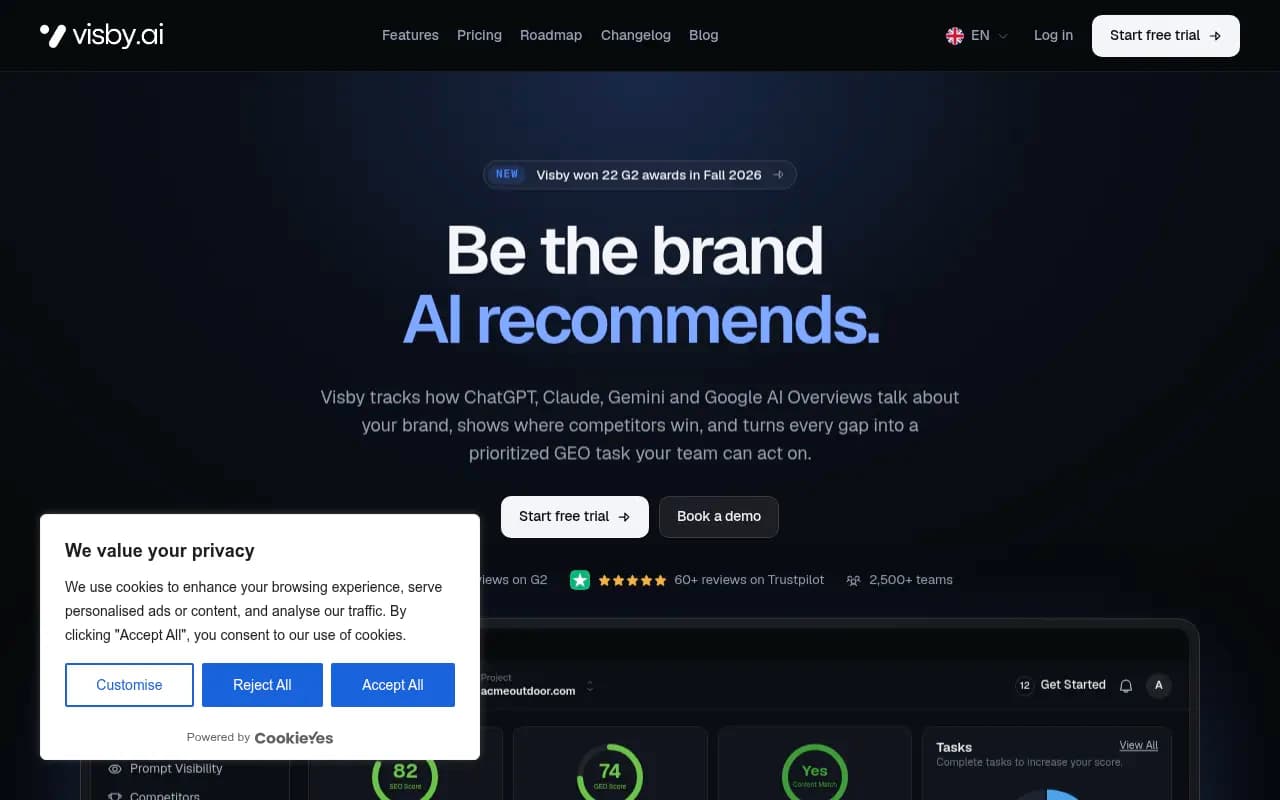
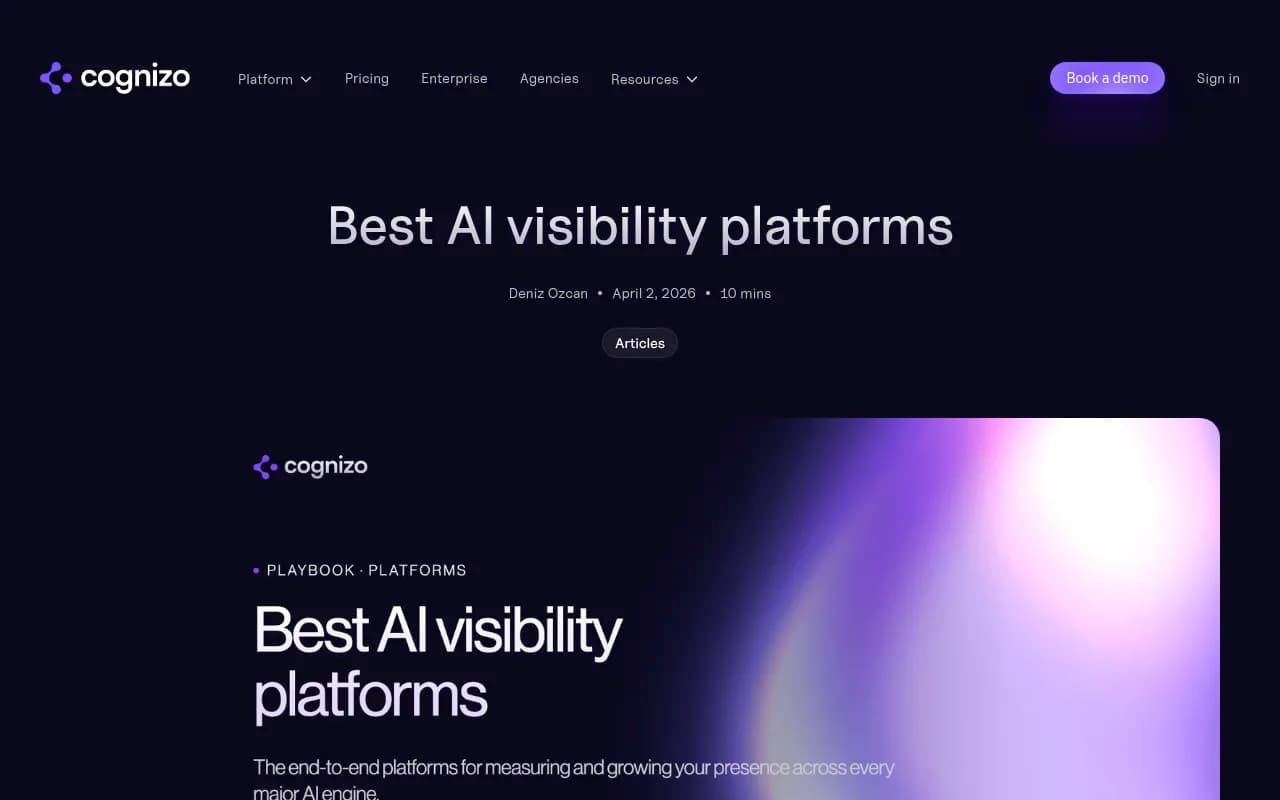
The trouble is not that Visby is bad. The trouble is that the thing it is built for, getting a small team started with GEO, has a ceiling. The Cognizo team described the pattern well in their guide to AI visibility platforms: teams start with a lighter tool, confirm the gap is real, then realize they need something that combines tracking with content optimization, AI traffic analytics and prompt volume data in one place.
Here is what Visby's pricing page lists today.
| Plan | Price | Domains | Tracked prompts | AI answers analyzed / month | Article generations | Seats |
|---|---|---|---|---|---|---|
| Starter | $79/mo | 1 | 15 | 45 | 5 | 1 |
| Growth | $199/mo | 3 | 90 | 270 | 15 | 3 |
| Enterprise | Custom | 5+ | 250+ | 750+ | 25 | 10+ |
Every plan covers any 3 engines from ChatGPT, Claude, Gemini and Google AI Overviews. Perplexity is not listed. Keep those numbers in mind, because most of the signs below come straight from them.
Sign 1: Your prompt list outgrew the plan
Fifteen prompts is a starter set. It is fine for proving that a gap exists. It is not enough to cover a product line, a few buyer personas and a handful of competitor comparisons.
The bigger issue is how those prompts are sampled. One "AI answer analyzed" is one prompt run on one engine. Fifteen prompts across three engines gives 45 answers a month, and the Growth and Enterprise tiers follow the same ratio (90 x 3 = 270). My reading of those numbers, and it is an inference rather than a stated Visby policy, is that each prompt runs about once per engine per month.
That matters because model outputs are nondeterministic. Ask the same question twice and you can get different brands. A single monthly sample cannot tell you whether a mention is stable or a fluke. If your reporting shows visibility jumping from 20% to 40% on a sample like that, you may be looking at noise.
The sign: you catch yourself wanting daily runs, more prompts per topic, and country or persona variants, and the plan cannot give you them.
Platforms built for volume run monitors daily. Promptwatch, for instance, runs prompt panels daily across models, countries and languages, and adds prompt volumes and difficulty scores so you can pick which prompts deserve a slot at all.

Sign 2: Engine coverage stops matching where your buyers are
Choosing 3 of 4 engines sounds flexible until you realize your audience uses more than that. Perplexity is not on Visby's list. Neither are Copilot, Meta AI, Google AI Mode or Amazon Alexa. Which engine matters also changes by industry and by region.
Engines behave differently enough that this is not a nice-to-have. Promptwatch's sources per response data (daily tracking, web-search answers only) shows ChatGPT citing about 5 sources per answer, while Google AI Overviews and Perplexity cite about 10. Copilot swung from under 2 to nearly 17 within a few weeks before settling low. Each engine has a different number of citation slots, so winning a slot is a different problem on each one.
The sign: a stakeholder asks "what about Perplexity?" or "what does AI Mode say?" and the honest answer is that you are not tracking it.
Sign 3: One blended score stops explaining anything
A Reddit thread in r/digital_marketing captured a common frustration: someone sat through six AI search pitches in a month, and all of them sold a visibility score nobody could explain. That is a fair complaint about the category in general, not about Visby specifically. I have not verified how Visby calculates its numbers, so I will not claim it is guilty of this.
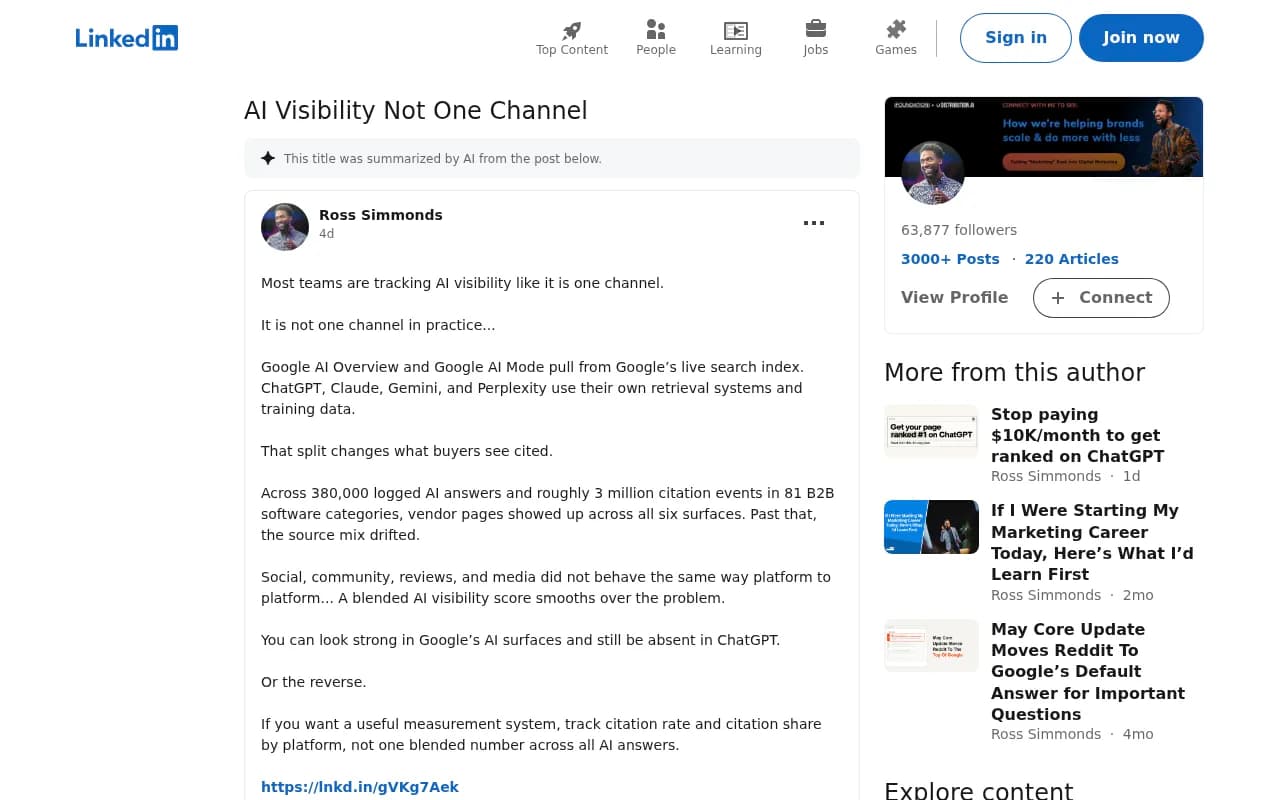
But the underlying point holds. Ross Simmonds made it on LinkedIn: treating AI visibility as a single channel hides what is happening, and breaking it out by platform makes gaps much easier to spot.
The data backs him up. In Promptwatch's social citations by AI model report for Sep 28 to Oct 4, 2026:
- ChatGPT got 0.46% of its citations from social platforms, and Reddit was just 0.09%.
- Google AI Overviews got 12.2% from social, with YouTube at 4.28% and Facebook at 2.38%.
- Perplexity got 2.7%, with LinkedIn and Reddit tied at 0.86%.
Imagine a tool that tells you to chase Reddit, G2 and Trustpilot social proof the same way for every engine. For ChatGPT that advice would send you to a channel that barely registers right now. Reddit's share of ChatGPT citations fell from roughly 4% to 0.5% on August 14, 2026, while AI Overviews declined more gradually.
The sign: your visibility score goes up and you cannot say which engine, which topic or which source type caused it.
Sign 4: You need to know why you are not cited
Task lists are useful. But a task such as "add a comparison page" is a hypothesis. To trust it, you want evidence: did AI crawlers even reach the page, did they hit errors, which pages get cited and for which prompts?
This is where monitoring-plus-tasks tools and full platforms diverge. The diagnostic layer includes:
- IP-verified AI crawler logs, showing which bots (GPTBot, ClaudeBot, PerplexityBot and others) visit which pages and what errors they get
- Query fan-out data, showing the actual web searches the engine runs
- Citation analytics by page, content type and source type
- Search Console and Bing data next to AI data, so you can see pages that rank but never get cited
Fan-outs deserve a closer look. Promptwatch's ChatGPT query fanout data found that a single prompt can trigger several searches, with the measured average moving from 2.15 searches per response in December to about 1.84 by early March, and exactly 1.0 once fanouts returned in April. Average query length also shrank, from about 117 characters to about 53. Your content has to match the queries ChatGPT generates, not only the user's prompt. A tool that tracks fixed prompts and nothing else misses that layer entirely. And that behavior moves: ChatGPT began using the site: operator at scale on August 8, 2026, jumping from about 0.4% to about 17% of fanout queries overnight.
I could not find crawler or log analytics on Visby's pricing page, but I only checked that page, so verify before you rule it out.
The sign: you are executing tasks and not sure whether they worked, or why a page that should be cited is not.
Sign 5: Leadership wants traffic and revenue, not mention counts
Visby reports organic AI-referred sessions from ChatGPT, Gemini and Claude, which is a good start. A full platform goes further: AI-referred visits and conversions across more sources, top landing pages, and a join between crawls, citations, clicks and search data per page.
The case for that is practical. Crisp, a Promptwatch customer, reported 2x higher conversion rates from AI traffic compared with traditional channels. TreeHouse, the company behind Pararius, grew AI search to roughly 25% of organic conversions. You only discover numbers like that if attribution is built in.
If your CFO asks what the channel returns, mention counts will not survive the meeting.
The sign: you export screenshots into a deck to show business impact.
Sign 6: Agencies, multi-brand teams and content volume
Visby's plans are capped by domains and seats: 1, 3 or 5+ domains and 1, 3 or 10+ seats. That suggests limits for agencies and multi-brand companies. Five to twenty-five article generations a month is also a real cap if you intend to close gaps at scale.
Content shelf life makes the volume question sharper. Promptwatch's content half-life report tracked every page ChatGPT cited on July 6, 2026 for 90 days. Landing pages and docs stayed cited longest, while news lost half its pages within 36 days. And according to the content type report, product pages were the most cited type at 22.4% of citations from Sep 28 to Oct 4, 2026. So the right mix of pages matters, and so does refreshing them.
Full platforms handle this with:
- Unlimited projects and client workspaces with white-label reports (for agencies)
- Content agents that plan, write and publish to a CMS on a schedule
- Content refresh for existing pages
- A shared action board with assignees and comments
The sign: you are paying for extra seats, copy-pasting generated drafts into a CMS, and still falling behind your content calendar.
What a full platform should cover
Before choosing, use a checklist. Cognizo's review evaluated six criteria: engine coverage, competitive analysis, citation tracking, a content studio, AI traffic analytics and real prompt volumes. That is a decent frame. I would add crawler logs and an execution layer that publishes and then verifies.
| Capability | Visby AI | Typical monitoring-only tracker | Full AI visibility platform |
|---|---|---|---|
| Prompt-level tracking | Yes, capped | Yes | Yes, with volumes and difficulty |
| Engines | Any 3 of 4 | Varies | All major engines, real UI data |
| Prioritized tasks | Yes | No | Yes |
| Article generation | 5 to 25 per month | No | Content agent and refresh |
| AI traffic attribution | Sessions from 3 engines | Rarely | Visitor analytics with conversions |
| Crawler logs | Not listed | No | IP-verified logs |
| Agency workspaces | Seat and domain caps | Varies | Unlimited projects, white-label |
Your options when you outgrow Visby
The market is crowded. Here is how I would sort the choices.
Full-stack GEO platforms
Promptwatch is the one I would put first on a shortlist for teams that want tracking, diagnostics and execution together. It monitors real interfaces of ChatGPT, AI Overviews, AI Mode, Gemini, Perplexity, Copilot and more, logs AI crawler visits, attributes traffic, and its Content Agent publishes to WordPress, Webflow or Framer. Paid plans start at $95/month (Essential), with Professional at $245 and Business at $579. Check promptwatch.com/pricing for current numbers. The free Explore plan tracks ChatGPT only. This is also what 1001 SEO Media's team uses, so I am not neutral, but the stack is the reason.
Profound is a strong enterprise monitoring product, though at a higher price point.

Monitoring-first trackers
If your main need is cheaper or broader tracking, tools like Peec AI and Otterly.AI cover prompt monitoring, though they generally lack crawler logs and content generation.


SEO suites adding AI features
If you already live inside a suite, Semrush One and Ahrefs Brand Radar bolt AI tracking on. Fixed prompt sets and shallower AI-specific data are the trade-off.

Other action-oriented tools
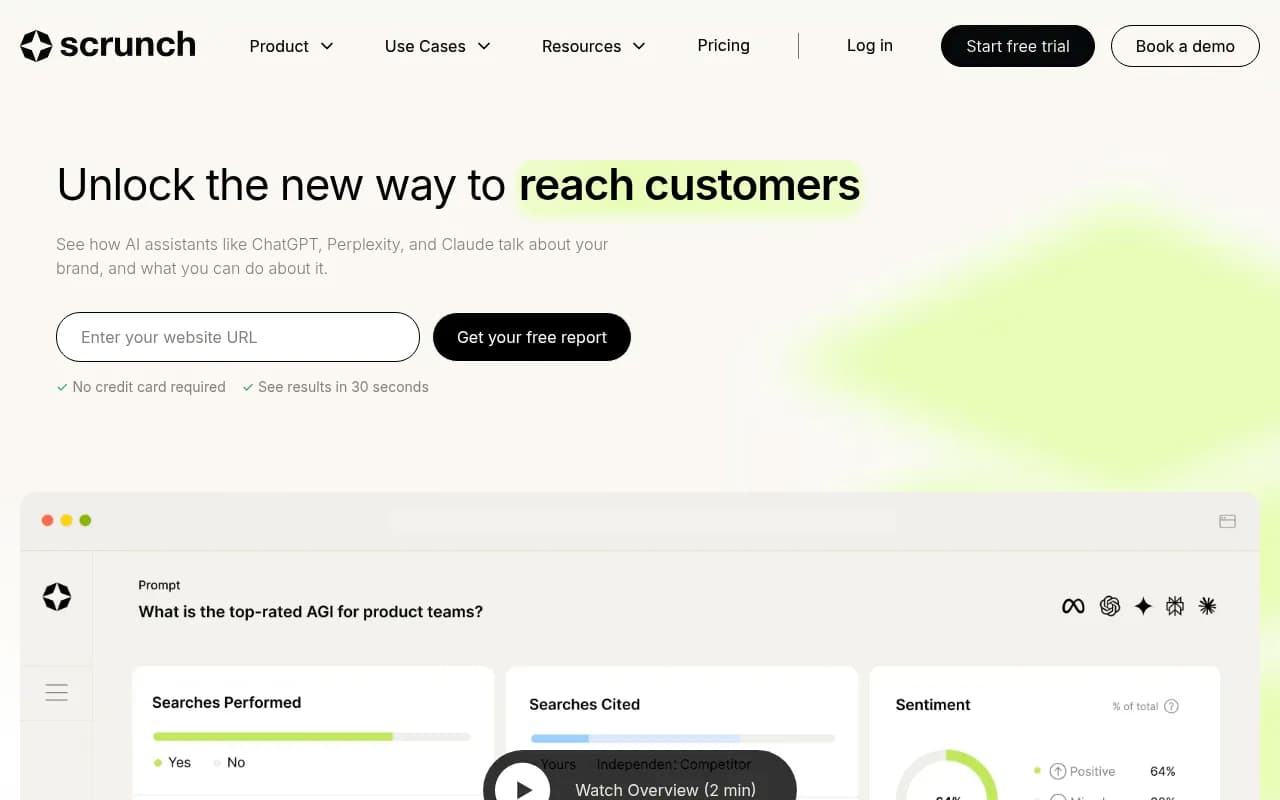
Several smaller tools pair tracking with fixes, including Scrunch, AthenaHQ, Relixir and Whitebox. If you want to browse more, the GEO software directory lists them side by side.
Market context: why this matters now
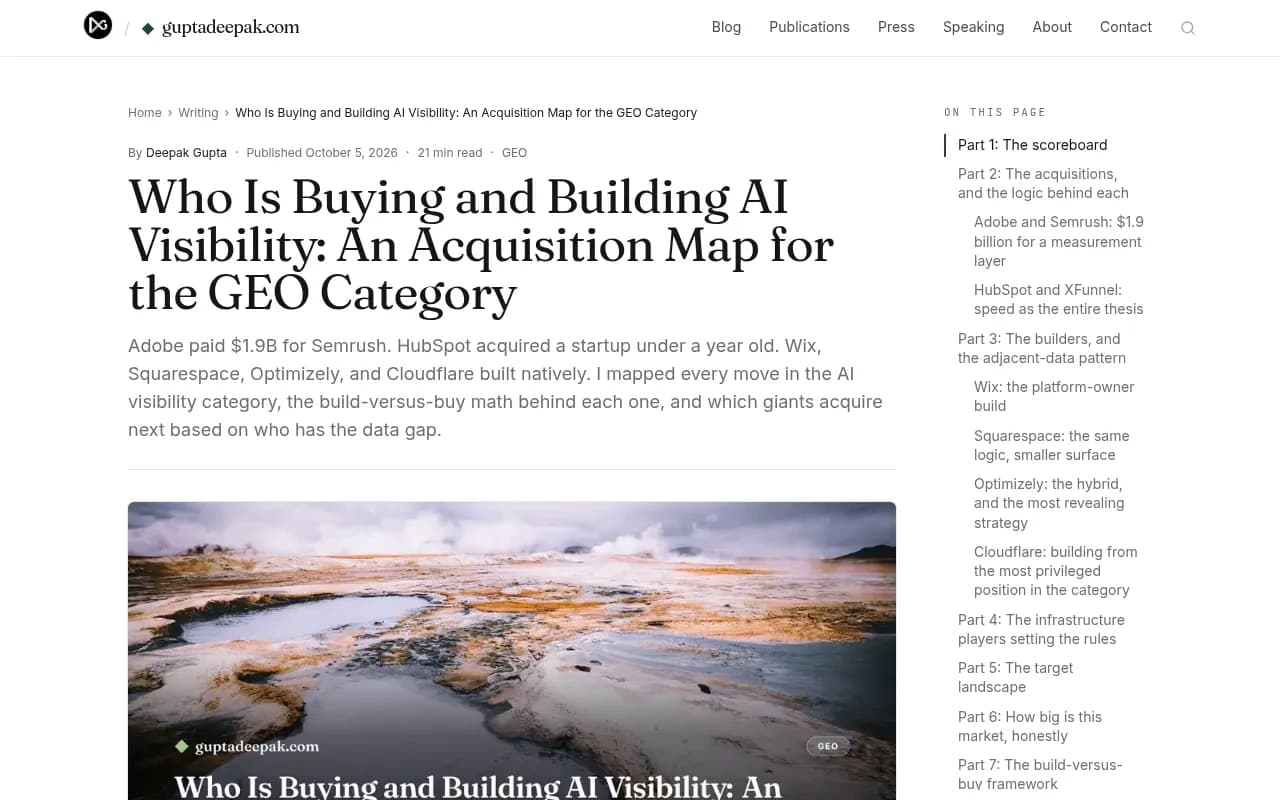
The category is consolidating fast. Deepak Gupta's M&A research notes Adobe paid $1.9B for Semrush, HubSpot acquired XFunnel and Sitecore acquired Scrunch, while Wix, Squarespace, Cloudflare and Optimizely built AI visibility natively. His thesis is that the hard part is not the dashboard but the measurement infrastructure that turns nondeterministic outputs into stable signals. That is the same limit I flagged in sign 1. Basic visibility dashboards are becoming a commodity. Measurement depth and execution are where the differences remain.
How to migrate without losing momentum
- Export your Visby prompts and your current baseline numbers.
- Rebuild them as monitors in the new platform and let them run for two weeks before comparing anything. Different tools count mentions differently.
- Add prompts you could not afford before: competitor comparisons, local variants, other languages.
- Turn on crawler logs and visitor analytics first, since they have no Visby equivalent to compare against.
- Move your open task list into the new platform's action board so nothing is lost.
- Keep Visby until the new baselines settle, if your billing allows it.
For tools by category, AI rank tracker directory is a good second stop.
When you should stay on Visby
If you have one domain, a short prompt list, one person doing the work and no pressure to prove revenue, Visby is a reasonable fit. Do not upgrade because six signs sound dramatic. Upgrade when two or three of them are costing you time or credibility.
If you want a human to help choose, 1001 SEO Media runs GEO and AI search programs and can audit what you currently track.
The short version
Visby is a good first tool. Teams outgrow it when sampling is too thin to trust, engines are missing, scores stop explaining causes, leadership asks for revenue, and content volume outpaces a capped plan. At that point pick a platform that measures per engine, shows why you are or are not cited, attributes traffic, and publishes the fix, then checks whether it worked.