Key takeaways
- Scrunch's Core plan sits at $250/mo for 125 prompts across four engines, which is well above the category median, but its persona and topic segmentation is still hard to match.
- Sitecore's June 2026 acquisition tied Scrunch's diagnostics to a real content-execution pipeline (SitecoreAI), which is rare in a category full of monitoring-only tools.
- AXP, Scrunch's agent-experience layer, serves LLM-optimized HTML to AI crawlers without touching the human-facing site, a genuinely different approach from competitors.
- The honest weak spots are real: no prompt-volume data, weekly (not real-time) citation exports, and an execution gap where insights become a manual backlog.
- If you need first-party prompt demand data, real-time citation mapping, or a self-serve entry tier under $100, look elsewhere; if you need persona-level AI visibility with enterprise procurement boxes checked, Scrunch still earns its renewal.
The pattern in every comparison post
Open any "Scrunch AI alternatives" roundup published in 2026 and you'll find the same structure: acknowledge Scrunch is solid, note the price, then spend 2,000 words pointing at Profound, Otterly, Peec, or Frase instead. I've read a dozen of these now, and they're not wrong about the price. $250/mo for 125 prompts and four engines (ChatGPT, Perplexity, Google AI Overviews, Copilot) is a mid-market entry fee dressed up as a starter plan. ThatMarketingBuddy's pricing index puts Scrunch at #31 out of 38 tools it tracks by price, 192% above the category median of $85.50/mo.
So why are teams still renewing?
Because price comparisons measure the wrong thing when the actual question is "does this tool tell me something I can act on, and can my organization survive the procurement process to buy it." For a specific type of buyer, mostly mid-market and enterprise brands plus agencies juggling multiple clients, Scrunch still clears that bar better than most of what's chasing it downmarket.
What Scrunch still does better than the field
Persona and topic segmentation that actually holds up
This is the feature reviewers across geotoolbox.ai, Reddit's r/GEO__AI__SEO, and several comparison sites keep circling back to. Scrunch lets you slice visibility data by buyer persona, topic, and geography in a way that's genuinely harder to replicate in Otterly or Peec, which are built more for flat prompt lists. If your brand sells differently to a CFO than to a developer, and those two personas ask AI assistants very different questions, this segmentation is the difference between a vanity dashboard and something a content team can plan against.
Scrunch's Prompt Templates feature, shipped in July 2026, extends this: build one template and it expands into dozens or hundreds of prompt variations automatically, rather than someone typing out every permutation by hand.
The GA4 bot-traffic dashboard
Multiple independent reviews single this out as "the feature people actually rave about." It turns raw AI crawler activity into reporting your team can drop into a client deck or an executive dashboard without extra work. Given how many GEO tools treat crawler visibility as an afterthought, or skip it entirely, this integration is one of the clearer differentiators Scrunch has over lighter competitors.
AXP: a different bet on the reachability problem
Most visibility tools stop at "here's your citation share." Scrunch's Agent Experience Platform (AXP) is an infrastructure layer that sits between your website and AI crawlers, serving compressed, structured, LLM-optimized HTML to bots without changing what human visitors see. It connects through Akamai, CloudFront, Azure Front Door, or Cloudflare.
The logic behind it is sound: when a brand shows near-zero AI visibility, the cause is often a blocked crawler or a JavaScript-heavy render, not bad content. A share-of-voice chart alone can't distinguish those two problems. Scrunch's own case studies back this up with real numbers. Akamai reported a 364% increase in appearances for non-branded prompts and a 218% increase in citations after enabling AXP on comparable pages. Runpod credited expanded prompt tracking plus AXP-driven rendering fixes for a 400% increase in paying customers tied to AI search optimization.
To be fair, Profound has publicly called AXP "an unproven approach that may violate search guidelines" since it effectively serves different content to bots than to humans. That's a competitor talking, so weigh it accordingly, but it's a legitimate question worth asking your own legal or SEO team before you turn it on.
With Google AI Overviews averaging around 10 citations per response and ChatGPT stuck near 5 according to Promptwatch's ongoing analysis of citation patterns, every slot you're fighting for is scarce (see Promptwatch's Average Sources Per Response data). A tool that fixes crawlability rather than just reporting on it has an obvious appeal in that kind of scarcity.

Enterprise controls that remove procurement friction
SOC 2 Type II compliance and SSO aren't exciting features to write about, but they're the difference between a tool a security team approves in a week versus a tool that gets stuck in review for a quarter. For enterprise and agency buyers managing sensitive client data, this matters more than a lot of the flashier comparison-chart items.
The Sitecore acquisition changed the calculus
Sitecore's acquisition of Scrunch, announced June 3, 2026, is the single biggest thing that changed about this product in the past year, and most of the alternative roundups treat it as a footnote. Scrunch's diagnostic output is now being wired directly into SitecoreAI's Content Management, Content Marketing, and Digital Asset Management tools. That's the execution layer Scrunch has historically lacked, reviewer after reviewer has pointed out that Scrunch tells you what's wrong but leaves the fixing to your team. If that integration matures the way Sitecore's announcement implies, Scrunch stops being a pure diagnosis tool and starts closing its own loop, which is exactly the gap competitors like Profound and newer agentic tools have used to differentiate themselves.
Where the criticism is fair
This isn't a defense piece pretending Scrunch has no flaws. The recurring complaints across independent reviews hold up:
- No prompt-volume data. Scrunch doesn't expose how many people are actually asking a given prompt, so you're guessing at which queries are worth fighting for. Profound's 1.3B real-user prompt dataset is a real advantage here.
- Citation exports lag. Several comparisons describe weekly CSV exports rather than the real-time conversation explorer Profound offers, and prompt testing reportedly has a five-minute delay versus an instant playground elsewhere.
- Auto-generated prompts skew branded. You'll spend time manually adding the non-branded queries that usually matter most for discovery.
- Multi-brand and agency support requires Enterprise. Core tops out at one brand, which is a real ceiling for agencies running several clients.
- Core's engine coverage is thinner than the marketing suggests. Self-serve Core covers four engines; Claude, Gemini, Meta AI, Grok, and Google AI Mode require Enterprise.
How Scrunch stacks up against the tools people compare it to
| Tool | Entry price | Engines on entry tier | Strongest differentiator | Where it loses to Scrunch |
|---|---|---|---|---|
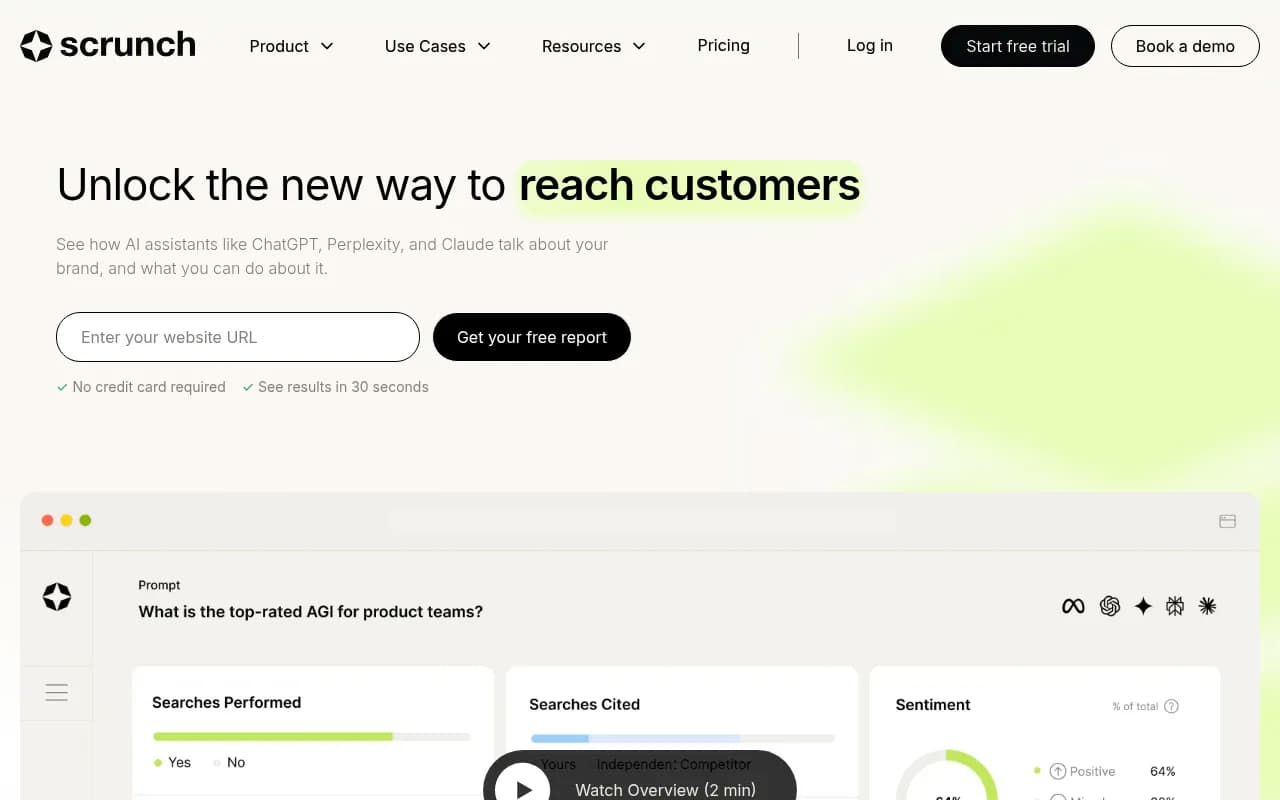
| Scrunch | $250/mo | 4 (9 on Enterprise) | Persona/topic segmentation, AXP crawler-fix layer, GA4 bot dashboard | Prompt-volume data, real-time citations |
| Profound | $99/mo | 1 | 1.3B real-user prompt dataset, instant playground, full content layer | No AXP equivalent, higher ceiling pricing |
| Otterly.AI | ~$29-49/mo | Limited | Cheapest credible entry point | No implementation features, 15-prompt cap |
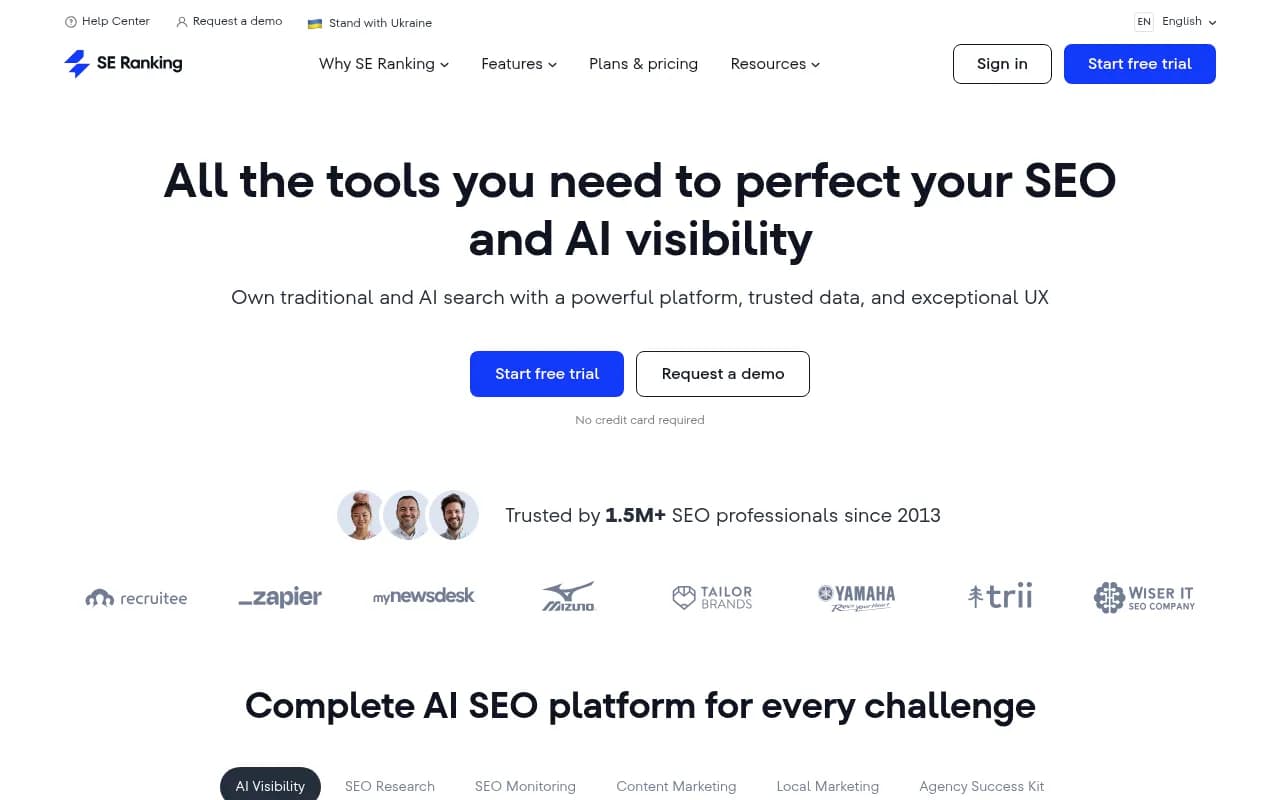
| SE Ranking (AI toolkit) | Bundled with SEO plan | Several | Traditional SEO plus AI monitoring in one place | Less specialized on persona segmentation |
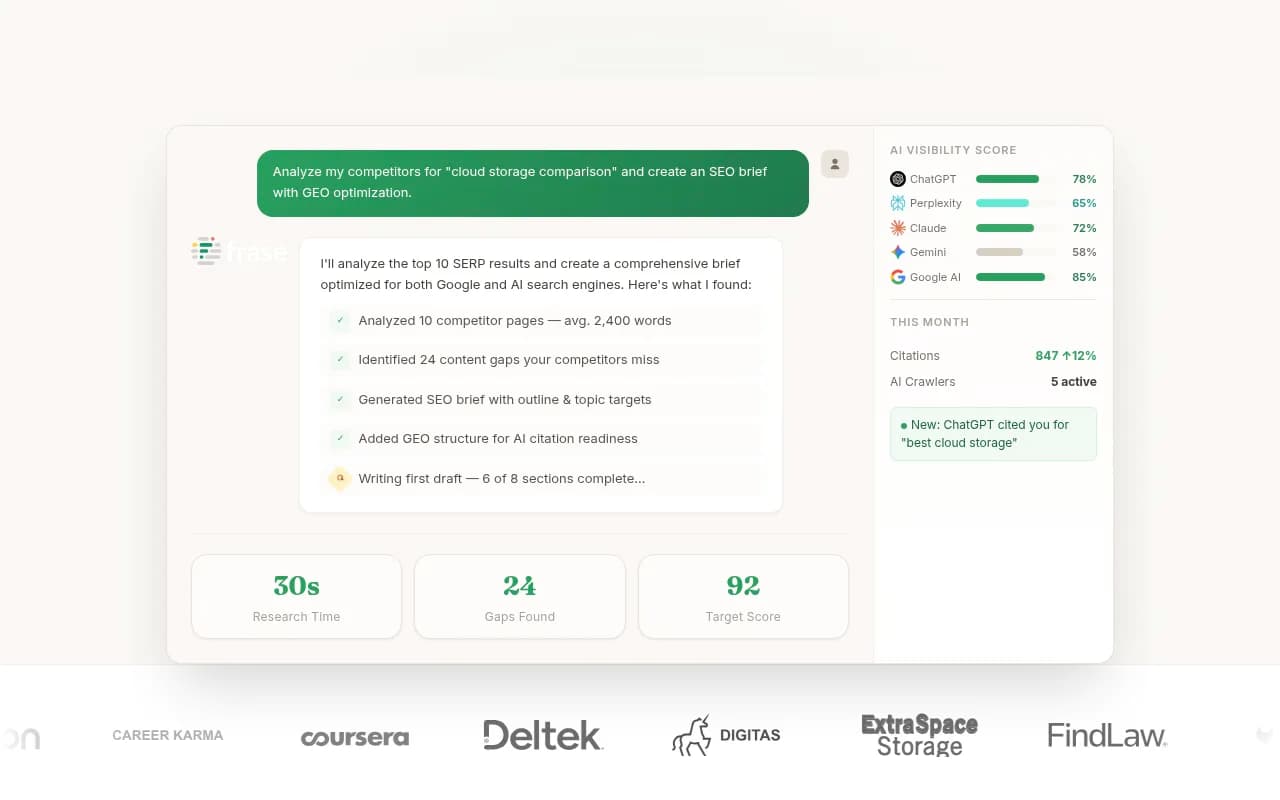
| Frase | Under half Scrunch's price | Fewer platforms | Content creation suite bundled in | Thinner AI visibility tracking |


Who should actually keep paying for Scrunch
Based on the consensus across reviews and Scrunch's own customer list (Lenovo, Crunchbase, Akamai, Runpod), the profile that keeps renewing looks like this:
- Mid-market and enterprise brands where persona-level visibility data feeds into real content and product marketing decisions, not just a monthly screenshot for leadership.
- Agencies running visibility programs for multiple clients who need client-ready reporting and are willing to pay for Enterprise multi-brand access.
- Organizations with a security-first procurement process where SOC 2 and SSO save weeks of internal review.
- Teams that suspect their AI invisibility problem is a crawlability or JavaScript-rendering issue rather than a content-quality issue, and want a tool built to diagnose (and now, via Sitecore, potentially fix) that specific failure mode.
Who shouldn't bother: solo marketers and small teams tracking a handful of prompts, who can replicate most of Scrunch's basic monitoring by hand for free, and anyone who needs first-party prompt-volume data to prioritize a content roadmap, since that's a gap Scrunch still hasn't closed.
The honest bottom line
Scrunch isn't the cheapest, the fastest, or the one with the deepest raw dataset. What it still has is a specific, well-executed answer to "why is my brand invisible to AI, and can I prove that to a security team." If your organization fits the profile above, the alternatives save money but usually cost you segmentation depth, crawler-level diagnostics, or procurement speed. If it doesn't fit, the twelve competitors in every comparison post are right there, and most of them are cheaper for a reason.
Whatever tool you land on, the underlying problem isn't going away: AI answer engines cite a small, contested set of sources per response, and understanding why you're or aren't one of them requires actually watching what the crawlers do on your site, not just what a dashboard says about your prompts. If you want to compare the fuller field of AI visibility platforms with that lens, the directory at bestgeosoftware.com is a reasonable place to keep looking.