Key takeaways
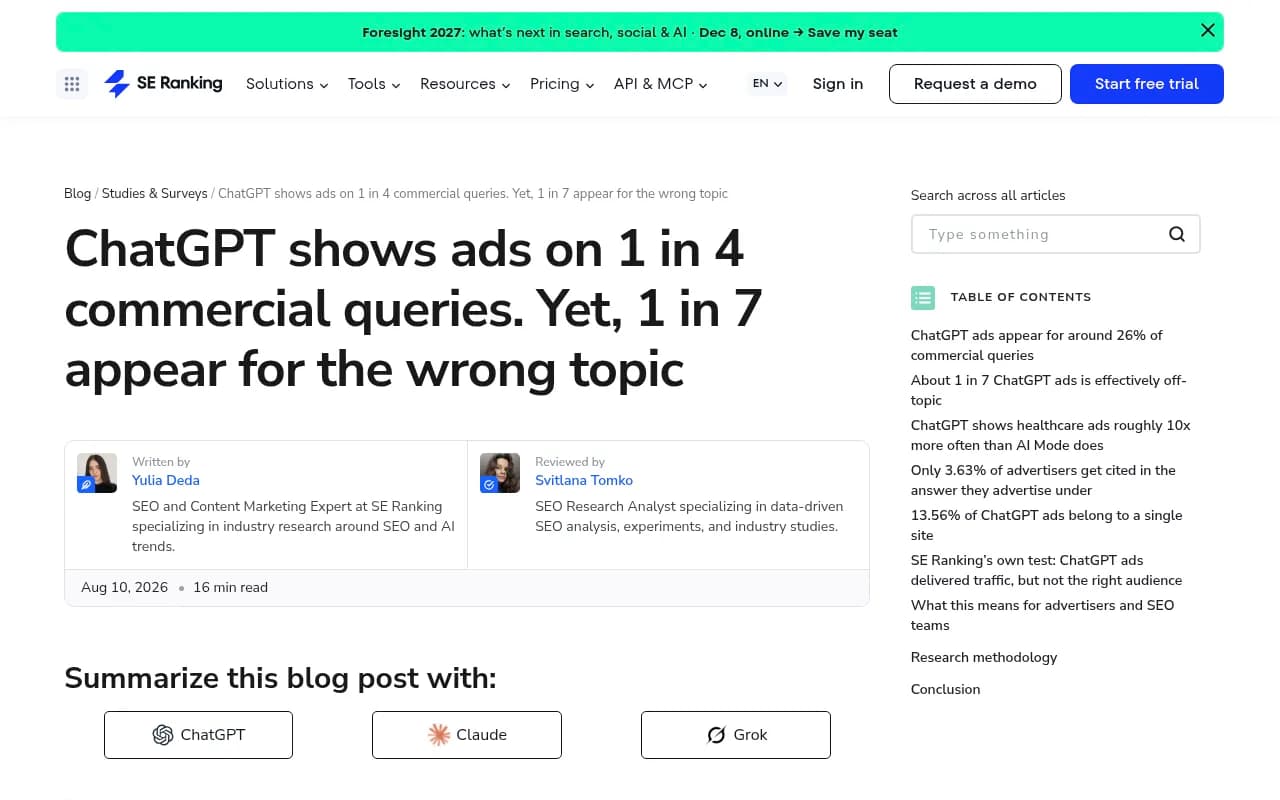
- Ad rates depend on who measures and on what. SE Ranking found ads on 25.94% of commercial prompts, while Promptwatch Data found ads in 20.1% of web-searching ChatGPT responses over 90 days (32.4% in the latest 7). Never compare these numbers without checking the base.
- Organic, non-branded prompts carry most of the ads: about 73% of ad-bearing responses in Promptwatch's data.
- Targeting is loose. SE Ranking measured about 14% of ads as effectively unrelated to the prompt, and advertisers cannot see which conversations triggered them.
- Buying an ad barely moves organic AI visibility. Only 3.63% of advertisers were also cited in the answer above their ad.
- You cannot see competitor ads without running prompts yourself. Build a prompt list from paid search terms and conquest queries, hold the session constant, repeat across days, and track advertisers per prompt.
Why this question matters now
For a long time the answer to "who is bidding on this?" lived in Google's auction insights, SpyFu, or Semrush. ChatGPT has none of that. There is no public ad library and no auction report for advertisers. You have to go and look.
And there is more to look at than you might guess. SE Ranking notes that OpenAI announced ads in ChatGPT on January 16, 2026, after Sam Altman had called the idea a "last resort" in 2024. In Promptwatch's own logs, ChatGPT served no ads until May 27, 2026, and they then climbed in bursts. This guide covers which prompts attract those ads and how to build your own view of rivals' placements.
How often ChatGPT shows ads, and why the numbers disagree
Several studies exist, and they measure different things. That is the first trap.
| Source | Headline number | What it measures |
|---|---|---|
| SE Ranking (Aug 2026) | Ads on 25.94% of commercial prompts | 50,000+ commercial prompts across 20 niches |
| Promptwatch Data (May 20 to Aug 17, 2026) | 20.1% average; 32.4% over the last 7 days | Responses where ChatGPT searched the web, returned a citation and completed ad extraction |
| LLMPulse | 72% of US answers carry an ad | US sample; commercial prompts drew an ad 74.6% of the time, informational 69.5% |
Three different bases, three very different figures. None is wrong. A rate computed over "commercial prompts" is not the same as a rate over "web-searching responses with citations", and a US-only sample differs from a global one. Quote the base whenever you quote the number.
The trend is more useful than any single figure. Promptwatch Data's ChatGPT ads report shows ads at 1.69% of responses on May 27, a brief spike on June 25 and 26, then a jump past 30% on July 1 that held. The daily peak was 43.9%. Since July 1 the daily rate has mostly sat between the low 20s and high 30s. Rates move in steps, which means a single test run can land on an outlier day. Check across several days before concluding anything.
Which prompts attract ads
By prompt type
In the same Promptwatch report, the split of ad-bearing responses over the whole period was:
| Prompt type | Share of ad-bearing responses |
|---|---|
| Organic (non-branded) | 73.1% |
| Brand-specific | 17.9% |
| Competitor comparison | 9.1% |
One caution from the report itself: this is a volume mix, not a trigger probability. If you track more organic prompts, their share rises even if OpenAI changed nothing. So do not read "organic gets 73%" as "organic prompts are 73% likely to show ads." It tells you where, in a typical monitor, the ads show up.
By intent and topic
It would be tidy to say ads only land on shopping queries. They don't. LLMPulse found commercial questions drew an ad 74.6% of the time and informational ones 69.5%, a gap of only five points. So informational prompts are very much in play.
Category matters too. SE Ranking reported ads on 28.69% of healthcare prompts, versus 2.64% in Google AI Mode. Sensitive YMYL topics are apparently fair game on ChatGPT in a way they are not on Google's AI surface. If you work in health, finance or legal, assume your prompts are being targeted.
By matching logic, which is loose
This explains why odd ads appear. ChatGPT Ads does not rely on classic keyword matching. Per SE Ranking's analysis, advertisers supply natural-language context hints describing the conversations they want to appear in, plus keyword-style phrases. Those signals guide a matching system rather than acting as strict rules.
The result: roughly 14.35% of ads were effectively unrelated to the prompt, about one in seven. A dating-app prompt got an ad for a clothing retailer. A newspaper-subscription query got an electricity provider. In Relationships and News & Politics, more than half the ads were mismatched, compared with 2.6% in Pets. SE Ranking's guess is that the system latched onto concepts like "mail", "subscription" and "publication."
Practical meaning for you: a rival's ad on your prompt does not prove they chose that prompt. It may be semantic drift. Before you panic, look at whether the same advertiser shows up repeatedly on a cluster of related prompts. That is the signal of intent.
Nobody owns this auction yet
LLMPulse's US sample found 3,033 distinct advertisers. The biggest, ZoomInfo, appeared in 2.04% of ad-carrying answers. The top 10 combined held 13.8%, and 1,170 advertisers showed up in exactly one answer. A separate Search Engine Journal piece puts 600+ advertisers on high-intent prompts by spring.
SE Ranking also noted a niche-level concentration: in one niche, 13.56% of ads belonged to a single site.
So the market is fragmented and long-tail. That is good news if you are late. It also means your real competitor on a given prompt may not be who you expect, because the advertiser could be someone from an adjacent category the matcher decided was relevant.
One more point from LLMPulse: when someone asks about your brand, the ad is usually not yours. Brand-specific prompts are a conquesting surface, and about 18% of ad-bearing responses in Promptwatch's data come from them.
Paid visibility is not AI visibility
A finding that surprised me: ads and answers look almost independent. In SE Ranking's data, only 3.63% of advertisers were also cited as a source in the answer above their ad. The exact advertised URL showed up in citations 0.09% of the time. Advertiser brands were mentioned in 4.44% of responses.
OpenAI said it will not accept money to influence the answer, and the numbers fit that. So you need two programs: one to earn citations and mentions in the answer, and one (optional) to buy the slot below it. Ads also sit below the generated response, one sponsored offer at a time, with no rival stacked beside it in SE Ranking's sample. That makes the slot closer to a single position than a ranked list.
If you want to improve the organic side, the Promptwatch Data reports on citation shares by content type and domain rank show what ChatGPT actually cites. Product pages were the most cited type at 22.4% in the week of Sep 28 to Oct 4, 2026, per the content type report.
How to find the prompts rivals are bidding on
There is no auction insights report, so the method is observational. Impression share, meaning the percentage of ad impressions on a prompt that went to one advertiser, is the metric worth computing. It beats raw counts because it normalizes across prompts with different fill rates. Here is a workflow that holds up.
Step 1: map the queries your buyers ask
If your rivals bid on prompts you haven't mapped, you will never see them. Your ad view starts and ends with your own prompt list. Pull from:
- Your paid search terms and top converting keywords
- Search Console queries, rewritten as natural questions
- Sales call and support questions
- People Also Ask style questions around your category
Rewrite them the way people talk to a chatbot. "I'm struggling to keep my remote team aligned on deadlines" is a ChatGPT prompt. "Team project software" is a keyword. Ads target the former.
Step 2: add conquest prompts
Add the comparison and switching variants: "X vs Y", "alternatives to [competitor]", "[competitor] pricing", "switch from [competitor]". Brand-specific and competitor-comparison prompts together drew about 27% of ad-bearing responses in Promptwatch's data, and they attract different advertisers than organic prompts do. Segment your analysis by prompt type.
Step 3: fix the session
Ads appear in eligible US sessions, so run prompts that way, with the same wording each time. Change the wording and you change the result. Keep location and logged-in state consistent, and note which model version responds.
Step 4: repeat across days
Given that daily rates swing from the low 20s to the high 30s, a one-off check is nearly worthless. Run each prompt multiple days, over several weeks if you can. Record advertiser, ad copy, claim and landing page each time.
Step 5: compute advertiser share per prompt and cluster
For each prompt, count how many runs carried an ad and which advertiser held it. Roll prompts into topics. An advertiser with high impression share across a cluster is deliberately bidding. One that appears once is probably matching noise.
Step 6: read the landing pages
The landing page tells you what the rival wants to convert on: demo, pricing, free trial, comparison. That is cheap competitive research you cannot get from a ranked list.
Tools that help
You can do the above by hand in a spreadsheet for 30 prompts. At a few hundred, you need automation.
Promptwatch has an Ads Radar that shows which advertisers appear on your tracked ChatGPT prompts, what they promote, and where the ads send visitors, viewable by ad or by prompt. It sits next to the citation and visibility data, so you can see in one place whether a prompt where a rival buys ads is also one where you earn nothing organically. Details are on the ChatGPT ads page. Ads Radar is available on Business, every agency plan, and Enterprise; confirm current pricing at promptwatch.com/pricing.

Peec AI launched an Ads page that surfaces which of your topics and prompts attract the most competitor ad activity, on the same prompts you already track.

LLM Pulse published the large US study and tracks LLM responses.
SE Ranking published the commercial-prompt study and offers an AI visibility toolkit.
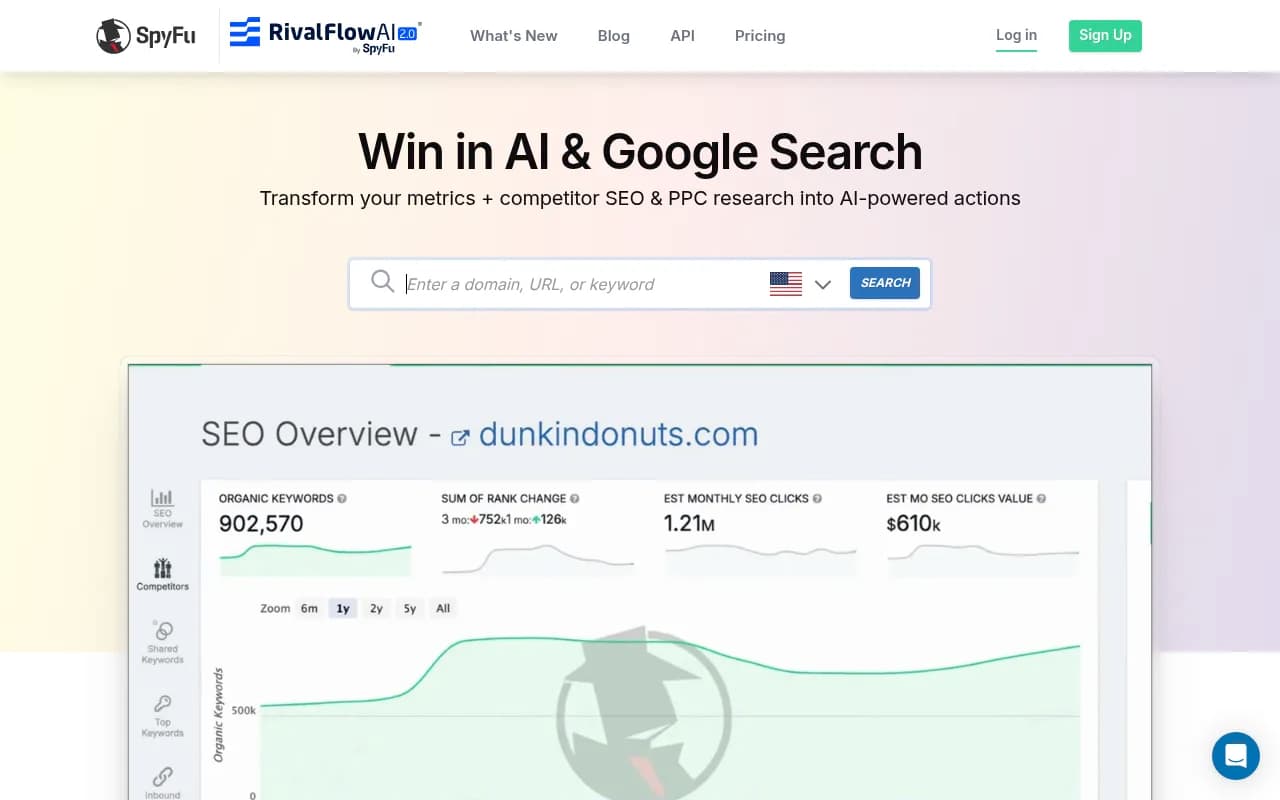
For the paid-search seed list in step 1, SpyFu shows keywords competitors buy on Google, which is a decent proxy for the conquest prompts worth testing.
| Need | Option |
|---|---|
| Competitor advertisers per tracked prompt, plus citations and visibility in one tool | Promptwatch |
| Topic and prompt-level view of competitor ad activity | Peec AI |
| Seed keywords from rivals' paid search | SpyFu |
| Manual check on a small list | Spreadsheet plus repeated runs |
For wider options, the AI rank tracking directory at ai-rank-tools.com lists more trackers.
What to do with what you find
If a rival owns a cluster
Decide whether to contest it. Because advertisers cannot see which conversations triggered their ads, rivals may be paying for mismatched placements. Contesting a cluster where the winner is probably noise is a poor use of budget. Contesting one with a consistent, relevant advertiser is more defensible.
If the prompt has no ads
That is an opening, not just an absence. With 3,033 advertisers scattered and no one above about 2% of ad-carrying answers, early positioning is cheap relative to Google.
If rivals appear on your brand prompts
This is the most defensible place to advertise yourself. Someone asking about you by name and seeing a competitor's offer is the clearest case of lost intent. Check your brand-specific prompts weekly.
Fix the organic side in parallel
Since ads barely influence the answer, work on citations separately: product and landing pages, accurate schema, clean merchant data. Promptwatch's shopping data advises complete Product schema, accurate price and availability, and a clean feed, though that report is dated November 2025, so treat the numbers as dated.
Mistakes to avoid
- Mixing ad rates from different studies without naming each base
- Drawing conclusions from one run on one day
- Treating every rival ad as intentional targeting
- Tracking only keyword-style prompts instead of conversational ones
- Forgetting to separate organic, brand and comparison prompts
- Assuming an ad will earn you a mention in the answer
A simple weekly routine
- Run or review your prompt set across at least three days.
- Log advertiser, copy and landing page per prompt.
- Update advertiser share by topic.
- Flag new advertisers and prompts that gained or lost ads.
- Compare against your own organic citations on the same prompts.
The tutorial from HubSpot Marketing walks through how to buy ChatGPT ads and why the channel resembles early Google Ads; it is a reasonable primer if you plan to bid yourself.
Bottom line
Ads in ChatGPT are common enough to monitor and loose enough that you should not take any single placement at face value. Map conversational prompts, add conquest variants, hold the session steady, repeat over days, and judge advertisers by share across clusters rather than isolated sightings. The auction is fragmented today, and the teams that start logging it now will have months of baseline data when their competitors begin asking the same question.