Key takeaways
- For organic software prompts (Sep 28 to Oct 4, 2026), github.com is the most cited domain in ChatGPT at 1.2% of all software citations, followed by learn.microsoft.com at 0.98% and g2.com at 0.73%.
- Documentation and help centers are the largest source type at 2.64%. Review sites and analysts together earn 1.57%, more than any single vendor, Microsoft included.
- The long tail is huge. The 23 charted domains add up to only 7.89% of citations, so no one owns this category.
- The practical playbook is crawlable docs, an active public GitHub presence, complete G2 and Capterra profiles, and a strong own-site content base.
What the data actually says
The source is Promptwatch Data's report on the most cited sites in ChatGPT for software-related prompts, published October 6, 2026. It covers organic software prompts run through the ChatGPT interface between Sep 28 and Oct 4, 2026, and is drawn from a dataset of 26B+ data points.
One thing to get straight before reading any numbers: every percentage is a share of all software citations, not a share of the 23 domains in the chart. Those 23 domains together earn just 7.89%. So when GitHub sits at 1.2%, that is the top of a very flat distribution, not a near-monopoly.
The top of the chart looks like this:
| Rank | Domain | Share of software citations |
|---|---|---|
| 1 | github.com | 1.2% |
| 2 | learn.microsoft.com | 0.98% |
| 3 | g2.com | 0.73% |
| 4 | docs.aws.amazon.com | 0.41% |
| 5 | docs.cloud.google.com | 0.35% |
| 6 | gartner.com | 0.34% |
| 7 | capterra.com | 0.32% |
| 8 | Intercom | 0.28% |
| 9 | Zapier | 0.24% |
The rest of the chart includes apps.apple.com, help.salesforce.com, help.openai.com, developers.google.com, blog.hubspot.com, zendesk.com, softwareadvice.com, adobe.com, and support.microsoft.com. The report does not give exact figures for those.
Why the mix is interesting
Three very different kinds of source sit at the top: a code host, vendor documentation, and a review marketplace. That tells you ChatGPT is not treating "software" as one question. A prompt like "how do I authenticate with this API" pulls docs. "What are the best CRM tools for a 50-person team" pulls review sites. "Is there an open-source library for X" pulls GitHub.
If you want a quick sanity check on this, run a handful of your own prompts and look at which source types show up per intent. You will see the pattern within ten minutes.
By company, Microsoft is bigger than it looks
Microsoft's single biggest domain is learn.microsoft.com at 0.98%, but across three domains the company reaches 1.35%. That would put it ahead of GitHub in a company-level view. Google is at 0.98% across four domains, AWS at 0.69% across two, and OpenAI at 0.42% across two.
The lesson is not that you need Microsoft's scale. It is that big vendors earn citations from several surfaces at once: docs, support, developer portals, and marketing pages. Each surface answers a different kind of prompt.
By source type, docs win
| Source type | Share of software citations |
|---|---|
| Docs and help centers | 2.64% |
| Vendor sites | 2.01% |
| Review sites and analysts (G2, Gartner, Capterra, Software Advice) | 1.57% |
| GitHub (developer community) | 1.2% |
| App stores | 0.47% |
Vendor sites and docs together reach 4.65%, about three times the share of review sites and analysts. I find that reassuring. Many software marketers assume ChatGPT mostly repeats what G2 says. The data says your own site, specifically the documentation part of it, is the bigger lever. Reviews still matter, since 1.57% beats any single vendor, but they are not the main event.
Does third-party research agree?
Partly. Other studies use different prompt sets, so treat the numbers as directional rather than comparable.
Overthink Group, working with Amadora, ran 1,263 solution-aware prompts for one business week in June 2026 across ChatGPT, Gemini, Perplexity, and Google AI Overviews, focused on niche B2B categories. They reported that G2's network (G2, Capterra, GetApp, Software Advice) accounted for 8% of total citations in their sample, and that 70.8% of all citations were "best of" or "top" listicles.
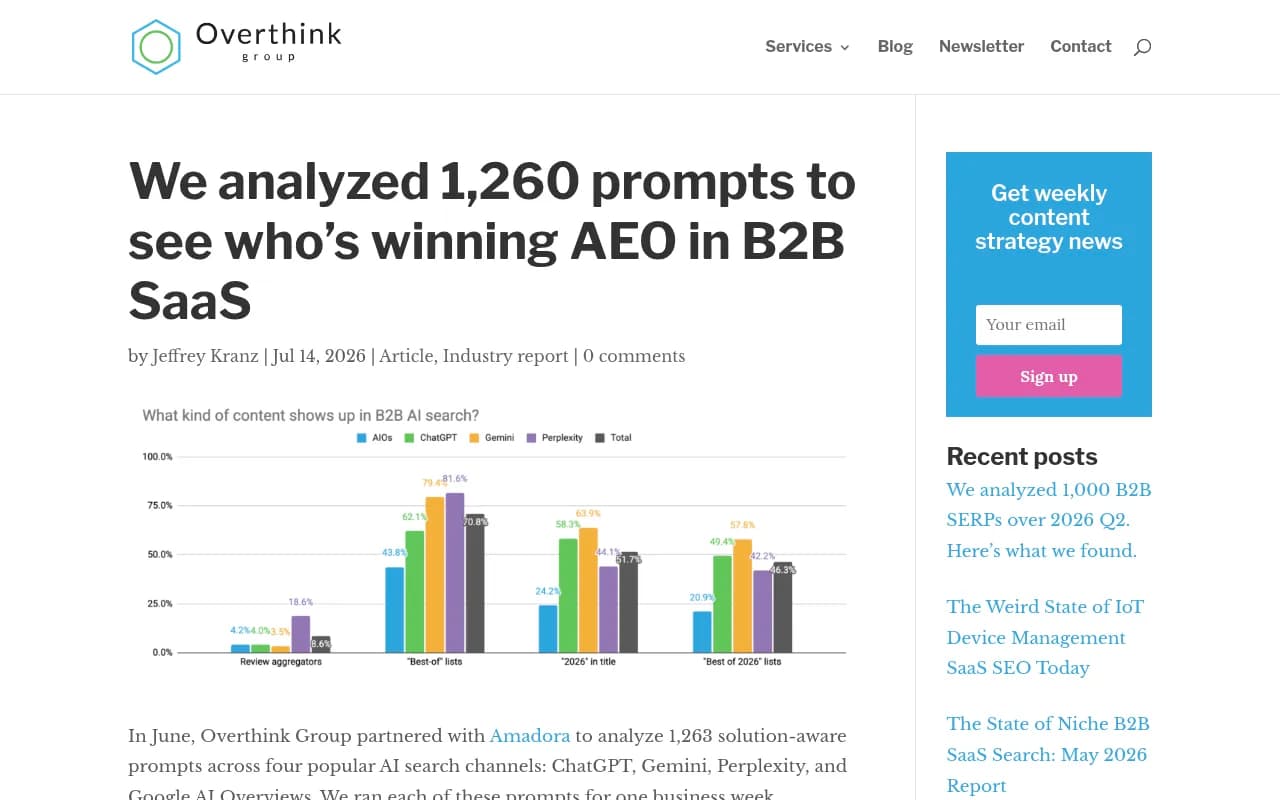
Their sample is niche, shortlist-style prompts, which lean toward evaluation content. That explains why G2 looks so much stronger there than in Promptwatch's broader software prompt set. Same direction, different weight.
G2 itself published research on April 15, 2026 claiming that 51% of B2B software buyers now start their purchasing process in an AI chatbot rather than a traditional search engine. That is G2's own number about its own category, so read it with that in mind. I have not verified it independently, and neither has the Promptwatch report. Even so, if it is directionally right, software prompts are where AI citations are most commercially valuable.
On the content-format side, Promptwatch's data shows product pages are the most cited content type in ChatGPT at 22.4% of citations (Sep 28 to Oct 4, 2026). Software vendors tend to get cited through product and documentation pages, not blog posts alone.
Why GitHub keeps showing up
GitHub is a repository host, not a publisher, and yet it leads. READMEs, release notes, and issue threads are dense, factual, and tied to a specific tool. For prompts like "best library for parsing X" or "how does this SDK handle retries," that is exactly what a model wants to cite.
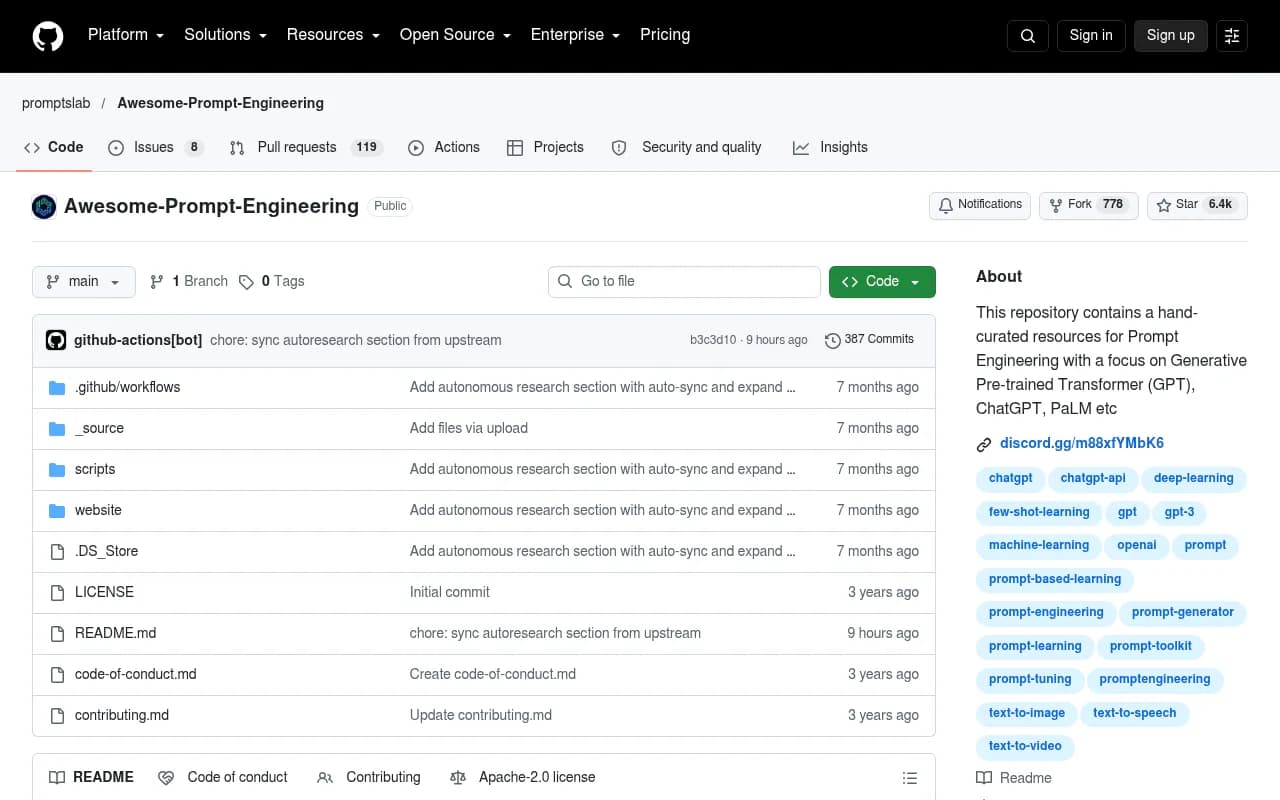
A lot of the AI-tooling ecosystem lives there too. Curated lists such as the Awesome-Prompt-Engineering repository collect prompt testing tools, agent system prompts, and AI coding assistant configs, which shows how much developer knowledge about software sits in repos rather than on marketing sites.
If you sell to developers, a polished repo is not optional. Keep the README current, describe what the tool does in plain language near the top, and publish examples people can copy.
What to do about it
1. Make documentation crawlable and complete
Docs and help centers are the largest source type. That is where to spend first. Check that your docs are not behind a login, are not rendered only by client-side JavaScript, and are not blocked in robots.txt for AI crawlers. Give each page one clear topic, a descriptive title, and the exact terms people use in questions.
It also helps to know which AI crawlers actually hit your pages and whether they hit errors. Promptwatch Data tracks AI crawler traffic weekly, and server logs or a crawler analytics tool will show you your own picture.
2. Keep a public GitHub presence
For developer tools, this is the second pillar. An SDK repo, sample projects, and an issue tracker that gets real answers all create citable pages. Even for non-developer products, a public repo of integrations or templates gives AI a stable, factual place to point to.
3. Treat your own site as the main source, but cover review sites
Promptwatch's own recommendation from the report is to treat your site as your main citation source while still keeping G2 and Capterra profiles complete and current. That matches the numbers: vendor sites plus docs are about three times review sites, but review sites collectively beat any single vendor.
Practically, that means:
- Fill in every field on your G2, Capterra, and Software Advice profiles.
- Keep pricing, integrations, and feature descriptions consistent with your site.
- Keep collecting recent reviews so the content does not look stale.
- Check what the review pages say about you against what you want AI to say.
4. Plan for the long tail
Since the top 23 domains hold under 8% of citations, most of the action is elsewhere: niche blogs, forums, comparison pages, partner sites. Do not chase only the biggest names. Look at which less obvious domains are cited for your category prompts and find ways to appear there, whether through partnerships, guest content, or integration listings.
Also worth knowing: almost half of ChatGPT responses cite 10 or more unique domains, per Promptwatch's unique domains report. A single answer pulls from many places, so being one of many sources is a realistic goal.
5. Refresh what ages fast
Not all content lasts equally. Promptwatch's content half-life data shows landing pages and docs stay cited longest, while news loses half its pages within 36 days. Evergreen docs and product pages deserve maintenance. Announcement posts will fade whatever you do.
Tools for tracking and acting on this
You cannot manage this by guessing. At a minimum you want to track your own prompts, see which sources get cited, and watch whether docs, GitHub, and review sites appear for your brand.
Promptwatch is the tool I would start with for software brands, since it tracks the real ChatGPT interface and shows which of your pages are cited, which AI crawlers visit, and where content gaps are, then helps produce the content to fix them.

If you are comparing options, other trackers in our catalog include Profound and Otterly.AI.


For a broader view of the category, the GEO software directory at bestgeosoftware.com lists many more.
Here is how the options compare for this use case:
| Need | What to look for | Example |
|---|---|---|
| See which domains ChatGPT cites for your prompts | Real-interface tracking, citation source reports | Promptwatch |
| Check whether AI crawlers read your docs | IP-verified crawler logs | Promptwatch |
| Basic mention monitoring on a budget | Prompt tracking only | Otterly.AI |
| Enterprise brand tracking | Multi-engine monitoring | Profound |
What not to read into this
A few cautions, since it is easy to overreach with one week of data.
First, this is a single week, Sep 28 to Oct 4, 2026. Citation patterns shift. Promptwatch Data has documented sudden changes, such as reddit.com's share of ChatGPT citations falling from about 4% to 0.5% on August 14, 2026. The software chart could move too.
Second, these are organic prompts in ChatGPT. Perplexity, Gemini, and Google AI Overviews behave differently. Social platforms made up 12.2% of AI Overviews citations versus 0.46% in ChatGPT in the same week, which is a reminder to check each engine separately.
Third, I would not take the G2 buyer research figure as settled. It comes from G2 and I have not been able to verify it. The direction is plausible, the exact number is not something to put in a board deck.
A short checklist
- Run 20 to 30 prompts your buyers would use, split by intent: how-to, comparison, and category.
- Record which domains get cited and mark them as docs, vendor, review, GitHub, or other.
- Fix your docs first, then your repo, then your review profiles.
- Re-run monthly and watch for sudden shifts.
For more on the wider data behind AI citations, the Promptwatch Data hub has the full report list.
Bottom line
GitHub, Microsoft Learn, and G2 lead ChatGPT's software citations, but the real finding is that the whole top 23 earns less than 8% of the total. Documentation is the biggest source type, review sites collectively outweigh any single vendor, and your own site plus docs is about three times review sites. Fix your docs, keep your repo alive, and keep your G2 and Capterra profiles current.