Key takeaways
- ChatGPT had over 900 million weekly active users in early 2026, and 77% of American users treat it as a search engine -- making AI visibility a real business priority, not a nice-to-have.
- Most "rank tracking" tools for ChatGPT are monitoring-only: they show you where you're invisible but don't help you fix it.
- The tools in this guide range from simple brand mention checkers to full optimization platforms with content generation, citation analysis, and AI crawler logs.
- The right tool depends on your budget and what you actually need: pure visibility data, competitive benchmarking, or a full optimization workflow.
- If you want to go beyond tracking and actually improve your AI visibility, look for tools with content gap analysis and content generation built in -- not just dashboards.
Something changed in how people search, and it happened faster than most marketing teams expected. When someone asks ChatGPT "what's the best project management software for remote teams," they're not getting a list of blue links to click through. They're getting a direct answer -- and if your brand isn't in that answer, you don't exist for that person in that moment.
ChatGPT had 900 million weekly active users in February 2026. Around 77% of Americans who use it treat it like a search engine. That's a massive audience making product decisions, and traditional SEO rank tracking tells you nothing about whether you're visible to them.
That's the problem this category of tools exists to solve. But not all of them solve it equally well. Some just show you a dashboard. Others actually help you do something about what you find.
Here's a breakdown of the 8 best options in 2026, what they're actually good at, and where they fall short.
What makes a good ChatGPT visibility tool?
Before getting into specific tools, it's worth being clear about what separates a useful tool from a mediocre one.
The basic function -- querying AI models and checking if your brand appears -- is table stakes. Any tool can do that. The more important questions are:
- Does it track across multiple AI models (ChatGPT, Perplexity, Claude, Gemini, etc.) or just one?
- Does it show you why competitors are appearing and you're not?
- Does it give you prompt-level data, not just aggregate scores?
- Does it help you actually fix the gaps, or just document them?
The tools below are ranked roughly by capability, from full-stack optimization platforms down to simpler trackers. Depending on your situation, simpler might be exactly what you need.
The 8 best ChatGPT visibility tools in 2026
1. Promptwatch -- best for full optimization, not just tracking
Promptwatch is the most complete option on this list. Most tools show you a visibility score and leave you to figure out what to do with it. Promptwatch is built around a specific loop: find the gaps, create content to fill them, track the results.
The Answer Gap Analysis is the standout feature -- it shows you exactly which prompts your competitors are appearing for that you're not, and what content your site is missing that would make AI models want to cite you. From there, the built-in AI writing agent generates articles and comparisons grounded in real citation data (880M+ citations analyzed), not generic SEO advice.
On the tracking side, it monitors 10 AI models including ChatGPT, Perplexity, Claude, Gemini, Grok, DeepSeek, and Google AI Overviews. The AI crawler logs are genuinely useful -- you can see which pages ChatGPT and Perplexity are actually crawling, how often, and whether they're hitting errors. Most competitors don't have this at all.
It's used by 6,700+ brands and agencies including Booking.com and Center Parcs, and its data has been cited by the Wall Street Journal. Pricing starts at $99/month for the Essential plan (1 site, 50 prompts, 5 articles) up to $579/month for Business (5 sites, 350 prompts, 30 articles).

2. Profound -- best for enterprise teams with dedicated analysts
Profound is a strong enterprise option with solid AI search analytics. It tracks visibility scores, conversation volume, and trends across major AI platforms, and it's built for teams that have someone dedicated to interpreting the data.
The tradeoff is price and complexity. Profound starts at $499+/month and the more advanced features are locked to higher tiers. It's a good fit for large brands that need deep reporting and have the budget for it. For smaller teams, the cost-to-value ratio is harder to justify, especially since it's primarily a monitoring platform rather than an optimization one.

3. Otterly.AI -- best for agencies on a budget
Otterly.AI is one of the more affordable options in this space, starting at $29/month. It tracks brand visibility across multiple AI engines, provides a Brand Visibility Index, sentiment analysis, and a basic GEO audit. For agencies managing multiple brands who need a lightweight monitoring layer, it does the job.
The limitations are real though: lower tiers have prompt limits, and it's reporting-focused without content optimization capabilities. Think of it as a solid monitoring dashboard, not a strategy tool.

4. Peec AI -- best for clean reporting across languages
Peec AI sits at $89/month and is popular with agencies and small teams who need clean, readable reports. It supports multi-language tracking, which matters if you're operating in non-English markets where most tools fall short.
It's firmly in the monitoring camp -- the reporting is good, but there's no content generation or gap analysis. If your main need is "show me a visibility report I can send to a client," Peec AI handles that well.

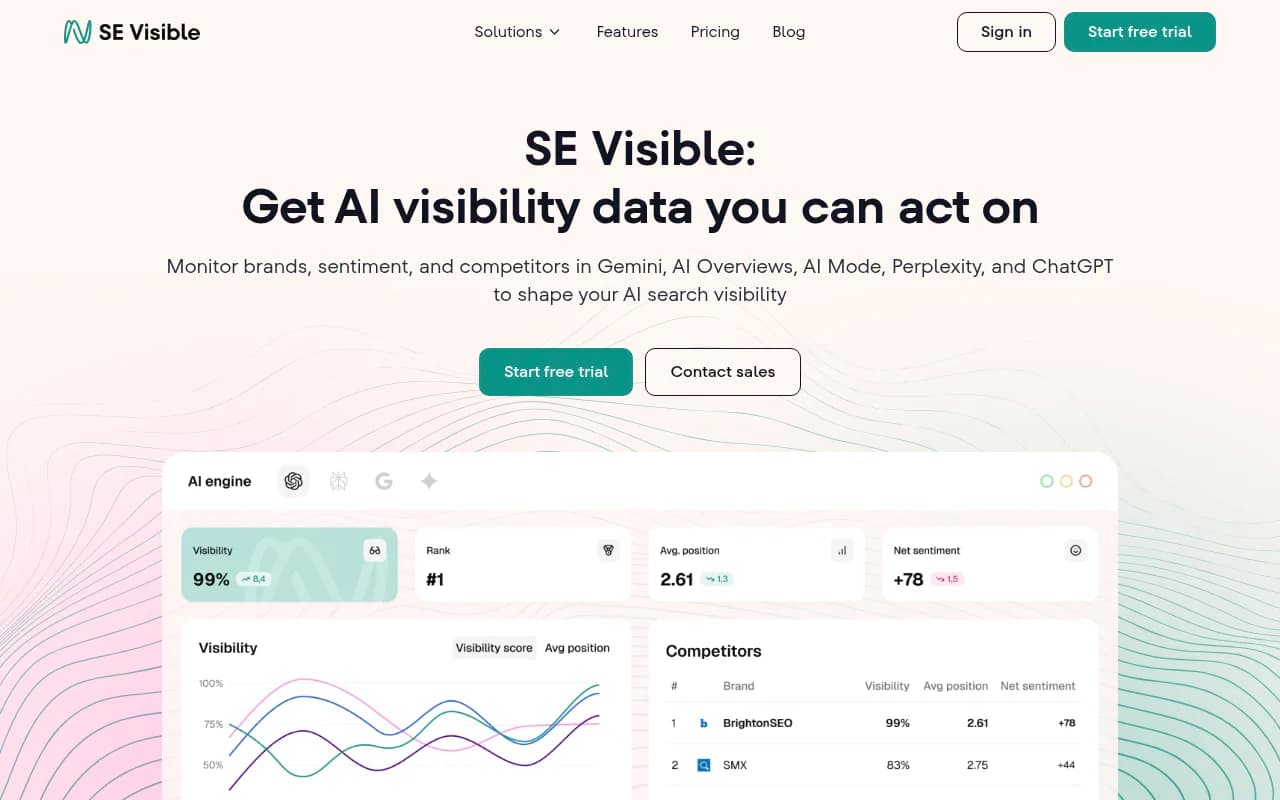
5. SE Visible (by SE Ranking) -- best for CMOs who want strategic context
SE Visible is SE Ranking's AI visibility product, and it's built with a slightly different audience in mind: marketing leaders and brand specialists who want strategic context, not just raw data. It includes a Visibility Score, Net Sentiment Score, sentiment trends, top sources, and competitor benchmarks.
At $189/month it's mid-tier on price. The main limitation is that data export is CSV-only, which can be frustrating if you're trying to build custom dashboards. But for someone who wants to understand their brand's narrative in AI search without getting lost in technical details, it's a clean option.
6. Nightwatch -- best for teams that want SEO and AI tracking together
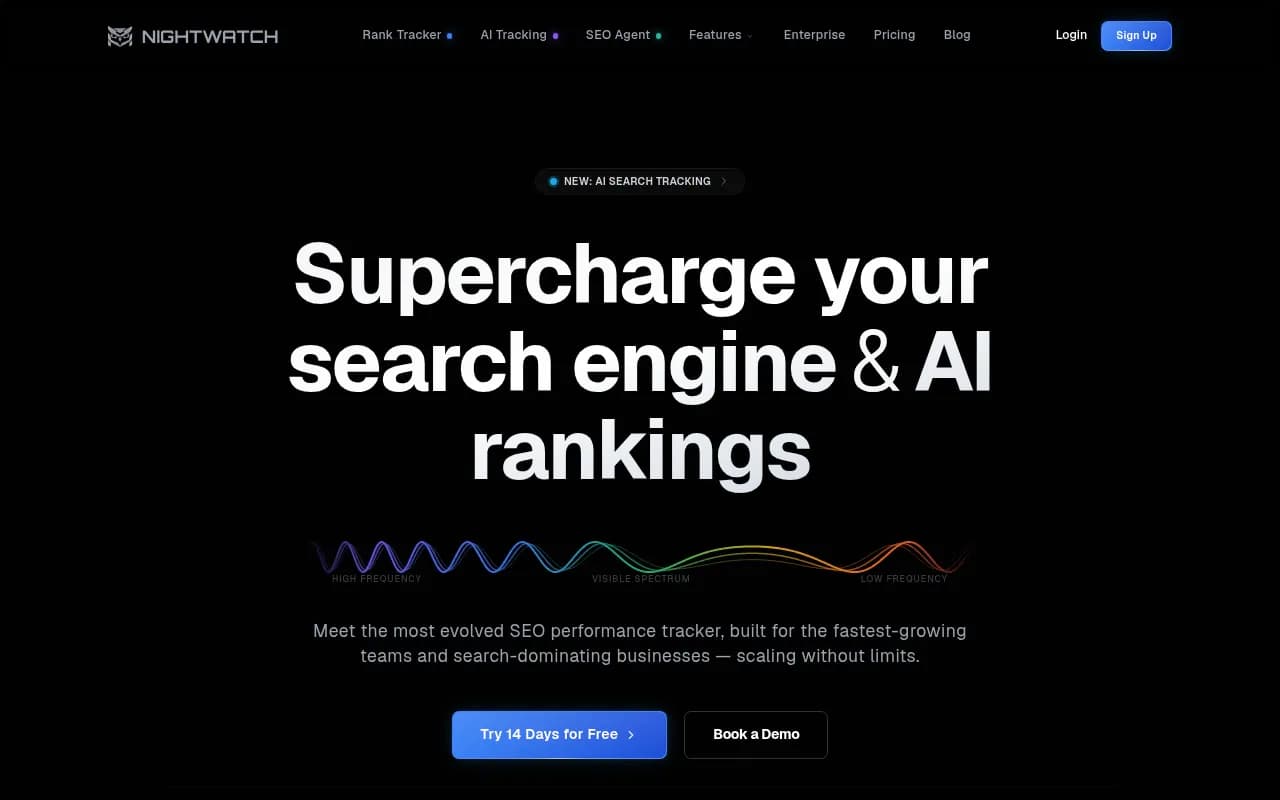
Nightwatch is primarily an SEO rank tracker that added AI visibility as an add-on. The base plan starts at $39/month, with the AI tracking module adding another $99/month. If you're already using Nightwatch for traditional rank tracking, adding AI visibility is a natural extension.
The AI tracking covers generative rankings, an AI visibility score, and citation data. It's not as deep as dedicated AI visibility tools, but for teams that want one platform for both SEO and AI monitoring, it's a practical choice.
7. ZipTie -- best for detailed analysis and clear action items
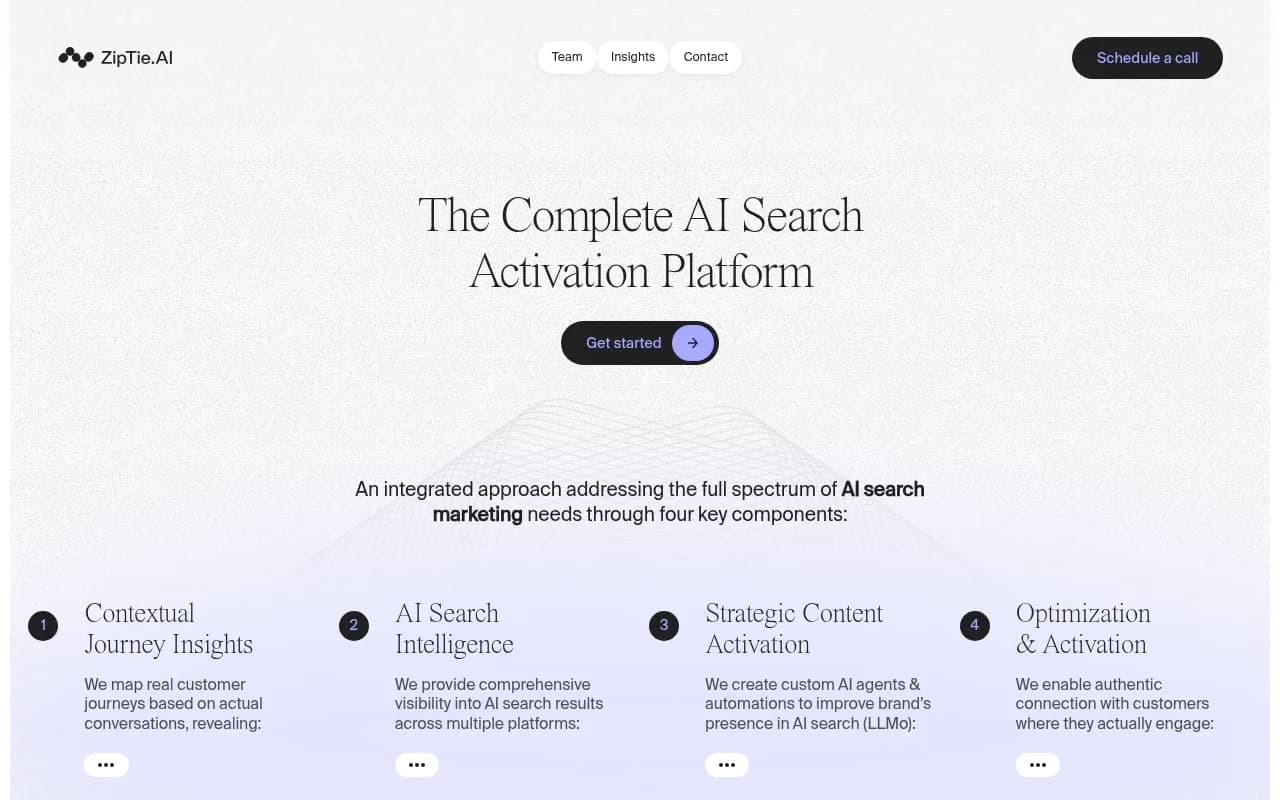
ZipTie is positioned as an "actionable AI optimization" tool rather than a pure tracker. It provides an AI success score, citation optimization recommendations, and competitor analysis. Starting at $69/month, it's reasonably priced for what it offers.
The billing model is credit-based, which some teams find unpredictable, and there can be delays on report generation. But if you want more than a dashboard -- something that tells you specifically what to fix -- ZipTie is worth looking at.
8. AIClicks -- best for beginners who want simple ChatGPT tracking
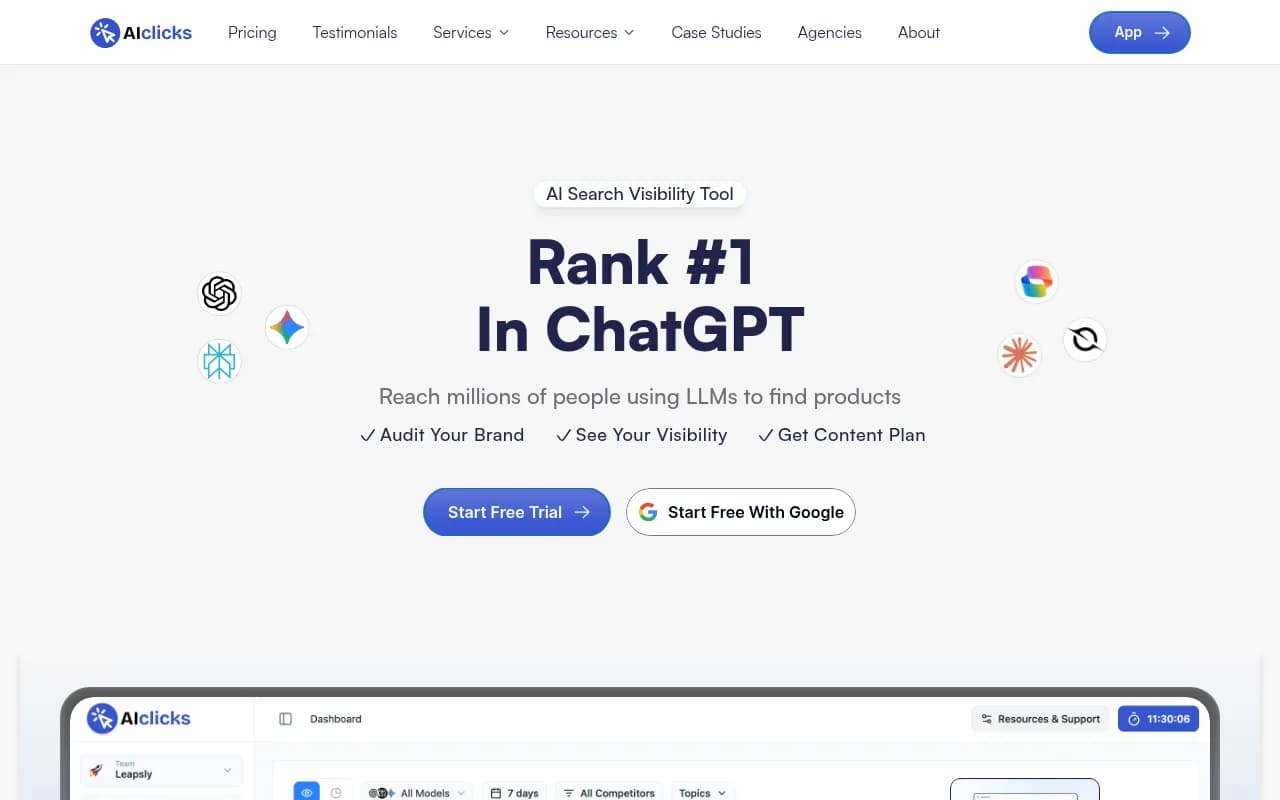
AIClicks is the most straightforward option on this list. It's designed for marketers and beginners who want to see how their brand appears in ChatGPT without a steep learning curve. Starting at $49/month, it covers basic ChatGPT rank tracking and reporting.
It won't give you deep competitive analysis or content recommendations, but it's a reasonable starting point if you're new to AI visibility and want to understand the basics before investing in a more complex platform.
Side-by-side comparison
| Tool | Core focus | AI models tracked | Content optimization | Starting price | Best for |
|---|---|---|---|---|---|
| Promptwatch | Full optimization loop | 10 (ChatGPT, Claude, Perplexity, Gemini, Grok, DeepSeek, Copilot, Mistral, Meta AI, Google AIO) | Yes (built-in AI writer + gap analysis) | $99/mo | Teams that want to improve visibility, not just measure it |
| Profound | Enterprise analytics | Multiple | No | $499+/mo | Large brands with dedicated analysts |
| Otterly.AI | Brand monitoring | Multiple | No | $29/mo | Agencies needing affordable multi-brand monitoring |
| Peec AI | Clean reporting | Multiple | No | $89/mo | Multi-language reporting for agencies |
| SE Visible | Strategic brand tracking | Multiple | No | $189/mo | CMOs and marketing leaders |
| Nightwatch | SEO + AI hybrid | Multiple (add-on) | No | $39/mo + $99 AI add-on | Teams already using Nightwatch for SEO |
| ZipTie | Actionable analysis | Multiple | Recommendations only | $69/mo | Teams wanting clear optimization guidance |
| AIClicks | Simple ChatGPT tracking | ChatGPT-focused | No | $49/mo | Beginners and small teams |
The monitoring-only problem
One thing worth being direct about: most tools on this list (and in this category generally) are monitoring dashboards. They show you a score, maybe a competitor comparison, and leave you to figure out the rest.
That's useful information, but it's not a strategy. Knowing you're invisible for "best project management software for remote teams" doesn't tell you what to write, how to structure it, or why AI models are citing your competitors instead of you.
The tools that go further -- showing you the specific content gaps and helping you fill them -- are the ones that actually move the needle. Right now, that's a short list. Promptwatch is the clearest example of a platform built around the full loop rather than just the measurement step.
How to choose the right tool for your situation
A few practical filters:
If you're just starting out and want to understand AI visibility basics: AIClicks or Otterly.AI. Low cost, low complexity, enough to get oriented.
If you're an agency managing multiple clients: Otterly.AI or Peec AI for monitoring. Promptwatch if you want to offer optimization as a service, not just reporting.
If you're a mid-size brand with a marketing team: ZipTie or SE Visible for analysis and strategic context. Promptwatch if you want to act on the data, not just read it.
If you're enterprise with a dedicated SEO/GEO team: Profound or Promptwatch, depending on whether you prioritize deep analytics or the ability to generate and test content directly.
If you're already using traditional SEO tools: Nightwatch is worth considering as an add-on if you want AI tracking without switching platforms.
What to actually track
Regardless of which tool you use, here are the metrics that matter:
- Brand mention rate: How often does your brand appear when someone asks a relevant question? This is the baseline.
- Citation share vs. competitors: Not just "are you mentioned" but "are you mentioned more or less than competitors for the same prompts?"
- Prompt-level visibility: Aggregate scores hide important variation. You might be highly visible for awareness-stage queries but invisible for purchase-intent ones. Prompt-level data shows this.
- Which pages are being cited: If AI models are citing your homepage but not your product pages, that's a signal about where to focus content work.
- AI crawler activity: Are AI crawlers actually visiting your site? Are they hitting errors? This affects whether your content gets indexed and cited at all.
Most tools cover the first two. Fewer cover the last three. That gap is where a lot of AI visibility work gets stuck.
The bottom line
The tools in this space have matured quickly. A year ago, most were barely functional. Now there are real differences in capability, and those differences matter depending on what you're trying to accomplish.
If you just want to know whether ChatGPT mentions your brand, almost any tool on this list will tell you that. If you want to understand why you're not being cited and what to do about it, you need something with actual optimization capabilities -- not just a better dashboard.
The category is still young enough that the gap between "monitoring" and "optimization" is wide. That gap is where the real opportunity is in 2026.