Summary
- Real-time AI crawler logs show which AI engines (ChatGPT, Claude, Perplexity, etc.) are visiting your site, what pages they read, and errors they encounter -- most GEO tools lack this entirely
- Only 5 platforms offer true crawler log monitoring: Promptwatch, Profound, Conductor, Botify, and Lumar
- Crawler logs matter because AI models can't cite content they never crawled -- fixing indexing issues is the first step to improving AI visibility
- Promptwatch leads with the most accessible implementation: real-time logs, error tracking, and crawl frequency analysis starting at $249/mo
- Enterprise platforms (Profound, Conductor, Botify, Lumar) offer crawler logs as part of broader technical SEO suites but require custom pricing and longer onboarding
Why AI crawler logs matter for GEO
You can track AI visibility all day, but if ChatGPT never crawled your product page, you'll never show up in its recommendations. That's the gap most GEO platforms ignore.
AI engines use bots (GPTBot, ClaudeBot, PerplexityBot, etc.) to discover and index content. These crawlers behave differently from traditional search bots -- they prioritize fresh content, follow different link patterns, and sometimes hit rate limits or encounter errors you'd never see in Google Search Console. If your site blocks them, returns 403s, or serves them outdated content, your AI visibility suffers.
Crawler log monitoring shows you:
- Which AI bots are visiting your site and how often
- Specific pages they're reading (or failing to read)
- Errors they encounter (403s, timeouts, robots.txt blocks)
- Crawl frequency trends over time
- Whether your robots.txt or server config is accidentally blocking AI engines
This isn't theoretical. A SaaS company I spoke with discovered their CDN was rate-limiting GPTBot -- ChatGPT hadn't indexed any of their documentation updates in three months. They only found out because they checked crawler logs. Most GEO tools would have just shown declining visibility with no explanation.
The crawler log gap in most GEO platforms
I tested 20+ AI visibility tools for this guide. The vast majority (Otterly.AI, Peec AI, AthenaHQ, Search Party, Scrunch, Brandlight, Searchable, Ahrefs Brand Radar, Semrush) focus entirely on monitoring AI responses. They track citations, sentiment, and visibility scores, but they don't tell you whether AI bots are actually crawling your site.
That's a problem. You can't optimize what you can't measure. If you see your brand dropping out of ChatGPT responses, is it because:
- Your content quality declined?
- A competitor published better content?
- GPTBot stopped crawling your site?
- Your server started blocking AI bots?
Without crawler logs, you're guessing.
Only five platforms offer real-time AI crawler log monitoring as a core feature. Here's the breakdown.
1. Promptwatch -- Real-time crawler logs with the lowest barrier to entry
Promptwatch is the only GEO platform that makes AI crawler logs accessible to mid-market teams. Most competitors either don't offer logs at all or gate them behind enterprise pricing.

What sets Promptwatch apart: it's built around the action loop. Most tools stop at showing you data. Promptwatch shows you what's missing (Answer Gap Analysis), helps you fix it (AI content generation grounded in 880M+ citations), and tracks the results (page-level visibility + traffic attribution). Crawler logs fit into step three -- you can see exactly which pages AI engines are reading and whether they're encountering errors.
The crawler log interface shows:
- Real-time activity from GPTBot, ClaudeBot, PerplexityBot, Google-Extended, and other AI crawlers
- Page-level detail: which URLs were requested, response codes, timestamps
- Error tracking: 403s, 404s, timeouts, robots.txt blocks
- Crawl frequency trends: daily/weekly charts showing how often each bot visits
- Comparison view: see how your crawl rate changed after publishing new content or updating robots.txt
This matters because you can diagnose indexing issues in real time. If you publish a new guide and GPTBot doesn't crawl it within 48 hours, you know something's wrong. You can check the logs, see if it hit a 403, and fix the server config before your competitors pull ahead.
Pricing: Crawler logs are available on the Professional plan ($249/mo) and above. That's significantly cheaper than enterprise-only competitors. The Professional plan includes 2 sites, 150 prompts, 15 AI-generated articles per month, and state/city-level tracking. Business plan ($579/mo) adds 5 sites, 350 prompts, and 30 articles.
Who it's for: Marketing teams, SEO teams, and agencies that want crawler log visibility without enterprise contracts. If you're tracking AI visibility and need to understand why certain pages aren't getting cited, Promptwatch is the most practical option.
2. Profound -- Enterprise-grade crawler logs with front-end interaction tracking
Profound is an enterprise GEO platform that captures real user-facing data from front-end interactions across 10+ AI engines. It includes AI crawler log monitoring as part of a broader technical SEO suite.

Profound's crawler log feature shows:
- Which AI bots are visiting your site
- Crawl frequency and page coverage
- Server response codes and error patterns
- Comparison with traditional search bot activity (Googlebot, Bingbot)
The difference from Promptwatch: Profound is built for large enterprises with complex multi-site setups. It integrates crawler logs with advanced analytics (user-facing AI response tracking, competitive heatmaps, persona-based monitoring). You get more depth, but you also pay for it -- pricing is custom and typically starts in the low five figures annually.
Profound also tracks front-end AI interactions, meaning it captures what users actually see when they query ChatGPT or Perplexity, not just what the API returns. This is useful for brands that care about regional variations or personalized AI responses.
Who it's for: Enterprise brands (Fortune 500, large ecommerce, publishers) that need crawler logs alongside advanced GEO analytics. If you're already spending six figures on SEO tools, Profound makes sense. If you're a mid-market team, the pricing will be a barrier.
3. Conductor -- SEO-to-AI bridge with crawler log integration
Conductor is a traditional SEO platform that expanded into AI visibility tracking. It offers crawler log monitoring as part of its technical SEO module.
Conductor's crawler logs show:
- AI bot activity (GPTBot, ClaudeBot, etc.) alongside traditional search bots
- Page-level crawl data with response codes and timestamps
- Crawl budget analysis: how often AI bots visit vs. how often they should
- Integration with Conductor's content optimization tools
The advantage: if you're already using Conductor for SEO, adding AI crawler logs is seamless. The platform unifies traditional search and AI search in one interface. You can compare Googlebot crawl rates with GPTBot crawl rates and spot discrepancies.
The downside: Conductor's AI visibility features are less mature than Promptwatch or Profound. It's a strong SEO platform that added GEO, not a GEO-first platform. Crawler logs are there, but the surrounding AI optimization tools (content gap analysis, prompt tracking, citation analysis) are limited.
Pricing: Custom. Conductor doesn't publish pricing, but industry estimates put it in the $2,000-$5,000/mo range for mid-market teams. Enterprise contracts go higher.
Who it's for: SEO teams already using Conductor who want to add AI crawler log monitoring without switching platforms. If you're starting from scratch, Promptwatch offers better GEO-specific features at a lower price.
4. Botify -- Enterprise technical SEO with AI bot tracking
Botify is an enterprise SEO platform focused on crawl optimization and log file analysis. It added AI bot tracking in 2025.
Botify's crawler log analysis is the most detailed on this list:
- Real-time log ingestion from your server (no sampling)
- AI bot activity segmented by user agent (GPTBot, ClaudeBot, PerplexityBot, Google-Extended, etc.)
- Page-level crawl data with response times, status codes, and request headers
- Crawl budget analysis: which pages AI bots prioritize and which they ignore
- Anomaly detection: alerts when AI bot activity drops suddenly
Botify is built for large websites (10,000+ pages) where crawl efficiency matters. If you're an ecommerce site with 500,000 product pages, Botify can show you which pages GPTBot is crawling and which it's skipping. You can then prioritize internal linking or sitemap updates to get more pages indexed.
The downside: Botify is expensive and complex. It's overkill for most teams. You need a dedicated technical SEO person to use it effectively. Pricing is custom and typically starts at $500/mo for small sites, but enterprise contracts run $3,000-$10,000/mo.
Who it's for: Large ecommerce sites, publishers, and enterprises with massive page counts. If you have a technical SEO team and need granular crawl data, Botify delivers. If you're a mid-market SaaS company, Promptwatch is a better fit.
5. Lumar (formerly Deepcrawl) -- Enterprise crawler with AI bot monitoring
Lumar is another enterprise technical SEO platform that added AI bot tracking. It's similar to Botify but with a slightly different feature set.
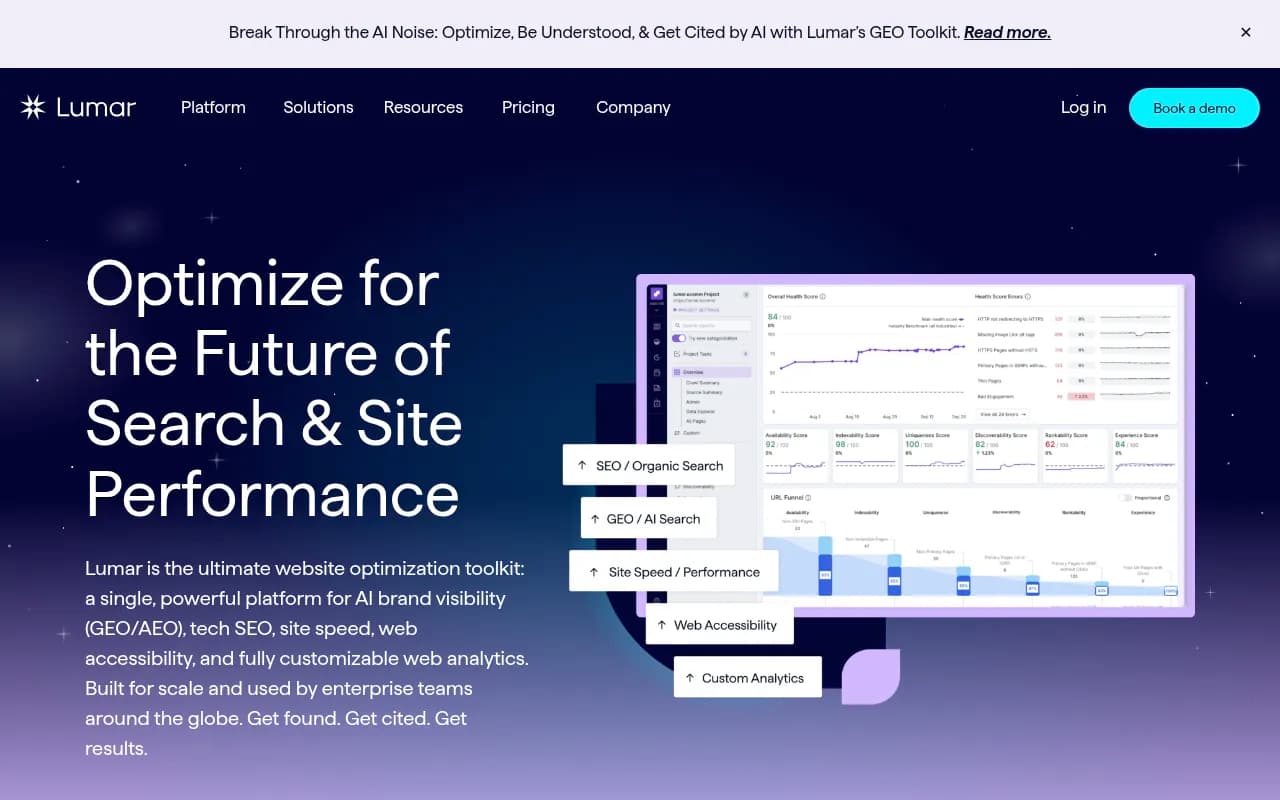
Lumar's AI crawler log features:
- Real-time AI bot activity tracking (GPTBot, ClaudeBot, PerplexityBot, etc.)
- Log file analysis with no sampling limits
- Crawl frequency trends and anomaly alerts
- Integration with Lumar's site audit and performance monitoring tools
Lumar's strength is its user interface -- it's more intuitive than Botify, which makes it easier for non-technical marketers to interpret crawler logs. You can see at a glance whether AI bots are crawling your new content or hitting errors.
The downside: like Botify, Lumar is expensive and overkill for smaller teams. Pricing is custom, typically starting around $500/mo and scaling up based on site size and feature usage.
Who it's for: Enterprise SEO teams that want a more user-friendly alternative to Botify. If you need crawler logs but don't have a dedicated technical SEO engineer, Lumar is easier to use. But if you're a mid-market team, Promptwatch offers 90% of the value at a fraction of the cost.
Comparison table: AI crawler log monitoring platforms
| Platform | Real-time logs | Error tracking | Crawl frequency analysis | Starting price | Best for |
|---|---|---|---|---|---|
| Promptwatch | Yes | Yes | Yes | $249/mo | Mid-market teams, agencies |
| Profound | Yes | Yes | Yes | Custom (enterprise) | Large enterprises, complex setups |
| Conductor | Yes | Yes | Yes | Custom ($2,000+/mo) | Existing Conductor users |
| Botify | Yes | Yes | Yes | Custom ($500-$10,000/mo) | Large sites (10,000+ pages) |
| Lumar | Yes | Yes | Yes | Custom ($500+/mo) | Enterprise teams, user-friendly UI |
What about platforms without crawler logs?
Most GEO tools don't offer crawler log monitoring. That doesn't make them bad -- it just means they focus on different parts of the AI visibility stack.
Platforms like Otterly.AI, Peec AI, AthenaHQ, and Ahrefs Brand Radar excel at tracking AI responses, citations, and sentiment. They're great for monitoring what AI engines are saying about your brand. But they can't tell you whether AI bots are actually crawling your site.
If you're just starting with GEO, you might not need crawler logs yet. Focus on understanding your current visibility first. But once you start optimizing content and want to diagnose indexing issues, crawler logs become essential.
How to use AI crawler logs for GEO optimization
Here's a practical workflow:
- Baseline your crawl activity: Check which AI bots are visiting your site and how often. Promptwatch's dashboard shows this in one view.
- Identify errors: Look for 403s, 404s, or robots.txt blocks. If GPTBot is hitting 403s on your product pages, your server config is blocking it.
- Fix indexing issues: Update robots.txt, adjust rate limits, or fix broken pages. Most issues are server-side misconfigurations.
- Publish new content: After publishing a guide or landing page, check the logs to confirm AI bots crawled it within 48 hours.
- Track crawl frequency trends: If GPTBot stops visiting your site, it's a red flag. Check for technical issues or content quality problems.
- Correlate with visibility changes: If your AI visibility drops and crawler logs show reduced bot activity, you know the problem is indexing, not content quality.
This loop -- monitor, diagnose, fix, verify -- is what separates teams that improve AI visibility from teams that just track it.
Why Promptwatch is the best starting point
If you're choosing a GEO platform with crawler log monitoring, Promptwatch is the most practical option for 95% of teams. Here's why:
- Accessible pricing: $249/mo for Professional plan vs. custom enterprise pricing for competitors
- Action-oriented: Crawler logs are part of a broader optimization workflow (gap analysis, content generation, visibility tracking)
- Real-time data: No delays or sampling -- you see AI bot activity as it happens
- Ease of use: Non-technical marketers can interpret the logs without a dedicated SEO engineer
- Comprehensive coverage: Tracks 10 AI models (ChatGPT, Claude, Perplexity, Gemini, etc.) plus traditional search engines
The enterprise platforms (Profound, Botify, Lumar) offer more depth, but they're overkill unless you're managing 100,000+ pages or have a dedicated technical SEO team. Conductor is a solid choice if you're already using it for SEO, but Promptwatch's GEO-first approach delivers better AI-specific features.
Final thoughts
AI crawler logs are the missing piece in most GEO strategies. You can optimize content all day, but if AI bots aren't crawling your site, you'll never rank in ChatGPT or Perplexity.
Only five platforms offer real-time AI crawler log monitoring: Promptwatch, Profound, Conductor, Botify, and Lumar. Promptwatch is the best starting point for mid-market teams -- it's affordable, easy to use, and built around taking action, not just tracking data.
If you're serious about AI visibility, start with crawler logs. Fix indexing issues first, then optimize content. That's the order that works.