Key takeaways
- AirOps is a capable LLM workflow platform, but it wasn't built to prove content ROI -- it lacks native rank tracking, AI citation monitoring, and attribution.
- Content teams in 2026 need tools that close the loop: generate content, track how it ranks in Google AND AI search engines, and tie results back to revenue.
- The best alternatives depend on your biggest gap: content quality, AI visibility, SEO depth, or workflow automation.
- Tools like Surfer SEO, Jasper, Clearscope, Frase, and Writesonic each solve a different piece of the puzzle -- none of them does everything.
- If AI search visibility is your priority (and it should be), pairing any content tool with a dedicated GEO tracker like Promptwatch is the most direct path to proving results.
AirOps built a real following by making it easier to orchestrate LLM workflows at scale. Prompt management, content pipelines, bulk generation -- it handles that well. But "content teams that need to prove results" is a different brief than "teams that need to produce content faster."
Proving results means tracking what happens after you hit publish. It means knowing whether your article ranks on page one, whether ChatGPT cites it when someone asks a relevant question, and whether any of that traffic converts. AirOps doesn't do much of that. It's a production tool, not a measurement tool.
That gap is why so many content and SEO teams are looking elsewhere in 2026. Below are five alternatives worth considering -- each one evaluated on content quality, SEO and GEO capabilities, and how well it helps you actually demonstrate impact.
What to look for in an AirOps alternative
Before jumping to the list, it's worth being clear about what "proving results" actually requires in 2026:
- Traditional SEO tracking: keyword rankings, organic traffic, SERP position changes
- AI search visibility: are you being cited by ChatGPT, Perplexity, Claude, Gemini when users ask relevant questions?
- Content quality signals: topical coverage, semantic depth, E-E-A-T alignment
- Attribution: can you connect content performance to leads, signups, or revenue?
Most content tools cover one or two of these. The best setups combine a strong content creation tool with a dedicated visibility tracker. Keep that in mind as you read through the options below.
| Tool | Content generation | Traditional SEO | AI visibility tracking | Attribution | Best for |
|---|---|---|---|---|---|
| Surfer SEO | Yes (with editor) | Strong | Limited | No | SEO-focused content teams |
| Jasper | Yes (strong) | Basic | No | No | High-volume marketing copy |
| Clearscope | Brief-focused | Strong | No | No | Content quality and optimization |
| Frase | Yes | Good | Limited | No | Research-heavy content workflows |
| Writesonic | Yes | Basic | Some | No | Speed and scale |
| Promptwatch | No (tracks only) | No | Best-in-class | Yes (traffic attribution) | AI visibility + GEO optimization |
1. Surfer SEO -- best for teams that live and die by Google rankings
Surfer has been the go-to content optimization tool for SEO teams for years, and it's held up well. The core product is a content editor that scores your article in real time against the top-ranking pages for your target keyword. You get NLP-based term suggestions, word count targets, heading structure guidance, and a content score that actually correlates with ranking performance.
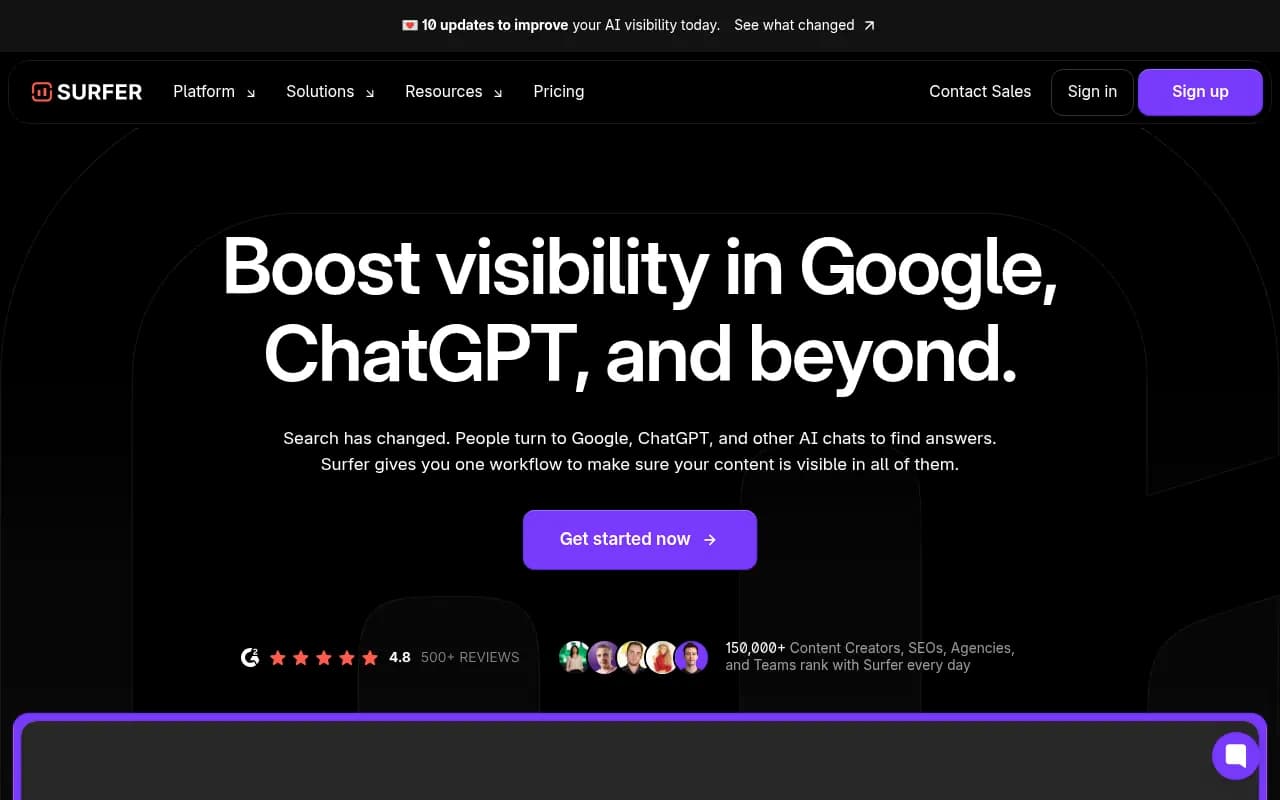
What makes Surfer worth considering as an AirOps alternative is the combination of content creation and ranking data in one place. The Topical Map feature helps you plan clusters of content around a topic, not just individual articles. And the AI writer (Surfy) can generate first drafts that are already optimized for the target keyword -- so you're not writing blind and then editing for SEO afterward.
The honest limitation: Surfer is built for Google. It doesn't track AI citations, it doesn't tell you whether Perplexity is recommending your content, and it has no attribution layer. If your stakeholders are asking "what did this content do for revenue?", Surfer won't answer that question directly.
That said, for teams whose primary KPI is organic search traffic, Surfer is one of the most reliable tools in the market. Pair it with Google Search Console and you have a solid feedback loop.
Pricing starts around $89/month for the Essential plan.
2. Jasper -- best for high-volume marketing copy at scale
Jasper has evolved significantly from its early days as a GPT-3 wrapper with templates. The current product is closer to an AI marketing platform -- it has brand voice settings, campaign workflows, a document editor, and integrations with tools like Surfer and Google Docs.
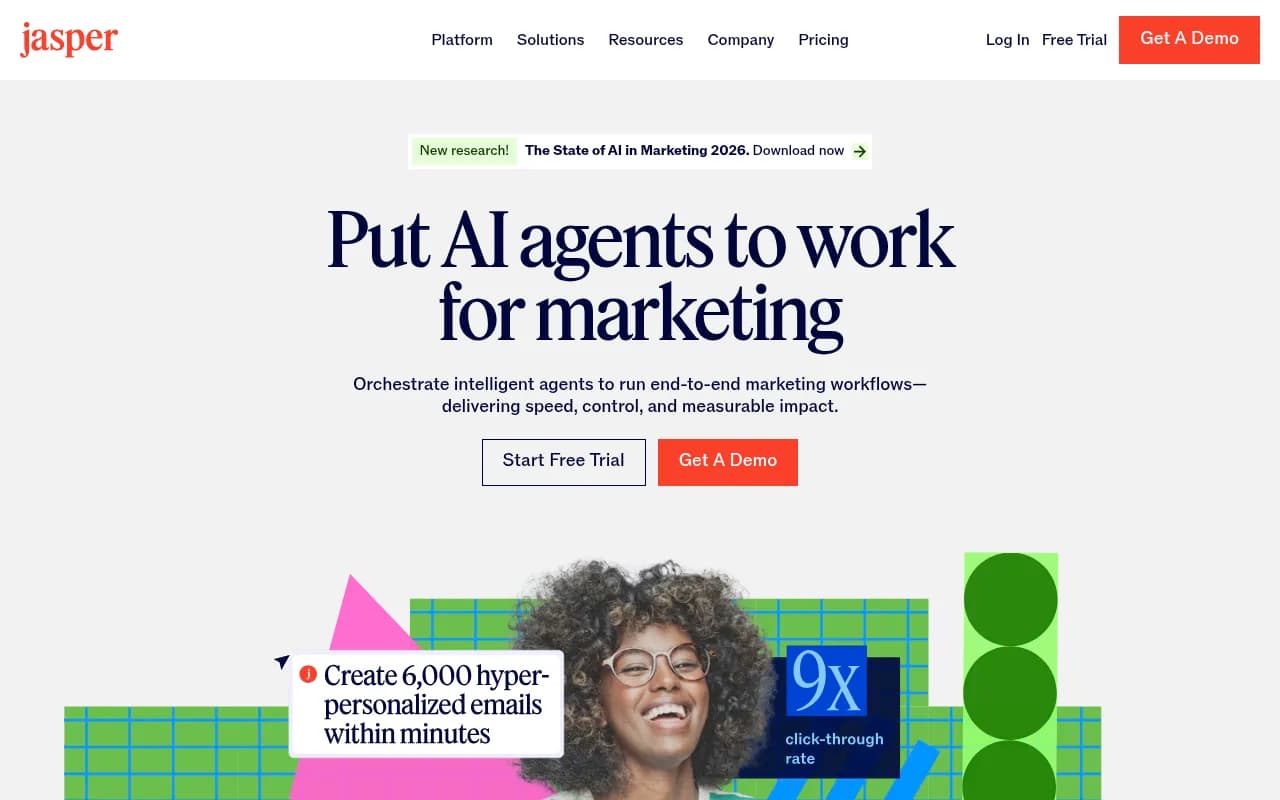
For content teams that need to produce a lot of material quickly -- landing pages, email sequences, social posts, blog drafts -- Jasper is genuinely fast. The brand voice feature is useful if you're managing multiple clients or product lines and need consistent tone across everything.
Where Jasper falls short for teams trying to prove results: it's still primarily a writing tool. There's no native rank tracking, no AI visibility monitoring, and no way to see whether the content you're producing is actually performing. You're generating output, not measuring outcomes.
Jasper also sits at a higher price point than most alternatives -- the Creator plan starts at $49/month, but meaningful team features require the Pro plan at $69/month per seat, which adds up fast for larger teams.
If you're already using a separate SEO platform and just need a faster, more brand-consistent way to produce drafts, Jasper fits that role well. If you need a single tool that shows you whether your content is working, it's not the right fit.
3. Clearscope -- best for content quality and editorial standards
Clearscope takes a different approach than most content tools. It's not trying to write your content for you -- it's trying to make sure the content you write is actually comprehensive. The platform analyzes top-ranking pages for a keyword and surfaces the terms, topics, and questions your content needs to cover to be competitive.
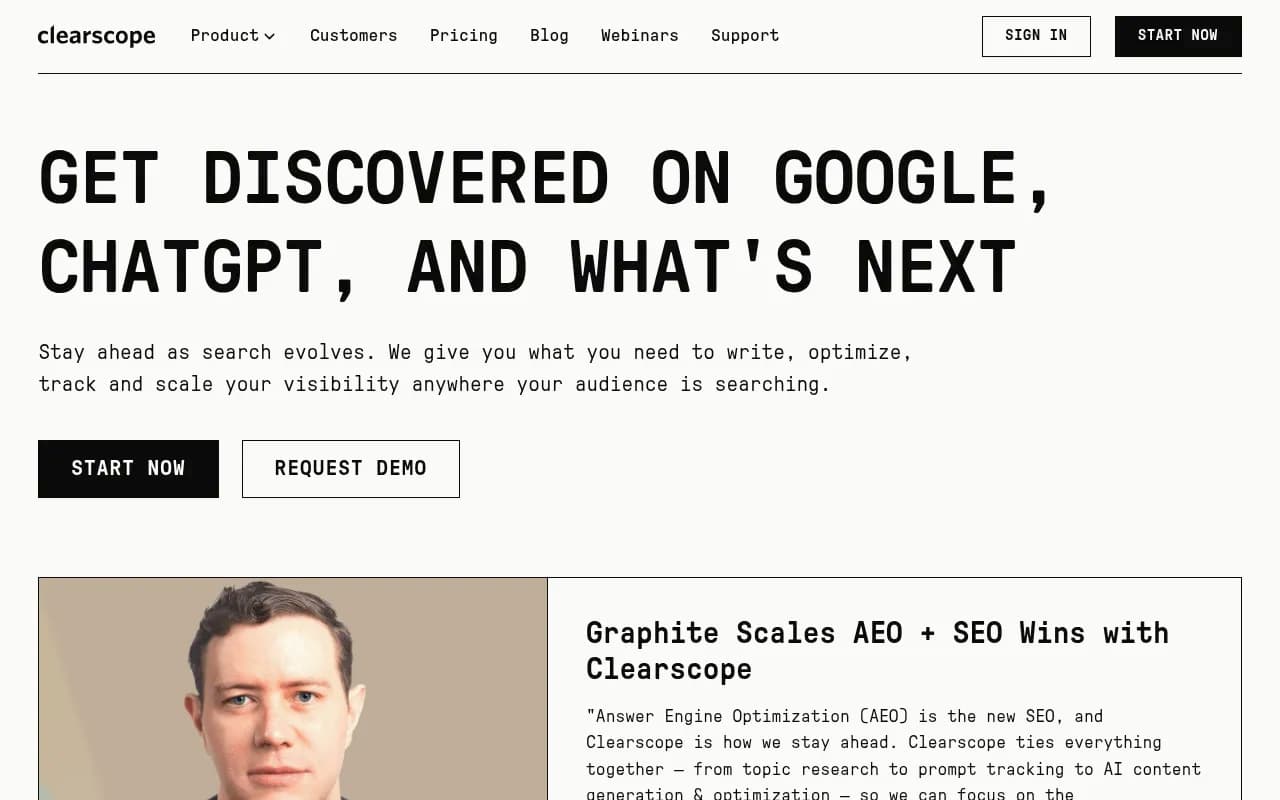
The content report is genuinely useful for writers who know their subject but want to make sure they're not missing anything obvious. The grading system (A+ to F) gives editors a quick signal about whether a piece is ready to publish or needs more depth. For teams with editorial standards to maintain, Clearscope is one of the better tools for enforcing them at scale.
The downside is that Clearscope is expensive relative to what it does. Plans start at $189/month, and you're essentially paying for a content brief and optimization tool -- not a full content platform. There's no AI writer, no rank tracking, and no AI visibility features.
It's a strong choice if content quality is your bottleneck and you have budget to spend on a specialized tool. Less compelling if you need to justify the cost with measurable outcomes.
4. Frase -- best for research-heavy content workflows
Frase sits in an interesting middle ground between content research, brief creation, and AI writing. The core workflow is: enter a keyword, Frase pulls the top-ranking pages and summarizes what they cover, you build a brief from that research, then use the AI writer to draft against the brief.
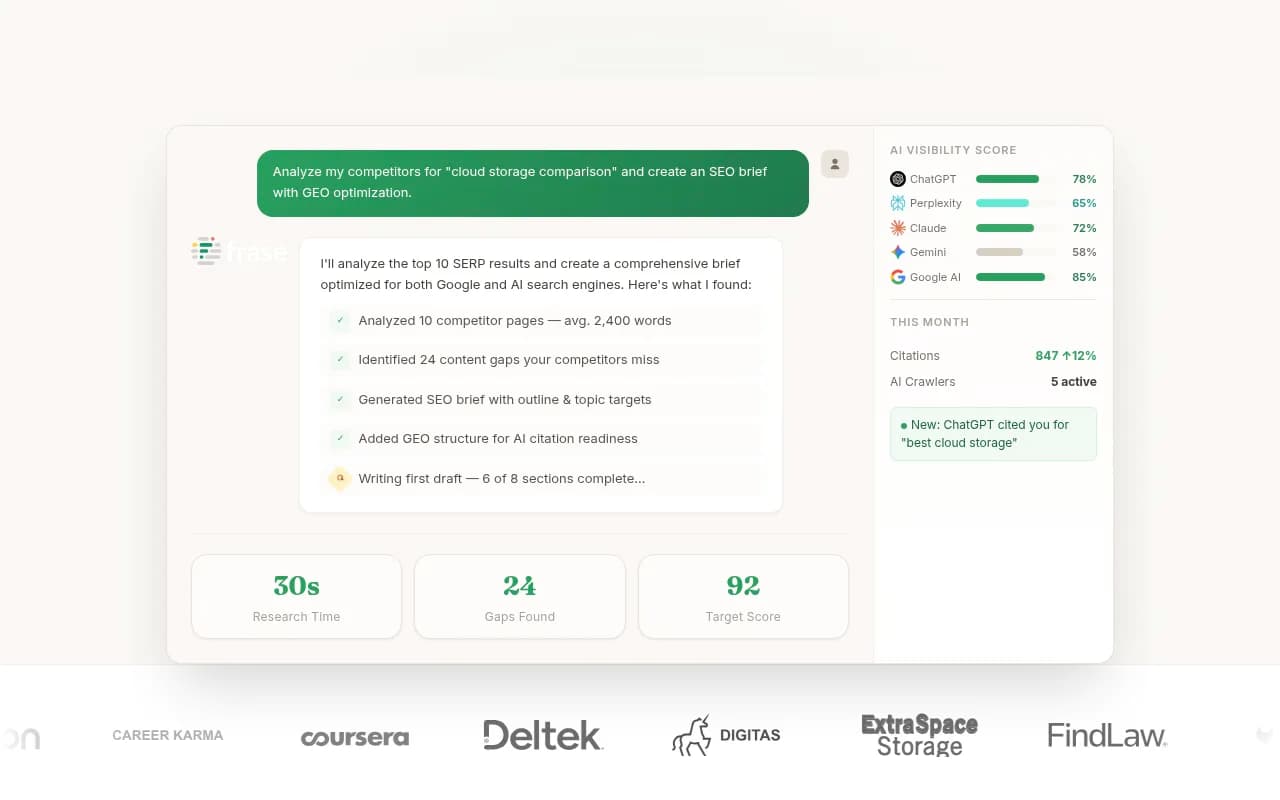
For content teams that do a lot of research-intensive writing -- technical topics, comparison articles, detailed guides -- Frase's research aggregation saves real time. Instead of manually reading 10 competing articles before you start writing, Frase surfaces the key points from all of them in one view.
The AI writer has improved considerably and can produce decent first drafts, though like most AI writing tools, it needs human editing to be genuinely good. The SEO scoring is lighter than Surfer's but functional for most use cases.
Frase's pricing is more accessible than Clearscope -- the Solo plan starts at $15/month, though the Pro plan at $45/month is where most teams will land. That makes it one of the better value options on this list.
The gap: no AI search visibility tracking, no attribution, no way to see whether your content is being cited by AI models. It's a production tool, not a results tool.
5. Writesonic -- best for speed and AI search optimization combined
Writesonic has been quietly building out features that go beyond content generation. The platform now includes an AI Article Writer, a brand voice feature, and -- more relevant to this list -- some AI search optimization capabilities through its Chatsonic and Botsonic products.
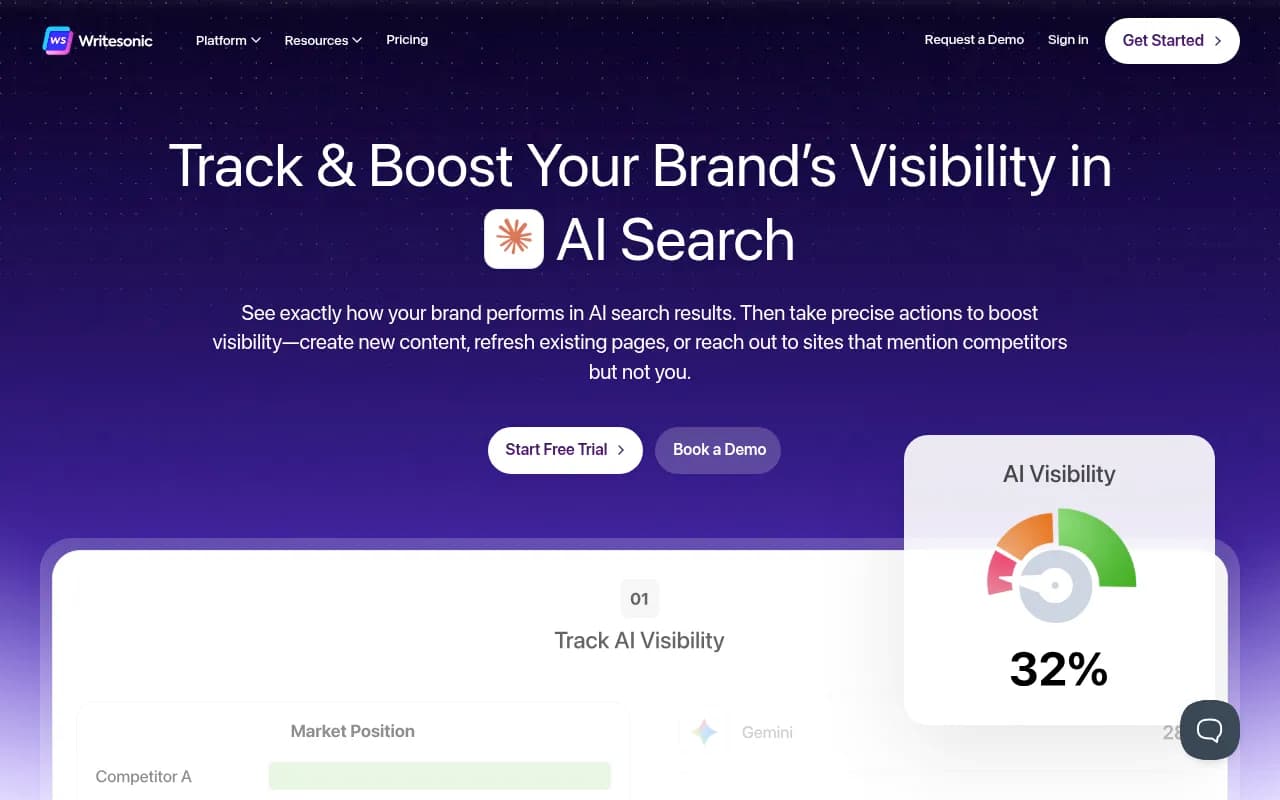
For content teams that need to move fast and publish at volume, Writesonic's article writer is one of the faster options. It can pull from real-time web data, which helps with accuracy on time-sensitive topics. The interface is more approachable than Jasper for non-technical users.
The AI visibility features are still maturing compared to dedicated GEO platforms, but Writesonic is one of the few content creation tools that's at least thinking about AI search optimization as part of its product roadmap. That puts it ahead of most alternatives on this list in terms of directional alignment with where content marketing is going.
Pricing is competitive -- the Individual plan starts at $20/month, and team plans are available at higher tiers.
The missing piece: tracking AI visibility
Here's the honest reality about every tool on this list: none of them will tell you whether ChatGPT recommends your brand when someone asks a relevant question. None of them track whether Perplexity cites your article. None of them show you which AI models are crawling your site and which pages they're reading.
That's a significant gap in 2026, when a growing share of search behavior is happening inside AI interfaces rather than traditional search engines. If your content team's job is to prove results, and some of those results are now coming from AI-driven discovery, you need visibility into that channel.
This is where a dedicated GEO platform becomes relevant. Promptwatch is the tool most content and SEO teams are using to fill this gap -- it tracks how your brand appears across ChatGPT, Claude, Perplexity, Gemini, Grok, and several other AI models, and it goes further than just monitoring.

The part that's actually useful for content teams trying to prove results: Promptwatch's Answer Gap Analysis shows you exactly which prompts your competitors are visible for that you're not. That's not a vague content suggestion -- it's a specific list of questions AI models are answering without citing you, which you can turn directly into content briefs. The Content Agents then generate articles grounded in that prompt data. And the page-level tracking shows you when those articles start getting cited, by which models, and how often.
That's a closed loop: find the gap, create the content, track the result. Most content tools stop at step one.
How to choose
The right choice depends on what's actually broken in your current setup:
- If your content isn't ranking on Google, start with Surfer SEO or Frase. Both will help you produce more SEO-aligned content without a steep learning curve.
- If your editorial quality is inconsistent and you need to enforce standards across a team, Clearscope is worth the price.
- If you need to produce a high volume of brand-consistent content quickly, Jasper or Writesonic will get you there faster than most alternatives.
- If you're trying to understand and improve your AI search visibility -- which is increasingly where content results actually show up -- none of the above will help much. That's a separate problem that requires a dedicated tool.
The teams that are best positioned in 2026 are using a content creation tool for production and a GEO platform for measurement. Those are different jobs, and trying to find one tool that does both well usually means settling for one that does neither particularly well.
Pick the right tool for each job. Measure both channels. That's how you prove results.