Key takeaways
- Google's AI Mode and tools like ChatGPT Search are reducing click-through rates on traditional results, making "ranking #1" less meaningful than being cited in AI-generated answers.
- Reddit and YouTube have become primary sources that AI models pull from when generating responses -- your brand's presence on these platforms directly affects your AI visibility.
- Your website is no longer the only (or even the primary) source of your brand's AI visibility. Off-site content now carries real weight.
- Traditional backlink-focused SEO still matters but is no longer sufficient on its own. Content that answers real questions, in real communities, is what AI models want to cite.
- Tracking AI visibility requires different tools and metrics than traditional rank tracking -- page-level citation data, prompt monitoring, and crawler logs are the new signals to watch.
The ground has shifted -- and most SEO teams haven't noticed yet
For about 25 years, SEO had a fairly stable playbook. Research keywords, build pages, earn backlinks, watch rankings. Rinse, repeat. The game was complicated but the rules were clear.
That playbook is breaking down. Not slowly, either.
Google's AI Mode (the successor to AI Overviews) now generates synthesized answers at the top of results pages, pulling from dozens of sources simultaneously. ChatGPT Search, Perplexity, Claude, and Gemini are handling queries that would have gone to Google two years ago. And when users ask these tools a question, they don't get ten blue links -- they get a single answer, with a handful of citations buried underneath.
The implication is uncomfortable: you can rank #1 on Google for a keyword and still be completely invisible to the growing share of users who never scroll past the AI answer. Visibility and rankings have decoupled.
Meanwhile, Reddit threads and YouTube videos are showing up everywhere in AI-generated responses. Not because of some algorithmic quirk -- because AI models genuinely find them useful. They contain real opinions, real experiences, and real specificity that polished brand content often lacks.
This is the new landscape. Let's break down what's actually happening and what to do about it.
Why AI search is eating traditional click traffic
Google's AI Overviews launched in 2024 and immediately triggered a wave of concern about click-through rates. The concern was justified. When a user asks "what's the best project management software for remote teams" and gets a 400-word synthesized answer with a comparison table, a large portion of them never click anything.
The same pattern plays out across ChatGPT, Perplexity, and Gemini. These tools are designed to give complete answers, not to route traffic. That's a fundamental tension with the traditional SEO model, which depended on users clicking through to your site.
What this means practically:
- Informational queries (how-to, what-is, comparisons) are increasingly answered without a click. These were the bread and butter of content marketing.
- Branded and transactional queries still drive clicks -- people who want to buy something or navigate to a specific site still click through.
- The value of ranking shifts from "getting the click" to "being cited in the AI answer." Citation = trust signal = brand awareness, even without a click.
This doesn't mean SEO is dead. It means the goal has changed. You're no longer just optimizing to rank -- you're optimizing to be cited, recommended, and referenced by AI models.
Reddit's unexpected rise as an AI source
Here's something that would have seemed absurd three years ago: a Reddit thread from 2022 is now influencing what ChatGPT tells someone about your product category.
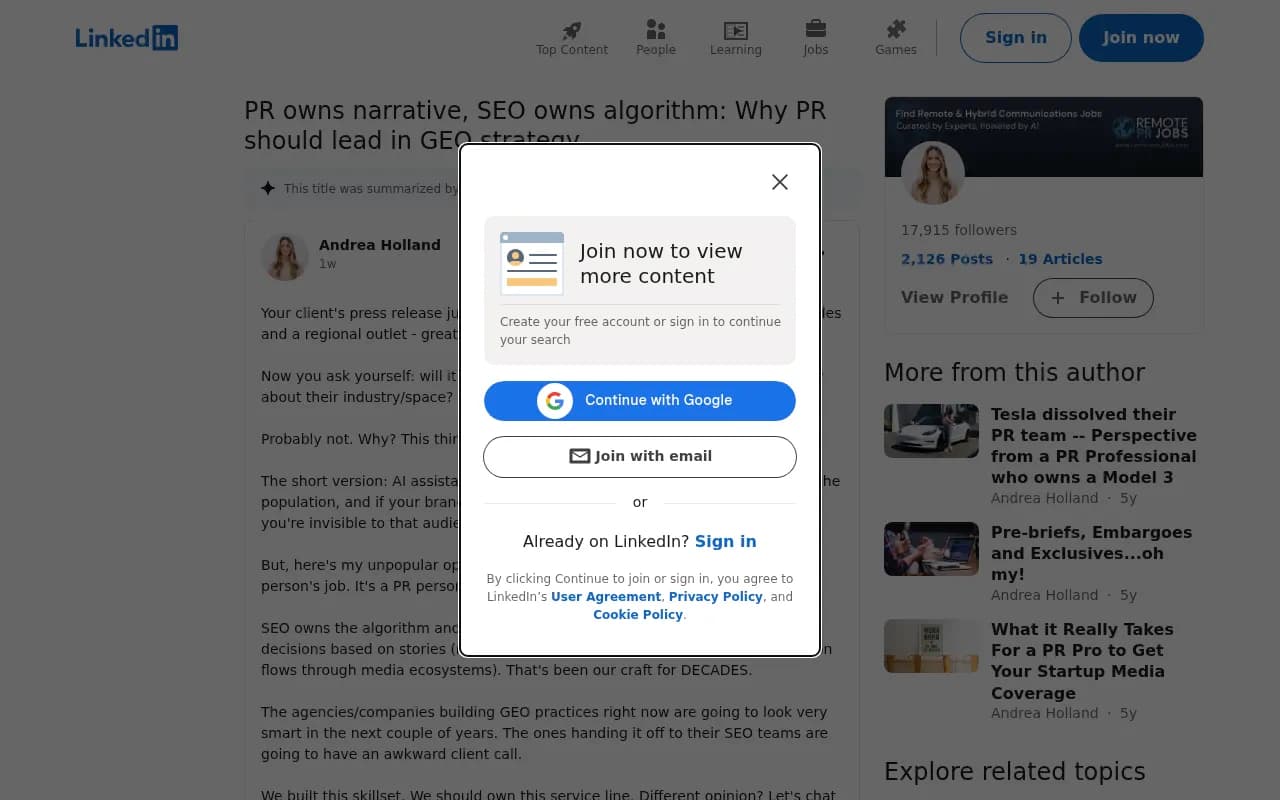
Reddit's deal with Google (reportedly worth around $60 million annually) gave Google direct access to Reddit's data for AI training. But beyond that, Reddit content has become a default source for AI models because it contains something most brand content doesn't: unfiltered human experience.
When someone asks ChatGPT "is [software product] worth it?", the model is likely pulling from Reddit discussions, review threads, and community debates -- not the product's own website. The people who've actually used the product, complained about it, praised it, and compared it to alternatives are on Reddit. That's the signal AI models trust.
What this means for brands:
- Reddit presence is no longer optional for brands that want AI visibility. If your product category has active subreddits (r/productivity, r/entrepreneur, r/webdev, etc.), you need to be part of those conversations -- authentically.
- Negative Reddit sentiment gets amplified by AI. If the dominant narrative about your brand on Reddit is negative, AI models will reflect that. Monitoring and responding to Reddit discussions is now a reputation management task, not just a community management one.
- User-generated content and community engagement have direct SEO/GEO value. Encourage customers to share experiences in relevant communities.
The brands winning AI visibility in 2026 aren't just publishing blog posts. They're showing up in the places where real people talk.
YouTube: the citation source most SEO teams ignore
YouTube has always been treated as a separate channel from SEO. Different team, different KPIs, different strategy. That separation is becoming a liability.
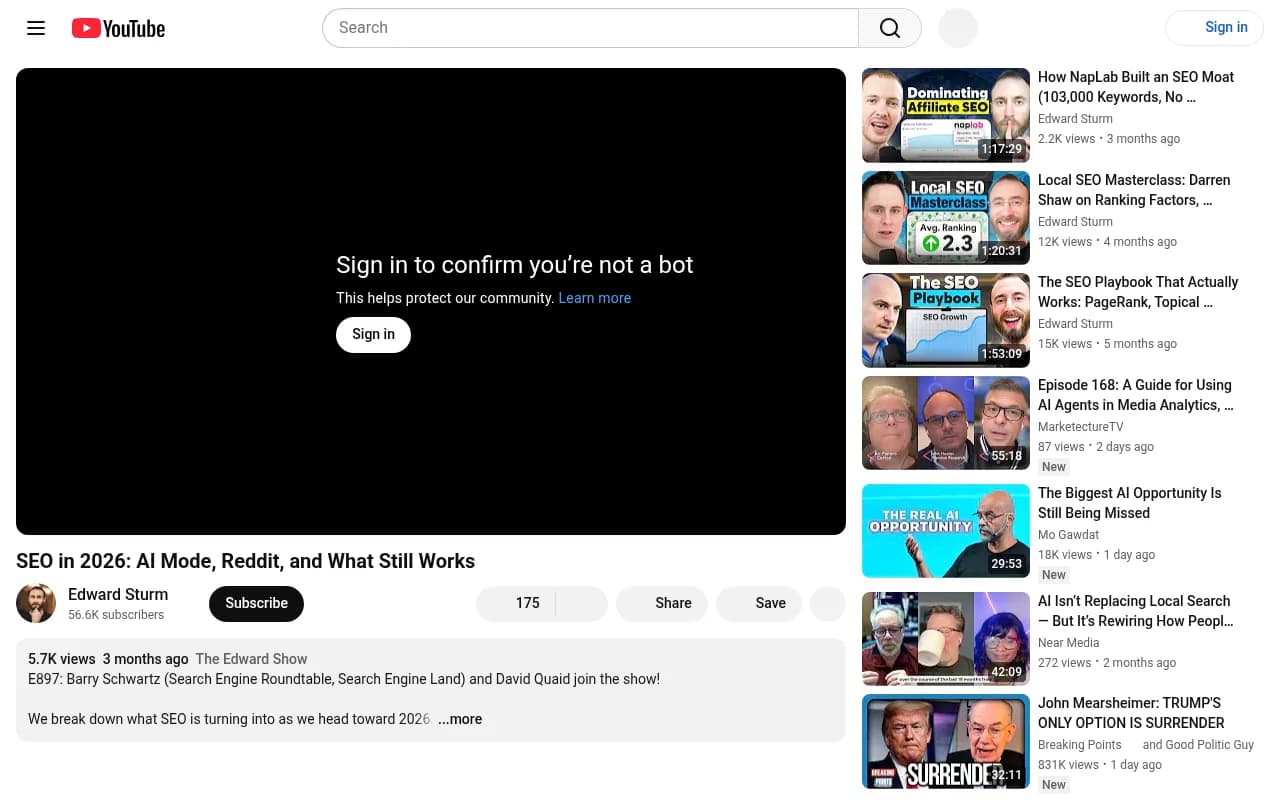
AI models increasingly cite YouTube videos when answering questions, particularly for how-to queries, product comparisons, and anything where demonstrating is more effective than explaining. Google's AI Overviews regularly surface YouTube content. Perplexity cites video transcripts. ChatGPT references YouTube creators when discussing topics where they have established authority.
The mechanism is straightforward: AI models can process video transcripts. A well-structured YouTube video with a clear transcript is, from an AI's perspective, a high-quality text document with the added trust signal of engagement metrics (views, comments, watch time).
What this means practically:
- Transcripts matter. Make sure your YouTube videos have accurate transcripts -- either auto-generated and corrected, or manually uploaded. This is what AI models actually read.
- Video titles and descriptions should be treated like on-page SEO. Include the specific questions your video answers.
- Consistency and depth beat one-off viral content. A channel with 50 detailed videos on a specific topic builds topical authority that AI models recognize.
- YouTube videos that rank well in traditional search also tend to get cited in AI answers. The signals overlap more than most people realize.
What still works (and what doesn't)
Let's be direct about this, because there's a lot of noise.
What still works
Technical SEO fundamentals. Page speed, crawlability, structured data, mobile optimization -- these still matter. AI crawlers (from ChatGPT, Claude, Perplexity, and others) need to be able to access and parse your content. If your site has crawl errors or blocks AI bots, you're invisible regardless of content quality.
Topical authority. Covering a subject in depth, across multiple related pages, still signals expertise to both Google and AI models. Thin content spread across unrelated topics is less effective than deep coverage of a specific domain.
E-E-A-T signals. Experience, Expertise, Authoritativeness, Trustworthiness -- Google's quality framework -- aligns closely with what AI models look for when deciding what to cite. First-hand experience, named authors with credentials, and factual accuracy all help.
Long-form, specific content. Generic "ultimate guides" that cover everything superficially are losing ground to content that answers a specific question with real depth. AI models prefer specificity.
What's losing effectiveness
Backlink-only strategies. Links still matter, but a site with 500 mediocre backlinks and thin content is losing ground to a site with 50 strong links and genuinely useful content.
Keyword stuffing and over-optimization. AI models don't respond to keyword density. They respond to relevance and usefulness.
Publishing for volume without quality. The AI content farms that flooded the web in 2023-2024 are being filtered out. Quality signals -- engagement, citations, community discussion -- are what matter now.
Ignoring off-site presence. If your entire SEO strategy lives on your own website, you're missing the channels AI models actually pull from.
The new metrics: what to track in 2026
Traditional SEO metrics -- rankings, organic traffic, domain authority -- are still useful but incomplete. Here's what to add to your measurement stack:
AI citation rate. How often does your brand or content appear in AI-generated answers? This requires dedicated tracking tools, not Google Search Console.
Prompt visibility. Which questions is your brand being recommended for? Which competitor prompts are you missing from? This is the AI equivalent of keyword gap analysis.
AI crawler activity. Are ChatGPT, Claude, and Perplexity actually crawling your site? How often? Which pages? Crawler log analysis tells you whether AI models can even find your content.
Off-site mention sentiment. What are Reddit, YouTube, and review sites saying about your brand? This directly influences AI recommendations.
Share of voice in AI answers. Compared to competitors, how often does your brand appear when users ask relevant questions? This is the AI equivalent of rank tracking.
For teams that want to track all of this in one place, Promptwatch covers the full stack -- from monitoring which prompts trigger competitor mentions to generating content designed to close those gaps.

Generative Engine Optimization (GEO): the emerging discipline
"GEO" -- Generative Engine Optimization -- has emerged as the term for optimizing content to appear in AI-generated responses. It's related to traditional SEO but has distinct principles.
The core idea: AI models generate answers by synthesizing information from sources they trust. To be cited, you need to be a source they trust. That trust is built through:
- Factual accuracy and specificity. Vague claims get ignored. Specific, verifiable facts get cited.
- Clear structure. AI models parse content more easily when it's organized with clear headings, lists, and logical flow.
- Answering the actual question. Content that directly addresses common queries in your space is more likely to be pulled into AI answers.
- Off-site authority. Being discussed positively on Reddit, cited in YouTube videos, mentioned in industry publications -- these off-site signals feed into AI model training and retrieval.
GEO isn't a replacement for SEO. It's an extension of it, applied to a new set of channels and a new set of ranking mechanisms.
Tools worth knowing about in 2026
The tooling landscape has expanded rapidly. Here's a practical breakdown of what different tools do well:
| Tool | Best for | Key strength |
|---|---|---|
| Promptwatch | Full GEO/AI visibility stack | End-to-end: gap analysis, content generation, tracking |
| Semrush | Traditional SEO + AI overview monitoring | Broad SEO suite with AI features added |
| Ahrefs Brand Radar | Brand monitoring in AI results | Established backlink data + AI tracking |
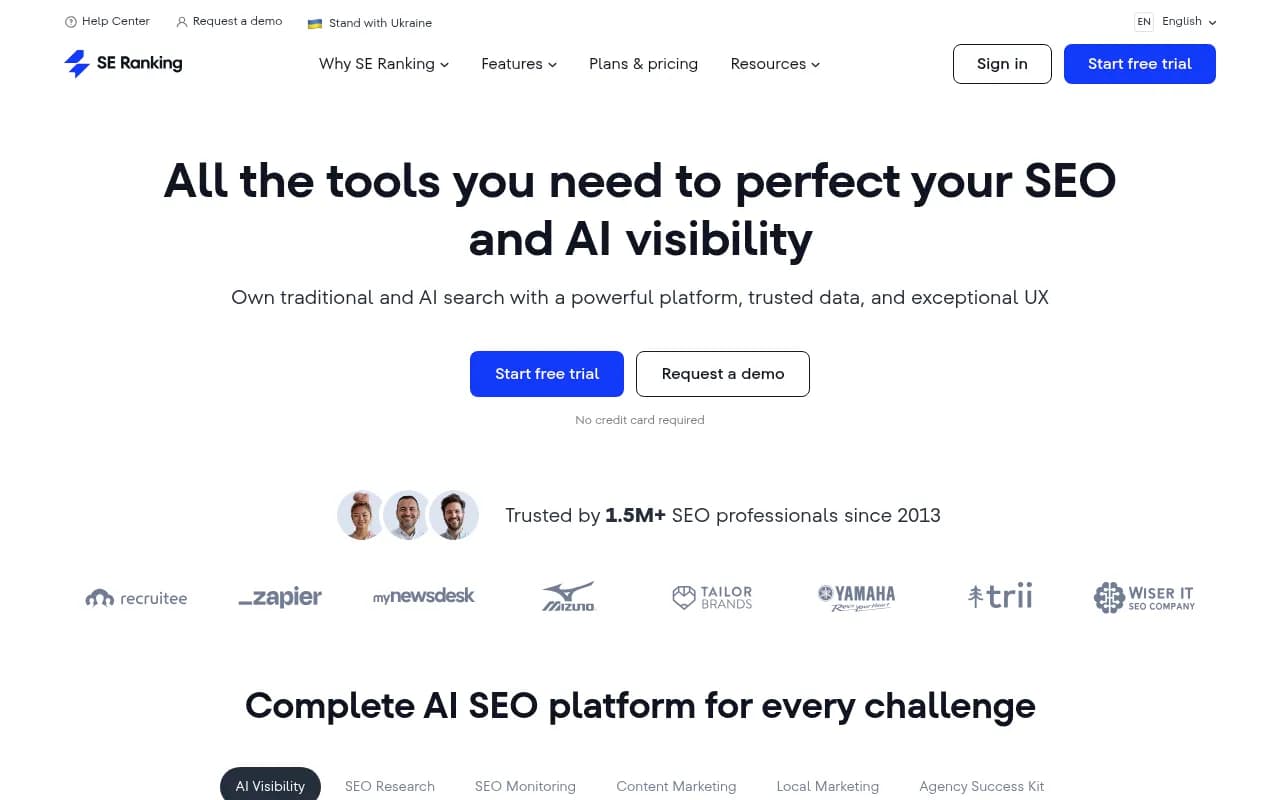
| SE Ranking | Mid-market SEO + AI visibility | Good value, AI toolkit included |
| Profound | Enterprise AI visibility | Deep monitoring for large brands |
| Otterly.AI | Budget AI monitoring | Simple, affordable citation tracking |
| AthenaHQ | AI search tracking | Multi-model monitoring |



The main distinction to understand: most tools in this space are monitoring dashboards. They show you where you're visible and where you're not. Fewer tools help you do something about the gaps -- generate content, fix crawl issues, track whether changes improved your visibility. When evaluating tools, ask whether they close the loop between finding gaps and fixing them.
Practical steps to take right now
If you're an SEO or marketing team trying to adapt, here's where to start:
Audit your AI visibility. Run your core product/service queries through ChatGPT, Perplexity, and Google AI Mode. Is your brand being cited? What sources are being cited instead? This takes 30 minutes and is more illuminating than most keyword reports.
Check your robots.txt. Make sure you're not accidentally blocking AI crawlers. Some bots (like GPTBot for OpenAI) can be blocked separately from Google's crawler. If you want AI visibility, you generally want these bots to access your content.
Map your Reddit and YouTube presence. Search Reddit for your brand name and product category. What's the dominant narrative? Are you present in those conversations? Do the same for YouTube -- are there videos about your product category that don't mention you?
Identify your prompt gaps. Which questions should your brand be answering that it currently isn't? These are your content priorities. Tools like Promptwatch can automate this analysis, but you can start manually by listing the 20 most common questions your customers ask and checking whether your content answers them clearly.
Publish content that answers specific questions. Not "The Ultimate Guide to X" -- but "Why does X fail for remote teams?" or "How to set up X in under 10 minutes." Specific, question-answering content gets cited. Generic overview content doesn't.
Build a monitoring cadence. Check your AI visibility monthly at minimum. The AI search landscape is moving fast enough that quarterly reviews will leave you behind.
The bigger picture
The shift happening in search right now is real, but it's worth keeping some perspective. Google still processes billions of queries daily. Traditional organic search still drives enormous amounts of traffic. The fundamentals -- useful content, technical accessibility, genuine authority -- haven't changed.
What's changed is the surface area. Your brand's visibility is now determined by what's on your website and what's being said about you on Reddit, YouTube, podcasts, review sites, and industry publications. AI models are synthesizing all of it.
The brands that will win in this environment are the ones that build genuine authority across multiple channels, answer real questions with real specificity, and treat AI visibility as a measurable, trackable metric -- not an afterthought.
That's a harder job than traditional SEO. But it's also a more honest one. The shortcuts that worked in 2015 don't work anymore. What works now is actually being useful, in the places where people are actually looking.