Key takeaways
- Structured content (headings, lists, FAQ sections) consistently outperforms long-form prose in AI citation rates across all major platforms.
- Word count barely affects whether AI engines cite your content -- what matters is how clearly the content answers a specific question.
- Listicle-format "Top N" content earns disproportionate citations in commercial and product-comparison queries.
- Only 38% of pages cited in Google AI Overviews also rank in the top 10 organically -- down from 76% in mid-2025, meaning rankings alone no longer predict AI visibility.
- Citation patterns vary significantly by platform and industry; there is no single "best" format that works everywhere.
- YouTube is now the single most-cited domain in Google AI Overviews for queries where video content exists.
The rules changed. If you built your content strategy around ranking #1 and assumed that would automatically get you cited in AI answers, the 2026 data says otherwise.
An Ahrefs study of 863,000 keywords and 4 million AI Overview URLs found that only 38% of pages cited in Google AI Overviews also rank in the top 10 for the same query. Seven months earlier, that figure was 76%. That's not a rounding error -- it's a structural shift in how AI engines select sources.
So if organic rankings are no longer a reliable proxy for AI citations, what is? The answer, increasingly, comes down to format. What you write matters, but how you structure it may matter more.
Here's what the data actually shows about the content types AI engines cite most in 2026.
1. Structured listicles ("Top N" comparisons)
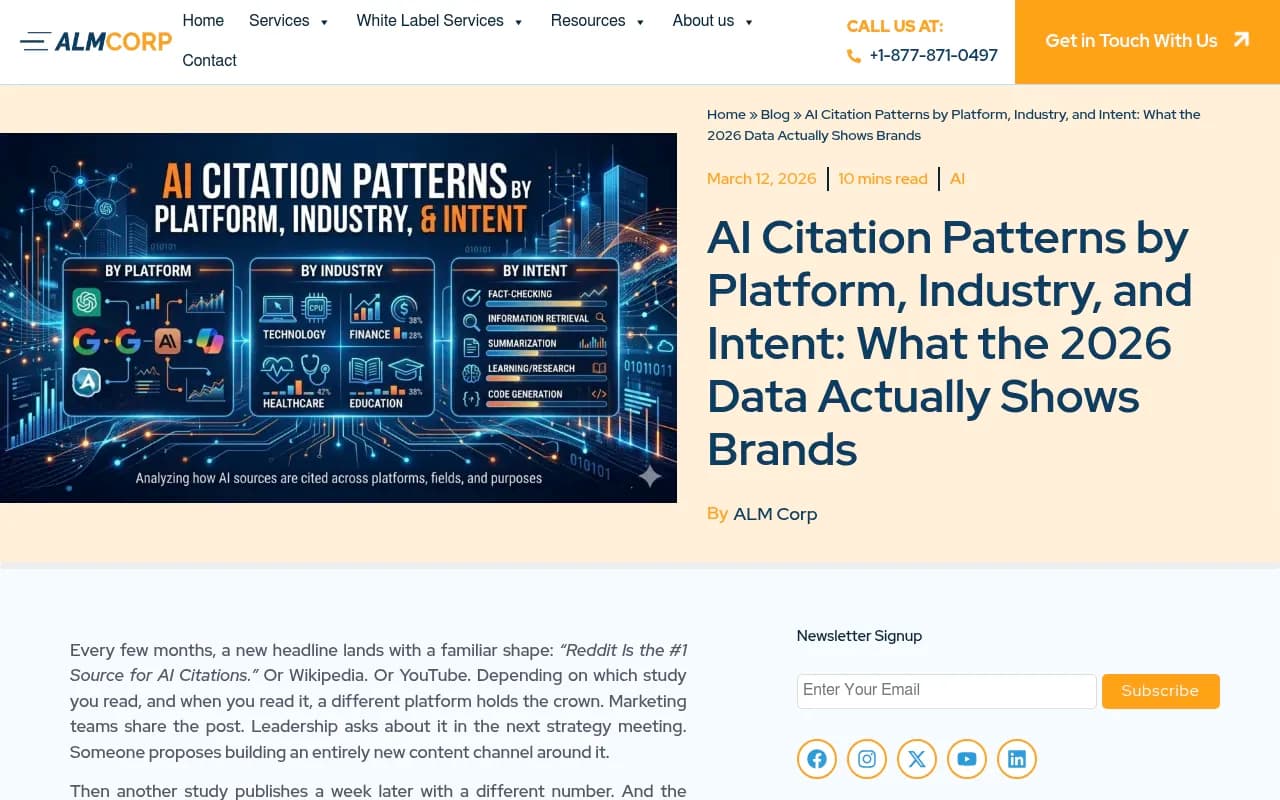
Analysis of over 2,500 unique domains cited by AI search engines, published in the AI Brand Visibility Report for March 2026, found that listicle-format content -- structured "Top N" comparisons and ranked lists -- earns citations at a rate that outpaces almost every other format in commercial queries.
Why? Because AI engines are often answering questions like "what are the best tools for X" or "top alternatives to Y." A page structured as a numbered list with clear headings for each item maps almost perfectly onto what the model needs to construct its answer. It can extract item 3 without reading items 1 through 10.
The format works because it's modular. Each entry is self-contained. AI models don't need to parse narrative context to find the useful bit -- it's already isolated.
If you're in a competitive category and not publishing structured comparison content, you're leaving a significant citation surface on the table.
2. FAQ pages and Q&A-structured content
FAQ content has been a staple of SEO for years, but its relevance in AI search has grown considerably. Structured content with explicit headings, lists, and FAQ sections is consistently rated the most effective format for AI search visibility across multiple studies compiled by Position Digital in their 2026 AI SEO statistics roundup.
The reason is mechanical. AI models are trained on question-answer pairs. When your page mirrors that structure -- a clear question as a heading, a direct answer in the first sentence or two below it -- the model can extract and cite that answer with minimal interpretation required.
The practical implication: FAQ sections shouldn't be buried at the bottom of a page as an afterthought. They work best when the questions reflect real search prompts, not marketing-speak. "How does X work?" beats "What makes our solution unique?"
3. Comparison articles
"X vs Y" and "X alternatives" pages punch well above their weight in AI citations, particularly for commercial-intent queries. This makes sense given how people use AI search -- they're often in evaluation mode, trying to decide between options, and the AI is synthesizing a recommendation.
Pages that directly compare two or more products, services, or approaches give AI models exactly what they need: structured, opinionated, specific information that can be surfaced in a "here are your options" response.
The key word is specific. Vague comparisons ("both tools have pros and cons") get ignored. Comparisons with concrete differentiators ("Tool A charges per seat, Tool B charges per query -- here's when that matters") are far more likely to be cited.
| Format | Best for | Citation strength |
|---|---|---|
| Top N listicles | Commercial, product queries | Very high |
| FAQ / Q&A | Informational, how-to queries | High |
| Comparison articles | Evaluation, "vs" queries | High |
| How-to guides | Instructional queries | High |
| Research/data pages | Evidence-seeking queries | High |
| Definition pages | Conceptual queries | Medium-high |
| Case studies | Trust/proof queries | Medium |
| Video content (YouTube) | Visual/tutorial queries | Very high (YouTube) |
| Reddit/forum threads | Opinion, experience queries | High (platform-dependent) |
| Wikipedia-style reference | Factual, entity queries | High |
4. How-to guides with clear step structure
Instructional content performs well when it's genuinely structured as steps rather than narrative prose. A how-to guide that uses numbered steps, each with a clear action and outcome, gives AI models a clean extraction path.
The research from Pushleads, which analyzed over 174,000 pages, found that word count barely affects AI search citations. A 600-word how-to guide with crisp numbered steps can outperform a 3,000-word tutorial that buries the instructions in context and caveats.
That's a meaningful finding for content teams that have been chasing word count targets. Length isn't the signal. Clarity of structure is.
5. Original research and data-driven content
Pages that contain original data -- survey results, proprietary analysis, benchmark studies -- earn citations across a different kind of query: the evidence-seeking kind. When someone asks an AI "what percentage of marketers use X" or "how much does Y cost on average," the model needs a source with a specific number.
If your page has that number and it's clearly attributed and structured, you become citable for a whole class of queries that generic content can't touch.
This is one of the harder content types to produce consistently, but the citation longevity tends to be stronger. A data point from your original research can keep earning citations long after a listicle has been superseded.
6. Definition and concept explainer pages
"What is X" queries are a huge slice of AI search volume, and they tend to favor pages that define a concept clearly, early, and without excessive hedging. The ideal structure: a one-to-two sentence definition right at the top, followed by context, examples, and related concepts.
Pages that bury the definition three paragraphs in -- or worse, define the term by explaining what it's not before explaining what it is -- tend to get skipped. AI models want the answer first.
This is one area where schema markup genuinely helps. SE Ranking's research found that approximately 65% of pages cited by Google AI Mode include structured data markup, and roughly 71% of pages with FAQ schema saw improved AI visibility. A DefinedTerm or FAQPage schema on a definition page signals exactly what the page contains.
7. YouTube videos
YouTube is now the single most-cited domain in Google AI Overviews, accounting for 18.2% of all citations that come from outside the top 100 organic results. That's a striking number, and it reflects something important: AI engines are increasingly comfortable citing non-text content, particularly for queries where visual demonstration adds value.
This doesn't mean every brand needs a YouTube channel. But if you're in a category where "how to" or "tutorial" queries are common, and you don't have video content, you're ceding a significant citation surface to competitors who do.
The practical angle: YouTube video descriptions, titles, and transcripts all feed into how AI engines understand and cite video content. A well-structured video description with timestamps and clear topic labels is the text-layer equivalent of heading structure on a webpage.
8. Reddit and community forum threads
Reddit's presence in AI citations has grown substantially, and the pattern is specific: AI engines cite Reddit threads primarily for opinion, experience, and recommendation queries. "What do people actually think of X?" "Has anyone tried Y?" "Best Z for a beginner?"
These are queries where first-person experience carries more weight than brand-published content, and AI models have learned to reflect that. Tinuiti's Q1 2026 AI Citation Trends Report, which tracked high commercial-intent prompts across nine verticals, found Reddit particularly prominent in categories where peer experience is a trust signal -- software, consumer products, and services with high switching costs.
The implication for brands is uncomfortable but real: you can't directly control what Reddit says about you. What you can do is participate authentically, ensure your product generates positive organic discussion, and monitor which threads are being cited for queries relevant to your brand.
9. Wikipedia and authoritative reference pages
Wikipedia remains a consistent citation source across virtually every AI platform, particularly for factual and entity-based queries. Its citation strength comes from a combination of factors: structured content, neutral tone, extensive internal linking, and the fact that it's been a training data staple for most major models.
For brands, the lesson isn't "edit Wikipedia" -- it's to understand what makes Wikipedia-style content citable: clear structure, factual specificity, sourced claims, and a neutral framing that doesn't read like marketing copy.
Pages that explain your category, your technology, or your industry in a genuinely informative way -- not a promotional one -- tend to earn the kind of trust signals that Wikipedia pages carry.
10. Product and service pages with structured specifications
This one surprises people. Product pages, when structured with clear specifications, pricing, and feature lists, earn citations for commercial queries where the AI is assembling a "here are your options" response.
The key is structure. A product page that reads like a brochure -- "Our revolutionary platform transforms the way teams collaborate" -- gives AI models nothing to work with. A product page that clearly states what the product does, who it's for, what it costs, and what features it includes is a different story.
SE Ranking's research on Google AI Mode found that structured data markup appears on approximately 65% of cited pages. For product pages specifically, Product schema with clear attributes (price, availability, description) is one of the most direct ways to signal citable information.
What the data says about length
The word count question gets asked constantly, and the honest answer is: it barely matters.
Pushleads' analysis of 174,000+ pages found no meaningful correlation between word count and AI citation rates. This contradicts years of SEO conventional wisdom that longer content performs better.
What does matter is whether the content answers the query clearly and early. A 500-word page that answers a specific question in the first paragraph will outperform a 2,500-word page that takes three sections to get to the point.
The practical implication: stop padding. Write until you've answered the question completely, then stop. For AI search, concise and structured beats long and comprehensive every time.
What the data says about structure
Structure is the single most consistent signal across all the research. Position Digital's compilation of 100+ AI SEO statistics for 2026 identifies structured content -- headings, lists, FAQ sections -- as the most effective format in AI search, full stop.
The specific elements that matter:
- Clear H2/H3 heading hierarchy that reflects the questions being answered
- Bullet lists and numbered steps rather than dense paragraphs
- FAQ sections with explicit question-format headings
- Tables for comparisons and specifications
- Schema markup (FAQPage, HowTo, Product, Article) to reinforce the structural signals
One finding worth sitting with: brands are 6.5x more likely to be cited through third-party sources than their own domains, according to Position Digital's analysis. That means your Wikipedia presence, your Reddit reputation, your YouTube content, and the review sites that cover your category all matter as much as -- or more than -- your own website for AI citation purposes.
Platform differences matter more than most brands realize
One of the clearest findings from Tinuiti's Q1 2026 research is that there is no universal top source for AI citations. The patterns shift significantly by platform:
- Google AI Overviews favor pages with structured data and strong organic signals, but the top-10 overlap has dropped sharply
- ChatGPT and Claude tend to cite longer-form explanatory content and established reference sources
- Perplexity cites a broader range of sources including recent news and niche publications
- Google AI Mode shows higher engagement with structured product and comparison content
Building a content strategy around one platform's citation patterns and assuming it generalizes is a mistake. The brands getting the most AI visibility in 2026 are publishing across multiple formats and monitoring which formats earn citations on which platforms.
How to track which of your content formats are actually getting cited
Knowing the patterns is one thing. Knowing which of your pages are being cited, by which models, for which queries, is where the real work happens.
Promptwatch tracks citations across 10 AI models -- including ChatGPT, Perplexity, Google AI Overviews, Claude, Gemini, and Grok -- and shows you page-level data on which content is being cited and how often. The Answer Gap Analysis feature shows which prompts competitors are visible for that you're not, which is a direct way to identify which content formats and topics you're missing.

For tracking AI visibility at the brand level across multiple platforms, a few other tools worth knowing:


The practical checklist
If you want to apply this research to your content operation, here's what it comes down to:
- Audit your existing content for structure. Do your pages have clear heading hierarchies? Are answers surfaced early, or buried in paragraphs?
- Prioritize FAQ and listicle formats for commercial and informational queries where you're not currently visible in AI answers.
- Add schema markup -- particularly FAQPage, HowTo, and Product schema -- to pages that match those content types.
- Stop optimizing for word count. Optimize for answer clarity.
- Build comparison content for your category. "X vs Y" and "Top N alternatives to X" pages are consistently over-indexed in AI citations relative to how much effort they take to produce.
- Monitor your YouTube presence. If you're in a tutorial-heavy category, video content is now a citation surface you can't ignore.
- Track what's actually getting cited. Publishing content without knowing whether AI engines are picking it up is flying blind.
The shift from organic rankings to AI citations as a primary visibility metric is real and it's accelerating. The brands that adapt their content formats now -- rather than waiting for the data to be even more conclusive -- will have a meaningful head start.