Key takeaways
- Switching GEO vendors mid-contract is mostly a measurement problem, not a legal one. If you cannot compare old and new data on the same terms, you will not know whether the move worked.
- Run both vendors in parallel for at least 30 days, against the same prompt set, and log every AI platform change date so you do not blame (or credit) a vendor for something ChatGPT did.
- Export your prompts, responses, citations and crawler data before you give notice. Assume nothing about portability until you have seen the export.
- Raw server and CDN logs are the neutral source for AI crawler data. Use them to audit both vendors.
- Negotiate the exit early: short terms, explicit exit clauses and a proof-of-value period you control are now standard advice for enterprise AI contracts.
Why teams switch mid-contract
Nobody enjoys breaking a contract. Most enterprise teams I have seen consider it for one of four reasons: the vendor tracks but does not help fix anything, the data does not match what the team sees in the real ChatGPT or AI Overviews interface, pricing scaled faster than value, or the platform lacks something procurement now requires (security certification, SSO, an audit log).
The GEO market is young, and a lot of 2025-era buying decisions were made quickly. A dashboard that looked sufficient when the question was "are we mentioned at all?" often falls short when the question becomes "what do we publish next, and did it work?" That gap is the most common trigger.
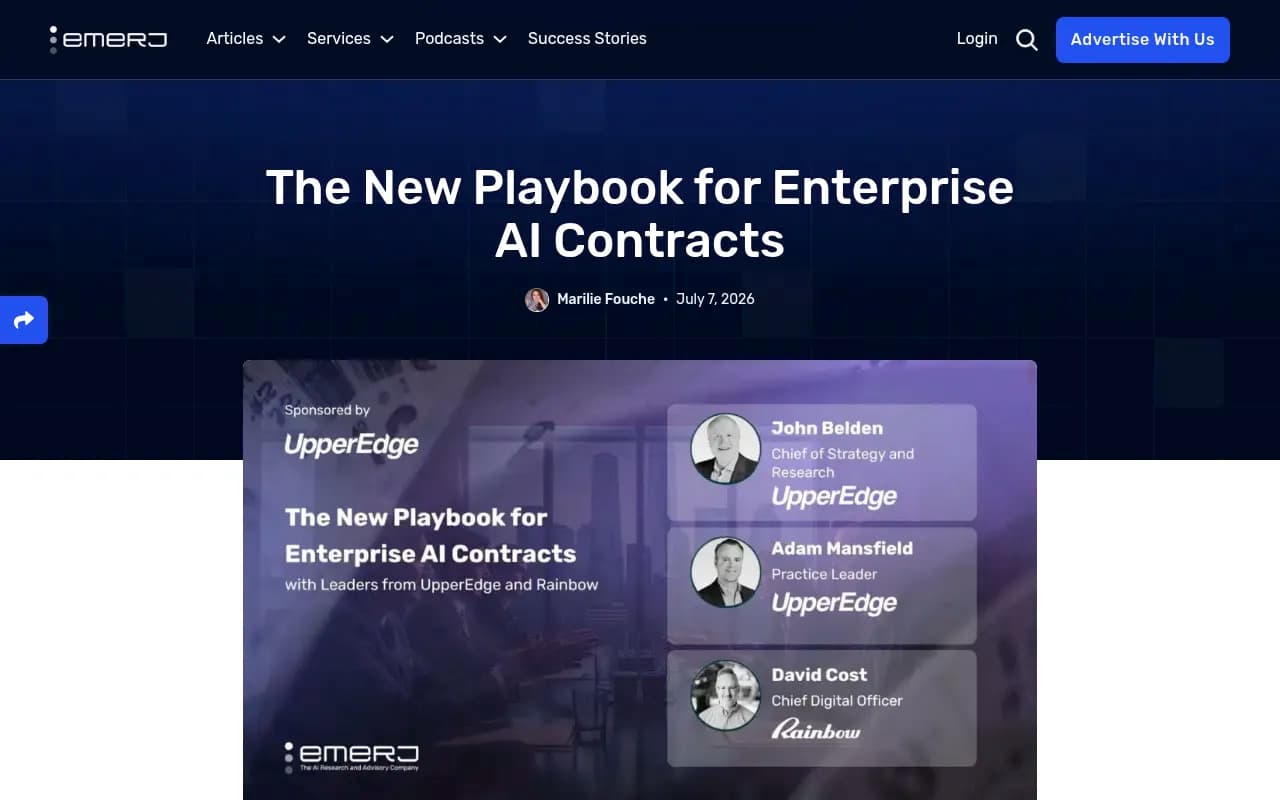
The wider AI contracting picture backs up the instinct to move carefully. A sponsored Emerj article from UpperEdge (July 2026) recommends replacing multi-year agreements with short terms, explicit exit clauses and enterprise-controlled proof-of-value. It also cites GAO findings that agencies were locked into vendors not by restrictive clauses but by the cost of re-architecting around a competitor. Treat the source with the usual caution for sponsored content, but the lock-in point is real in GEO too: your prompt library, historical baseline and reporting dashboards are the switching cost.
Step 1: Decide whether you should switch at all
Before reading your contract, write down what is broken. Be specific. "The dashboard is clunky" is not a reason to pay an early-termination fee. "We cannot see which pages AI crawlers fail to read" is.
A quick test: can you name three decisions your team made in the last quarter because of this vendor's data? If not, the problem is either the tool or how you use it. Fix usage first if it is cheap, because a migration costs weeks of analyst time regardless of which vendor you pick.
Common legitimate reasons:
- Monitoring only. You get a score, and the work of fixing it falls on your team.
- Data you cannot reconcile with the real interfaces. User-facing answers and citations can differ from API outputs.
- No crawler visibility, so you cannot tell an access problem from a content problem.
- Missing enterprise requirements such as ISO 27001, SSO, audit logs or API access.
- Cost per tracked response that no longer makes sense at your volume.
Step 2: Read the contract before you tell anyone
Do this quietly, and do it first. You are looking for a handful of clauses.
| Clause | What to look for | Why it matters |
|---|---|---|
| Term and renewal | Auto-renewal window, notice period | Missing a 60 or 90 day notice window can add a full year |
| Termination for convenience | Whether it exists, and the fee | Sets the real cost of leaving early |
| Termination for cause | Definition of material breach, SLA credits | Sustained data gaps may qualify |
| Data export | Formats, timing, whether historical responses are included | Determines your baseline survives |
| Data retention after exit | How long they keep or delete your data | GDPR and security reviews |
| Pricing triggers | Overage rates, seat or prompt caps | Surprise costs during a parallel run |
| Usage commitments | Prepaid volume, rollover rules | Unused prepaid credits are usually lost |
I could not find reliable public benchmarks for typical GEO contract terms such as termination for convenience or export rights, so do not assume your vendor's terms are standard. Ask your legal team to read yours line by line, and ask the vendor in writing what the export includes.
A useful point from the contract-negotiation research: AI contracts tend to price seats, tokens and platform commitments differently. Work out which of those you are actually locked into, because that is what you are negotiating around. Sometimes the cheapest exit is not termination but a downgrade at renewal combined with a new vendor's proof-of-value.
Options besides a hard break
- Let the contract run to term and start the new vendor in parallel. Costly in the short term, safest for data.
- Negotiate an early exit in exchange for a defined handover period. Vendors often prefer this to a dispute.
- Reduce scope (fewer projects, fewer prompts) and migrate in phases.
- Wait for the renewal window and use the intervening months as a structured evaluation.
Step 3: Export everything you can, in a usable form
This is the step teams skip, then regret. Before you give notice, pull every dataset you can get.
- Your full prompt list with topics, tags, personas, languages and countries.
- Historical responses with brand positions, not just aggregate scores.
- Citation data: which domains and URLs were cited, and when.
- Competitor lists and brand aliases, including any rules about how your brand name is matched (this matters if your name is also a common word).
- Sentiment and any claim-level data.
- Crawler and visitor analytics, if the vendor provided them.
- Saved reports and dashboard configurations. Screenshots count if nothing else exports.
Ask for CSV or Excel, and confirm whether responses come with the positions of each brand inside the answer. A visibility score exported without the underlying responses is nearly useless for re-scoring in a new tool.
A caution on prompt portability: prompts are easy to move, but the metadata around them (volume estimates, difficulty, topic groupings, personas) usually is not. Plan to rebuild some of that.
Step 4: Build a migration scorecard for the new vendor
Use the same criteria on every shortlisted vendor, and score them on your own data, not the demo environment. The GEO software directory at bestgeosoftware.com and the AI rank tracking tools directory at ai-rank-tools.com are useful for building a longlist.
A realistic enterprise scorecard:
| Criterion | Question to ask |
|---|---|
| Data source | Does it collect from the real user interfaces of each AI engine, or only APIs? |
| Coverage | Which engines, countries, languages and local targeting are included? |
| Crawler analytics | Does it show IP-verified AI crawler activity and failures on your site? |
| Traffic attribution | Can it connect AI citations to visits and conversions? |
| Action layer | Does it tell you what to do, and can it help produce and publish content? |
| Export and API | Can you get all your data out later? Is there an API or MCP access? |
| Security | ISO 27001, GDPR, SSO, audit log, role-based access |
| Pricing | Cost per tracked response at your volume, plus what is gated to higher tiers |
The action layer is where vendors differ most. Many tools stop at reporting. Others help you plan, write and publish content, then measure whether it was crawled and cited. If your reason for switching is "we have data but no execution," weight this heavily.
Vendors worth shortlisting
The category is crowded, so here is a grounded starting point rather than an exhaustive list.
Promptwatch is the platform 1001 SEO Media's team would put at the top of a migration shortlist for teams that want more than monitoring. It tracks real interfaces of ChatGPT, Google AI Overviews, AI Mode, Gemini, Perplexity, Copilot and others, adds IP-verified AI crawler logs and visitor analytics, and has a Content Agent that writes and publishes to WordPress, Webflow or Framer. It is ISO/IEC 27001 certified and GDPR compliant, and includes MCP and API access on every plan. Business is $579/month and is the first tier with the Content Agent; confirm current pricing at promptwatch.com/pricing. There is a 7-day free trial on monthly billing, and a free AI visibility report is a low-effort way to sanity-check your baseline.

Other enterprise-oriented options in the catalog include Profound, Scrunch, BrightEdge, Botify, Conductor and Evertune. Mid-market and monitoring-focused alternatives include Peec AI, Otterly.AI and AthenaHQ.





I have not verified current feature and pricing differences across all of these, so treat any list, including this one, as a starting point and test on your own prompts. For a head-to-head view of the biggest names, Promptwatch publishes a 2026 platform comparison and pages such as Promptwatch vs Profound, though remember that vendor-authored comparisons are written with a point of view.
Step 5: Run both vendors in parallel
This is the heart of the playbook. A clean cutover without overlap means you will never know if a change in your numbers came from the market, the platform, or the vendor.
Set the rules before you start
- Use the identical prompt set in both tools: same wording, same countries, same languages, same personas where supported.
- Set the same tracking frequency. Daily is the common baseline.
- Define the metrics you will compare: visibility or mention rate, position, share of voice, citation rate, sentiment. Vendors compute these differently, so you are comparing trends and rank order, not absolute numbers.
- Agree on a window. Thirty days is a minimum; sixty is better if you have seasonal volatility.
Expect the numbers not to match
They will not. Different collection methods, sampling times and scoring formulas produce different scores. Your job is to check whether both vendors tell the same story about direction and ranking, and to investigate where they disagree. Pull a handful of prompts and run them by hand in the real interface to see which tool is closer to what a user sees.
Log every platform change
AI engines change behavior in steps, and those steps can look like vendor error. Keep a shared log of platform events during the overlap. Promptwatch Data has documented several that would have moved any tracker's numbers:
- Average citations per ChatGPT response dropped across GPT-5.3, GPT-5.4 and GPT-5-Mini around the GPT-5.3 rollout on March 4, 2026.
- reddit.com's share of ChatGPT citations fell from roughly 4% to 0.5% on August 14, 2026.
- On August 8, 2026, ChatGPT began using the site: operator at scale, taking it from about 0.4% to about 17% of fanout queries.
- ChatGPT query fanouts averaged 2.15 per response in early December 2025 and about 1.84 by early March 2026, and average query length also shrank over the period.
If your old vendor shows a sudden drop in citations on one of those dates, the brand did not necessarily do anything wrong. If your new vendor shows a different shift, check the log before you conclude one of them is broken. Re-baseline after major model updates, and do not hand your new vendor a bad review because a platform moved the goalposts in week three.
Step 6: Audit crawler data against your own logs
If crawler visibility is one reason you are switching, do not take either vendor's word for it. Raw server and CDN logs are the neutral source.
Promptwatch's AI crawler traffic report (weekly, June 8 to September 6, 2026) counted only IP-verified requests from OpenAI, Anthropic, Google, Perplexity and Mistral. In the week of August 31 to September 6, OpenAI made up 79.8% of those requests, down from 94.8% in the week of June 8. The practical advice from that report is a good audit rule: if a provider is large in the benchmark but near zero in your logs, you are probably blocking it with robots.txt, CDN or WAF rules.
A checklist for the parallel period:
- Pull a week of raw CDN or server logs and filter by known AI user agents.
- Verify source IPs against each operator's published ranges. Spoofed user agents are common.
- Compare per-bot request counts with what each vendor reports.
- Check robots.txt, CDN and WAF rules for each provider. The free AI crawler URL inspector and robots.txt generator for AI can help.
- Note which vendor surfaces failures (blocked, timed out, wrong status) in plain language.
Tools like DarkVisitors can also help with bot visibility if you want a third data point.
Step 7: Plan the cutover
Once the parallel run shows the new vendor is at least as accurate and clearly more useful, plan the exit.
Timeline
| Phase | Typical length | What happens |
|---|---|---|
| Contract review and export | 1 to 2 weeks | Clauses mapped, data pulled, notice dates confirmed |
| Proof of value on new vendor | 2 to 4 weeks | Pilot on a subset of prompts and one market |
| Parallel run | 30 to 60 days | Both vendors on the same prompt set |
| Decision and notice | 1 week | Written notice, handover terms agreed |
| Cutover | 1 to 2 weeks | Dashboards, reports, alerts and integrations repointed |
| Post-migration check | 30 days | Re-baseline, review actions, retire old accounts |
These are working estimates, not industry standards. Large multi-market programs will take longer.
What to repoint
- Executive dashboards and scheduled PDF reports
- Slack or email alerts
- Looker Studio or BI connectors
- API and MCP integrations feeding internal tools
- CDN or WordPress plugin connections for crawler logs and visitor analytics
- CMS publishing connections, if the new vendor writes and publishes content
Change the stakeholders' expectations early. Tell leadership the trend lines will have a seam in them, show them the parallel-run comparison, and annotate charts with the switch date. A dashboard that suddenly shows a different number with no explanation destroys trust faster than any vendor failure.
Close out the old vendor cleanly
- Get written confirmation of the termination date and any final invoice.
- Request deletion or return of your data, in writing, and keep the confirmation for security reviews.
- Revoke API keys, SSO connections, CDN log shipping and plugin tokens.
- Remove old tracking snippets so you are not paying for or exposing duplicate data flows.
Step 8: Re-baseline and measure the first 90 days
Once live, expect a short settling period. Re-baseline your Visibility Score or equivalent metrics at the cutover date and compare against that, not against the old vendor's history. Keep the old vendor's exported numbers as a reference for direction only.
Then check whether the thing you switched for actually improved. If the reason was execution, count how many content pieces went from gap to published and whether the pages were crawled and cited. If it was crawler visibility, confirm that failures flagged by the new tool were fixed and the fixes show up in logs. The 90-day GEO program in Promptwatch's Academy is a reasonable structure for the quarter after a switch, whichever tool you end up using.
Common mistakes
- Giving notice before exporting data. Leverage drops the moment you announce.
- Comparing absolute scores between vendors instead of trends and rankings.
- Changing the prompt set during the parallel run, which ruins the comparison.
- Ignoring platform change dates and blaming the vendor.
- Skipping the security review for the new vendor because the old one passed. Confirm certifications, data residency and access controls again.
- Underestimating internal effort. Someone has to own the migration, and it is not a side task.
When an agency can help
If your team does not have the capacity to run a parallel evaluation, an outside specialist can. 1001 SEO Media runs GEO programs for brands and can help structure a vendor evaluation, though the playbook above works fine in-house too. For more tool options by category, the GEO software directory is a good place to continue.
Bottom line
Switch when the reason is concrete, protect your data before you signal intent, run a real parallel period, and keep a log of AI platform changes so you can explain every seam in the trend line. Teams that do this end up with a vendor they chose on evidence, rather than one they inherited from a rushed 2025 purchase.