Key takeaways
- Most GEO platforms stop at monitoring -- they show you where you're invisible but leave you to figure out the fix yourself.
- Searchable covers tracking and some content tooling but lacks deep crawler intelligence and AI traffic attribution.
- Relixir brings an AI-native CMS angle and autonomous content publishing, but its monitoring depth is narrower.
- Promptwatch is the only platform in this comparison that completes the full loop: gap discovery, AI-grounded content generation, crawler log analysis, and revenue attribution in one place.
- If you're an agency or brand that needs to prove ROI from AI search, the platform you pick matters more than ever in 2026.
The GEO platform market has gotten crowded fast. Two years ago there were maybe five tools worth considering. Now there are dozens, and most of them look similar at a glance: dashboards, prompt tracking, brand mention counts, a chart showing your "AI visibility score." The problem is that dashboards don't move the needle. Knowing you're invisible in ChatGPT doesn't help unless you know what to do about it.
That's the real question to ask when evaluating any GEO platform: does it close the loop? Meaning, does it go from "here's where you're missing" all the way to "here's the content that will fix it, here's how to publish it, and here's the traffic it drove"?
Three platforms that claim to do this -- or at least come close -- are Searchable, Relixir, and Promptwatch. Let's actually compare them.
What "closing the loop" means in GEO
Before getting into the tools, it's worth being precise about what a complete GEO workflow looks like. There are four stages:
- Monitoring: Which AI models mention your brand? For which prompts? How often?
- Gap analysis: Which prompts are competitors visible for that you're not? What content is missing from your site?
- Content creation: Can the platform help you produce content that AI models will actually cite?
- Attribution: Can you connect AI visibility improvements to real traffic and revenue?
Most tools handle stage one reasonably well. Stage two is where things start to diverge. Stages three and four are where the majority of platforms simply stop.
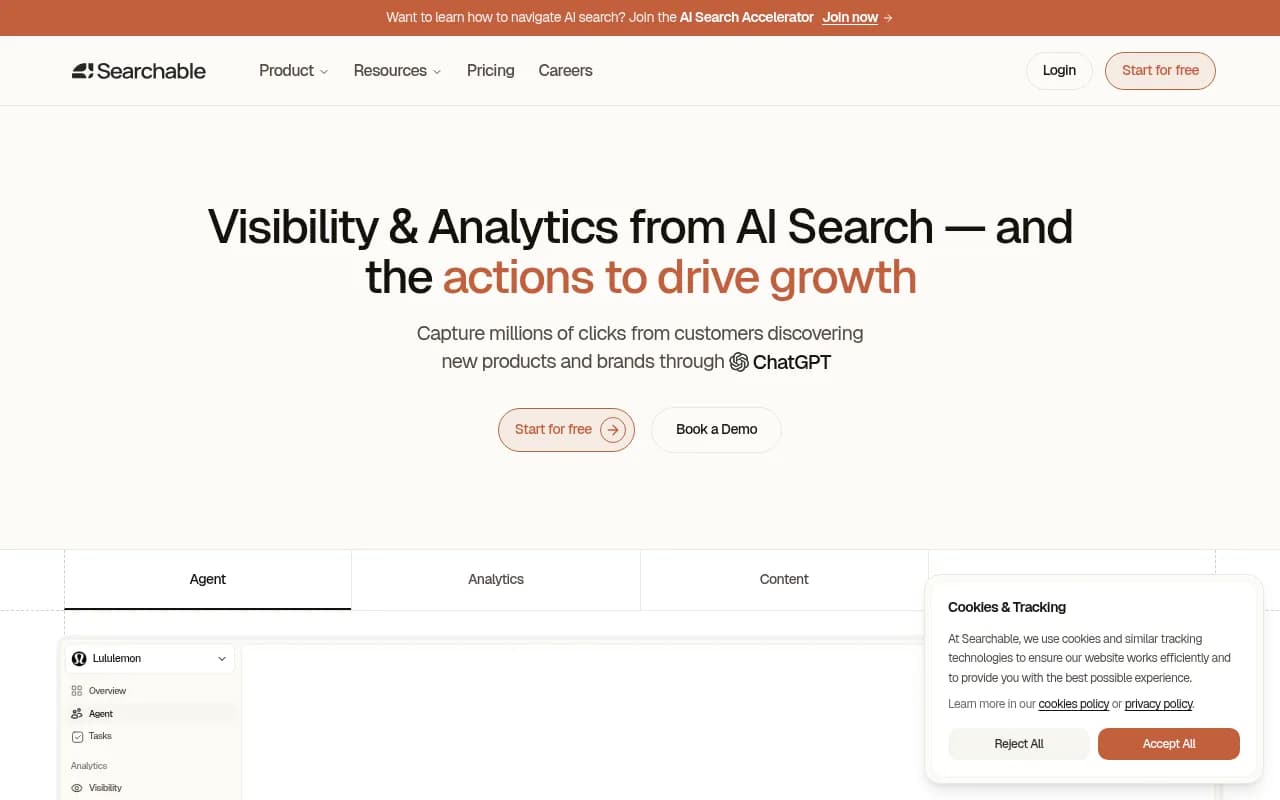
Searchable: solid monitoring, limited action layer
Searchable positions itself as an AI search visibility platform with both monitoring and content tools. It tracks brand mentions across several major AI models and gives you visibility scores over time. The interface is clean and the onboarding is relatively quick.
Where Searchable does well: the monitoring side is genuinely useful. You get brand mention tracking, some competitive benchmarking, and basic prompt coverage reports. For a team that's just getting started with GEO and wants a clear picture of where they stand, it's a reasonable entry point.
The gaps become apparent when you try to go deeper. Searchable doesn't expose AI crawler logs, so you can't see which pages ChatGPT or Perplexity are actually crawling, how often they return, or what errors they're hitting. That matters because a lot of AI visibility problems are technical -- the model isn't citing you because it can't properly index your content, not because the content is bad.
The content tooling in Searchable is also fairly surface-level. You can get some suggestions, but there's no grounding in real citation data. It won't tell you that 880 million analyzed citations suggest a particular content angle performs well for your category. It's more like a checklist than a content engine.
For attribution, Searchable is limited. There's no server log integration, no code snippet for tracking AI-referred sessions, and no GSC connection to close the loop between AI visibility and actual traffic. You're left inferring.
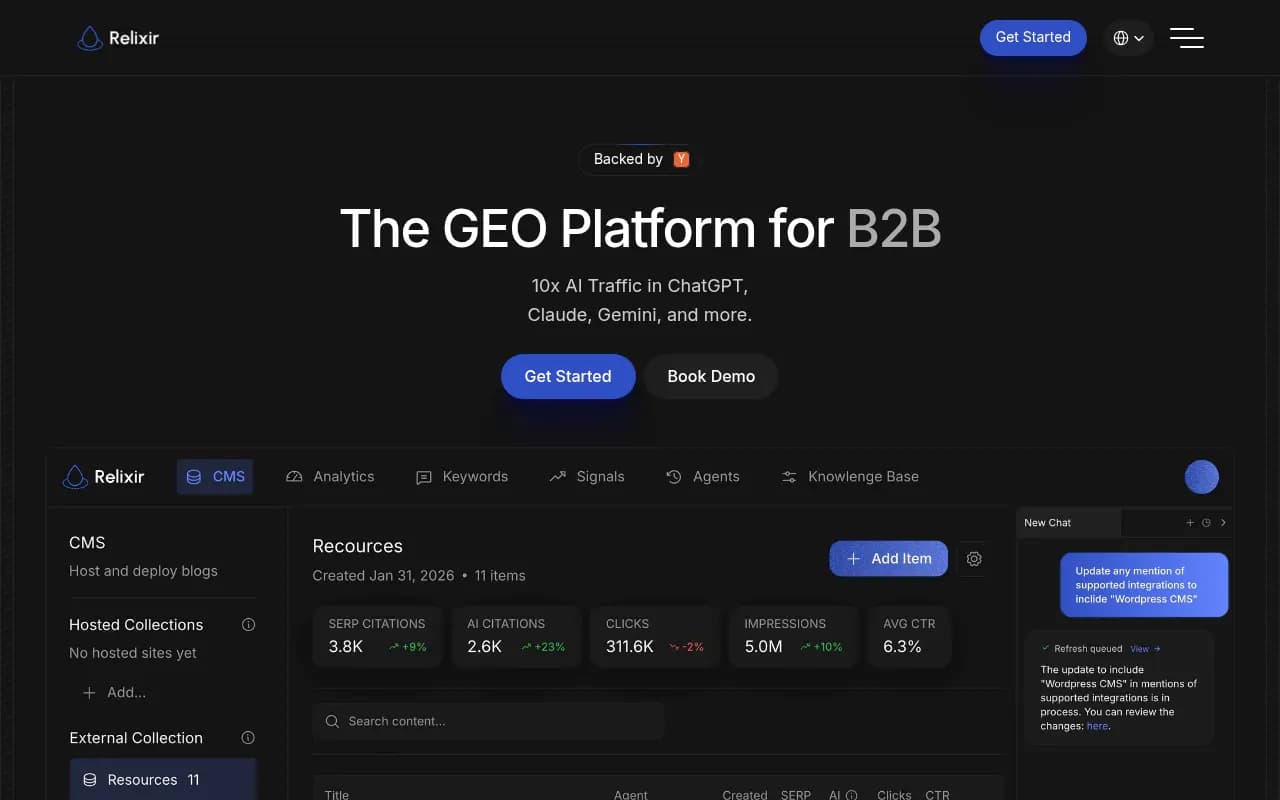
Relixir: interesting CMS angle, narrower monitoring
Relixir takes a different approach. It's built around the idea of an AI-native CMS -- the platform can autonomously generate and publish content designed to rank in AI search. That's genuinely interesting, and for teams that want to move fast on content production, it's appealing.
The autonomous publishing angle is Relixir's strongest differentiator. You can set up content workflows that generate articles, listicles, and comparison pages based on GEO-relevant prompts, and the platform handles the publishing side. If volume is your bottleneck, this helps.
But Relixir's monitoring layer is narrower than you'd want for a platform making "all-in-one" claims. It covers fewer AI models than Promptwatch, and the prompt intelligence -- things like volume estimates, difficulty scores, and query fan-outs that show how one prompt branches into sub-queries -- isn't as developed. You can generate a lot of content quickly, but without strong signal about which prompts are worth targeting, you risk producing content that doesn't move the needle.
There's also no Reddit or YouTube tracking. That might sound like a niche feature, but it's actually important: AI models like ChatGPT and Perplexity frequently cite Reddit threads and YouTube videos in their responses. If you don't know which discussions are influencing AI recommendations in your category, you're missing a real optimization lever.
Attribution in Relixir is better than Searchable's but still not complete. The platform tracks content performance, but connecting that to actual revenue requires external tooling.
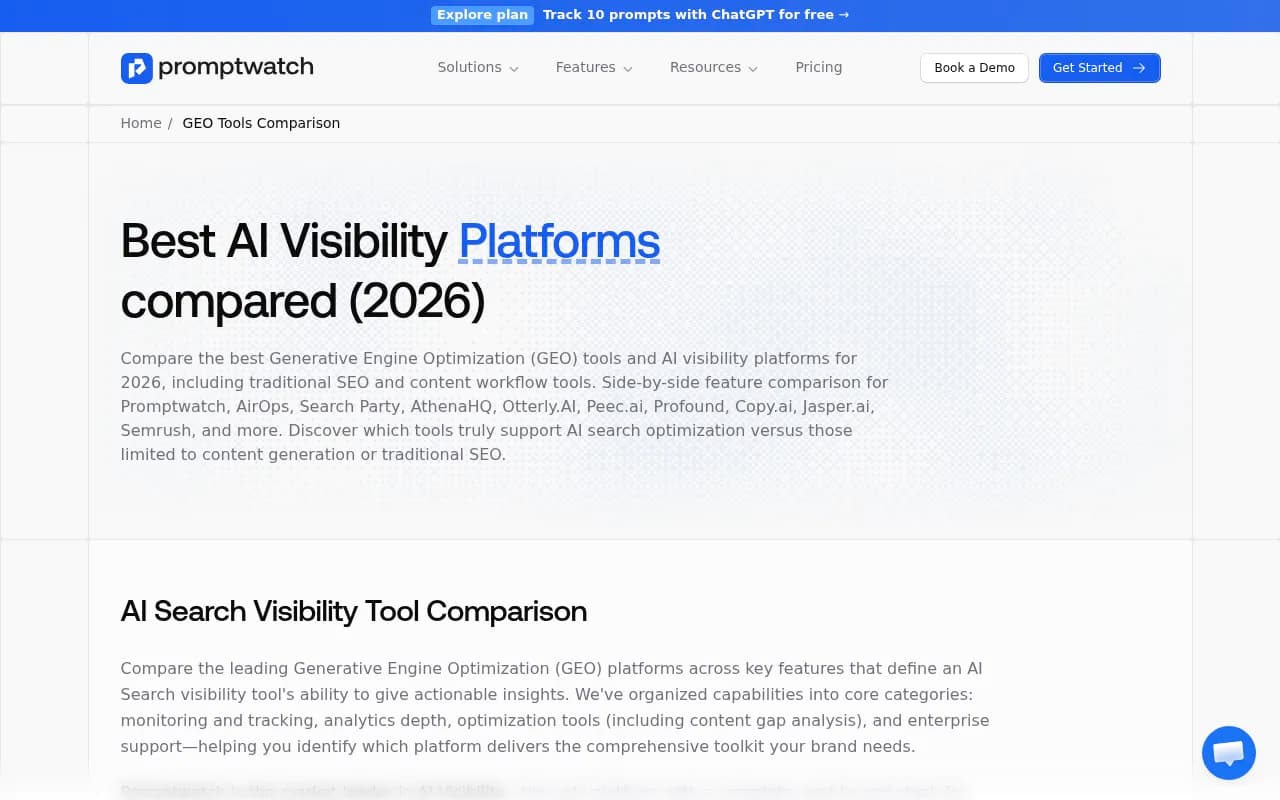
Promptwatch: the full loop
Promptwatch is the platform that most directly addresses all four stages of the GEO workflow. It's used by 6,700+ brands and agencies -- Booking.com and Center Parcs among them -- and its data (over 1.1 billion citations, clicks, and prompts processed) gives it a signal advantage that newer platforms can't replicate quickly.
The monitoring layer covers 10 AI models: ChatGPT, Perplexity, Google AI Overviews, Google AI Mode, Claude, Gemini, Meta/Llama, DeepSeek, Grok, Mistral, and Copilot. You get brand mention tracking, page-level citation data, competitor heatmaps, and multi-language/multi-region support with customizable personas.
What separates Promptwatch from Searchable and Relixir is the Answer Gap Analysis. This shows you exactly which prompts competitors are visible for that you're not -- not as a vague "opportunity" signal, but as specific prompts with volume estimates and difficulty scores. You can see the content your site is missing and prioritize by what's actually winnable.
From there, the built-in AI writing agent generates content grounded in real citation data. It's not generic SEO filler -- it's engineered around what AI models actually cite, with prompt volumes and competitor analysis baked in. Articles, listicles, comparisons: the formats that tend to get cited.
The AI Crawler Logs feature is something neither Searchable nor Relixir offers at the same depth. You can see in real time which AI crawlers are hitting your site, which pages they're reading, how often they return, and what errors they're encountering. This is the technical layer that most GEO teams are completely blind to.
For attribution, Promptwatch closes the loop three ways: a code snippet for tracking AI-referred sessions, Google Search Console integration, and server log analysis. You can connect AI visibility improvements to actual revenue, which is what every marketing team eventually needs to justify the investment.

Feature comparison
| Feature | Searchable | Relixir | Promptwatch |
|---|---|---|---|
| AI models monitored | ~5-6 | ~5-6 | 10 |
| Prompt volume & difficulty scores | Limited | Limited | Yes |
| Answer gap analysis | Basic | No | Yes (full) |
| AI crawler logs | No | No | Yes |
| Content generation | Basic | Yes (autonomous) | Yes (citation-grounded) |
| Reddit & YouTube tracking | No | No | Yes |
| ChatGPT Shopping tracking | No | No | Yes |
| Query fan-outs | No | No | Yes |
| AI traffic attribution | No | Partial | Yes (3 methods) |
| Multi-language/region | Limited | Limited | Yes |
| Looker Studio / API | No | No | Yes |
| Free trial | Yes | Yes | Yes |
Pricing reality check
Pricing in this category is all over the place, so it's worth being direct.
Promptwatch runs $99/month at the Essential tier (1 site, 50 prompts, 5 articles), $249/month for Professional (2 sites, 150 prompts, 15 articles, crawler logs, state/city tracking), and $579/month for Business (5 sites, 350 prompts, 30 articles). Agency and enterprise pricing is custom. There's a free trial.
Searchable and Relixir both have free trials and their entry pricing is broadly comparable to Promptwatch's Essential tier, though feature depth at each tier differs significantly. Relixir's autonomous publishing can look attractive on a per-article cost basis if you're producing high volumes, but the weaker monitoring means you may be publishing into the dark.
The honest framing: if you're paying for a GEO platform and it can't tell you which content to create, can't show you what AI crawlers are doing on your site, and can't connect visibility to revenue -- you're paying for a dashboard, not a platform.
Which tool is right for which team
The right choice depends on where your biggest bottleneck is.
If your team is just starting with GEO and needs a simple way to understand your current AI visibility, Searchable is a reasonable starting point. It's accessible and the learning curve is low. But expect to outgrow it.
If content volume is your primary constraint and you have strong in-house monitoring capabilities already, Relixir's autonomous CMS angle is worth exploring. It can move fast. Just go in knowing the monitoring and attribution layers will need supplementing.
If you need a platform that actually closes the loop -- from identifying which prompts to target, to generating content that gets cited, to proving the traffic impact to your CMO -- Promptwatch is the most complete option available in 2026. The crawler logs alone are worth the price for any team that's been frustrated by AI visibility improvements that don't seem to translate to traffic.
For agencies managing multiple clients, Promptwatch's multi-site support, white-label reporting, Looker Studio integration, and API access make it the practical choice. Searchable and Relixir don't have the same agency infrastructure.
The monitoring-only trap
One thing worth naming directly: there's a real risk in the GEO market right now of paying for monitoring and calling it optimization. A lot of platforms -- not just these three, but across the category -- have built impressive-looking dashboards that show you visibility scores, brand mention counts, and competitor comparisons. That data is useful. But it's the beginning of the work, not the end.
The teams that are actually winning in AI search in 2026 are the ones who've figured out the content side. They know which prompts to target, they're producing content that AI models want to cite, and they're tracking whether it's working. That requires a platform that does more than monitor.
The gap between "we know we're invisible" and "we fixed it and here's the revenue impact" is where most GEO programs stall. The platform you pick determines whether you can cross that gap or just stare at it.
Bottom line
Searchable is a decent monitoring tool. Relixir is an interesting content-first bet. Promptwatch is the only platform in this comparison that genuinely covers the full GEO workflow -- monitoring, gap analysis, content generation, crawler intelligence, and attribution -- without requiring you to stitch together multiple tools.
For most marketing and SEO teams taking AI search seriously in 2026, that completeness is what matters. The goal isn't a better dashboard. It's more citations, more traffic, and a clear line between the two.