Key takeaways
- Most AI content platforms can tell you what to write, but few can prove whether what you wrote actually got cited by ChatGPT, Perplexity, or Google AI Overviews.
- Promptwatch is the only platform in this comparison that completes the full loop: find content gaps, generate citation-engineered articles, then track whether those specific pages are being cited.
- AirOps is a strong content production engine with solid GEO research behind it, but its citation tracking is limited compared to dedicated AI visibility tools.
- Atomic AGI combines SEO and LLM tracking in one interface and is worth considering for teams that want a unified dashboard without paying enterprise prices.
- Searchable offers monitoring and some content tools, but lacks the depth of citation data and content generation that the other three provide.
Why "getting cited" is the only metric that matters now
Something shifted in 2025. Brands that used to obsess over page-one rankings started asking a different question: "Does ChatGPT mention us?"
The answer, for most of them, was no. And the follow-up question -- "what do we do about it?" -- is where the real differences between these four platforms show up.
AirOps published a report on the 2026 state of AI search that put some hard numbers around the problem. Only 30% of brands stay visible from one AI answer to the next. Pages not updated quarterly are three times more likely to lose citations. About 48% of citations come from community platforms like Reddit and YouTube, not from brand-owned domains.
Those numbers reframe the whole conversation. Getting cited by AI isn't a vanity metric -- it's the new version of ranking. And the tools you use to chase it need to do more than show you a dashboard.
So let's look at what each of these four platforms actually does, where they're strong, and where they fall short.
The four platforms at a glance
Before getting into the details, here's a quick comparison across the dimensions that matter most for content engineering and citation proof:
| Feature | Promptwatch | AirOps | Atomic AGI | Searchable |
|---|---|---|---|---|
| AI citation tracking | Yes (10 models) | Limited | Yes (LLMs + Google) | Yes (basic) |
| Content gap analysis | Yes (Answer Gap Analysis) | Yes (research-driven) | Yes | Limited |
| AI content generation | Yes (citation-grounded) | Yes (core feature) | Yes | Yes |
| Crawler logs (AI bots) | Yes | No | No | No |
| Page-level citation tracking | Yes | No | Partial | No |
| Reddit/YouTube citation data | Yes | Research only | No | No |
| ChatGPT Shopping tracking | Yes | No | No | No |
| Traffic attribution | Yes (GSC, snippet, logs) | No | No | No |
| Prompt volume/difficulty | Yes | No | Yes | No |
| Pricing starts at | $99/mo | Custom | Custom | Custom |
Promptwatch: the full loop, not just the data
Promptwatch is built around a specific idea: monitoring without action is just expensive anxiety. Most platforms show you that you're invisible in AI search. Promptwatch shows you that, then helps you fix it, then proves whether the fix worked.

The core workflow goes like this. Answer Gap Analysis identifies the exact prompts where competitors are getting cited but you aren't. You can see the specific topics and questions that AI models want to answer but can't find on your site. From there, the built-in writing agent generates articles grounded in 880M+ analyzed citations -- not generic SEO content, but pieces engineered around what AI models actually cite. Then page-level tracking shows whether those specific pages start getting picked up.
That last part is what separates Promptwatch from almost everything else in this space. It's not enough to publish content and hope. Promptwatch's crawler logs show you when ChatGPT, Claude, or Perplexity actually visits your pages, which pages they read, how often they return, and what errors they hit. You can watch the loop close in real time.
A few other things worth knowing. Promptwatch tracks 10 AI models including ChatGPT, Claude, Gemini, Perplexity, Google AI Overviews, Google AI Mode, Grok, DeepSeek, Copilot, and Meta AI. It surfaces Reddit and YouTube discussions that directly influence AI recommendations -- a channel most competitors ignore. And it tracks ChatGPT Shopping carousels, which matters a lot for e-commerce brands.
Pricing is transparent: $99/mo for the Essential plan (1 site, 50 prompts, 5 articles), $249/mo for Professional (2 sites, 150 prompts, 15 articles, crawler logs), and $579/mo for Business (5 sites, 350 prompts, 30 articles). There's a free trial.
The honest limitation: if you're primarily a content production shop that needs to output hundreds of articles per month, Promptwatch's article limits may feel constraining at lower tiers. It's optimized for quality and citation-grounding over raw volume.
AirOps: content production with GEO thinking baked in
AirOps approaches the problem from the content side rather than the monitoring side. It's primarily a content operations platform -- workflows, AI writing, scaling -- but it's put real effort into understanding what makes content get cited by AI models.
Their 2026 State of AI Search report is genuinely useful research (it's where several of the statistics in this guide come from). The finding that 85% of brand mentions originate from third-party pages rather than owned domains, for instance, has real implications for how you build a content strategy. AirOps uses this kind of research to inform what it builds.
Where AirOps is strong: if you need to produce a high volume of structured, AI-optimized content at scale, it's a capable platform. The workflow tooling is mature. Teams that need to brief, draft, review, and publish dozens of articles per week will find it handles that pipeline well.
Where it's weaker: AirOps isn't primarily a citation tracking tool. You can produce content through it, but you won't get the same depth of visibility into whether that content is actually being cited by specific AI models. There's no crawler log showing you when Perplexity visits your pages. There's no prompt-level difficulty scoring to help you prioritize. The monitoring side is thinner than the production side.
For teams that already have a monitoring tool and just need a production engine, AirOps is worth a look. For teams that want the full loop in one place, it's not quite there.
Atomic AGI: unified SEO and LLM tracking
Atomic AGI takes a different angle. It's trying to be the platform where traditional SEO tracking and LLM visibility live together, so you're not running two separate tools and trying to reconcile the data.
The appeal is real. Most marketing teams are still running Google Search Console and a rank tracker alongside whatever AI visibility tool they've adopted. Atomic AGI argues you shouldn't have to. Its dashboard tracks Google rankings and LLM citations in the same interface, which reduces context-switching and makes it easier to see how the two channels interact.
The content generation side exists too -- Atomic AGI can produce AI-optimized articles -- and the platform has a useful blog covering best practices for AI search tracking. For teams new to GEO, that educational layer has value.
The honest trade-off: Atomic AGI is a solid unified tracker, but it doesn't go as deep on any single capability as the specialists do. The citation data isn't as granular as Promptwatch's. The content production isn't as mature as AirOps'. The prompt intelligence (volume estimates, difficulty scoring, query fan-outs) is present but not as developed. If you're a smaller team that wants one tool instead of three, it's a reasonable choice. If you're a larger brand where each capability needs to be best-in-class, you may find yourself wanting more depth.
Searchable: monitoring with content tools attached
Searchable is an AI search visibility platform that combines monitoring with some content optimization features. It's a reasonable entry point for teams just starting to think about AI visibility.
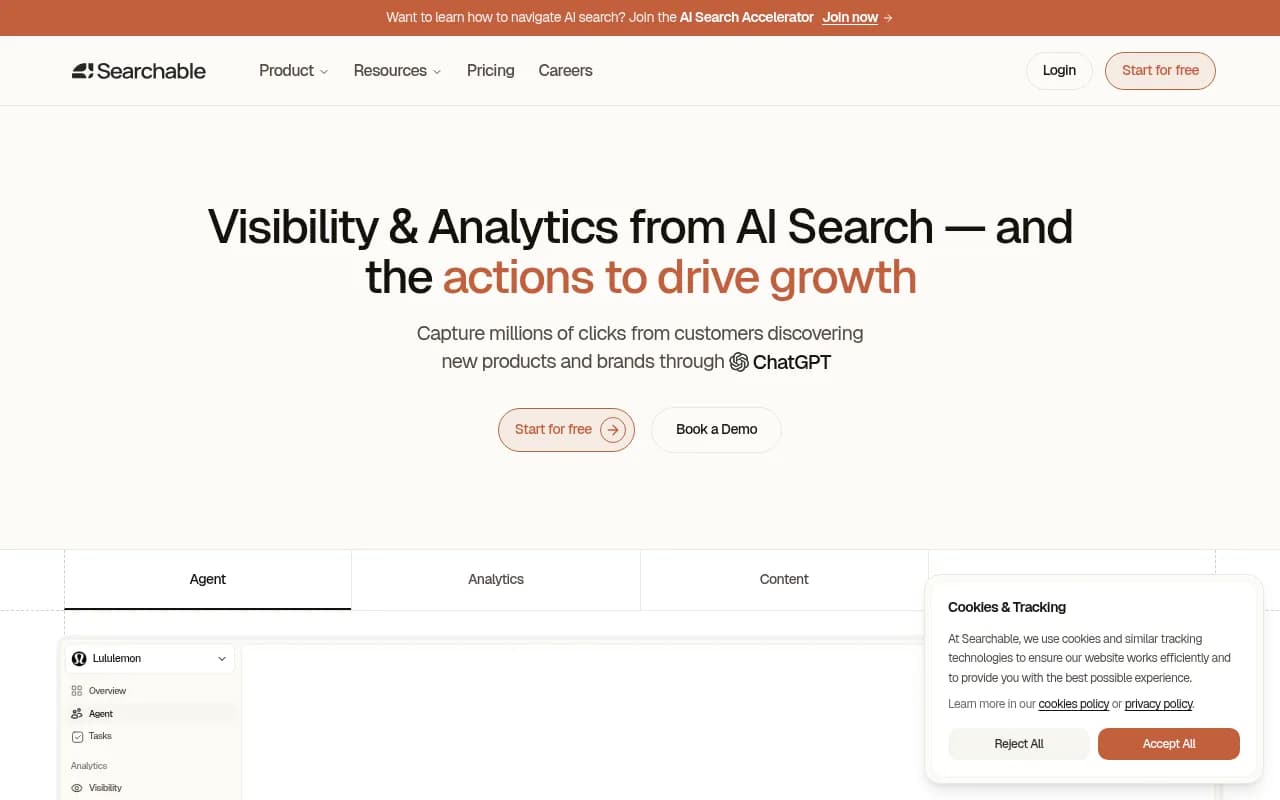
The monitoring side covers the main AI models and gives you a view of brand mentions and citation share. The content tools help you identify topics and optimize existing pages. For smaller teams or brands with limited budgets, it's a functional starting point.
Where Searchable falls short in this comparison: it doesn't have the citation data depth that Promptwatch brings (no crawler logs, no Reddit/YouTube citation tracking, no ChatGPT Shopping monitoring). The content generation is more basic. There's no equivalent to Promptwatch's Answer Gap Analysis that shows you the specific prompts where competitors are winning. And there's no traffic attribution to connect AI visibility to actual revenue.
It's not a bad tool -- it's just a less complete one. If you're choosing between these four and citation proof is the goal, Searchable is the weakest option for that specific use case.
The citation proof problem: who actually solves it?
Here's the core question this guide is trying to answer: which platform can actually prove that the articles it helped you create are getting cited?
This is harder than it sounds. You can publish content and then manually check whether ChatGPT mentions it when you ask relevant questions. But that's not proof -- it's anecdote. Real citation proof requires:
- Page-level tracking that shows which specific URLs are being cited by which AI models
- Crawler logs that show when AI bots visit those pages (so you know they've been indexed)
- Traffic attribution that connects AI citations to actual visits and conversions
- Enough prompt coverage to be statistically meaningful, not just a handful of test queries
Only one platform in this comparison does all four: Promptwatch. The crawler logs are particularly distinctive -- seeing that Perplexity crawled your new article three days after you published it, then started citing it two weeks later, is the kind of evidence that lets you actually learn what works.
AirOps gets you to step one (publishing content that's structured for AI citation) but doesn't close the loop on steps two through four. Atomic AGI handles step one and partial step two. Searchable handles step one at a basic level.
Which platform is right for your situation?
The honest answer depends on what problem you're actually trying to solve.
If you want the complete loop -- gap analysis, content creation, citation tracking, traffic attribution -- Promptwatch is the clearest choice. It's the only platform here that was built specifically to answer the question "did our content get cited, and did that citation drive revenue?"
If you're primarily a content production team that needs to scale output and already has a monitoring tool, AirOps is worth evaluating. Its GEO research is solid and the production workflows are mature.
If you want traditional SEO and LLM tracking in one dashboard and don't need deep citation proof, Atomic AGI is a reasonable unified option, especially for smaller teams.
If you're just starting out and want basic AI visibility monitoring with some content guidance, Searchable is a functional entry point -- but expect to outgrow it as your program matures.
One thing worth noting: the market for these tools is moving fast. Platforms that were monitoring-only a year ago are adding content features. Platforms that were content-only are adding tracking. The gap between them is narrowing, but Promptwatch's head start on the full loop -- and the 880M+ citations it's analyzed to train its content recommendations -- is a meaningful advantage that takes time to replicate.
A note on the broader landscape
These four platforms aren't the only options. The AI visibility space now has 28+ tools by some counts, and new ones keep appearing.
For teams evaluating the broader market, a few others worth knowing about:

Profound has a strong feature set for enterprise teams, though at higher price points and without Reddit tracking or ChatGPT Shopping monitoring.

AthenaHQ covers 8+ AI search engines and is solid for monitoring, though it's more tracking-focused than optimization-focused.

Otterly.AI is one of the more affordable monitoring options, though it stops at monitoring -- no crawler logs, no content generation, no traffic attribution.
The pattern across the market is consistent: most tools are good at showing you the problem. Fewer are good at helping you fix it. And almost none can prove the fix worked. That last capability is what makes the difference between a monitoring subscription and an actual growth tool.
Bottom line
The question in the title -- which platform proves its articles get cited -- has a clear answer in 2026. Promptwatch is the only one of these four that tracks the full journey from content gap to published article to AI citation to traffic attribution. That's not a minor feature difference; it's a fundamentally different product philosophy.
AirOps, Atomic AGI, and Searchable all have their place depending on your team's priorities and budget. But if citation proof is the goal, the loop needs to close. Right now, only one platform closes it.