Key takeaways
- Most GEO platforms stop at monitoring -- they show you visibility scores but leave you to figure out what to do next
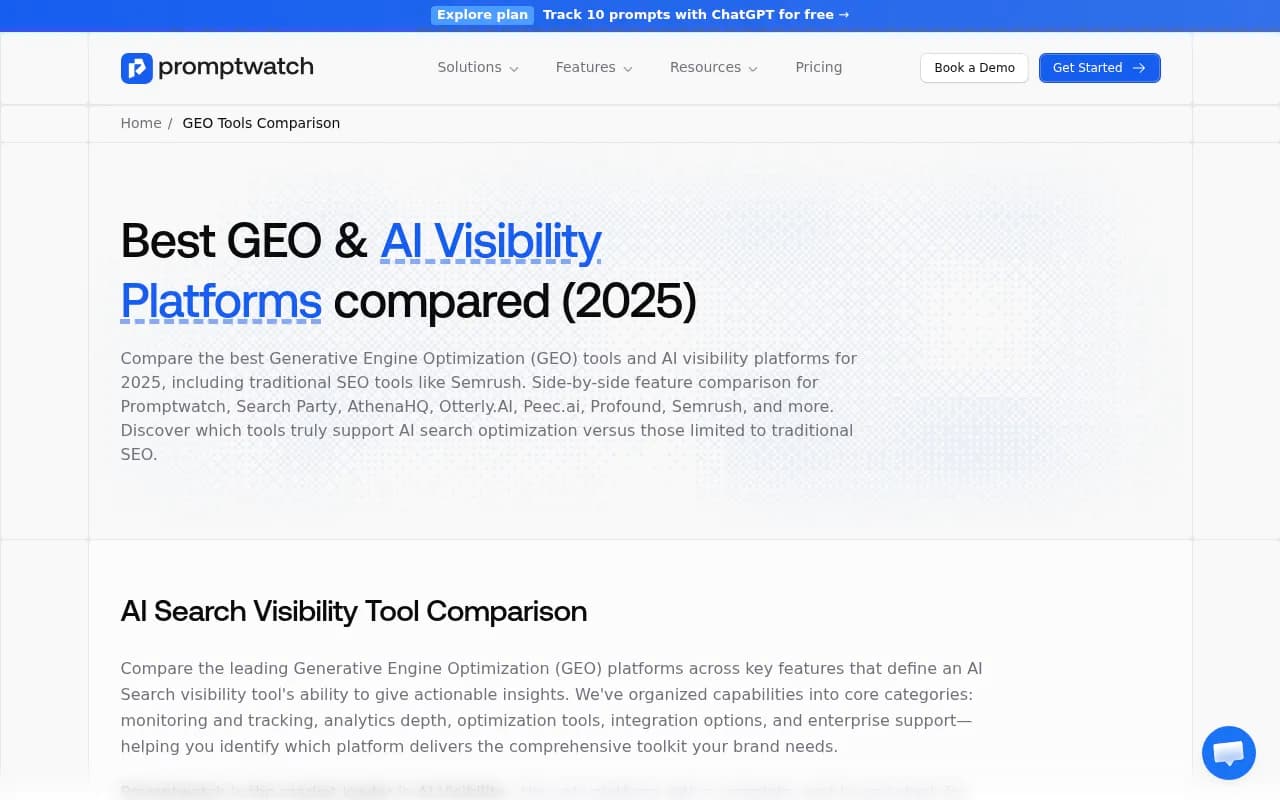
- Promptwatch is the only platform in this comparison with a full action loop: gap analysis, AI content generation, and traffic attribution in one place
- Profound has solid enterprise monitoring but no content creation or crawler log access
- Relixir brings an AI-native CMS angle but is narrower in model coverage and analytics depth
- Searchable covers the basics at a lower price point but lacks the depth enterprise teams need for competitive markets
The GEO platform market in 2026 looks a lot like the early SEO tool market circa 2012: crowded, confusing, and full of products that mostly do the same thing while claiming to be completely different. Every vendor promises "AI visibility." Most deliver a dashboard with some brand mention counts and a competitor comparison chart.
If you're evaluating platforms at the enterprise level, that's not enough. You need to know which prompts your competitors are winning that you're not, why AI models are or aren't citing your content, and -- critically -- what to actually do about it.
This comparison covers four platforms that come up most often in enterprise GEO conversations: Searchable, Profound, Promptwatch, and Relixir. I've tried to be direct about what each one does well, where each one falls short, and which type of team should use which tool.
What "enterprise GEO" actually requires
Before getting into the platforms, it's worth being clear about what enterprise teams actually need from a GEO platform -- because "enterprise" gets thrown around loosely.
At the enterprise level, you're typically dealing with:
- Multiple brands or product lines, each needing separate tracking
- Large prompt libraries (hundreds of queries across different personas and regions)
- A need to connect AI visibility to actual revenue, not just brand mentions
- Teams that include both SEO strategists and content creators who need to act on data
- Reporting requirements for executives who want to see ROI
A monitoring-only tool can satisfy the first two. The last three require something more. That's the lens I'm using here.
The four platforms at a glance
| Feature | Promptwatch | Profound | Searchable | Relixir |
|---|---|---|---|---|
| AI models tracked | 10 (ChatGPT, Claude, Gemini, Perplexity, Grok, DeepSeek, Copilot, Mistral, Meta AI, Google AI Overviews) | 6-8 | 5-6 | 4-5 |
| Content gap analysis | Yes | Limited | No | Partial |
| AI content generation | Yes (built-in writing agent) | No | No | Yes (AI-native CMS) |
| Crawler logs | Yes | No | No | No |
| Prompt volume/difficulty | Yes | No | No | No |
| Reddit/YouTube tracking | Yes | No | No | No |
| ChatGPT Shopping tracking | Yes | No | No | No |
| Traffic attribution | Yes (GSC, snippet, server logs) | Limited | No | No |
| Multi-language/region | Yes | Yes | Limited | Limited |
| Agency/multi-client | Yes | Yes | Yes | No |
| Starting price | $99/mo | ~$200/mo | ~$99/mo | Custom |
| Free trial | Yes | Yes | Yes | Demo only |
Promptwatch: the platform that actually helps you fix things
Promptwatch is the most complete platform in this comparison. It's the one I'd recommend to any team that wants to move beyond tracking and start actually improving their AI visibility.

The core difference is what Promptwatch calls the action loop. Most platforms tell you where you're visible and where you're not. Promptwatch goes further: it shows you the specific prompts your competitors are winning that you're not (Answer Gap Analysis), generates content designed to close those gaps (the built-in AI writing agent), and then tracks whether that content actually gets cited. You close the loop with traffic attribution via GSC integration, a code snippet, or server log analysis.
That's a genuinely different workflow from "here's your visibility score, good luck."
A few capabilities worth calling out specifically:
The AI crawler logs are something no other platform in this comparison offers. You can see exactly which AI crawlers (ChatGPT, Claude, Perplexity, etc.) are hitting your site, which pages they're reading, and what errors they're encountering. If Perplexity's crawler keeps hitting a 404 on your most important product page, you'll see it. That kind of diagnostic data is invaluable and almost entirely absent from competitor platforms.
Prompt Intelligence is also genuinely useful at the enterprise level. You get volume estimates and difficulty scores for each prompt, plus query fan-outs that show how one prompt branches into sub-queries. This lets you prioritize which content to create first -- high-volume, winnable prompts -- rather than guessing.
The Reddit and YouTube tracking is a feature most teams don't think about until they realize that AI models heavily cite Reddit threads and YouTube videos in their responses. Knowing which discussions are shaping AI recommendations in your category is the kind of insight that changes content strategy.
Pricing runs from $99/month (Essential, 1 site, 50 prompts) to $579/month (Business, 5 sites, 350 prompts), with agency and enterprise pricing available. The 880M+ citations analyzed and 1.1B+ prompts processed give the platform a data foundation that smaller competitors can't match.
The main limitation: the platform has a learning curve. There's a lot here, and teams that just want a simple brand mention tracker may find it more than they need. But for enterprise teams that want to actually move the needle on AI visibility, it's the most capable option available.
Profound: solid monitoring, limited action
Profound is a well-regarded enterprise monitoring platform. It covers the major AI models, provides competitive benchmarking, and has a clean interface that enterprise teams tend to appreciate.

What Profound does well: the monitoring layer is genuinely good. You get brand mention tracking across multiple AI engines, sentiment analysis, and competitive share-of-voice data. The reporting is polished enough to share with executives without a lot of cleanup.
What Profound doesn't do: help you fix anything. There's no content gap analysis, no built-in content generation, no crawler logs, and no prompt volume data. You can see that your competitor is getting cited more than you for a given query category, but Profound won't tell you which specific prompts are driving that gap or what content you'd need to create to close it.
For large enterprises with dedicated content teams who just need a monitoring and reporting layer, Profound is a reasonable choice. But if your team needs to actually do something with the data -- and most do -- you'll end up exporting CSVs and figuring out the rest manually.
Pricing is on the higher end for what you get. The platform targets enterprise accounts, and the pricing reflects that, but the feature set doesn't justify the premium over Promptwatch for most use cases.
Searchable: accessible but shallow
Searchable is positioned as an accessible entry point into AI visibility monitoring. The interface is clean, setup is quick, and the pricing is reasonable.
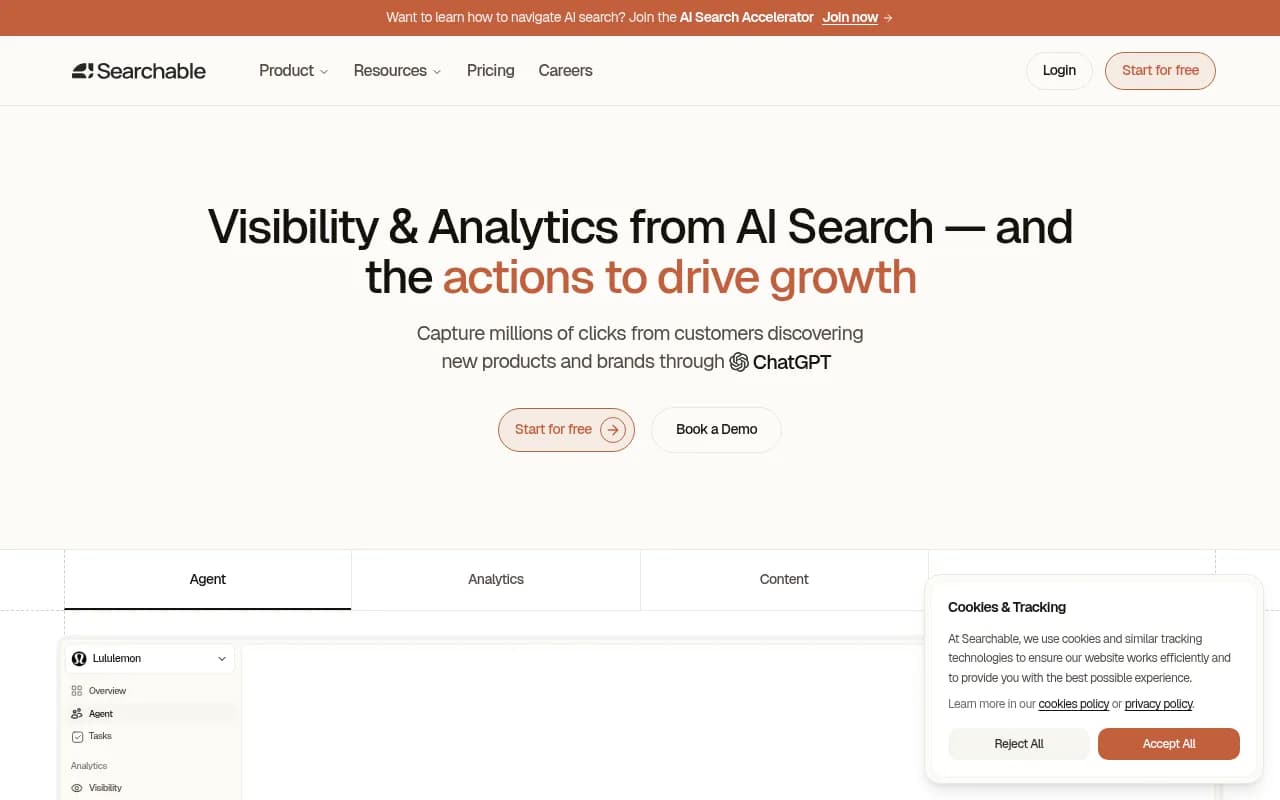
The platform covers the core use case: tracking brand mentions across several AI engines, comparing visibility against a handful of competitors, and generating basic reports. For small marketing teams or companies just starting to think about GEO, it gets you oriented.
The limitations become apparent quickly at the enterprise level. Model coverage is narrower than Promptwatch or Profound. There's no content gap analysis, no content generation, no crawler logs, and no traffic attribution. Prompt volume data isn't available, so prioritization is guesswork. Multi-language and multi-region support is limited.
Searchable is fine for a team that needs basic AI visibility monitoring and doesn't have budget for a more comprehensive platform. It's not the right tool for enterprise teams that need to compete seriously in AI search.
Relixir: interesting angle, narrower scope
Relixir takes a different approach from the other three. It's built around an AI-native CMS concept -- the idea that content creation and GEO optimization should be tightly integrated from the start.
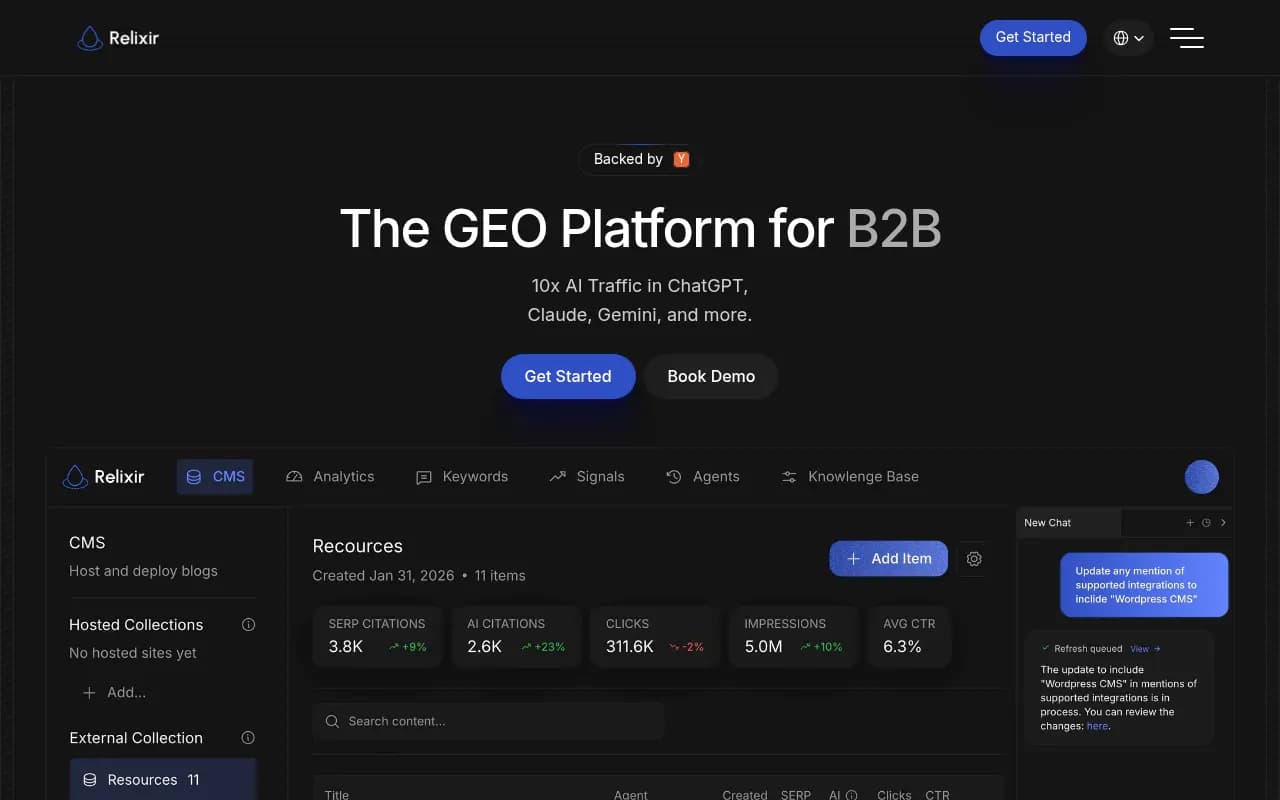
The content generation capabilities are real. Relixir can produce content that's designed to be cited by AI models, and the CMS integration means you're not copy-pasting between tools. For teams that want a tighter content workflow, that's genuinely useful.
The monitoring side is where Relixir falls short relative to Promptwatch and Profound. Model coverage is narrower (roughly 4-5 engines versus Promptwatch's 10). There's no crawler log access, no prompt volume data, and the competitive intelligence layer is less developed. Traffic attribution is limited.
Relixir also doesn't offer multi-client or agency functionality in the same way, which limits its appeal for agencies managing multiple brands.
The platform is best suited to content-forward teams at mid-market companies that want to build AI-optimized content without a complex monitoring setup. For enterprise teams that need the full picture -- monitoring, diagnostics, competitive intelligence, and content -- it's not a complete solution.
How the platforms stack up on the things that matter most
Monitoring depth
Promptwatch and Profound are the clear leaders here. Both cover the major AI engines with meaningful depth. Promptwatch's 10-model coverage is the broadest in this comparison, and the crawler log data adds a diagnostic layer that monitoring dashboards alone can't provide.
Searchable and Relixir are adequate for basic tracking but won't give you the granular data enterprise teams need.
Content gap analysis and optimization
This is where the gap between Promptwatch and the rest of the field is widest. Promptwatch's Answer Gap Analysis is the only tool in this comparison that shows you the specific prompts your competitors are winning that you're not -- with enough specificity to actually act on. Relixir has some gap-detection capability, but it's less developed. Profound and Searchable don't offer this at all.
Content generation
Promptwatch and Relixir both have built-in content generation. Promptwatch's writing agent is grounded in citation data (880M+ citations analyzed), which means the content it generates is informed by what AI models actually cite -- not just generic SEO principles. Relixir's content generation is solid but less data-driven.
Profound and Searchable have no content generation capabilities.
Traffic attribution
Promptwatch is the only platform in this comparison with meaningful traffic attribution. The ability to connect AI visibility to actual website traffic and revenue -- via GSC integration, a code snippet, or server log analysis -- is what separates a GEO platform from a brand monitoring tool. None of the other three platforms come close here.
Pricing and value
| Platform | Entry price | Best for |
|---|---|---|
| Promptwatch | $99/mo | Teams that need monitoring + optimization + content |
| Profound | ~$200/mo | Large enterprises that need polished monitoring/reporting |
| Searchable | ~$99/mo | Small teams needing basic AI visibility monitoring |
| Relixir | Custom | Content-forward teams wanting AI-native CMS + GEO |
Promptwatch offers the best value at the enterprise level because it replaces multiple tools: a monitoring platform, a content gap analysis tool, and a content generation tool. Profound costs more and does less. Searchable costs less and does significantly less. Relixir's pricing is opaque (custom/demo-only), which makes it hard to evaluate for budget-conscious teams.
Which platform should you choose?
The honest answer depends on what you actually need to do.
If you need to monitor AI visibility and report on it to stakeholders, Profound is a reasonable choice. The reporting is polished and the monitoring is solid. But you'll need other tools to act on the data.
If you're just getting started with GEO and have a limited budget, Searchable gets you oriented without a big investment. Don't expect it to scale with you.
If your team is content-first and you want an integrated CMS and content generation workflow, Relixir is worth a look. Just know that the monitoring and analytics layer is thinner than you might need.
If you need to actually improve your AI visibility -- not just measure it -- Promptwatch is the platform to use. The combination of Answer Gap Analysis, AI content generation grounded in citation data, crawler logs, and traffic attribution is something none of the other three platforms can match. It's the only tool in this comparison that takes you from "here's where you're invisible" to "here's the content that will fix it" to "here's proof it worked."
For enterprise teams that are serious about competing in AI search, that full loop is what matters. Monitoring without optimization is just expensive awareness of a problem you're not solving.

A note on the broader market
These four platforms represent different philosophies about what a GEO tool should be. Profound and Searchable are monitoring-first. Relixir is content-first. Promptwatch is the only one that treats monitoring and optimization as two halves of the same workflow.
That distinction matters more as AI search matures. In 2024, just knowing whether you appeared in ChatGPT responses was interesting. In 2026, that's table stakes. The teams winning in AI search are the ones that understand why they're appearing (or not), what content gaps they need to fill, and whether the content they're creating is actually moving the needle.
The platforms that help you do all three are the ones worth paying for.