Key takeaways
- Searchable's pricing starts around $199/month but lacks several capabilities that matter for serious AI visibility work, including content generation, crawler logs, and Reddit/YouTube tracking.
- Most GEO platforms in this price range are monitoring-only dashboards -- they show you data but don't help you act on it.
- The tools that deliver the best value in 2026 combine tracking with content gap analysis and actual content creation.
- If you're paying for AI visibility software, you should be getting more than a dashboard. The best alternatives close the loop between finding gaps and fixing them.
- Promptwatch is the only platform in this category rated as a "Leader" across all evaluation criteria, and it costs less than several monitoring-only competitors.
Searchable has been around long enough to build a reputation as a solid AI visibility monitoring tool. And it is solid -- for monitoring. You can track brand mentions across ChatGPT, Perplexity, and a handful of other models. You get visibility scores. You get competitor comparisons.
But here's the thing: once you've seen the data, Searchable largely leaves you on your own to figure out what to do with it. And in 2026, with AI search eating into traditional organic traffic faster than most marketing teams expected, "here's your score, good luck" isn't really enough.
This guide breaks down what Searchable actually costs, what you're getting for that money, and which alternatives are worth your attention -- especially if you want a platform that helps you move the needle, not just measure it.
What Searchable charges in 2026
Searchable's pricing sits in the mid-market range for GEO platforms. Based on publicly available information, plans start around $199/month for basic brand monitoring across a limited set of AI models, with higher tiers running into the $400-600/month range for additional prompts, models, and team seats.
That's not outrageous for the category. But the question isn't whether the price is reasonable in isolation -- it's whether you're getting enough for that price compared to what else is available.
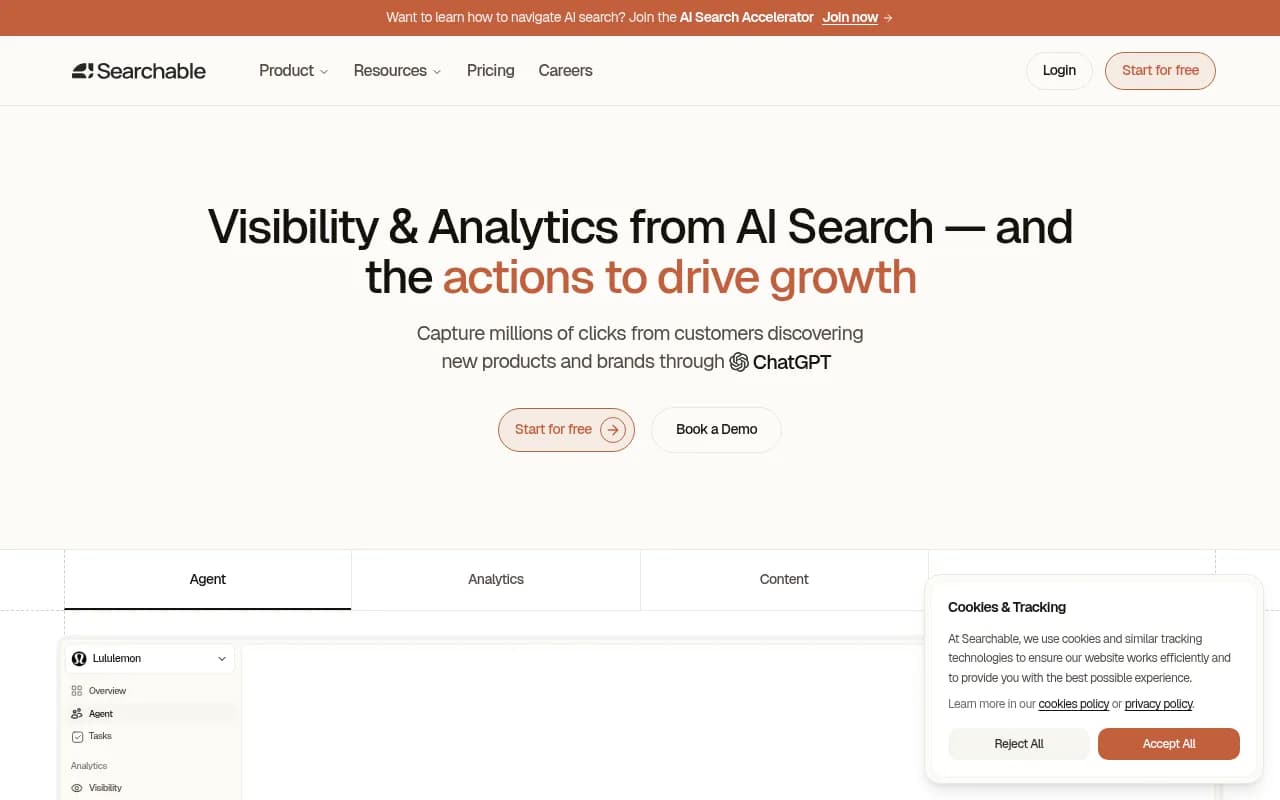
Here's what Searchable includes at most tiers:
- Brand mention tracking across select AI models
- Visibility scoring and share-of-voice metrics
- Competitor comparison dashboards
- Basic prompt monitoring
Here's what's notably absent, even at higher tiers:
- AI crawler logs (which pages AI bots are actually visiting on your site)
- Content gap analysis (which prompts competitors rank for that you don't)
- Built-in content generation to fix those gaps
- Reddit and YouTube tracking (two sources that heavily influence AI citations)
- ChatGPT Shopping monitoring
- Prompt volume and difficulty scoring
- Traffic attribution to connect AI visibility to actual revenue
That list of missing features isn't a minor quibble. These are the capabilities that turn a monitoring tool into an optimization tool. If you're paying $400/month to watch your visibility score and then manually trying to figure out what to write about, you're doing half the job yourself.
The monitoring-only problem
Most GEO platforms launched in 2023 and 2024 with the same basic architecture: query AI models, record whether your brand appeared, display the results in a dashboard. That was genuinely useful when the category was new. Marketers needed to understand that AI search was happening and that their brand might not be showing up.
That's table stakes now. The question in 2026 isn't "am I visible in AI search?" -- it's "why aren't I visible for these specific prompts, and what do I do about it?"
Searchable, like several of its peers, was built around answering the first question. The second one requires a different architecture entirely.
To actually improve your AI visibility, you need to know:
- Which prompts your competitors are winning that you're not (gap analysis)
- What content those prompts are citing and why (source analysis)
- What you should create to close those gaps (content strategy)
- Whether the content you create actually gets cited (page-level tracking)
- Whether those citations drive real traffic (attribution)
Searchable handles parts of step 4 and maybe some of step 1. The rest is on you.
How Searchable compares to the field
Here's a direct comparison of Searchable against the main alternatives across the capabilities that actually matter for AI visibility optimization:
| Platform | Monitoring | Content gap analysis | Content generation | Crawler logs | Reddit/YouTube tracking | Traffic attribution | Starting price |
|---|---|---|---|---|---|---|---|
| Searchable | Yes | Limited | No | No | No | No | ~$199/mo |
| Otterly.AI | Yes | No | No | No | No | No | ~$99/mo |
| Peec.ai | Yes | No | No | No | No | No | ~$79/mo |
| AthenaHQ | Yes | Limited | No | No | No | No | ~$299/mo |
| Profound | Yes | Yes | No | No | No | Limited | ~$499/mo |
| Promptwatch | Yes | Yes | Yes | Yes | Yes | Yes | $99/mo |
The pattern is pretty clear. Most platforms in this space are monitoring dashboards at various price points. Promptwatch is the outlier -- it's the only one that covers the full loop from tracking to gap analysis to content creation to attribution, and it starts cheaper than Searchable.

Better alternatives to Searchable in 2026
Promptwatch -- best overall value
If you're currently paying for Searchable and feeling like you're stuck after seeing the data, Promptwatch is the most direct upgrade. It monitors 10 AI models (ChatGPT, Claude, Perplexity, Gemini, Grok, DeepSeek, Copilot, Meta AI, Google AI Overviews, and Google AI Mode), but the monitoring is just the starting point.
The Answer Gap Analysis shows you exactly which prompts your competitors are getting cited for that you're not. Not vague topic suggestions -- specific prompts, with volume estimates and difficulty scores so you can prioritize the ones worth going after.
Then there's the built-in AI writing agent. It generates articles, listicles, and comparison pages grounded in citation data from over 880 million analyzed citations. This isn't generic content -- it's built around what AI models actually cite, which is meaningfully different from what ranks well in traditional Google search.
The crawler logs are something most platforms don't even attempt. You can see in real time which AI crawlers (ChatGPT's GPTBot, Claude's ClaudeBot, Perplexity's crawler) are visiting your site, which pages they're reading, and whether they're hitting errors. That's genuinely useful for diagnosing why certain pages aren't getting cited.
Pricing starts at $99/month for the Essential plan (1 site, 50 prompts, 5 articles). The Professional plan at $249/month adds crawler logs, city/state tracking, and 15 articles per month. Business is $579/month for 5 sites and 30 articles.
For context: Searchable's mid-tier is more expensive than Promptwatch's Professional plan, and Promptwatch Professional includes capabilities Searchable doesn't have at any price.
Profound -- best for enterprise teams with budget
Profound is a strong platform with genuinely good analytics. It covers the major AI models, has solid competitor analysis, and the interface is well-designed. The gap analysis is more developed than Searchable's.
The catch is price. Profound sits at the higher end of the market, typically $499/month and up, and it still doesn't include content generation or Reddit/YouTube tracking. You're paying enterprise prices for a monitoring and analysis tool. That's fine if you have a dedicated content team that can act on the insights -- less fine if you need the platform to help you create the content too.

AthenaHQ -- decent monitoring, limited optimization
AthenaHQ covers 8+ AI engines and has a clean interface. The monitoring is solid and the competitor heatmaps are useful for understanding where you stand relative to the field.
What it doesn't do is help you fix what it finds. There's no content gap analysis in the traditional sense, no content generation, no crawler logs. It's a monitoring tool at a monitoring-tool price, which is fine if that's all you need -- but if you're comparing it to Searchable, you're essentially choosing between two dashboards.

Otterly.AI -- cheapest entry point for basic monitoring
If your only goal is to get a basic read on whether your brand is appearing in AI responses, Otterly.AI is the cheapest way to do that. It's genuinely affordable and covers the main models.
The limitations are significant though. No gap analysis, no content tools, no attribution. It's a starting point, not a strategy. Worth considering if you're just beginning to explore AI visibility and want to understand the category before committing to a more capable platform.

Peec.ai -- good for multi-language monitoring
Peec.ai's standout feature is multi-language support. If you're running campaigns in multiple markets and need to monitor AI visibility across languages and regions, it handles that better than most. The core monitoring is solid.
Like Otterly.AI, it stops at monitoring. No content tools, no attribution, no crawler logs. But for international brands that need language-specific tracking, it's worth a look.

Scrunch AI -- focused on brand narrative
Scrunch AI takes a slightly different angle -- it's more focused on how AI models describe your brand and whether those descriptions are accurate and favorable. That's useful for brand reputation work, less useful for pure visibility optimization.
If your concern is "AI is saying inaccurate things about us" rather than "AI isn't mentioning us enough," Scrunch AI is worth evaluating. For pure visibility growth, it's not the right fit.
What to actually look for when evaluating GEO tools
Before you switch from Searchable (or evaluate any platform in this category), here's a practical checklist of questions to ask:
Does it show you gaps, not just scores? A visibility score tells you where you are. A gap analysis tells you what to do next. These are very different things.
Can it help you create content, or just identify what's missing? Knowing you need more content about "best project management tools for remote teams" is step one. Having a tool that can generate a well-researched article on that topic, grounded in what AI models actually cite, is step two.
Does it track AI crawler activity on your site? This is underrated. If GPTBot is crawling your site but hitting 404 errors on your most important pages, you want to know that. Most platforms don't surface this at all.
Can it connect visibility to revenue? At some point, your CMO is going to ask whether the AI visibility work is driving results. Tools that can tie citations to traffic (via GSC integration, a code snippet, or server log analysis) let you answer that question. Tools that only show visibility scores don't.
Does it cover the sources that influence AI citations? Reddit threads and YouTube videos show up in AI citations more than most people realize. If your platform isn't tracking those, you're missing part of the picture.
The honest verdict on Searchable
Searchable is a competent monitoring tool. If you need a clean dashboard showing your brand's AI visibility across major models, it delivers that. The interface is decent, the data is reasonably reliable, and the competitor comparison features are useful.
The problem is that "competent monitoring tool" describes a lot of platforms in this space, several of which cost less. And none of them -- including Searchable -- help you actually improve your visibility unless you're willing to do the strategy and content work yourself.
In 2026, the platforms that justify their price tags are the ones that close the loop: find the gaps, generate the content, track the results. Searchable handles maybe one of those three steps well.
If you're already paying for Searchable and getting value from the monitoring, that's fine. But if you're frustrated that the data doesn't translate into clear action, or if you're looking for a first GEO platform and want something that does more than report, the alternatives above -- particularly Promptwatch -- are worth a serious look.
The category has matured enough that "we show you your visibility score" is no longer a compelling value proposition on its own. The tools that will matter in the next 12 months are the ones that help you do something about it.