Key takeaways
- Qwairy and Promptwatch both cover 10+ AI models and offer content tools, but their philosophies differ significantly
- Qwairy leads on breadth of AI model coverage (38+ individual models) and includes a backlink marketplace at a lower starting price
- Promptwatch is the only platform with AI crawler logs, page-level citation tracking, Reddit/YouTube insights, and ChatGPT Shopping data in one place
- For teams that want to monitor and act -- not just monitor -- Promptwatch's content generation and gap analysis workflow is more complete
- Qwairy's €79/month entry price makes it accessible for smaller teams; Promptwatch starts at $99/month with a free trial
The GEO tools market has gotten genuinely crowded in 2026. A year ago, most teams were still debating whether AI search visibility even needed dedicated tooling. Now there are 20+ platforms fighting for the same budget line, and the differences between them actually matter.
Qwairy and Promptwatch are two of the more fully-featured options in that field. Both go beyond basic mention tracking. Both have content tools. Both claim to help you act on what you find. But they're built around different assumptions about what GEO teams actually need, and those differences show up quickly once you get into the details.
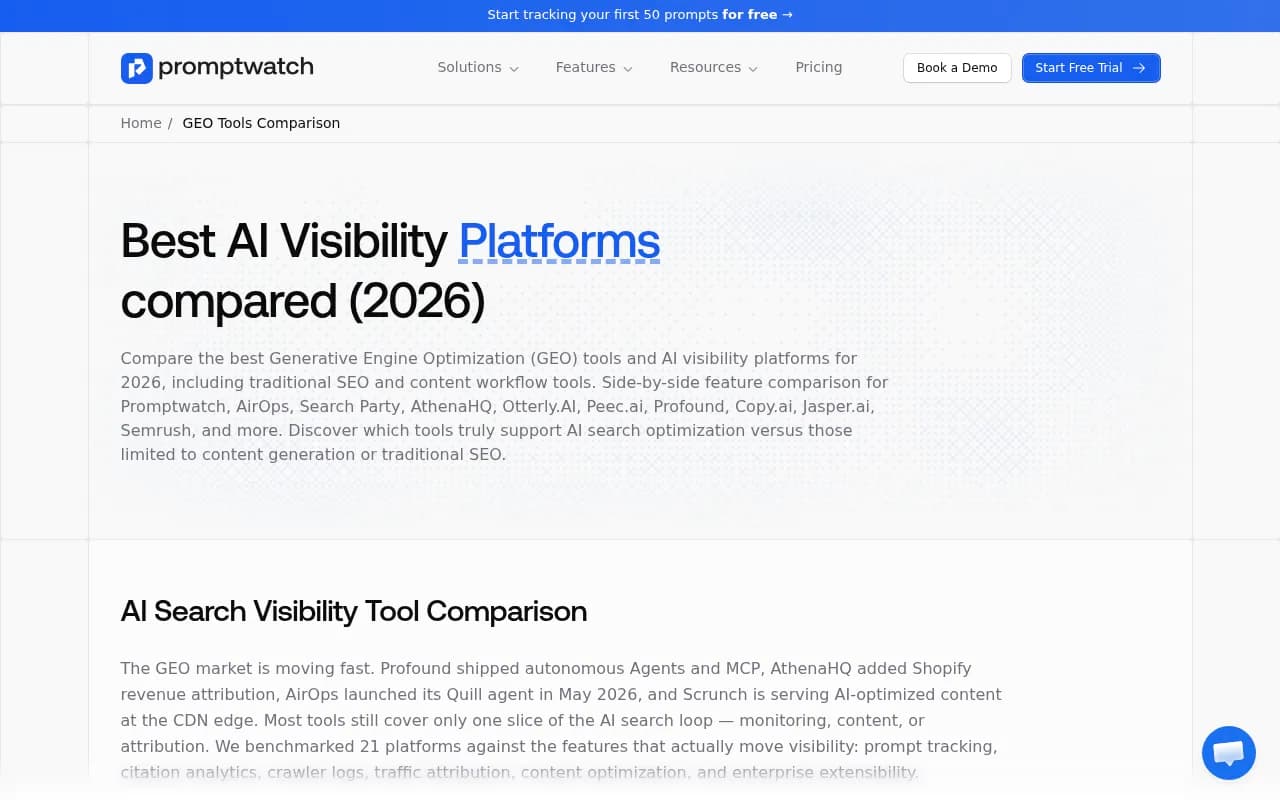
This breakdown covers every major feature category -- AI model coverage, monitoring depth, content tools, crawler data, attribution, and pricing -- so you can make a clear decision without having to book five demos.
What each platform is trying to do
Before getting into features, it helps to understand the design philosophy behind each tool.
Qwairy positions itself as a broad-coverage platform. Its pitch is that it tracks more AI models (38+ individual models across 10+ providers) than anyone else, and bundles monitoring with a content studio, MCP server, and a backlink marketplace -- all from a single subscription with no per-provider surcharges. The framing is: get everything in one place without paying extra as you add AI engines.
Promptwatch is built around what it calls the action loop: find gaps, create content, track results. The idea is that monitoring data is only useful if it leads somewhere. So the platform connects prompt tracking and citation analysis directly to content generation tools and then back to traffic attribution. It's less about raw model count and more about closing the loop between "we're not visible here" and "we published something that fixed it."
Neither approach is wrong. They just suit different teams.
AI model coverage
Both platforms cover the main engines your customers are actually using: ChatGPT, Claude, Gemini, Perplexity, Copilot, Grok, Google AI Overviews, Google AI Mode, Mistral, and DeepSeek.
Where Qwairy differentiates is in the depth of model-level tracking. It tracks 38+ individual models within those providers -- so you're not just seeing "ChatGPT" as a monolith but getting data broken down by model version. That matters if you're trying to understand why your visibility differs between GPT-4o and GPT-4.5, for example.
Promptwatch tracks 10 AI models across the same major providers, with a focus on how those models behave in real user interfaces rather than just API outputs. This distinction is worth paying attention to: the answer a user sees in the ChatGPT web app can differ from what the API returns, and Promptwatch specifically tracks the UI-facing responses. That's where your actual customers are.
For most GEO teams, coverage of the 10 major engines is sufficient. If you're running enterprise-level research across model versions, Qwairy's 38+ model breakdown is genuinely useful.
Monitoring depth and prompt intelligence
Both platforms let you track custom prompts and see where your brand appears (or doesn't) in AI responses. But the data layers around that core function differ.
Promptwatch adds prompt volume estimates and difficulty scores, so you can prioritize which prompts are worth optimizing for. It also surfaces query fan-outs -- the sub-queries an AI model generates internally when answering a broader question. That's useful because AI engines don't just answer the exact prompt; they decompose it, and knowing those sub-queries tells you what content to create.
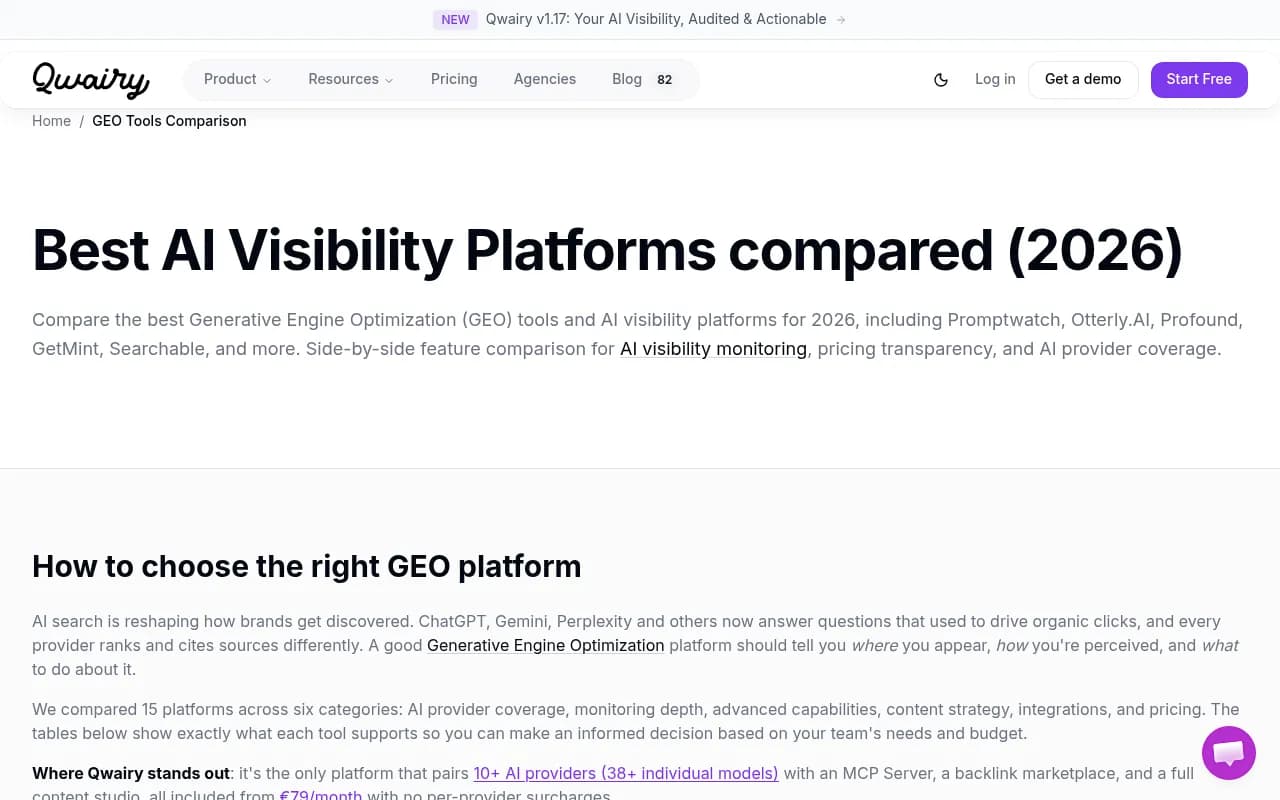
Qwairy's monitoring includes sentiment analysis and share of voice tracking, which are solid for brand health reporting. Its comparison tables (visible in its platform) show feature-by-feature breakdowns across 15 platforms, which is a useful research tool in itself.
One area where Promptwatch has a clear edge: Answer Gap Analysis. This feature shows you the specific prompts where competitors are getting cited but you're not -- not as a vague "you're missing coverage here" signal, but as a list of actual prompts with actual competitor citations. That's the kind of data that turns into a content brief, not just a slide in a quarterly report.
Content tools
Both platforms have content generation capabilities, which already puts them ahead of monitoring-only tools like Otterly.AI or Peec.ai.
Qwairy includes a content studio as part of its subscription. It's designed to help teams create content informed by their visibility data, and it's bundled without extra cost at the base tier.
Promptwatch's Content Agents generate articles, listicles, comparisons, and briefs grounded in real prompt data, citation data, prompt volumes, persona targeting, search results, screenshots, brand guidance, and competitor analysis. The key word there is "grounded" -- the content isn't generic AI output, it's built around the specific gaps the platform has already identified. You go from gap analysis to brief to published article within the same workflow.
The pricing tier matters here. Promptwatch's Essential plan ($99/month) includes 5 articles per month. Professional ($249/month) gives you 15, and Business ($579/month) gives you 30. Qwairy bundles content studio access from its base tier at €79/month, which is a meaningful cost difference for smaller teams.
AI crawler logs and technical visibility
This is where the platforms diverge most sharply.
Promptwatch's AI Crawler Logs (available on Professional and above) show real-time logs of AI crawlers hitting your website -- which pages they read, errors they encounter, how often they return, and when a page moves from "crawled" to "cited." You can see ChatGPT, Claude, Perplexity, and other crawlers in the log, understand which content they're consuming, and fix indexing issues before they become visibility problems.
Qwairy does not appear to offer equivalent crawler log functionality. This is a significant gap if you're trying to understand why your content isn't being cited, not just that it isn't.
The crawler log data also feeds into Promptwatch's attribution model. By connecting website integrations (Cloudflare, Fastly, Vercel, server logs, Google Search Console, or a tracking snippet), you can trace the path from AI crawler visit to citation to actual traffic and revenue. That's a level of attribution most GEO platforms -- including Qwairy -- don't offer.

Citation and source analysis
Both platforms track citations -- the specific URLs that AI models link to in their responses. But Promptwatch goes further with offsite citation analysis, tracking which external pages, Reddit threads, YouTube videos, and third-party domains are driving AI visibility outside your own site.
The Reddit and YouTube tracking is worth calling out specifically. AI models like Perplexity and ChatGPT frequently cite Reddit discussions and YouTube content in their responses. If a Reddit thread is driving citations to a competitor and you don't know it exists, you're missing an optimization opportunity. Qwairy doesn't appear to offer Reddit or YouTube-specific insights.
Promptwatch also tracks ChatGPT Shopping -- when your brand appears in ChatGPT's product recommendations and shopping carousels. For e-commerce brands, this is increasingly important as ChatGPT's shopping features expand.
Competitor analysis
Both platforms offer competitor heatmaps and share-of-voice comparisons. You can see which brands are winning for specific prompts and how your visibility stacks up across AI engines.
Promptwatch's competitor heatmaps show visibility by LLM, so you can see if you're strong on Perplexity but weak on ChatGPT, and which competitors are filling that gap. Combined with the Answer Gap Analysis, this becomes actionable: you know exactly which prompts to target and which competitors you're losing to.
Qwairy's competitive analysis is solid for reporting purposes -- the kind of data that goes into a monthly visibility report for a client or stakeholder.
Integrations and technical setup
Qwairy includes an MCP server, which is notable. MCP (Model Context Protocol) is becoming a standard for connecting AI tools to external data sources, and having it built in means Qwairy can plug into AI agent workflows more easily.
Promptwatch connects through Cloudflare, Fastly, Vercel, server logs, Google Search Console, or a JavaScript tracking snippet. It also has a Looker Studio integration and an API for custom reporting. The website integrations are what enable the low-latency crawler log data -- you're not just polling AI APIs, you're seeing actual crawl activity on your infrastructure.
Pricing comparison
| Qwairy | Promptwatch | |
|---|---|---|
| Entry price | €79/month | $99/month |
| Mid tier | ~€149/month | $249/month |
| Top tier | ~€299/month | $579/month |
| Free trial | Yes | Yes |
| Content generation | Included from base | 5-30 articles/month by tier |
| Crawler logs | Not available | Professional+ ($249/mo) |
| AI models tracked | 38+ individual models | 10 major engines |
| Reddit/YouTube tracking | No | Yes |
| ChatGPT Shopping | No | Yes |
| Backlink marketplace | Yes | No |
| MCP server | Yes | No |
| Per-provider surcharges | No | No |
Qwairy's pricing is more accessible at the entry level, and the bundled content studio means you're not paying extra for basic content tools. Promptwatch's higher tiers are justified if you need crawler logs, traffic attribution, and the full content generation workflow -- those features don't exist in Qwairy.
Feature comparison summary
| Feature | Qwairy | Promptwatch |
|---|---|---|
| AI model coverage | 38+ models, 10+ providers | 10 major engines |
| Real UI tracking (not just API) | Partial | Yes |
| Prompt volume & difficulty scores | No | Yes |
| Query fan-outs | No | Yes |
| Answer gap analysis | Limited | Yes |
| Content generation | Yes (bundled) | Yes (tiered) |
| AI crawler logs | No | Yes (Professional+) |
| Page-level citation tracking | No | Yes |
| Traffic attribution | No | Yes |
| Reddit/YouTube insights | No | Yes |
| ChatGPT Shopping tracking | No | Yes |
| Offsite citation analysis | No | Yes |
| Competitor heatmaps | Yes | Yes |
| Share of voice | Yes | Yes |
| Sentiment analysis | Yes | Yes |
| MCP server | Yes | No |
| Backlink marketplace | Yes | No |
| Multi-language/region | Yes | Yes |
| API access | Yes | Yes |
| Looker Studio integration | No | Yes |
Who should use Qwairy
Qwairy makes the most sense for teams that:
- Need broad model-level coverage and want to track 38+ individual AI models
- Are working with tighter budgets and want content tools bundled from the base tier
- Want MCP server integration for AI agent workflows
- Are building or managing a backlink strategy alongside their GEO work
- Need solid monitoring and reporting without the complexity of crawler log analysis
Who should use Promptwatch
Promptwatch is the better fit for teams that:
- Want to close the loop from gap identification to content creation to revenue attribution
- Need AI crawler logs to understand why content isn't being cited
- Are tracking ChatGPT Shopping or need Reddit/YouTube citation data
- Want page-level visibility tracking tied to actual traffic
- Are running GEO programs at agencies or brands where proving ROI matters
The core difference is that Promptwatch treats monitoring as the starting point, not the end product. Most GEO teams eventually hit the ceiling of "we know we're not visible, now what?" -- and that's where the content agents, gap analysis, and attribution tools become the actual value.
The honest take
Qwairy is a genuinely capable platform. The 38+ model coverage is real differentiation, the pricing is fair, and the MCP server is a forward-looking feature that will matter more as AI agent workflows become standard. If you're a smaller team or agency that needs solid monitoring with content tools included, it's worth evaluating seriously.
But if your GEO program has matured past "track and report" and you need to actually move the needle -- create content that gets cited, understand why your pages aren't being crawled, and connect visibility to revenue -- Promptwatch covers more of that workflow in one place. The crawler logs alone are something no other platform in this category offers at the same depth.
Both tools offer free trials. The fastest way to decide is to run the same set of prompts through both and see which data you actually want to act on.