Key takeaways
- Otterly.AI built a genuinely useful monitoring product in 2025, covering citation tracking across six AI platforms with a clean interface most teams could pick up quickly
- Its core limitation was always the same: it showed you where you were invisible but gave you no tools to fix it
- By 2026, as GEO shifted from "interesting experiment" to "budget line item," teams started demanding content generation, crawler logs, and traffic attribution alongside monitoring
- Several alternatives now close those gaps, ranging from lightweight trackers to full-stack optimization platforms
- The right tool depends on whether you need monitoring only, or the full loop from gap analysis to content creation to citation tracking
When Otterly.AI launched, it was solving a real problem at the right time. Brands were waking up to the fact that ChatGPT and Perplexity were answering questions their customers used to Google -- and nobody had a clean way to track whether they were being cited or ignored. Otterly stepped in with something usable: citation monitoring across six AI platforms, competitive benchmarking, and alerts when your brand appeared (or didn't).
For 2025, that was enough to get traction. The category was new, expectations were low, and just having a dashboard that showed AI citation data felt like progress.
But 2026 is a different environment. GEO (Generative Engine Optimization) has moved from experimental to operational. Teams aren't just asking "are we visible in AI search?" They're asking "why aren't we visible, what do we publish to fix it, and how do we connect that to revenue?" Otterly.AI's monitoring-only model started showing its limits right around the time those questions got louder.
This guide is an honest look at what Otterly.AI got right, where it fell short, and what teams actually switched to when they needed more.
What Otterly.AI got right in 2025
Citation tracking that actually worked
The core product delivered. Otterly.AI tracked brand mentions and citations across ChatGPT, Perplexity, Google AI Overviews, and a few other platforms, and it did so in a way that was readable by non-technical marketers. You could see which prompts triggered your brand, which competitors showed up instead, and how citation frequency changed over time.
That was genuinely valuable. Most teams in 2025 had no visibility into this at all. They were running traditional SEO reports while AI search quietly ate into their discovery traffic.

The research output was solid
Otterly.AI's blog and research arm produced some of the more cited data in the GEO space. Their analysis of over one million AI citations across ChatGPT, Perplexity, and Google AI Overviews (published in early 2026) surfaced findings that actually changed how teams thought about content strategy.
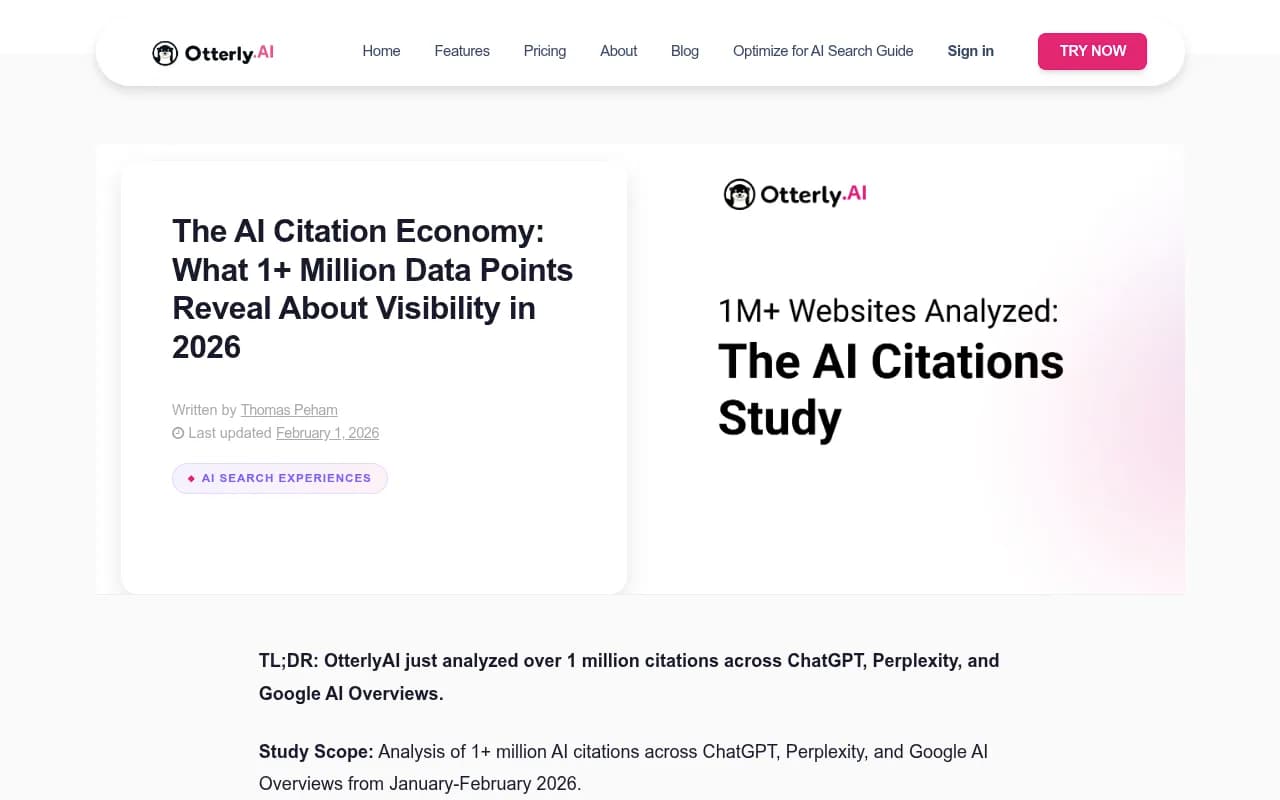
A few findings from that study worth knowing:
- Community platforms like Reddit and Quora capture 52.5% of AI citations vs. 47.5% for brand domains
- 73% of sites have technical barriers (robots.txt, CDN rules, JS rendering) that block AI crawlers entirely
- Reference-grade content with chunked structure and schema markup gets 3-5x more citations than generic pages
That's useful research. It shaped how a lot of teams approached their GEO strategy, even if Otterly.AI itself didn't give them the tools to act on it.
Accessible pricing and onboarding
Otterly.AI positioned itself as affordable and approachable, which mattered in a category where enterprise tools were charging five figures before you'd proven ROI. Smaller marketing teams could get in, run some queries, and build a basic picture of their AI visibility without a lengthy procurement process.
Where it fell short
Monitoring without action
This is the central issue. Otterly.AI shows you data. It doesn't help you do anything with it.
You can see that a competitor is getting cited for "best project management software for remote teams" and you're not. But Otterly.AI won't tell you what content gap is causing that, what article you should write to close it, or how to structure that content so AI models actually cite it. You get the diagnosis without the prescription.
In 2025, that was acceptable. Teams were still figuring out what AI visibility even meant. By 2026, the question shifted to "okay, we know we're invisible -- now what?" and Otterly.AI didn't have an answer.
No crawler logs or AI agent analytics
One of the more important developments in GEO has been understanding how AI crawlers actually behave on your site. Which pages do they read? How often do they return? Are they hitting errors? Is there a lag between when a page gets crawled and when it starts getting cited?
Otterly.AI doesn't surface any of this. You can't see whether GPTBot or ClaudeBot has visited your site, what they found, or why certain pages aren't getting picked up. That's a significant blind spot when you're trying to diagnose why your content isn't being cited despite being technically well-written.
Limited prompt intelligence
Otterly.AI lets you track specific prompts, but it doesn't give you much to work with in terms of prioritization. There's no volume data telling you how often a prompt is actually being asked, no difficulty scoring to help you figure out which gaps are winnable, and no query fan-out analysis showing how one prompt branches into related sub-queries.
The result is that you're essentially guessing which prompts to focus on. That's fine when you're just exploring the space, but it's a problem when you're trying to build a systematic GEO strategy.
No content generation
This one became a dealbreaker for a lot of teams. The whole point of identifying citation gaps is to fill them. But Otterly.AI has no content tools -- no brief generation, no AI writing assistance, no way to go from "we're missing this topic" to "here's a draft article grounded in real prompt data."
Teams were exporting data from Otterly.AI and then switching to a separate tool to actually create content. That friction adds up, and it means the gap analysis and the content creation are never really connected.
Traffic attribution is missing
Knowing you're getting cited is one thing. Knowing whether those citations are driving traffic, leads, or revenue is another. Otterly.AI doesn't connect AI visibility to business outcomes. You can't see whether your improved citation rate in Perplexity is actually moving the needle on conversions.
Why teams switched in 2026
The pattern that emerged across teams that moved away from Otterly.AI was consistent: they outgrew monitoring-only. Once AI search became a real channel with real budget attached to it, the question changed from "are we visible?" to "how do we get more visible, and can we prove it's working?"
That required a different kind of tool.
The alternatives teams moved to
For teams that wanted the full optimization loop
Promptwatch became the most common destination for teams that needed more than monitoring. The core difference is that it's built around an action cycle rather than a dashboard: find gaps, create content, track results.
The Answer Gap Analysis shows exactly which prompts competitors are visible for but you're not -- not just as a list, but with enough context to understand what content is missing. Content Agents then generate articles, comparisons, and briefs grounded in that prompt data. And page-level tracking shows when new content starts getting cited and by which models.
It also has the crawler log functionality that Otterly.AI lacks -- real-time data on which AI agents are hitting your site, what they're reading, and when pages move from crawl to citation.

For teams that needed competitive intelligence depth
Profound is another option that came up frequently, particularly for teams that wanted strong competitive benchmarking. It has a more robust feature set than Otterly.AI and goes deeper on competitor analysis, though it sits at a higher price point.

For teams that wanted multi-language tracking
Peec AI handles multi-language and multi-region monitoring better than most tools in the category, which mattered for European and global brands that found Otterly.AI's coverage thin outside English-language queries.

For teams that wanted something lightweight
Some teams didn't need the full stack -- they just needed better monitoring than Otterly.AI with a few more features. AthenaHQ and Rankshift both fit that profile, offering cleaner prompt tracking and slightly more diagnostic capability without the full optimization layer.

Feature comparison: Otterly.AI vs. the alternatives
| Feature | Otterly.AI | Promptwatch | Profound | Peec AI | AthenaHQ |
|---|---|---|---|---|---|
| Citation tracking | Yes | Yes | Yes | Yes | Yes |
| Competitor benchmarking | Yes | Yes | Yes | Limited | Yes |
| Prompt volume/difficulty | No | Yes | Partial | No | No |
| AI crawler logs | No | Yes | No | No | No |
| Content gap analysis | No | Yes | No | No | No |
| Content generation | No | Yes | No | No | No |
| Traffic attribution | No | Yes | No | No | No |
| Reddit/YouTube tracking | No | Yes | No | No | No |
| ChatGPT Shopping tracking | No | Yes | No | No | No |
| Multi-language support | Limited | Yes | No | Yes | No |
| Free trial | Yes | Yes | Yes | Yes | Yes |
| Starting price | Low | $99/mo | Higher | Mid | Mid |
The bigger picture: what 2025 revealed about GEO tools
Otterly.AI's trajectory is actually a useful lens for understanding how the GEO tool category matured. In 2025, monitoring was the product. Teams needed to see the problem before they could solve it, and any tool that gave them visibility into AI citations was adding value.
But the research Otterly.AI itself published tells a more demanding story. If 73% of sites have technical barriers blocking AI crawlers, and if reference-grade content gets 3-5x more citations, then the job isn't just to measure the gap -- it's to close it. That requires crawler diagnostics, content tooling, and attribution, none of which monitoring-only platforms provide.
Neil Patel made a similar point in a May 2026 video that got some traction: the shift AI CEOs were all pointing to wasn't about models, it was about systems and agents. Your content is now being evaluated by AI agents deciding what to trust, cite, and recommend. Optimizing for that is a systems problem, not a dashboard problem.
That framing explains why teams that started with Otterly.AI in 2025 often found themselves needing something more by mid-2026. The monitoring gave them the awareness. The optimization required a different set of tools.
Should you still use Otterly.AI?
Honestly, it depends on where you are in your GEO journey.
If you're just starting out and need a low-cost way to understand your AI visibility baseline, Otterly.AI is a reasonable starting point. The interface is accessible, the citation data is real, and the price doesn't require a business case to justify.
If you've already done that baseline work and you're now trying to improve your visibility systematically -- identifying gaps, creating content to fill them, tracking whether it's working -- then Otterly.AI will leave you stuck. You'll have a clear picture of the problem and no tools to fix it.
The teams that switched in 2026 weren't switching because Otterly.AI broke. They were switching because they'd outgrown what monitoring alone could do for them. That's a reasonable place to end up, and it's worth knowing before you start.
Choosing the right tool for where you are
The GEO tool market in 2026 has enough options that you can match the tool to your actual situation rather than defaulting to whatever's most visible.
If you want to explore the space without heavy commitment, start with something lightweight. If you're running a systematic GEO program with content production and attribution requirements, you need a platform that covers the full loop. And if you're an agency managing multiple clients across languages and regions, you need something built for that scale.
Otterly.AI served a real purpose in 2025. The question for 2026 is whether that purpose still matches what your team actually needs.