Key takeaways
- Profound is the enterprise-grade option with deep reporting, but its $499/month starting price puts it out of reach for most teams.
- Peec.ai is a clean, prompt-level tracker that works well for mid-market teams -- but it stops at monitoring and won't help you fix what's broken.
- Qwairy positions itself as a GEO strategy platform with optimization features, though it's newer and less proven at scale.
- Promptwatch is the only platform in this comparison that closes the full loop: find gaps, generate content, track results -- all in one place.
The GEO tool market has gotten crowded fast. Eighteen months ago, most marketing teams had never heard of "AI visibility." Now there are dozens of platforms claiming to track your brand across ChatGPT, Perplexity, Claude, and the rest. The hard part isn't finding a tool -- it's figuring out which ones actually help you do something useful with the data.
This comparison focuses on four platforms that come up most often in 2026: Qwairy, Promptwatch, Profound, and Peec.ai. They're not all the same category of product, even if they're often compared in the same breath. Some are monitoring dashboards. Some are optimization platforms. One is trying to be both. Understanding that distinction is the most important thing you can do before you spend money on any of them.
What these platforms actually do (and don't do)
Before getting into the specifics, it helps to understand the two fundamentally different things a GEO tool can be.
The first type is a monitoring dashboard. You give it a list of prompts, it queries AI models on a schedule, and it shows you whether your brand appeared in the responses. That's useful data. But it's passive -- you're watching a scoreboard without getting any help improving your score.
The second type is an optimization platform. It still monitors, but it also tells you why you're invisible for certain prompts, shows you what content is missing, and helps you create the content that will close the gap. This is where the real value is, and it's where most tools fall short.
With that framing in mind, here's how the four platforms stack up.
Qwairy
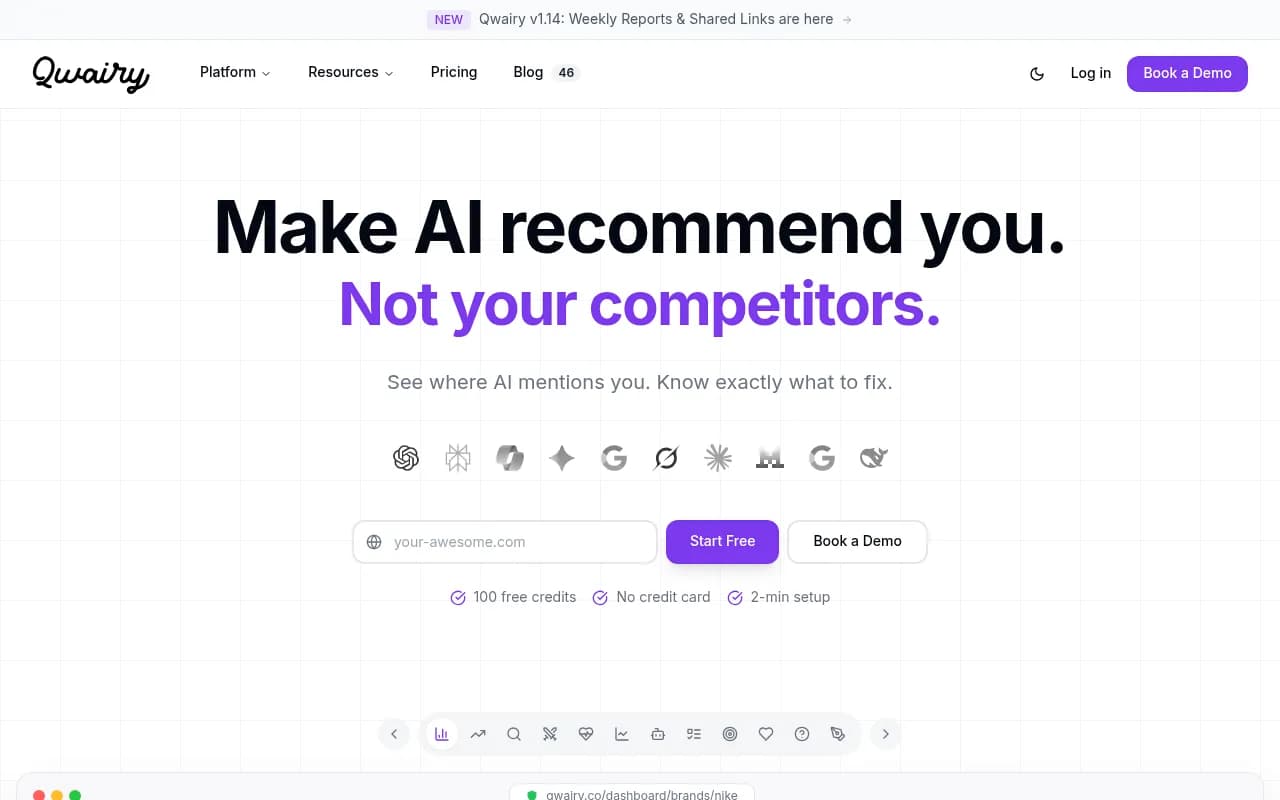
Qwairy markets itself as an "ultimate GEO strategy and optimization platform," which is an ambitious claim for a relatively new entrant. The positioning is right -- GEO needs optimization, not just tracking -- but the execution is still catching up to that vision.
What Qwairy does well is prompt strategy. It helps you think through which prompts to target and how to structure your content around them. For teams that are just starting to think about AI visibility and need a framework, that's genuinely useful.
Where it gets thinner is in the depth of data. Qwairy doesn't have the citation database or the crawler log infrastructure that more established platforms have built. You can get directional guidance, but the specificity -- which exact pages are being cited, which AI models are crawling your site, how often -- isn't there yet.
It's worth watching, but right now it's more of a strategy companion than a full-stack GEO platform.
Peec.ai

Peec.ai is the cleanest pure monitoring tool in this comparison. The interface is fast, the prompt-level tracking is reliable, and the pricing is transparent. Starting at $95/month for 50 prompts across 3 AI models, it's accessible for smaller teams.
The platform tracks visibility across major AI engines, shows you sentiment and mention context, and gives you a decent view of how your brand appears in AI responses over time. For teams that just need to answer "are we showing up?" -- Peec.ai does that job well.
The limitation is that it stops there. There's no content gap analysis. No crawler logs. No content generation. No way to understand why you're not appearing for certain prompts, let alone fix it. One Reddit user in r/webmarketing put it plainly: Peec gives you the data, but "you're still on your own for figuring out what to do with it."
Peec.ai's pricing tiers are worth understanding before you commit:
| Plan | Price | Prompts | Projects | Notable features |
|---|---|---|---|---|
| Starter | $95/mo | 50 | 1 | 3 AI models, daily tracking |
| Pro | $245/mo | 150 | 2 | Email support added |
| Advanced | $495/mo | 350 | 5 | Multi-country, GSC/GA/Looker |
| Enterprise | Custom | Custom | Unlimited | API, SSO, all models |
The Advanced plan at $495/month is where you start getting multi-country tracking and integrations -- but at that price, you're in the same territory as Profound, which offers considerably more depth.
Profound

Profound is the enterprise option in this group. It's well-funded, has a polished dashboard, and goes deeper on reporting than most competitors. If you're a large brand that needs stakeholder-ready visibility reports and has the budget to match, Profound is a serious contender.
The platform covers the major AI engines, tracks brand mentions and sentiment, and gives you competitive benchmarking data. The reporting is genuinely good -- the kind of thing you can put in front of a CMO without embarrassment.
The price reflects all of this. Profound starts at $499/month, and enterprise contracts go significantly higher. For a mid-sized marketing team or a growing brand, that's a hard number to justify when you're still figuring out your GEO strategy.
The other issue is that Profound, like Peec.ai, is primarily a monitoring platform. It shows you where you stand. It doesn't generate content briefs, doesn't have AI crawler logs that show you which pages are being read and which are being ignored, and doesn't help you close the gaps it identifies. You get excellent data and then you're left to act on it yourself.
Promptwatch
Promptwatch is the platform that's hardest to categorize alongside the others, because it's doing something structurally different. It's not just a monitor -- it's built around a three-step loop: find the gaps, create content to fill them, track the results.

The gap-finding piece uses Answer Gap Analysis to show you exactly which prompts your competitors are appearing for that you're not. Not just "you're invisible for these topics" -- it shows you the specific content your site is missing that AI models are looking for. That's a meaningfully different level of specificity.
The content creation piece is where Promptwatch separates from every other tool in this comparison. Content Agents generate articles, listicles, and briefs grounded in real prompt data, citation analysis, and competitor research. This isn't generic AI writing -- it's content engineered around the exact gaps the platform identified. You go from "we're not showing up for this prompt" to "here's a draft article that addresses exactly what's missing."
The tracking piece closes the loop. Page-level tracking shows which of your pages are being cited, by which AI models, and how often. Agent Analytics shows the timeline from when a page is published to when AI crawlers first visit it to when it starts generating citations. That crawl-to-citation visibility is something most competitors don't offer at all.
A few other things worth noting: Promptwatch tracks real user-facing AI responses, not just API outputs (which can differ). It covers 10 AI models including Google AI Overviews, ChatGPT Shopping, and DeepSeek. It has Reddit and YouTube tracking, which matters because those sources directly influence what AI models recommend. And it has offsite citation analysis -- so you can see which third-party pages, Reddit threads, and external sources are driving your AI visibility, not just your own site.
Pricing is more accessible than Profound:
| Plan | Price | Sites | Prompts | Articles/mo | Key extras |
|---|---|---|---|---|---|
| Essential | $99/mo | 1 | 50 | 5 | Core tracking |
| Professional | $249/mo | 2 | 150 | 15 | Crawler logs, city/state tracking |
| Business | $579/mo | 5 | 350 | 30 | Multi-site, full analytics |
| Agency/Enterprise | Custom | Custom | Custom | Custom | White-label, API |
The Essential plan at $99/month is comparable to Peec.ai's Starter, but includes content generation -- which Peec.ai doesn't offer at any tier.
Head-to-head comparison
| Feature | Qwairy | Peec.ai | Profound | Promptwatch |
|---|---|---|---|---|
| AI model coverage | Limited | 3-6 models | Broad | 10 models |
| Prompt tracking | Yes | Yes | Yes | Yes |
| Competitor benchmarking | Basic | Basic | Strong | Strong |
| Content gap analysis | Partial | No | No | Yes |
| Content generation | No | No | No | Yes |
| AI crawler logs | No | No | No | Yes |
| Page-level citation tracking | No | No | Partial | Yes |
| Reddit/YouTube tracking | No | No | No | Yes |
| ChatGPT Shopping tracking | No | No | No | Yes |
| Traffic attribution | No | No | No | Yes |
| Starting price | Unknown | $95/mo | $499/mo | $99/mo |
| Free trial | Unknown | Yes | Limited | Yes |
| Best for | Strategy planning | Clean monitoring | Enterprise reporting | Full-cycle optimization |
Who should use which platform
The honest answer is that the right choice depends on what you actually need from a GEO tool.
If you're a large enterprise with a dedicated analytics team and you need boardroom-ready reporting, Profound is worth the price. The depth of data is real, and the reporting quality is high. Just know that you'll need to bring your own content strategy to act on what you find.
If you're a smaller team that wants clean, reliable monitoring without complexity, Peec.ai is a reasonable starting point. It does what it says. But plan for the fact that you'll hit a ceiling quickly -- when you want to know why you're not ranking and what to do about it, Peec.ai won't have answers.
If you're evaluating Qwairy, it's worth a trial if the strategy-first framing appeals to you. It's a newer platform, so expectations should be calibrated accordingly.
If you want a platform that actually helps you improve your AI visibility -- not just measure it -- Promptwatch is the most complete option in this comparison. The combination of gap analysis, content generation, and crawler-level tracking is something none of the other three offer. And at $99/month to start, it's not priced like an enterprise-only product.
The monitoring-only trap
One thing worth saying directly: a lot of teams buy a GEO monitoring tool, watch their visibility scores for a few weeks, and then... don't know what to do next. The data is interesting. But interesting data doesn't improve your AI search rankings.
The platforms that are genuinely useful in 2026 are the ones that connect the data to action. That means knowing which content to create, having tools to create it, and being able to verify that the new content is actually getting crawled and cited. Most tools in this space stop at step one.
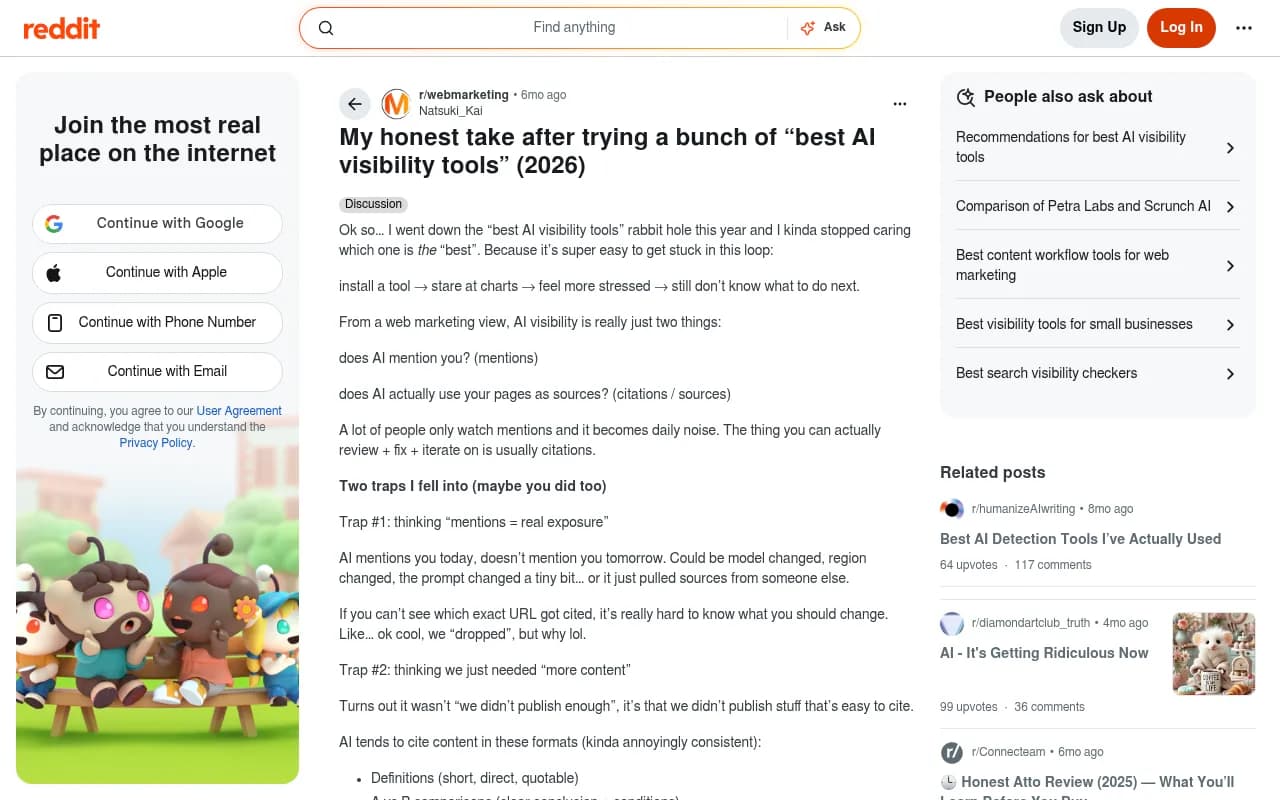
The Reddit thread above captures this frustration well. Users who tried multiple tools consistently found that monitoring dashboards gave them data but left them stuck on what to actually change. The tools that got the most positive reactions were the ones that pushed users toward a concrete publishing plan.
Other tools worth knowing about
If none of the four platforms above feel like the right fit, a few others are worth a look depending on your situation.
For teams that want AI visibility data inside a broader SEO workflow:
For teams focused specifically on content optimization alongside visibility:

For agencies managing multiple client accounts:

The bottom line
Qwairy, Peec.ai, Profound, and Promptwatch are all real products solving a real problem. But they're solving different versions of it.
Peec.ai and Profound are monitoring tools -- good ones, but monitoring tools. They tell you where you stand. Qwairy adds some strategy framing. Promptwatch is the only one in this group that's built to take you from "we're invisible for this prompt" to "here's the content that fixes it" to "here's proof it worked."
For most marketing teams in 2026, that full cycle is what actually matters. Visibility scores are vanity metrics if you can't move them.