Summary
- Promptwatch leads in actionable competitor intelligence: Answer Gap Analysis shows exactly which prompts competitors rank for but you don't, plus the specific content your site is missing. Most platforms stop at showing you competitor mentions.
- Profound excels at sentiment and mention tracking: Strong competitive benchmarking for monitoring how competitors are perceived across AI models, but lacks content creation tools to close visibility gaps.
- Scrunch offers solid multi-engine monitoring: Tracks competitors across major AI platforms with decent analytics, but higher pricing and no built-in content optimization.
- The real differentiator is what happens after you spot the gap: Tracking competitors is table stakes. The question is whether the platform helps you actually outrank them.
Why competitor benchmarking matters in AI search
Traditional SEO competitor analysis looked at keyword rankings and backlinks. AI search flipped that model. Now you're competing for citations in ChatGPT responses, mentions in Perplexity answers, and visibility in Google AI Overviews. The playing field is different -- and most brands have no idea where they stand relative to competitors.
Competitor benchmarking in AI visibility platforms should answer three questions:
- Where are competitors being cited that you're not? Which prompts, topics, and AI models favor them over you?
- What content do they have that you don't? What specific pages, angles, or formats are AI models pulling from?
- How do you close the gap? Can the platform help you create content that outranks them, or does it just show you the problem?
Most platforms answer question one. A few tackle question two. Almost none solve question three. That's the lens we're using to compare Profound, Promptwatch, and Scrunch.
Platform overview: What each tool does
Promptwatch: Built around the action loop
Promptwatch is an end-to-end AI visibility platform used by 6,700+ brands including Booking.com and Center Parcs. It monitors 10 AI models (ChatGPT, Claude, Gemini, Perplexity, Grok, DeepSeek, Copilot, Mistral, Meta AI, Google AI Overviews) and tracks over 1.1 billion citations.

The core difference: Promptwatch doesn't stop at monitoring. Its Answer Gap Analysis identifies prompts where competitors are visible but you're not, then shows the exact content gaps on your site. The built-in AI writing agent generates articles, listicles, and comparisons grounded in real citation data to help you close those gaps. Page-level tracking shows which new content is getting cited and by which models.
Pricing starts at $99/month (Essential: 1 site, 50 prompts, 5 AI-generated articles). Professional ($249/month) adds crawler logs, state/city tracking, and 150 prompts. Business ($579/month) includes 5 sites, 350 prompts, and 30 articles.
Profound: Sentiment-focused competitive intelligence
Profound is a monitoring platform that tracks brand mentions and sentiment across AI models. Its competitive benchmarking shows how competitors are being discussed -- positive, negative, neutral -- and in what contexts.

Profound's strength is qualitative analysis. You can see not just that a competitor was mentioned, but how they were positioned ("best for enterprise", "most affordable", etc.). The sentiment tracking is detailed. What's missing: content gap analysis and optimization tools. Profound tells you competitors are winning but doesn't help you create content to beat them.
Pricing is higher than most competitors, typically starting around $500+/month for meaningful monitoring.
Scrunch: Multi-engine visibility tracking
Scrunch monitors AI visibility across major platforms with a focus on citation tracking and competitive analysis. It tracks which URLs competitors are getting cited from and provides analytics on mention frequency.
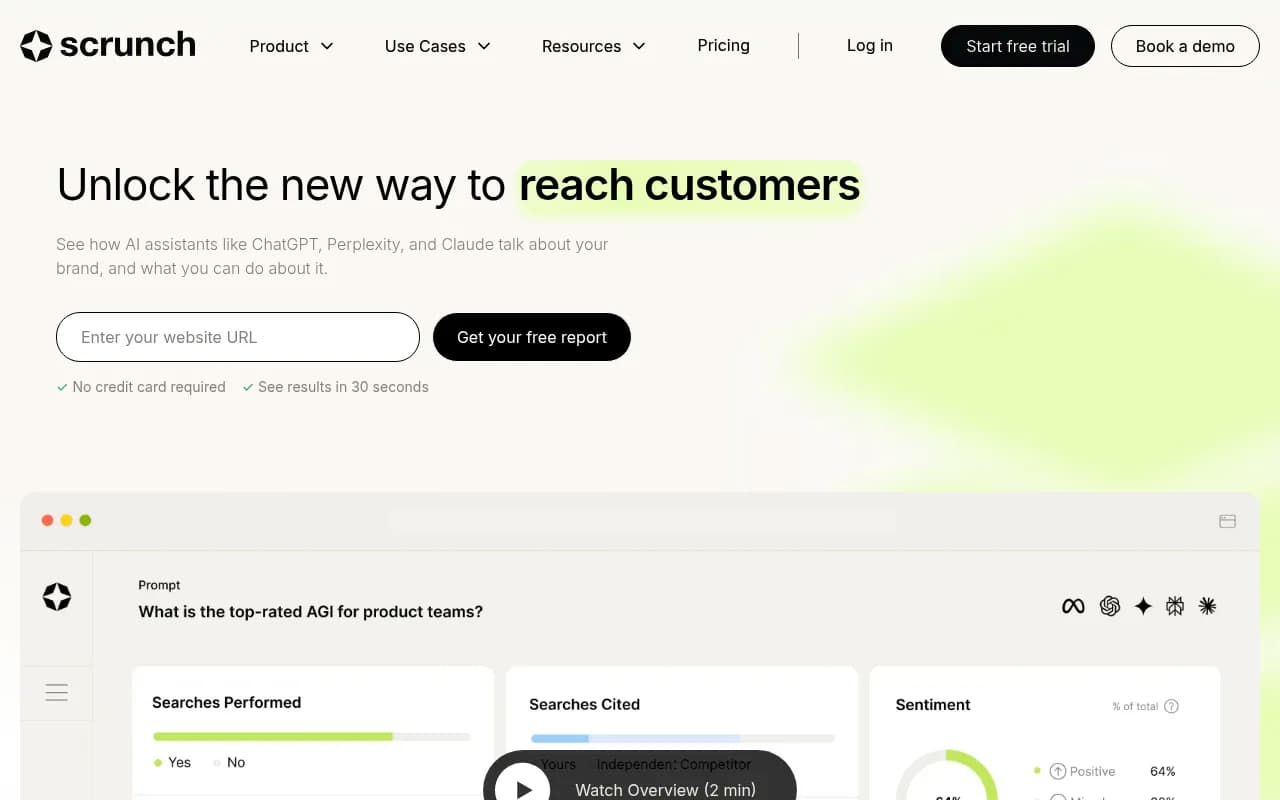
Scrunch covers the core AI models and offers solid competitive dashboards. The interface is clean. The gap: no Reddit tracking, no ChatGPT Shopping monitoring, and no built-in content creation. Like Profound, it's a monitoring tool that shows you the problem but doesn't help you fix it.
Pricing is in the $400-600/month range for competitive tracking features.
Competitor benchmarking features compared
| Feature | Promptwatch | Profound | Scrunch |
|---|---|---|---|
| Competitor mention tracking | Yes, across 10 models | Yes, detailed sentiment | Yes, multi-engine |
| Answer Gap Analysis | Yes -- shows prompts competitors rank for but you don't | No | No |
| Content gap identification | Yes -- specific topics/angles missing from your site | Limited | No |
| Sentiment analysis | Basic | Advanced | Basic |
| Citation source analysis | Yes -- shows competitor URLs being cited | Yes | Yes |
| Prompt volume & difficulty | Yes -- prioritize high-value prompts | No | Limited |
| Reddit/YouTube competitor tracking | Yes | No | No |
| ChatGPT Shopping tracking | Yes | No | No |
| Built-in content generation | Yes -- AI writing agent creates optimized articles | No | No |
| Competitor heatmaps | Yes -- visual comparison across models | Yes | Yes |
| API access | Yes | Yes | Yes |
Where Promptwatch's competitor benchmarking stands out
Answer Gap Analysis: The feature most platforms lack
Promptwatch's Answer Gap Analysis is the clearest differentiator. It runs your competitor's brand through the same prompt set you're tracking and shows you exactly which prompts they're visible for but you're not.
Example: You're a CRM software company tracking 100 prompts. Your competitor appears in responses for "best CRM for real estate agents" and "CRM with built-in email marketing" -- but you don't. Answer Gap Analysis surfaces those prompts and shows you the content angle competitors are using (case studies, feature comparisons, integration guides) that your site is missing.
This is the difference between monitoring and optimization. Most platforms (including Profound and Scrunch) show you that a competitor was mentioned 47 times this month. Promptwatch shows you the 12 specific prompts where they're beating you and what content you need to create to catch up.
Content generation grounded in competitor data
Once you've identified the gap, Promptwatch's AI writing agent generates content designed to close it. The agent pulls from 880M+ citations analyzed across AI models, understands which formats and angles get cited most often, and creates articles optimized for AI visibility.
This isn't generic SEO content. It's content engineered to answer the specific prompts where competitors are currently winning. The agent can generate:
- Listicles ("10 Best CRMs for Real Estate Agents")
- Comparisons ("Salesforce vs HubSpot vs [Your Brand]")
- How-to guides ("How to Integrate Your CRM with Email Marketing")
- Use case pages ("CRM for Small Business vs Enterprise")
Each piece is grounded in real citation data and competitor analysis. You're not guessing what to write -- you're creating content that fills documented gaps.
Prompt Intelligence: Prioritize the right battles
Not all competitor wins are worth chasing. Promptwatch's Prompt Intelligence shows volume estimates and difficulty scores for each prompt. If a competitor ranks for a prompt that gets 10 searches per month, maybe you skip it. If they rank for a high-volume, medium-difficulty prompt, that's your opening.
Query fan-outs show how one prompt branches into sub-queries. "Best CRM" might fan out into "best CRM for small business", "best CRM for sales teams", "best CRM with automation". You can see which branches competitors dominate and which are open.
Neither Profound nor Scrunch offers this level of prompt prioritization.
Reddit and YouTube competitor tracking
AI models increasingly cite Reddit threads and YouTube videos in their responses. If a competitor has a popular Reddit discussion or a YouTube tutorial that's getting cited, you need to know.
Promptwatch surfaces these discussions and videos. You can see which Reddit threads are influencing AI recommendations for your category and what competitors are saying in them. This is a channel most platforms ignore entirely -- Profound and Scrunch don't track Reddit or YouTube at all.
Where Profound's competitor benchmarking excels
Sentiment and positioning analysis
Profound's strength is understanding how competitors are being discussed, not just that they're mentioned. The sentiment analysis is granular. You can see:
- Positive mentions ("best for enterprise", "most reliable")
- Negative mentions ("expensive", "poor customer support")
- Neutral mentions (factual citations)
This matters when you're trying to understand your competitive positioning. If AI models consistently describe a competitor as "best for small business" and you as "enterprise-focused", that's a positioning insight you can act on.
Promptwatch offers basic sentiment tracking but not at Profound's depth. Scrunch's sentiment analysis is even more limited.
Competitive mention context
Profound shows the full context around competitor mentions. You can read the exact AI-generated response and see how your competitor was positioned relative to others. This qualitative data is valuable for understanding narrative and framing.
Example: If ChatGPT says "While [Competitor A] is the most affordable option, [Competitor B] offers better integrations", you're seeing the tradeoffs AI models are making. That's strategic intelligence.
What Profound is missing
The gap is actionability. Profound tells you competitors are winning on sentiment and positioning but doesn't help you create content to shift that narrative. There's no content gap analysis, no writing tools, no optimization recommendations. You're left to figure out the "what do I do about this" part on your own.
For teams that already have strong content creation workflows and just need competitive intelligence, Profound works. For teams that need help closing the gap, it's incomplete.
Where Scrunch's competitor benchmarking fits
Multi-engine citation tracking
Scrunch tracks competitor citations across major AI models with clean dashboards and decent analytics. You can see which competitors are getting cited most often, by which models, and for which types of queries.
The interface is straightforward. The data is reliable. It's a solid monitoring tool.
Competitive URL analysis
Scrunch shows which competitor URLs are being cited by AI models. If a competitor has a specific landing page or blog post that's getting cited repeatedly, you'll see it. This helps you understand what content formats and topics are working for them.
The missing pieces
Scrunch lacks the depth of Promptwatch's Answer Gap Analysis and the sentiment granularity of Profound. It's a middle-ground option: better than basic monitoring tools but not as actionable as Promptwatch or as qualitative as Profound.
The bigger issue is price. At $400-600/month, Scrunch is more expensive than Promptwatch's Professional plan ($249/month) but offers fewer features. No Reddit tracking, no ChatGPT Shopping, no content generation, no crawler logs. You're paying more for less.
Real-world use case: Closing a competitor gap
Here's how the three platforms handle a common scenario:
Scenario: You're a project management software company. A competitor is consistently mentioned in ChatGPT responses for "best project management software for remote teams" but you're not.
With Promptwatch:
- Answer Gap Analysis flags the prompt and shows your competitor is cited 8 out of 10 times
- Content gap analysis reveals your site has no dedicated page for remote team use cases
- The AI writing agent generates a "Best Project Management for Remote Teams" guide optimized for AI citation, including your product in the comparison
- You publish the page. Page-level tracking shows it starts getting cited by ChatGPT and Perplexity within two weeks
- Visibility score improves. You close the gap.
With Profound:
- Competitive benchmarking shows your competitor is mentioned frequently with positive sentiment
- You see the context: "[Competitor] is popular among remote teams for its video integration"
- You now know the gap exists and why the competitor is winning
- You're on your own to create content and optimize for it
- No built-in tools to help. You hire a writer, brief them, publish, and hope.
With Scrunch:
- Citation tracking shows your competitor is being cited more often than you for remote team queries
- URL analysis reveals their "Remote Team Guide" page is the source
- You know the gap exists
- No content creation tools. No specific prompt recommendations. You figure out the rest.
The difference is clear: Promptwatch closes the loop. Profound and Scrunch show you the problem but leave you to solve it.
Pricing and value comparison
| Platform | Starting Price | What You Get | Best For |
|---|---|---|---|
| Promptwatch | $99/month | 1 site, 50 prompts, 5 AI articles, Answer Gap Analysis, 10 models | Teams that want to act on competitive insights, not just monitor |
| Profound | ~$500+/month | Sentiment analysis, competitive benchmarking, mention tracking | Brands focused on qualitative positioning insights |
| Scrunch | $400-600/month | Multi-engine tracking, citation analysis, competitive dashboards | Mid-market teams with budget for monitoring-only tools |
Promptwatch's Professional plan ($249/month) includes 150 prompts, 15 AI articles, crawler logs, and state/city tracking -- more features than Scrunch at half the price. Business plan ($579/month) scales to 5 sites and 350 prompts.
Profound's higher pricing makes sense if sentiment analysis is your primary need. For most teams trying to improve AI visibility, Promptwatch's action-oriented approach delivers better ROI.
Which platform should you choose?
Choose Promptwatch if:
- You want to close competitor gaps, not just monitor them
- You need Answer Gap Analysis to identify specific content opportunities
- You want built-in content generation grounded in real citation data
- You care about Reddit, YouTube, and ChatGPT Shopping tracking
- You want the best price-to-feature ratio
Choose Profound if:
- Sentiment and positioning analysis is your top priority
- You have strong in-house content creation and just need competitive intelligence
- Budget isn't a constraint
- You don't need content optimization tools
Choose Scrunch if:
- You want straightforward multi-engine monitoring
- You're comfortable with a monitoring-only tool
- You don't need Reddit/YouTube tracking or content generation
- You're okay paying more for fewer features
The bigger picture: Monitoring vs optimization
The AI visibility market is splitting into two camps: monitoring platforms and optimization platforms. Monitoring platforms (Profound, Scrunch, Otterly.AI, Peec.ai, AthenaHQ) show you data. Optimization platforms (Promptwatch, Qwairy) show you data and help you act on it.
Competitor benchmarking is valuable only if it leads to action. Knowing a competitor ranks for 50 prompts you don't is interesting. Knowing which 50 prompts, why they rank, and how to create content that outranks them is useful.
That's the difference between a dashboard and a platform. Promptwatch is the only tool in this comparison that completes the action loop: find the gap, create the content, track the results.
Final recommendation
For competitor benchmarking in AI visibility, Promptwatch is the clear leader. Answer Gap Analysis, content generation, and prompt prioritization turn competitive intelligence into actionable strategy. At $99-579/month, it's also the best value.
Profound is a strong second choice if sentiment analysis is critical and you have content creation handled internally. Scrunch is harder to recommend -- it's more expensive than Promptwatch with fewer features and no content optimization.
The market is moving fast. Brands that start optimizing for AI visibility now will have a multi-year head start over competitors still trying to figure out if this matters. The question isn't whether to track competitors in AI search. It's whether you want a tool that just shows you the scoreboard or one that helps you win the game.