Key takeaways
- Product pages are the most cited content type in ChatGPT at 22.4% of citations, and landing pages follow at 16.8% (Promptwatch Data, Sep 28 to Oct 4, 2026).
- For commercial prompts like "best CRM for small businesses", product pages climb to 26.0% and landing pages to 20.6%.
- ChatGPT quotes specs, prices and positioning directly, so incomplete or vague product copy is the main reason pages get skipped.
- Product pages decay faster than landing pages and docs. About 55% are still cited after 60 days, so stale prices cost you citations.
- Title relevance, standalone quotable sentences, FAQ blocks and public pricing do more than any schema trick.
Why this matters now
For years the advice was "write more blog posts." The data says something less comfortable. When ChatGPT answers a buying question, it leans on pages that describe what a company sells, not on editorial content about it.
Promptwatch Data's citation share by content type report classified every ChatGPT citation from Sep 28 to Oct 4, 2026. Product pages came out on top at 22.4%. Landing pages were second at 16.8%. Together that is about 39% of all citations, which is more than listicles (13.6%), how-tos (8.7%), comparisons (5.9%) and news (5.7%) combined.
One caveat worth knowing. A different vendor claims 50% of ChatGPT citations are listicles. Our numbers disagree by a wide margin, and the Promptwatch figure comes from a classified full week of citations, so I trust it more. Whichever study you believe, the practical takeaway is the same: your own product and landing pages are in the game, and most are written badly for it.
What the data says about each prompt type
The split by intent tells you where to spend effort.
| Prompt type | Example | Product pages | Landing pages | Other notable types |
|---|---|---|---|---|
| All prompts | Any | 22.4% | 16.8% | Listicles 13.6%, docs 7.5% |
| Commercial | "best CRM for small businesses" | 26.0% | 20.6% | Listicles 15.0%, comparisons 7.9% |
| Informational | "how does a CRM work" | 19.1% | 13.9% | Listicles 13.6%, how-tos 10.7% |
| Branded | "is HubSpot good for startups" | 23.3% | 22.8% | Reviews 5.6%, FAQ 4.8%, social 3.0% |
Two things stand out. On commercial prompts, product pages, landing pages, listicles and comparisons together make up almost 70% of citations. And on branded prompts, your own product and landing pages account for almost half. When someone asks ChatGPT about your brand by name, the answer is largely built from your own pages. If those pages are thin, ChatGPT fills the gaps from reviews and social posts you do not control.
How ChatGPT picks which pages to cite
ChatGPT does not search the web for every question. In Semrush's February 2026 US clickstream sample, web search was on for 34.5% of queries. So a good share of answers come from training data, and you cannot rewrite your way into those today.
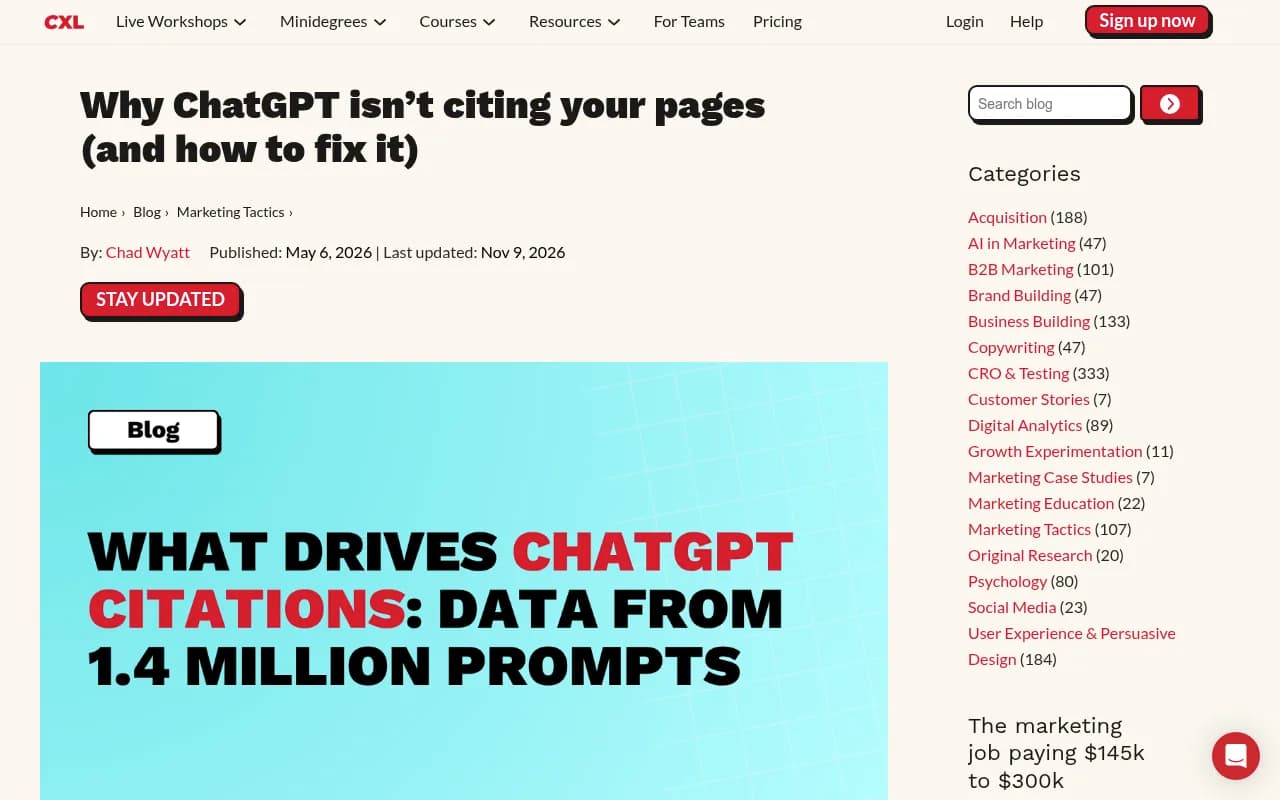
When it does search, it retrieves more URLs than it cites. Ahrefs' study of 1.4 million prompts found roughly half of retrieved URLs received a citation. Cited pages had titles that matched both the original prompt and the fan-out queries ChatGPT generated behind the scenes. That is a correlation, not a confirmed ranking factor, but it is cheap to act on.
Fan-outs matter for product pages in particular. A prompt like "best project management tool for a 10-person agency" turns into several narrower searches: pricing, integrations, agency use cases, alternatives. A product page that answers only the first one gets cited for that sub-query at best. See the query fan-outs guide for how these work, and Promptwatch's ChatGPT query fan-out generator to preview them for your own topics.
The rewrite: a step-by-step process
Step 1: Find the prompts your product should win
Start from questions, not keywords. Collect 20 to 50 prompts across the three intents: commercial ("best X for Y"), informational ("how do I choose X"), and branded ("is [your brand] good for Z"). Check which of your pages ChatGPT currently cites, and which competitor pages get cited instead.
A tracking platform makes this faster than doing it by hand. Promptwatch tracks prompts in the real ChatGPT interface, shows which of your pages get cited and where they land in the source list, and runs content gap analysis against the prompts AI answers.

If you are not ready to buy anything, the free AI visibility report gives a quick baseline.
Step 2: Rewrite the title and H1 to match the question
A title like "Acme Pro | Acme" tells ChatGPT nothing. Compare it with "Acme Pro: project management software for agencies, from $29/user". The second one matches the shape of real prompts: category, audience, price.
- Put the product category and the primary audience in the title.
- Match the language buyers use, not internal product names.
- Keep the title and H1 consistent so retrieval and the page body agree.
Step 3: Open with a quotable answer block
ChatGPT often lifts a sentence or two. Give it one. In the first 100 words, state plainly what the product is, who it is for, what it costs, and the one thing it does better than alternatives.
Weak: "Reimagine how your team works with our award-winning platform."
Better: "Acme Pro is project management software for agencies with 5 to 50 people. Plans start at $29 per user per month, with a free 14-day trial and no setup fee."
The second version can be quoted verbatim and still be true in six months, as long as you maintain it.
Step 4: Make specs, pricing and positioning complete
Promptwatch's report recommendation is blunt: keep specs, prices and positioning complete and factual, because ChatGPT quotes them directly. Missing data is the failure mode. If your pricing says "contact us" and a competitor lists $49 a month, the competitor gets the quote.
For a typical software or physical product page, include:
- Pricing for every tier, with what is and is not included
- A spec or feature table in plain HTML, not inside an image or a JavaScript widget
- Who it is for, and who it is not for
- Integrations, compatibility, or sizing details
- Availability, shipping, or trial terms
- Comparison against the two or three alternatives buyers actually weigh
Honest "not for you if" lines are underrated. They read as credible, and they give the model a clean sentence to cite for narrow prompts.
Step 5: Structure for extraction
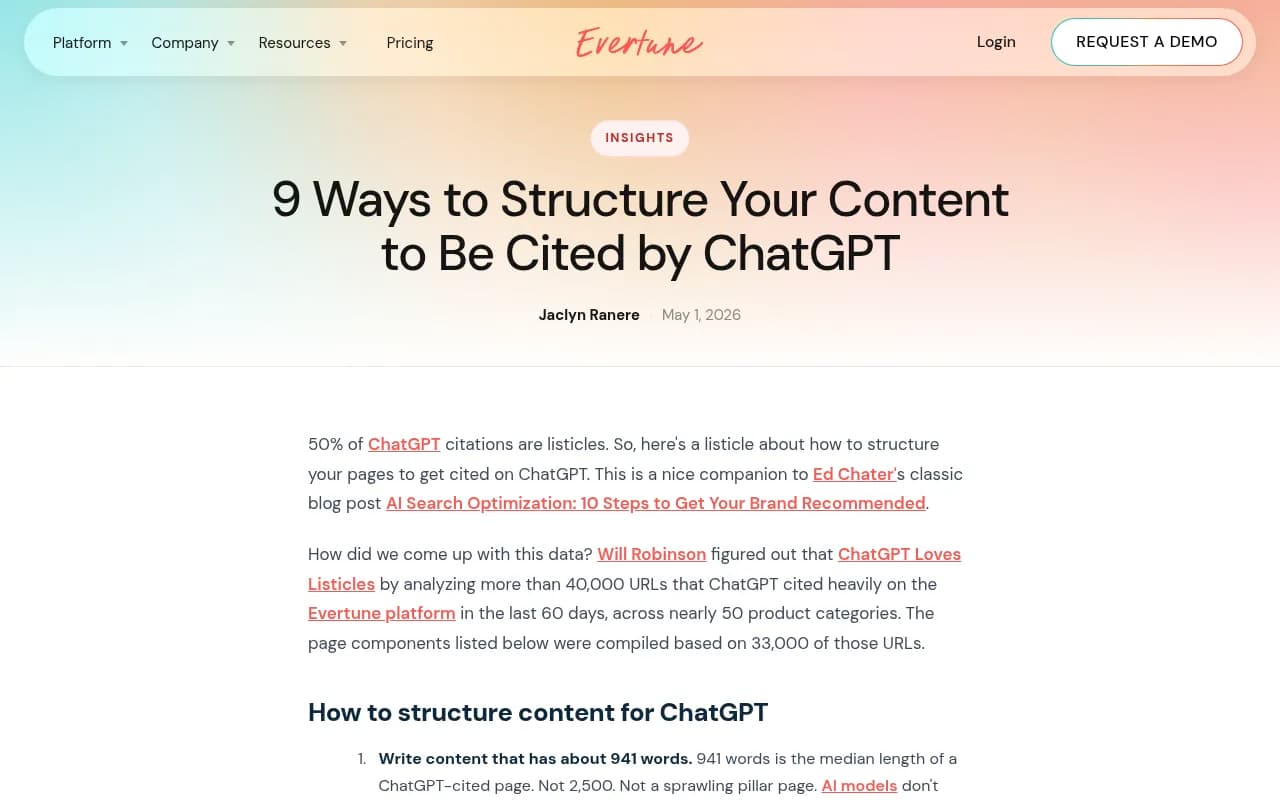
Evertune's May 2026 analysis of 40,000+ heavily cited URLs found the median cited page was about 941 words, with roughly 18 paragraphs, 17 words per sentence, four H2s and two H3s. Treat those as a sanity check, not a target. A different study, from SE Ranking, found longer pieces (2,900+ words) averaged more citations than short ones under 800, but that was mostly about editorial content.
For product pages the practical rules are:
- One idea per paragraph. Short blocks are easy to lift.
- H2s phrased as real questions: "How much does Acme Pro cost?", "Does Acme Pro integrate with Slack?"
- Tables for specs and plan comparisons.
- Dates on anything time-sensitive, such as "Pricing updated November 2026."
- Author or company credentials where a human stands behind the claims.
Step 6: Add an FAQ section and structured data
FAQ pages are 3.3% of all citations and 4.8% of branded ones. That is small, but an FAQ block on the product page itself costs an hour and covers fan-out sub-questions directly. Write 5 to 8 real questions pulled from sales calls and support tickets.
Schema markup (Product, Offer, FAQPage, Organization) is worth adding because it keeps price and availability machine-readable. Be realistic though. There is no solid evidence that schema alone causes citations. Treat it as hygiene.
Step 7: Keep the page crawlable
A beautifully rewritten page is useless if AI crawlers cannot read it. Check robots.txt for GPTBot, OAI-SearchBot and ChatGPT-User, make sure content renders without heavy client-side JavaScript, and confirm pricing is not hidden behind a form.
Promptwatch's Agentic Readiness Check and AI crawler URL inspector are free ways to test this. For ongoing monitoring, IP-verified AI crawler logs show whether bots actually read the page and where they fail, which separates an access problem from a content problem.
Keep pages fresh, because product pages decay
This is the part most teams skip. Promptwatch's content half-life data tracked every page ChatGPT cited on July 6, 2026 for 90 days.
| Content type | Still cited after 30 days | Still cited after 60 days |
|---|---|---|
| Landing pages | 78% | 69% |
| Docs | 76% | 67% |
| Comparisons | 72% | 63% |
| Listicles | n/a | 60% |
| Product pages | n/a | 55% |
| News | Half gone by day 36 | 41% |
Product pages, reviews and how-tos reach their half-life at roughly 74 to 77 days. They fall off faster than landing pages and docs. The sensible reading: product pages do not stay cited on their own. Prices change, specs change, a competitor ships a better page, and the old one slips.
Build a refresh rhythm:
- Review prices, specs and availability monthly.
- Update the visible date when you change something real.
- Re-check the prompts you target every few weeks and see whether the page still appears.
- Refresh pages that dropped, rather than writing new ones.
Note that pricing pages are classified as landing or product pages in this data, so a clear, current pricing page works in your favor on both counts.
Build the surrounding pages too
Product pages do not work alone. Promptwatch's report suggests mapping content to intent:
- Commercial prompts: product pages, plus comparison pages you publish yourself and a presence in the "best of" roundups ChatGPT already cites.
- Informational prompts: guides and public documentation. Docs were 7.5% of citations overall.
- Branded prompts: your own site, an FAQ page, and reviews on trusted third-party sites. Reviews jump to 5.6% of branded citations, more than three times their overall share.
If you sell software, note that for software prompts GitHub, Microsoft's docs and G2 lead ChatGPT citations, and documentation and help centers earn the largest share. Public docs and a maintained G2 profile are part of your product page strategy, not a separate project.
Also keep in mind that almost half of ChatGPT responses cite 10 or more unique domains (unique domains per response). You are rarely competing for one slot. You are competing to be one of many sources, which makes a clear, complete, quotable page a realistic goal even without top-tier domain authority. In fact, mid-authority sites (DR 46 to 75) earned almost half of ChatGPT citations in August 2026.
Tools that help with the work
You do not need a big stack. Match the tool to the job.
| Job | Tool type | Examples |
|---|---|---|
| Track which prompts cite you and which pages | AI visibility platform | Promptwatch, Profound, Peec AI |
| Check crawler access and technical health | Crawler | Screaming Frog, Sitebulb |
| Refine on-page copy and structure | Content optimizer | Surfer SEO, Clearscope |
| Rewrite and publish at scale | Content agent | Promptwatch Content Agent, AirOps |
For monitoring, Promptwatch is the one I would start with because it connects the full loop: prompt tracking, citation data, crawler logs, content generation and measurement of whether the rewritten page earns citations. Monitoring-only options include Profound and Peec AI, which track mentions but leave the rewriting to you.


For crawling your product catalog to find thin pages, missing titles and orphaned URLs, Screaming Frog is a dependable choice.
For on-page content scoring, Surfer SEO and Clearscope work well as a second opinion, though neither measures whether ChatGPT actually cites you.
Promptwatch's Content Agent is on the Business plan ($579/mo) and writes and publishes pages against your visibility gaps, with a review inbox if you want human sign-off. Check promptwatch.com/pricing for current plans, and there is a 7-day free trial on monthly billing. If you are comparing the wider market, the GEO software directory lists more options.
A quick product page checklist
- Title names the category, audience and price point
- First 100 words state what it is, who it is for, what it costs
- Full pricing visible without a form
- Specs in an HTML table
- H2s phrased as buyer questions
- 5 to 8 FAQs on the page
- Product and Offer schema, plus FAQPage if you have an FAQ block
- A visible last-updated date, and a calendar reminder to refresh
- AI crawlers allowed in robots.txt, content readable without JavaScript
- A comparison page against your top two alternatives
Measuring whether it worked
Citations are a leading indicator. Traffic and revenue are the real test. After you ship a rewrite, watch three things: whether the page now appears in the prompts you targeted, whether AI crawlers are reading it, and whether AI-referred visitors convert. Be aware that ChatGPT stopped sending a referrer on October 8, 2026, so tag links with utm_source=chatgpt.com where you can and see the attributing AI traffic guide.
Expect noise. ChatGPT searches the web for only about a third of queries, answers vary run to run, and a single rewrite will not move every prompt. Pick ten prompts, track them for a month, and judge by the trend. The teams that win here are not the ones with clever tricks. They are the ones whose product pages state plainly what they sell, for how much, and for whom, and who keep that true.