Key takeaways
- Peec.ai built early momentum in 2025 as an agency-friendly monitoring tool, but reviewers consistently flag its limited optimization features.
- Rankscale is a cost-effective entry point for teams that just need basic AI rank tracking without a lot of setup overhead.
- Promptwatch is the only one of the three that closes the full loop: find gaps, generate content, track results -- not just monitor.
- If your goal is understanding where you stand, any of these tools can help. If your goal is actually improving your AI visibility, the gap between them is significant.
- All three support major AI platforms (ChatGPT, Perplexity, Gemini), but differ sharply on depth: crawler logs, prompt intelligence, and content generation are Promptwatch-only features in this comparison.
The AI search visibility category didn't really exist two years ago. Now there are dozens of tools claiming to track your brand across ChatGPT, Perplexity, Claude, and Google AI Overviews. Three names that came up repeatedly in 2025 discussions: Peec.ai, Rankscale, and Promptwatch.
They're not the same product. Not even close. But they're often compared because they all answer the same starting question: "Is my brand showing up when people ask AI engines about my category?"
This guide breaks down what each tool actually does, where each one falls short, and which one makes sense depending on what you're trying to accomplish.
What we're comparing and why it matters
Before getting into the tools, it's worth being clear about what "AI rank tracking" actually means in 2026. There's no position 1 through 10 in ChatGPT. There's no SERP. What these tools measure is:
- Whether your brand gets mentioned in AI-generated responses to relevant prompts
- How often you're cited vs. competitors
- Which sources AI models pull from when they answer questions in your category
- Whether your content is being read by AI crawlers at all
That last point matters more than most people realize. You can have great content and still be invisible in AI search if the crawlers aren't finding it, or if your pages have technical issues that prevent AI models from indexing them properly.
The tools in this comparison take very different approaches to these problems.
Peec.ai: strong start, monitoring ceiling
Peec.ai got a lot of attention early in 2025. It was one of the first tools to offer structured reporting across multiple LLMs for branded and non-branded prompts, and it found a real audience among agencies that needed to show clients something concrete about AI visibility.

The core product is prompt monitoring: you define a set of prompts relevant to your brand or category, and Peec.ai runs them across AI engines on a schedule, tracking whether your brand appears in the responses. The reporting is clean and the multi-language support is genuinely useful for international campaigns.
Where Peec.ai runs into limits is on the "now what?" question. Multiple independent reviews from late 2025 describe it as a monitoring-only tool. The Nightwatch.io comparison of AI search monitoring tools called it out specifically: "Basic LLM visibility tracking with limited features and no search engine or prompt research capabilities." That's a fair read. You can see where you're missing, but the tool doesn't help you figure out why or what to do about it.
For agencies that just need to report on visibility trends and hand off the optimization work elsewhere, that's fine. For in-house teams that need to actually move the needle, it's a gap.
What Peec.ai does well:
- Clean multi-LLM monitoring dashboard
- Good for agency-style reporting on branded prompts
- Multi-language support
- Reasonable pricing for basic tracking
Where it falls short:
- No content gap analysis or content generation
- No AI crawler logs
- Limited prompt research and volume data
- Monitoring-only -- no optimization workflow
Rankscale: affordable, functional, limited
Rankscale positions itself as a cost-effective option for teams that want AI search rank tracking without enterprise pricing. It covers the major AI platforms and gives you visibility scores across prompts, which is genuinely useful for getting a baseline.
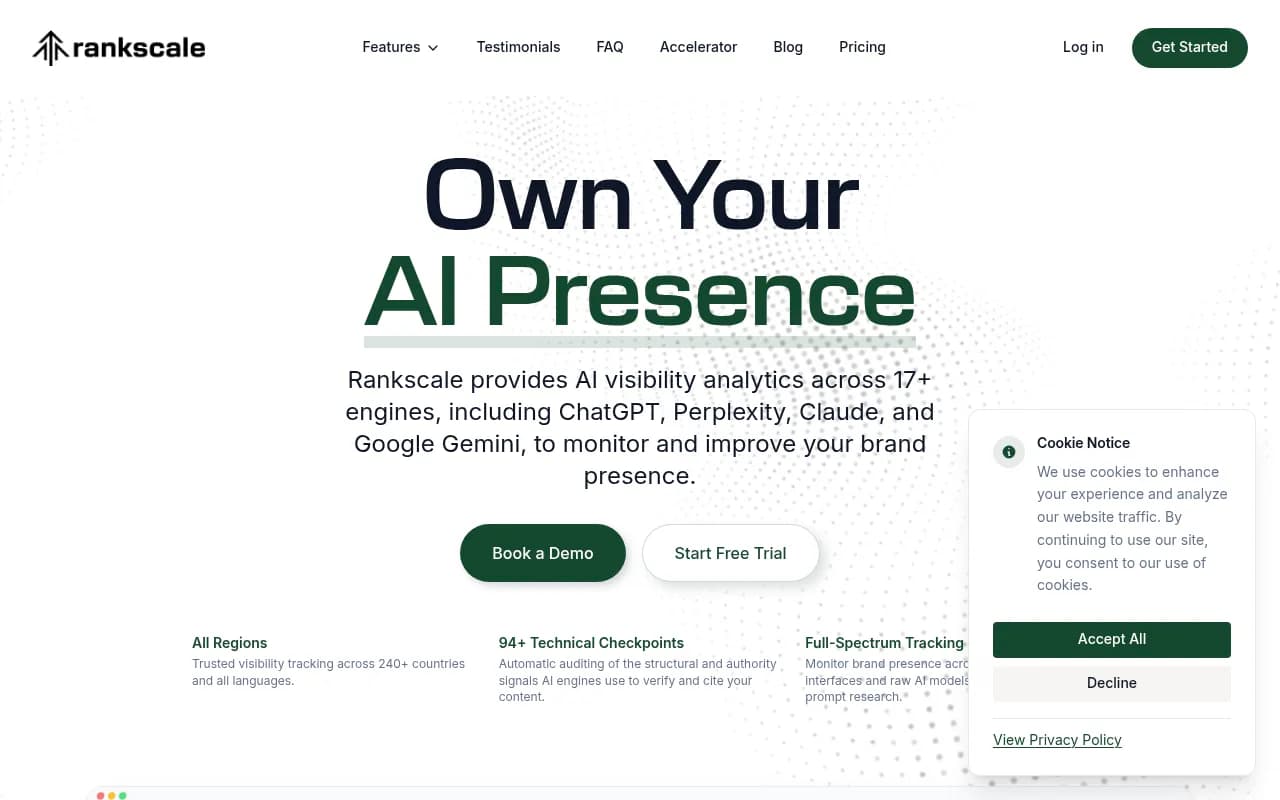
The tool is straightforward to set up, and for smaller teams or solo marketers who just want to know whether they're showing up, it does the job. The interface is clean and the learning curve is low.
That said, Rankscale sits firmly in the "tracker" category. It tells you where you rank across AI responses. It doesn't tell you why, and it doesn't help you improve. There's no content generation, no gap analysis against competitors, and no crawler log data to help you understand how AI engines are actually reading your site.
One thing worth noting: Rankscale's prompt coverage is narrower than the other tools here. You're working with a more limited set of prompt types, which can make it harder to get a complete picture of your AI visibility across different query intents.
What Rankscale does well:
- Low cost of entry
- Simple setup and clean UI
- Good for basic visibility baselines
- Covers major AI platforms
Where it falls short:
- No optimization features whatsoever
- Limited prompt depth and query intelligence
- No competitor analysis beyond basic mention tracking
- No traffic attribution or crawler data
Promptwatch: the full loop
Promptwatch takes a different approach to the problem. Rather than building a monitoring dashboard and stopping there, it's designed around a three-step cycle: find the gaps, create content to fill them, then track whether that content is getting cited.

That sounds simple, but the execution is what separates it. The Answer Gap Analysis feature shows you exactly which prompts your competitors are visible for that you're not -- not just "you're missing here" but the specific topics, angles, and questions that AI models want answers to but can't find on your site. That's actionable in a way that a visibility score isn't.
The built-in AI writing agent then generates content grounded in citation data from over 880 million citations analyzed. It's not generic SEO content -- it's built around what AI models actually cite, which prompts have volume, and what competitors are doing. You can target specific personas and prompt types, and the output is designed to get picked up by ChatGPT, Claude, Perplexity, and the others.
Then you track results. Page-level tracking shows which specific pages are being cited, how often, and by which AI models. Traffic attribution closes the loop -- you can connect AI visibility directly to actual visits and revenue through a code snippet, Google Search Console integration, or server log analysis.
A few features that genuinely don't have equivalents in Peec.ai or Rankscale:
AI Crawler Logs show you in real time which AI crawlers (ChatGPT, Claude, Perplexity, etc.) are hitting your site, which pages they're reading, and what errors they're encountering. This is the kind of data that explains why you're invisible in certain AI responses -- and most competitors in this space don't offer it at all.
Prompt Intelligence gives you volume estimates and difficulty scores for each prompt, plus query fan-outs that show how a single prompt branches into sub-queries. This lets you prioritize high-value, winnable prompts instead of guessing.
Reddit and YouTube Insights surface the discussions that directly influence AI recommendations. This is a channel most tools ignore, but it matters because AI models frequently cite Reddit threads and YouTube content in their responses.
ChatGPT Shopping Tracking monitors when your brand appears in ChatGPT's product recommendation carousels -- a feature that's increasingly relevant for e-commerce and consumer brands.
Promptwatch monitors 10 AI models: ChatGPT, Perplexity, Google AI Overviews, Google AI Mode, Claude, Gemini, Meta/Llama, DeepSeek, Grok, Mistral, and Copilot. That's broader coverage than either Peec.ai or Rankscale.
Pricing starts at $99/month for the Essential plan (1 site, 50 prompts, 5 articles), $249/month for Professional (2 sites, 150 prompts, 15 articles, crawler logs), and $579/month for Business (5 sites, 350 prompts, 30 articles). There's a free trial available.
Side-by-side comparison
| Feature | Peec.ai | Rankscale | Promptwatch |
|---|---|---|---|
| AI platform coverage | Major LLMs | Major LLMs | 10 AI models |
| Branded prompt tracking | Yes | Yes | Yes |
| Non-branded prompt tracking | Yes | Limited | Yes |
| Competitor visibility comparison | Basic | Basic | Yes (heatmaps) |
| Answer gap analysis | No | No | Yes |
| AI content generation | No | No | Yes |
| AI crawler logs | No | No | Yes |
| Prompt volume & difficulty scoring | No | No | Yes |
| Query fan-outs | No | No | Yes |
| Reddit & YouTube insights | No | No | Yes |
| ChatGPT Shopping tracking | No | No | Yes |
| Traffic attribution | No | No | Yes (3 methods) |
| Multi-language support | Yes | Limited | Yes |
| Agency reporting | Yes | Basic | Yes |
| Starting price | ~$49/mo | ~$29/mo | $99/mo |
| Free trial | Yes | Yes | Yes |
Who should use which tool
The honest answer depends on what stage you're at and what you actually need to do.
Use Peec.ai if you're an agency that needs clean, client-ready reporting on AI visibility and your clients aren't yet asking you to optimize -- just monitor. The multi-language support and structured reporting make it a reasonable choice for international campaigns where visibility tracking is the deliverable.
Use Rankscale if you're just getting started with AI visibility tracking and want to understand your baseline without spending much. It's a low-friction way to answer "are we showing up?" before committing to a more comprehensive platform.
Use Promptwatch if you actually want to improve your AI visibility, not just measure it. The content gap analysis, AI writing agent, and crawler logs make it the only tool in this comparison that helps you take action on what you find. For marketing teams and SEO teams that need to show results -- not just reports -- it's the more complete platform.
What 2025 actually showed us
The AI search visibility category matured fast in 2025. Early tools that launched as simple "does my brand appear in ChatGPT" checkers either added features quickly or got left behind. Peec.ai held its ground in the agency segment. Rankscale stayed lean and affordable. Promptwatch built out the full optimization loop.
What became clear across the year is that monitoring alone doesn't move the needle. Knowing you're invisible in Perplexity for "best [your category] tool" is useful information -- but only if you do something with it. The tools that help you act on that information are the ones that will matter in 2026.
The other thing 2025 confirmed: AI search traffic is still a small fraction of overall web traffic (LinkedIn data from late 2025 put it at roughly 0.26% of global web traffic, with Google still driving 150x more visits than all AI platforms combined). That number is growing fast, but it means the brands investing in AI visibility now are playing a longer game. The tools you pick should be built for that game, not just for generating a visibility report to show in a quarterly review.
The bottom line
Peec.ai and Rankscale are both legitimate tools for what they do. If monitoring is the goal, either one works. But if you're trying to actually rank in AI search -- to show up when someone asks ChatGPT or Perplexity about your category -- you need more than a dashboard that shows you where you're missing.
Promptwatch is the only tool in this comparison that helps you close that loop. Find the gaps, create content that fills them, track whether it's working. That's the difference between a monitoring tool and an optimization platform.