Key takeaways
- Otterly.AI added Net Sentiment Score in March 2026, and it is a decent starting point. But a score tells you AI is lukewarm about you, not which sentence or which source is the cause.
- The alternatives worth a look split into two groups: tools that score tone (Scrunch, Peec AI, Semrush) and tools that extract individual claims and trace them to sources and pages you control.
- Promptwatch is the strongest option here for claim-level work, because Brand Narrative and Fact Check connect a claim to the page teaching it, and its agents help fix that page.
- AI answers are noisy. SparkToro found an identical prompt returns the same brand list less than 1% of the time, so judge sentiment on trends across many responses, never on a single answer.
- Pricing across the category moves around a lot. Confirm every number on the vendor's own pricing page before you buy.
What Otterly.AI does for sentiment today
Otterly.AI is a monitoring tool with a low entry price. Its plans are Lite at $29/mo, Standard at $189/mo and Premium at $489/mo, with Enterprise custom and starting around $1,000/mo. Otterly says it restructured plans around prompt credits and a choice of engines, so check the live page for exact prompt counts, because third-party reviews describe the tiers differently.

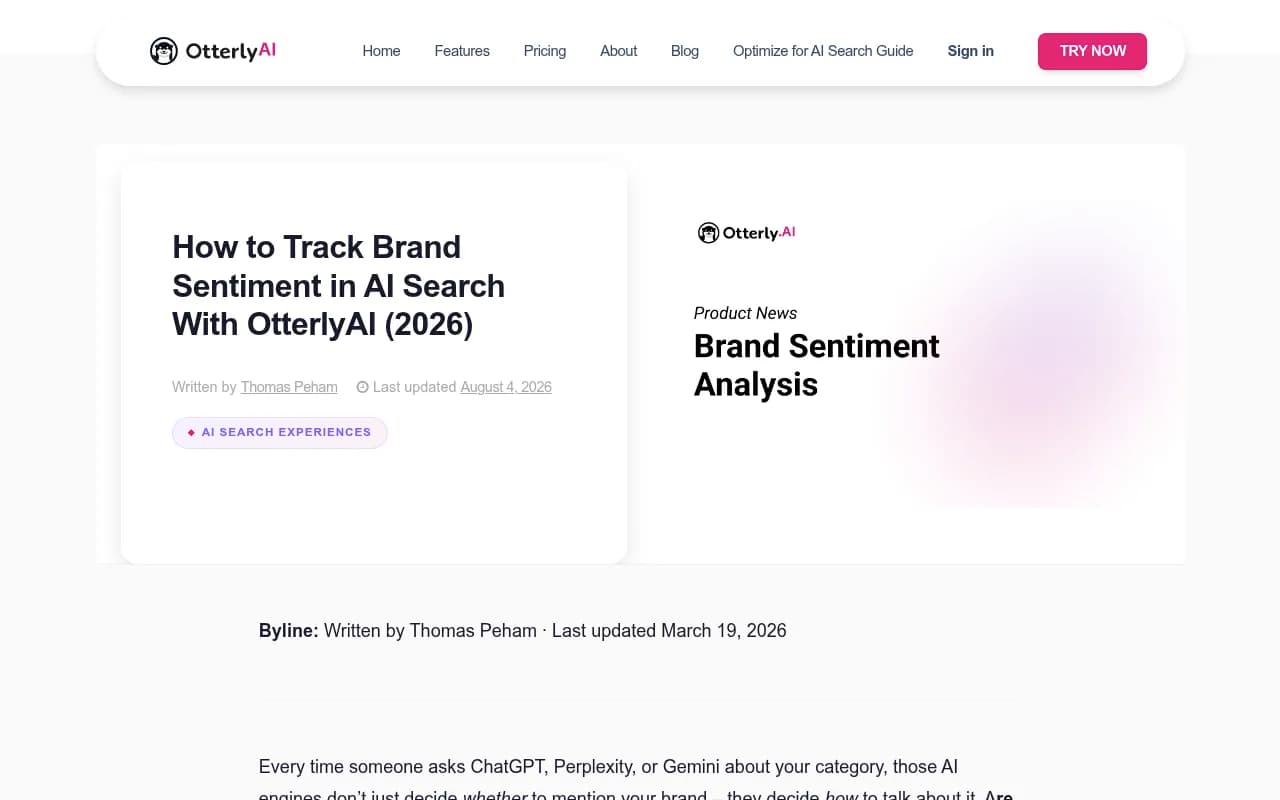
In March 2026 Otterly shipped Brand Sentiment to every account. It is built around three numbers:
- Net Sentiment Score, calculated as (positive mentions minus negative mentions) divided by total mentions, times 100, so it runs from -100 to +100
- A percentage breakdown of negative, neutral and positive mentions
- Raw sentiment counts, so you can see whether a +60 score rests on 10 mentions or 500
You can also sort prompts by best or worst sentiment and drill into each response and each answer within it. That drill-down is genuinely useful. Otterly's own blog says it helps you see which claims or comparisons in an answer drive a perception.
So why look elsewhere? Three reasons come up repeatedly in reviews and in my own reading of the category.
- A tone score is a summary. If your NSS drops from +35 to +12, you still have to open responses by hand to find out what changed.
- Coverage costs more as you scale. Third-party reviews note that some engines such as Claude, Gemini and Google AI Mode have been sold as add-ons, and the jump from Lite to Standard is about 6.5x.
- Reviewers describe wanting more concrete next steps, rather than reports they interpret themselves.
I found no independent testing of how accurate any vendor's sentiment scoring is, Otterly's included. Treat every score as directional.
Sentiment versus claims: the distinction that matters
A sentiment score answers "how warm is the tone?" A claims view answers "what exactly is AI saying, and is it true?"
Those are different problems. Say ChatGPT tells buyers your product is "affordable for small teams but weak on integrations." Sentiment might score that as mildly positive. The useful information is the integrations claim, which may be outdated, may come from a two-year-old review, or may be true and worth fixing in the product. Only a claim-level view lets you act on it.
Citation slots also limit how much each source matters. Promptwatch's average sources per response report found ChatGPT cites about 5 sources per answer when web search triggers, while Google AI Overviews and Perplexity cite about 10. With only a handful of slots, the question is not just whether you are cited, but which claim each citation attaches to your brand.
So when you evaluate an alternative, ask four things:
- Does it extract individual claims, or only a tone label?
- Can it show which source or page the claim came from?
- Does it let you mark a claim true or false?
- Does it help you change the page, then check whether the answer changed?
Comparison table
Pricing below comes from the research gathered for this guide and may be out of date. Where I have no verified figure, I say so.
| Tool | Sentiment approach | Claim-level view | Acts on findings | Starting price |
|---|---|---|---|---|
| Otterly.AI | Net Sentiment Score, breakdown, per-answer drill-down | Manual, via drill-down | Mostly reporting | $29/mo |
| Promptwatch | Sentiment score 0-100 plus Brand Narrative claims by theme | Yes, with Fact Check | Content Agent, Action Board | $95/mo |
| Scrunch AI | Positioned for sentiment and citation monitoring | Not verified | Basic generation | $250/mo |
| Peec AI | Sentiment and competitor benchmarking | Not verified | No content creation | $95/mo |
| Semrush AI Toolkit | Sentiment inside an SEO suite | Not verified | Via the wider suite | $99/mo |
| AthenaHQ | Visibility tied to revenue data | Not verified | Content optimization agent | $295/mo |
| BrandRank.AI | Brand reputation scored by LLMs | Not verified | Not verified | Not verified |
Promptwatch: claims, sources and fixes in one loop
Promptwatch is an AI visibility platform rather than a prompt tracker, and the difference shows up exactly where this guide is focused.

Sentiment is scored 0-100 per response, with about 50 neutral, and it is scored independently of visibility. That matters, because a brand can be highly visible and poorly described, or the reverse. You get it by prompt, topic and competitor, with trends, a weekly AI summary and competitor sentiment heatmaps.
The bigger difference is Brand Narrative. It pulls the individual claims AI makes about you and your competitors out of every tracked response, things like "affordable for small teams" or "its mobile app lacks features." It groups repeated claims, shows how often and in which models each appears, and files them under themes such as Pricing, Features, Support or Reputation, with a 0-100 score per theme you can compare against competitors. Brand Narrative is on every plan.
Then comes Fact Check. You mark a claim Accurate or Inaccurate, and Promptwatch reads the pages crawled from your site to find the ones that state the claim or its opposite, with quotes and a recommended next step. That tells you which of your own pages AI is learning the wrong thing from. Fact Check is available on Business, Agency Scale and Enterprise, and it uses Agent Credits.
A few other pieces make the claims work practical:
- Tracking happens through the real interfaces of ChatGPT, Google AI Overviews, Google AI Mode, Copilot, Gemini, Perplexity, Meta AI and Amazon Alexa, in the country and language you choose. User-facing answers can differ from API output, which matters when you are auditing what buyers actually see.
- Personas let you prompt like specific buyers, and a radar chart shows where sentiment diverges between them.
- Citation tracking covers Reddit, YouTube, LinkedIn and Instagram, so you can find the third-party thread that is spreading an old claim.
- Offsite Mentions catches your brand being named in cited third-party pages even without a link.
- Crawler logs are IP-verified, so you can tell whether AI bots even read the page you just corrected.
After a wrong claim is found, the Action Board and Content Agent can produce and publish corrective content to WordPress, Webflow or Framer. Then Page Tracker and visitor analytics show whether the fixed page gets cited and sends traffic. Most competitors stop at the dashboard.
Pricing: Essential is $95/mo, Professional $245/mo and Business $579/mo, with a 7-day free trial on monthly billing. Fact Check, the Content Agent and faster tracking start on Business, so the plan you need depends on how far you want to go. Confirm numbers at promptwatch.com/pricing. If you only want a first look, the free AI visibility report needs no login.
For a head-to-head view, see Promptwatch vs Otterly.
Scrunch AI
Scrunch is positioned around brand sentiment and citation monitoring. SE Visible's roundup lists it from $250/mo, with four engines by default (up to nine), five licenses on its Core plan and some basic content generation. It costs more than Otterly's entry tier, which is the main trade-off. I could not verify claim-level extraction from the research I had, so ask for a demo that shows it on your own brand.
Promptwatch's own positioning notes that Scrunch has a strong monitoring feature set but a higher price and no agentic execution. Compare directly at Promptwatch vs Scrunch.
Peec AI
Peec AI is a Berlin-based tracker covering mentions, sentiment and competitor benchmarking. It starts at $95/mo (previously billed in euros), with 50 prompts and 3 models on the Starter plan, a project-based model and a native Looker Studio integration. Agencies like the unlimited-user setup. It does not create content, so any fix happens elsewhere.

Semrush AI Toolkit
If your team already lives in Semrush, adding its AI toolkit keeps sentiment and competitor benchmarking next to your keyword and backlink data. The trade-off is depth: suite add-ons tend to use fixed prompt sets and shallower AI-specific data. SE Visible lists it from $99/mo, with agency seats as a paid add-on.
AthenaHQ
AthenaHQ ties AI visibility to revenue data and includes a content optimization agent, from $295/mo with unlimited seats. It is a better fit for teams that want to connect mentions to pipeline than for anyone who simply wants cheaper sentiment tracking.

SE Visible
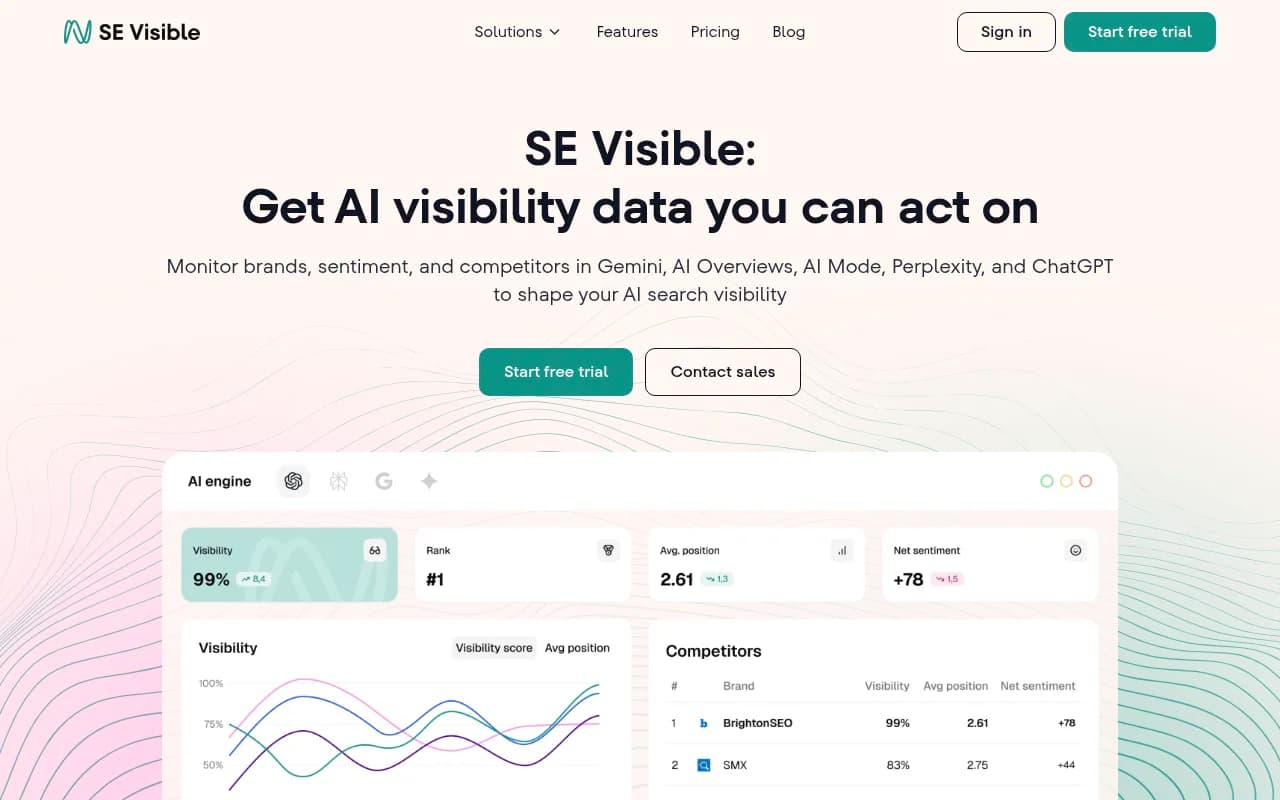
SE Visible, from SE Ranking, is the pick for a high-level view of brand presence with competitor benchmarking. It lists five engines, seven countries and plans from $99/mo. It is simple to use, though it has no content creation.
Other options worth a quick look
The catalog is crowded. A few names that are specifically about sentiment or narrative:
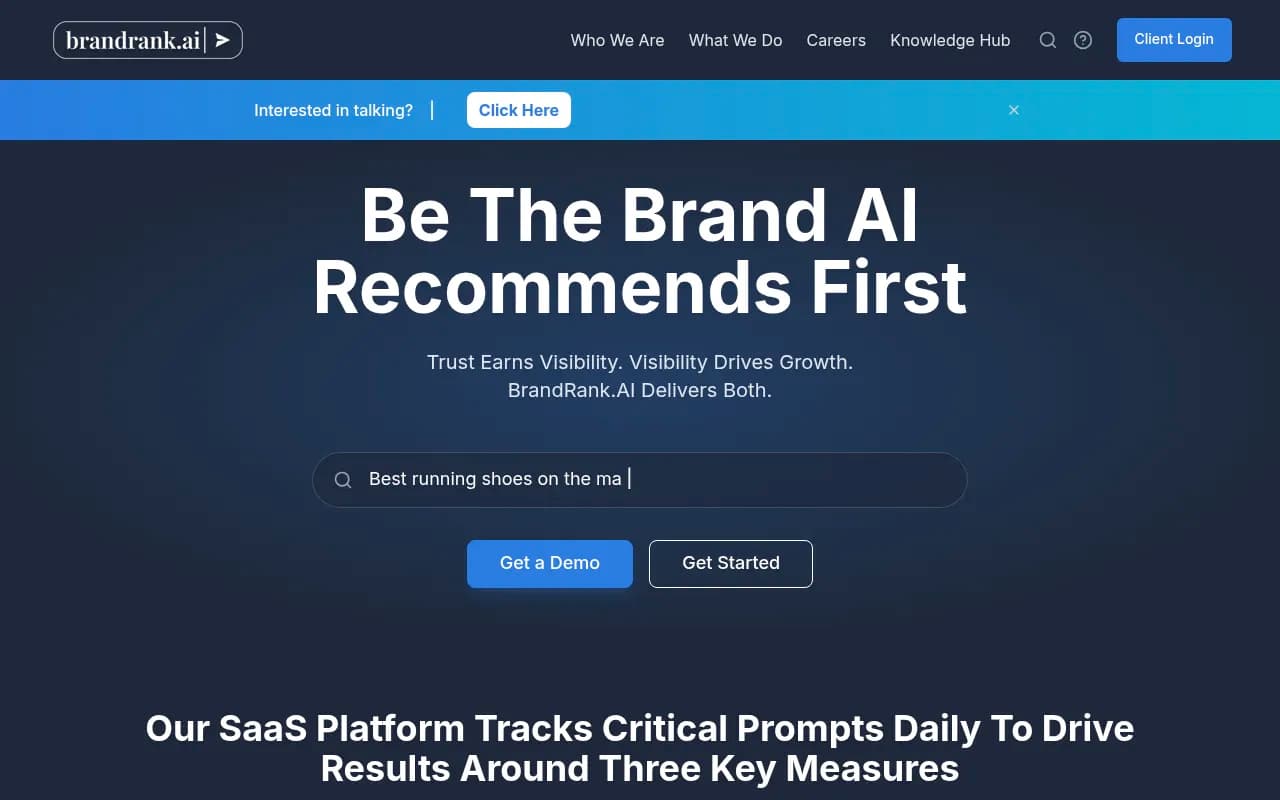
- BrandRank.AI scores brand reputation as seen by LLMs and takes an opinionated view of sentiment.
- Hall AI tracks how AI platforms cite and talk about your brand.
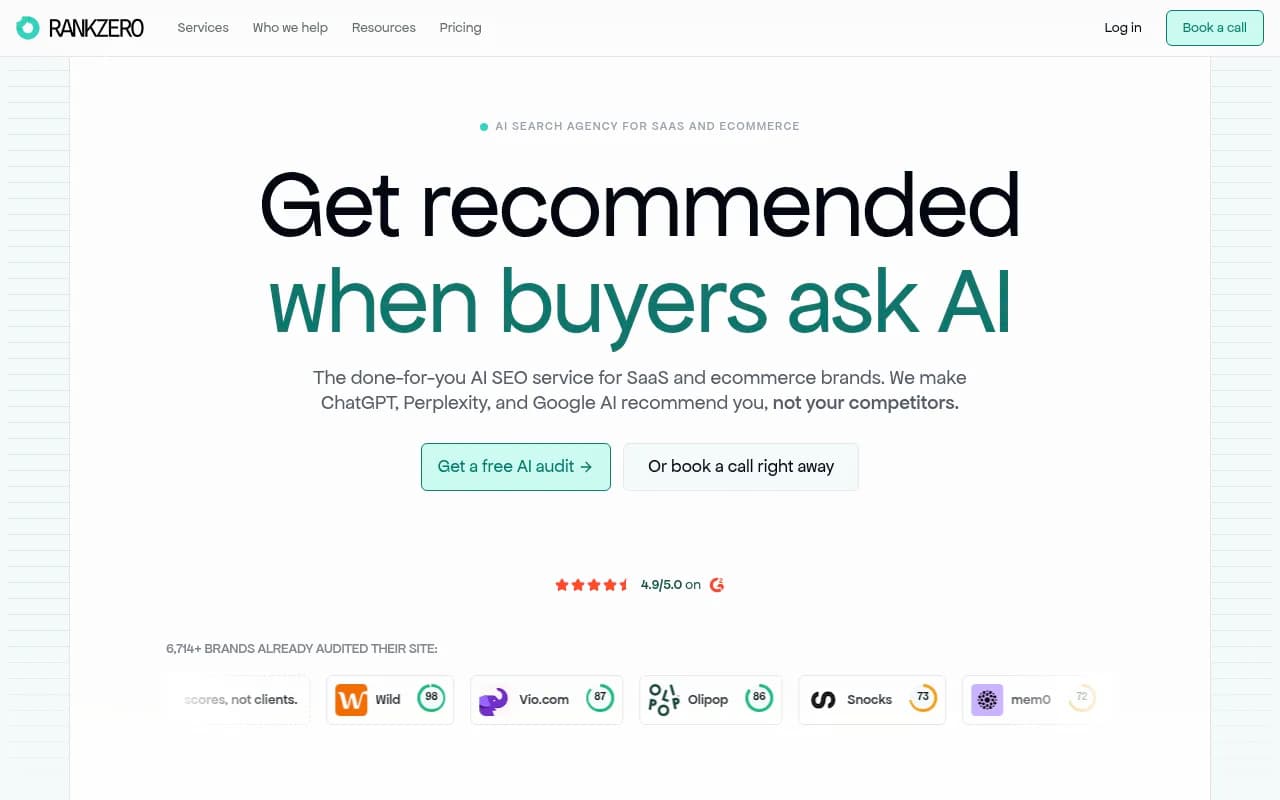
- RankZero covers AI visibility and sentiment tracking for agencies.
- Whitebox generates and ships AI narrative fixes automatically.

For a wider scan, the GEO software directory at bestgeosoftware.com lists far more options than this guide can cover.
Do you need AI sentiment, or traditional brand monitoring?
Quick clarification, because these get mixed up. Social listening tools like Brand24, Mention, Meltwater or Brandwatch measure what humans say on social media and the web. AI sentiment tools measure what models say about you in generated answers. The first can explain why the second looks the way it does, since AI often learns from the same public discussions, but they answer different questions.
If the question is "why does ChatGPT describe us this way?", you need an AI visibility tool with citation tracing. If the question is "what are people tweeting about our launch?", you need a listening tool.
How to run a claims audit in 30 minutes
Whatever tool you pick, this process works.
- Build a prompt set of 30 to 50 prompts across four types: branded ("is [brand] any good?"), competitor comparisons, category recommendations, and problem-based questions.
- Add stress-test prompts on purpose, some positive ("best features of [brand]") and some negative ("problems with [brand]"), then track sentiment for each separately. Otterly suggests this pattern too, and it is sound.
- Run them across engines and read the responses, not only the scores. Pull out every factual claim about your brand.
- Mark each claim accurate, inaccurate or outdated.
- For every inaccurate claim, find the cited source. If it is your own page, fix it. If it is a third party, you have an outreach or content job.
- Re-run the same prompts weekly and compare trends. Never act on one response, given how inconsistent AI outputs are.
How to choose
- If you want the cheapest entry and only need tone tracking, stay on Otterly Lite, or compare Peec AI and SE Visible at similar prices.
- If you want claims extracted, checked against your own pages and fixed, Promptwatch is the one built for that whole loop.
- If you are already in a big SEO suite and just need a sentiment column, try the Semrush toolkit first.
- If you are an enterprise with revenue attribution needs, look at AthenaHQ or Profound alongside Promptwatch.
Agencies running this for several clients should look at Promptwatch's agency plans (Kick-off $199/mo, Growth $399/mo, Scale $799/mo), which include unlimited projects and Brand Narrative. For more ways to compare tracking tools, the AI rank tracking directory at ai-rank-tools.com is a handy second stop.
Bottom line
Otterly.AI's sentiment feature is a fair first step, and its entry price is hard to beat. But a score only tells you that something is off. The alternatives that earn their cost show you the specific claim, the page behind it and whether your fix worked. Start with a free trial, run the claims audit above on your own brand, and judge each tool by whether it lets you find one wrong claim and trace it to its source.