Key takeaways
- Travel prompts are local, specific and multi-part. Track them by city, neighbourhood, language and amenity, not by a single "hotel + city" phrase.
- In Promptwatch Data for Sep 28 to Oct 4, 2026, booking and search sites earned more than half of the top travel citations in ChatGPT. Listing accuracy on OTAs and metasearch matters as much as your own site.
- Social citations differ by engine: ChatGPT cited social platforms 0.46% of the time, Google AI Overviews 12.2%. Facebook, Instagram and YouTube matter for Google surfaces, and Reddit seeding no longer pays off in ChatGPT.
- ChatGPT now searches inside your domain with the site: operator, so crawlable, indexable pages on your own site are a retrieval surface.
- Track prompts continuously. Platform behaviour changed overnight in August 2026, and a one-off audit goes stale.
Why local GEO is different for travel
Traditional local SEO is about the map pack, your Google Business Profile and a handful of "hotel near X" keywords. Those still matter. But travellers have started to type something closer to a briefing: "quiet boutique hotel near Edinburgh Old Town, good breakfast, free cancellation, under 200 pounds." An AI assistant breaks that into several sub-searches, pulls from different kinds of sources, and returns a shortlist of a few properties.
That shortlist is the new decision set. If you are not in it, the traveller never sees your listing, your rate or your photos.
Two things make travel unusual compared with, say, software or retail:
- Intent is geographic and contextual. The same hotel can be right for "family beach holiday" and wrong for "business trip near the airport."
- The citation network is its own ecosystem. OTAs, metasearch, review platforms, tourism boards, destination editorials and local guides all feed answers, and which ones matter depends on the city, the language and the assistant.
A caution on some of the numbers you will see around this topic. You will read claims like "70% of hotel bookings involve AI recommendations." That one came to me through a secondary summary of a Hotel Dive piece and looks aggressive, so I would not repeat it without checking the original. Adoption is clearly rising, but quote figures you can trace.
What AI actually cites for travel prompts
Start with data from the engine most travellers use. Promptwatch Data's report on travel citations in ChatGPT (Sep 28 to Oct 4, 2026) looked at organic travel prompts. Shares are of all travel citations, so individual domains look small, and the long tail is huge.
| Domain | Share of travel citations |
|---|---|
| Skyscanner (.net and .com) | 0.78% |
| Going.com | 0.52% |
| Tripadvisor | 0.49% |
| Kayak | 0.37% |
| Airbnb | 0.27% |
| 0.27% | |
| Expedia | 0.13% |
Lonely Planet and Time Out sit level with Expedia. The 17 top domains together hold only 4.18% of travel citations. By source type, booking and search leads at 2.42% (more than half of that 4.18%), then reviews and advice at 0.86%, guides and reference at 0.37%, community at 0.27%, tours at 0.16% and government at 0.1%.
What I take from this:
- No single site owns travel answers. Winning means being present in many places, correctly.
- Booking and metasearch listings are a citation surface. Out-of-date rates, photos or amenities on Skyscanner, Kayak, Airbnb or Expedia are a visibility problem, not just a distribution one.
- Reviews matter. Tripadvisor and Trustpilot show up, and Which? appears in the top list too.
- Editorial still counts. Lonely Planet and Time Out citations are worth pursuing if you are a destination or a flagship property.
- Going.com, a flight-deal service, out-cites Tripadvisor. Niche, specific utility sites can beat famous brands.
If you want the wider picture of how ChatGPT builds answers, the unique domains per response report shows almost half of responses cite 10 or more domains (same week). That means you are rarely competing for one slot. You are competing to be one of many sources, and to be named inside them.
Your own site still matters, especially for specifics
One vendor study (Listo, a hospitality GEO vendor, so treat it as single-study data I have not verified) reports that when a traveller adds a detail like "with a rooftop pool and a spa," ChatGPT's citations swing hard toward the hotel's own website to verify the claim. The same study found assistants disagree: ChatGPT leaned on official hotel sites, while Gemini leaned on editorial media. Even with the caveats, the practical lesson is sound. Put each amenity, room type and policy in plain, machine-readable text on your own pages, because that is where claims get checked.
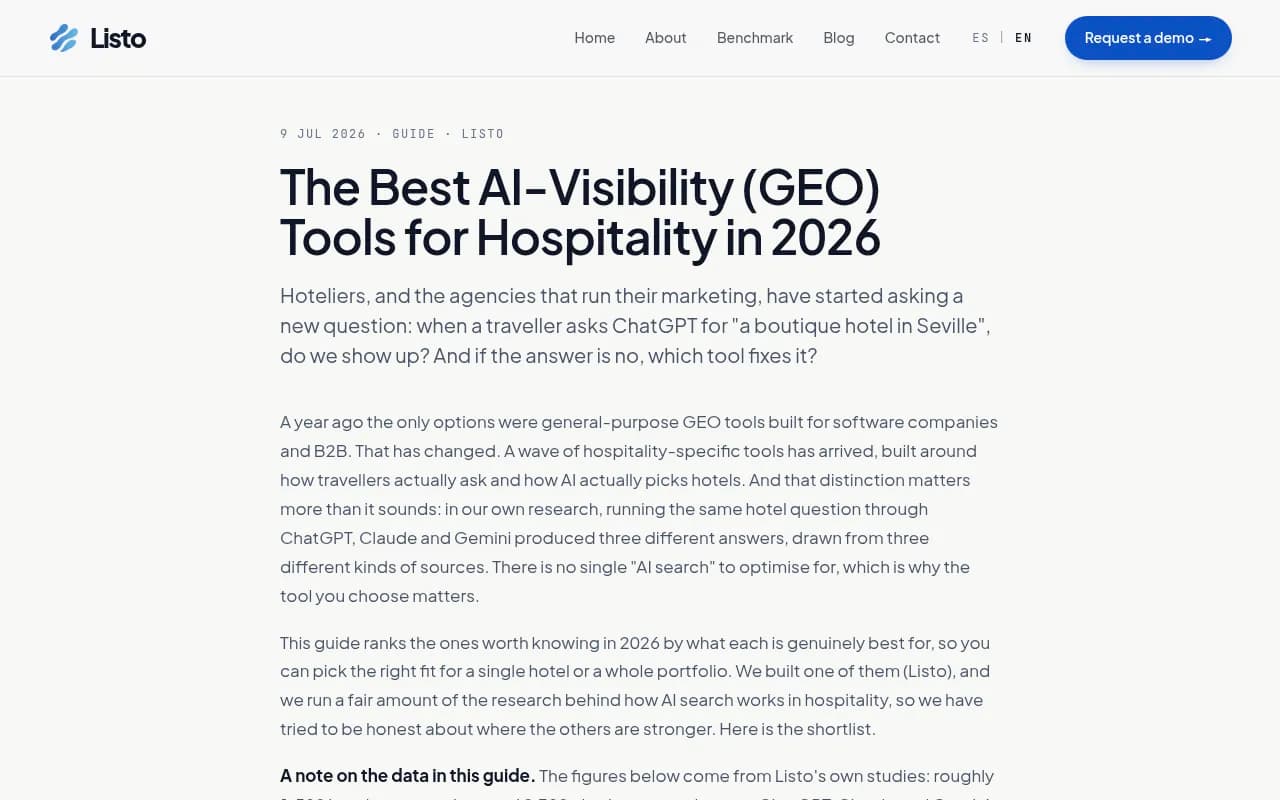
The screenshot above is from a vendor guide, so read its rankings as a vendor's view. The research behind it is still a useful read on how hotel prompts differ by assistant.
ChatGPT now searches your domain directly
On August 8, 2026, ChatGPT Search began using the site: operator at scale. Promptwatch Data shows the share of fan-out queries using site: jumped from 0.37% to 16.8%, roughly 46x, and average fan-outs per response rose from about 1.08 to about 1.83. The site: searches were added on top of the generic ones.
For a hotel, that means ChatGPT may literally run "site:yourhotel.com rooftop pool" while composing an answer. Consequences:
- Pages must be crawlable and indexed. Block the wrong crawler and you vanish from this path.
- Thin pages hurt. A room page with two lines and a gallery gives the model nothing to quote.
- Fan-out mappings built before August 8 are stale. Re-test your prompt sets.
- Platform behaviour can change overnight, so monitor continuously.
Social and community: it depends on the engine
The October 2026 social citations report (Sep 28 to Oct 4) shows how different the engines are:
| Engine | Social share of citations | Notable platforms |
|---|---|---|
| ChatGPT | 0.46% | LinkedIn 0.3%, Reddit 0.09% |
| Google AI Overviews | 12.2% | YouTube 4.28%, Facebook 2.38%, Reddit 2.15%, Instagram 1.61% |
| Perplexity | 2.7% | LinkedIn and Reddit 0.86% each |
The Reddit change is worth knowing about. Promptwatch's Reddit citations report shows reddit.com falling from roughly 4% to 0.5% of ChatGPT citations on August 14, 2026. For a hotel, that argues against investing in Reddit seeding for ChatGPT visibility. A complete, active Facebook, Instagram and YouTube presence is a better bet if Google AI Overviews and AI Mode matter in your source markets. For ChatGPT, spend the effort on your own site, listicles, guides and comparisons.
Build a local prompt set that mirrors how guests ask
Most hotel teams track five prompts like "best hotel in Lisbon." That tells you almost nothing. Build a matrix instead.
Dimensions to cover
- Destination level: "best areas to stay in Seville," "where to stay in Kyoto for first-timers."
- Proximity: "hotels within walking distance of the Colosseum." One of the cleanest tests of whether your location data and schema are understood.
- Traveller type: families, couples, business, solo, groups.
- Amenity and constraint: pool, spa, pet-friendly, free cancellation, price ceiling, breakfast.
- Brand and competitor: "is [your hotel] worth it," "[your hotel] vs [competitor]."
- Language: ask in the languages your guests use. The Listo test found recommendation overlap as low as 40% across languages on Claude. Treat that as indicative, but run your own check, because an assistant asked in Spanish searches the Spanish web.
- Region: where the traveller is searching from changes what gets shown.
Run them on real interfaces
Answers in the consumer UIs of ChatGPT, Google AI Overviews, AI Mode and Gemini can differ from API outputs, so track the interfaces people actually use, in each country. Pay attention to the query fan-outs too. They reveal the exact web searches the assistant ran, which tells you what pages you need to exist.
Measure with a few metrics, then read them together
| Metric | What a low number usually means |
|---|---|
| Share of voice | Coverage problem: you are missing from too many prompts |
| Position in answer | Prominence problem: named, but late |
| Mentions without self-citations | Content or crawlability problem on your own site |
| Sentiment | Review or reputation signal pulling you down |
| Citation source mix | You rely on a platform you do not control |
Track by city and by language, not just in aggregate. A group with hotels in four cities can look fine overall while one city is invisible.
Tools for tracking destination and hotel queries
There are two camps: hospitality-specific tools and general GEO platforms. Hospitality vendors such as Listo, HotelRank and Cendyn Wayfinder are tuned to hotel prompts, and Cendyn is strongest inside its own stack. I could not find public pricing for those in my research, so check directly. Their comparisons are vendor-written, and Listo's guide ranks itself first, so weigh accordingly.
General platforms are worth a look if you manage many markets, need crawler data or want to fix things rather than just watch them. Promptwatch is the one I would start with for this job. It tracks the real UIs of ChatGPT, AI Overviews, AI Mode, Gemini and Perplexity by country and language, with city and state tracking from the Business plan, and it pairs that with prompt volumes, query fan-outs and IP-verified AI crawler logs so you can see whether the assistants can read your property pages at all. It also surfaces content gaps and can draft and publish fixes. Confirm current plans at promptwatch.com/pricing.

Other options in the catalog, depending on budget and stack:



Yext is worth a mention because listing accuracy across directories is the part of local GEO that feeds booking and search citations. For more options in the category, browse the GEO software directory at bestgeosoftware.com.
| Option | Good for | Watch out for |
|---|---|---|
| Promptwatch | Multi-engine tracking by country, crawler logs, content fixes | Plan limits on prompts and responses, so scope your matrix |
| Hospitality-specific tools (Listo, HotelRank) | Hotel-tuned prompts and reporting | Vendor-written comparisons, limited public pricing |
| Cendyn Wayfinder | Hotels already on Cendyn | Content and schema focus, not independent tracking |
| Prompt trackers (Peec AI, Otterly.AI) | Cheap monitoring | Usually no crawler logs or content workflow |
| Yext | Listing consistency | Not an AI visibility tracker on its own |
A practical 30-day plan
Week 1: baseline
- Write 40 to 60 prompts across the dimensions above, in each guest language.
- Run them across ChatGPT, AI Overviews, AI Mode, Gemini and Perplexity.
- Record which sources get cited, not only whether you were named.
Week 2: fix the cheap things
- Check crawler access. Make sure AI bots are not blocked by robots.txt or a CDN rule, and that room and amenity pages are server-rendered and indexed.
- Add Hotel, LodgingBusiness and HotelRoom schema. Google's developer documentation describes these types, and one implementation guide recommends Hotel (or Resort, BedAndBreakfast, VacationRental) plus HotelRoom per room category.
- Audit OTA, metasearch and Google Business Profile listings for accurate rates, photos and amenities. One study cited by Hospitality.today of 4,000 Google AI Mode hotel queries reported 79% of hotel clicks going to Google Business Profiles. I have not verified that, but it is a good reason to keep the profile immaculate.
Week 3: fill content gaps
- Create pages for the specific constraints your prompts exposed: pet policy, accessibility, distance to landmarks, family rooms.
- Landing pages and docs-style pages stay cited the longest, while news loses half its pages within 36 days according to Promptwatch's content half-life report. Favour durable pages over seasonal posts.
- Product-style pages are the most cited type in ChatGPT, at 22.4% of citations in the content type report. Room and package pages count.
Week 4: reviews, editorial and re-test
- Ask for reviews on Tripadvisor and, where relevant, Trustpilot.
- Pitch destination editorials such as Lonely Planet or Time Out, and local guides that already rank for your city.
- Re-run the prompt set and compare share of voice and position by city.
For destinations and tourism boards
The same logic applies with a different mix. Government and tourism sites hold a small slice of travel citations (0.1% in the report above), so you will not win by being the official source alone. Provide structured event, itinerary and seasonal content, make sure operators in your region have accurate listings, and track prompts like "best time to visit," "things to do in [city] with kids," and "is [destination] safe." Track by source-market language, because a French traveller and an American traveller get different sources.
Agencies and outside help
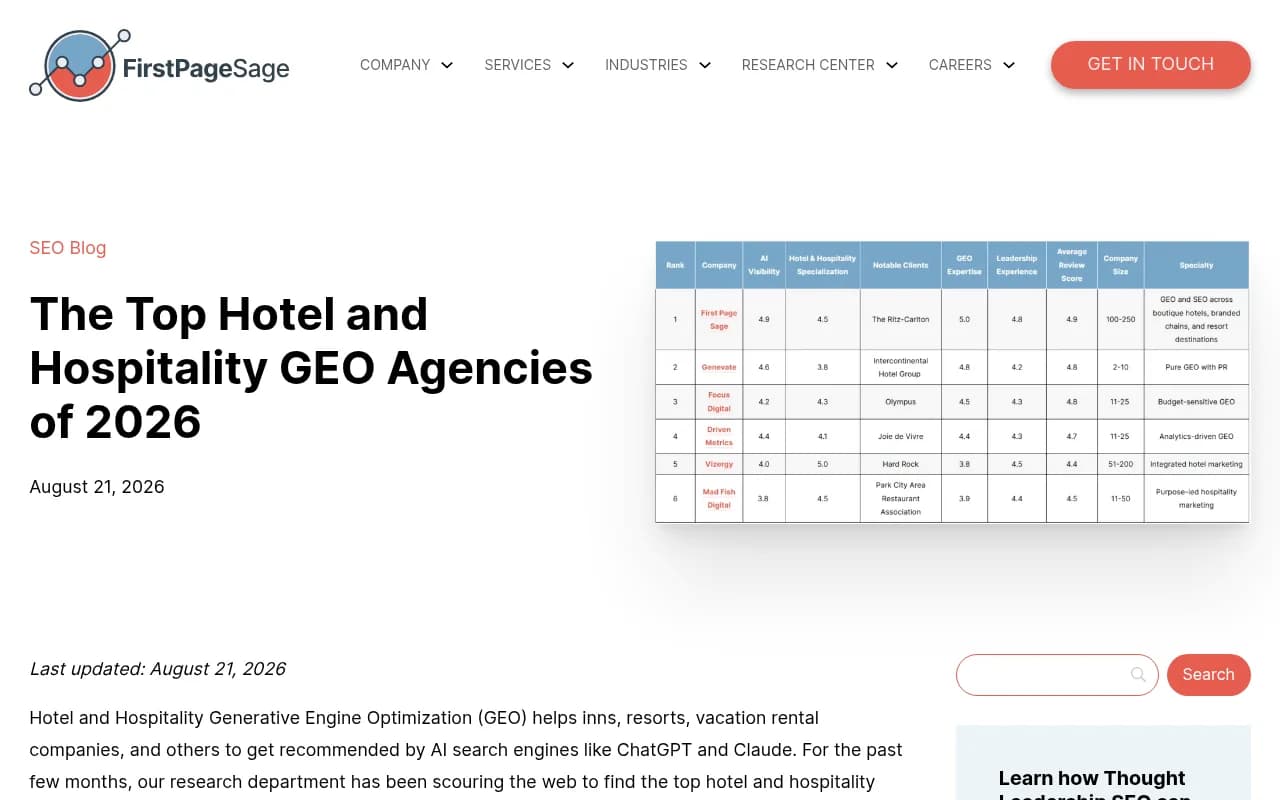
If you do not have the in-house time, an agency can run this. Hospitality-focused firms exist, and First Page Sage publishes a ranking of them, though it is a vendor ranking and its claim that meaningful AI visibility takes four to six months in competitive markets is anecdotal. If you want a broader SEO and GEO partner, 1001 SEO Media covers technical SEO, content and AI search work. Whoever you pick, ask to see prompt-level reporting by city and language.
Common mistakes
- Tracking one generic prompt per city and calling it a baseline.
- Treating all assistants as one "AI score." The lever differs by engine.
- Investing in Reddit for ChatGPT visibility after August 14, 2026.
- Ignoring languages. Your best-converting source market may be getting different answers.
- Auditing once. The August site: change shows behaviour can shift in a day.
- Letting OTA listings drift out of sync with your own site.
Bottom line
Local GEO for travel is prompt tracking plus source hygiene. Build a prompt matrix by city, language, amenity and traveller type. Make your own pages readable and indexable, keep every third-party listing accurate, and re-test on a schedule. Start by checking which sources are cited for your top ten destination prompts, then fix the one that appears most often and is wrong.