Key takeaways
- Manual AI Overview checks take 2-3 minutes each and fall apart past about 25 keywords; tracking 100 manually eats 15+ hours a week
- Citation data rotates fast. Profound found 59.3% of domains cited in Google AI Overviews changed month to month, and Ahrefs puts the odds of an AI Overview changing between any two observations at 70%
- A real bulk setup needs CSV/GSC keyword import, scheduled re-checks (not one-off snapshots), citation-level extraction (not just "present/absent"), and share-of-voice against competitors
- Google AI Overviews cite around 10 sources per answer on average, almost double ChatGPT's roughly 5, which makes AI Overviews the more forgiving surface for mid-authority sites trying to break in
- Segment your keyword list by vertical and intent before you build the dashboard. Healthcare and B2B tech trigger AI Overviews on 80%+ of queries; ecommerce sits around 4%, so one blanket tracking cadence won't serve both
Why checking AI Overviews one keyword at a time doesn't work anymore
I used to think I could eyeball AI Overview presence the same way I'd glance at a SERP. Open an incognito tab, type the keyword, see if the AI box shows up, note whether my URL is in there. Fine for five keywords. Completely unworkable for the 200+ terms most SEO teams actually care about.
Here's the math that killed that approach for me: each manual check, done properly with a logged-out browser, fixed location parameters, and a screenshot for the record, takes 2-3 minutes. Track 100 keywords that way and you're burning 15+ hours a week just collecting data, before you've analyzed anything. And the data you collect is stale almost immediately. Ahrefs found AI Overview content has roughly a 70% chance of changing between any two observations, with 45.5% of cited sources being entirely new from one check to the next. Profound's volatility research puts monthly citation drift at 59.3% for Google AI Overviews and 54.1% for ChatGPT, climbing to 70-90% when you compare January citations against July. A Sangra Health Economics paper on SSRN found only 10.6% of cited URLs persist across a 28-day window.
Put plainly: if you check a keyword today and don't check it again for a month, you have no idea what actually happened in between. You might have been cited for three weeks and lost it the day before your check. Bulk, continuous monitoring isn't a nice-to-have here, it's the only way the data means anything.
What "bulk monitoring" actually needs to capture
Before picking a tool, get clear on what you're measuring. Treating this as a single "are we visible" number is how teams end up with dashboards nobody trusts.
Trigger rate, segmented by intent
Not every keyword triggers an AI Overview, and the rate varies wildly by category. BrightEdge's vertical breakdown shows healthcare at 88%, education at 83%, B2B tech at 82%, restaurants at 78%, insurance at 63%, entertainment at 37%, and ecommerce barely cracking 4%. Semrush's own trend data shows informational queries falling from a 91.3% trigger rate to 57.1% between January and October 2025, while commercial queries crept up from roughly 7% to 19%. That shift into commercial territory is new, and it means a keyword list built two years ago probably needs reshuffling by intent now.
If your bulk tracker reports one blended trigger rate across a 300-keyword list spanning five verticals, you're averaging away the signal. Group keywords by category and intent, then track trigger rate per group.
Citation presence and position, not just a yes/no flag
Knowing you're "mentioned" isn't enough. You need the exact position among cited sources, the anchor text or snippet Google pulled, and whether it's a link-out citation or just a brand name drop. Sitechecker's approach lets you group keywords to compare AIO citation rates by topic cluster, which is the right level of granularity. A tool that only outputs a green checkmark is hiding the part that's actually actionable.
Competitor share of voice, not just your own presence
Daniel Espejo, co-founder of Omnia, put it well: "Platforms that only show brand mentions without attribution are hiding the most actionable data. When you're not cited on a query, who is?" A rising citation count on your side means nothing if a competitor is growing faster. BrightEdge's weekly data backs this up further: the top 1% of domains hold 64% of all citations, the top 10% hold 84%. Citations are concentrated, and losing one is both more common and more consequential than gaining one, since 87% of week-over-week citation changes BrightEdge tracked were losses, not gains.
Content type mix, because the game keeps shifting under citations
AI Overview citations aren't frozen to one content format. In July 2026, Promptwatch's AI Overviews citation type data shows product pages overtaking listicles as the most-cited format late in the month, nearly doubling since January from about 9% to roughly 18% of citations. Video citations in AI Overviews climbed from 2.7% in January to 6.3% by late July, a format most trackers and most teams aren't watching at all. If your bulk setup only logs "cited: yes/no" without noting what kind of page got cited, you'll miss that your competitors are winning citations with product pages while you keep publishing listicles.
The infrastructure: how to actually get keywords into a tracker at scale
The mechanics of bulk setup matter more than people expect. A few patterns worth copying:
Import from Google Search Console, not spreadsheets you type by hand
Sitechecker lets you add keywords manually, via CSV/Excel upload, or pull directly from GSC, including a suggested "high-potential keywords" list based on your existing impressions. Keyword.com supports the same CSV import pattern for keywords, rankings, and whole projects. Starting from your GSC query list rather than a hand-picked set means you're tracking what's actually driving impressions today, including long-tail queries you'd never think to add manually.
Set a re-check cadence that matches keyword volatility, not a flat schedule
Given how much citations rotate, daily or at minimum weekly re-checks are the baseline for anything commercially important. But match cadence to vertical risk: BrightEdge found finance domains change weekly at a 51.1% rate with 91% of those changes being losses, review sites change at 45.5% with 100% declines, while government and institutional sites only shift 3.6% of the time. If your keyword set skews finance or reviews, weekly checks aren't optional. If it skews government or reference content, monthly might genuinely be fine.
Segment desktop vs. mobile and by geography
AI Overview presence is non-deterministic, it can differ by device, location, and even between two identical requests. A credible bulk tool should let you fix gl and hl parameters or equivalent location settings and track desktop and mobile separately, otherwise you're averaging over noise you can't see.
Export everything, don't live inside one dashboard
The best setups push data out to where your team already works: CSV exports with full fields (timestamp, keyword, geo, device, citation URLs, presence flags), API access, and Looker Studio or Sheets connectors. SE Ranking's AI Overviews Tracker, for example, ships with API access and project-level historical data on its Growth plan, which matters if you're layering this on top of existing SEO reporting rather than replacing it.
Picking a tool: what separates a real bulk tracker from a glorified rank checker
Omnia's evaluation framework for AI Overview trackers calls out two failure modes worth knowing before you buy anything. False positives happen when a tool mistakes a Featured Snippet or a People Also Ask box for an actual AI Overview, which inflates your reported trigger rate. False negatives happen when Google tweaks its layout and a vendor's parser quietly stops detecting AI Overviews that are, in fact, showing up. Ask any vendor directly how they distinguish these before you commit budget.
The audit checklist worth running through for any candidate tool: does it support country-level presence tracking, device segmentation, timestamped and archived SERP snapshots (actual cached HTML or screenshots, not just a summary), URL-level citation extraction with proper canonicalization, full-field CSV export, and API or Looker Studio compatibility. If a tool is missing more than one of these, it's probably a rank tracker with an AI Overview label bolted on, not a bulk monitoring system.
| Tool | Bulk import | Citation-level detail | AI Overview specific | Pricing entry point |
|---|---|---|---|---|
| Sitechecker | CSV/GSC/manual | Position, snippet, grouping by topic | Yes, dedicated AIO module | ~$75/mo (verify on site) |
| SE Ranking | CSV, project import | Mentions, links, competitor comparison | Dedicated AI Overviews + AI Mode trackers | From ~$103/mo (Core) |
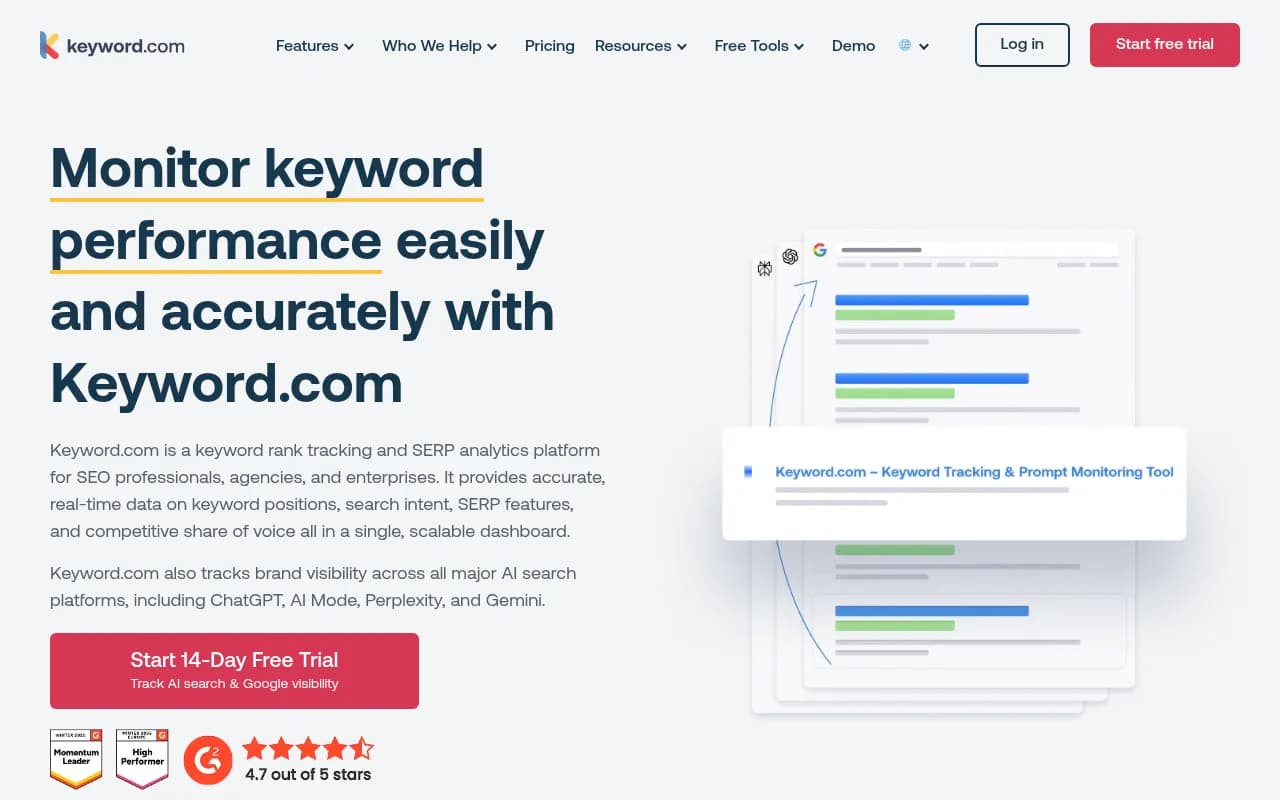
| Keyword.com | CSV import, modular credits | Citation analysis, sentiment (on 360 tier) | AI Visibility add-on covers AIO, AI Mode, Gemini, Copilot | From ~$3-4/mo base, AI add-on extra |
| Otterly.AI | Prompt-based, manual add | Agent Analytics, citation tracking | Yes, plus ChatGPT/Perplexity/Copilot | $29/mo (Lite), engines priced as add-ons |
| Omnia | CSV, keyword groups | Exact URL citations, geo and share of voice | Yes, plus execution/task output | Contact for pricing |
Pricing from third parties varies enough (one source cites a 4x gap on Sitechecker's actual cost) that you should always confirm current numbers on the vendor's own pricing page before budgeting.

Where AI Overviews sit inside the bigger AI visibility picture
AI Overviews are one surface among several now pulling clicks away from the traditional ten blue links. ChatGPT, Perplexity, Gemini, and Copilot all run their own citation logic, and the behavior differs enough that a tool built only for Google AI Overviews won't tell you anything about the others. Promptwatch's data on average sources per response shows AI Overviews citing around 10 sources per answer, roughly double ChatGPT's 5, and holding that count steady over time, while Microsoft Copilot's citation count has swung from under 2 to nearly 17 sources in a matter of weeks, a sign Microsoft is still rebuilding its retrieval system and that Copilot data shouldn't be trusted week to week yet.
That gap matters for bulk setups: AI Overviews' wider citation slate makes it the more forgiving surface for mid-authority sites. ChatGPT's citation share by domain rank backs this up too, with DR 46-75 sites capturing roughly 46% of all citations as of August 2026, while DR 91-100 sites dropped to just 3%. If your domain sits in that mid-authority band, AI Overviews is probably where bulk tracking will show the most movement worth acting on.
If your bulk monitoring is going to extend past Google's AI Overviews into ChatGPT, Perplexity, and the rest, Promptwatch is built for exactly that handoff: it tracks prompt-level citation share across all the major AI engines, including AI Overviews and AI Mode, with monthly search volumes and difficulty scoring per prompt, and crawler logs that show whether AI bots are even reaching your pages in the first place. Where most of the tools above stop at telling you that you lost a citation, Promptwatch's content gap analysis and automated Content Agent can draft and publish the page that wins it back.

A note on volume and reality check
Prevalence numbers for AI Overviews vary a lot by methodology, which is worth knowing before you set expectations for your own bulk dashboard. BrightEdge's commercial tracker and Google's own disclosure both land near 48-50% of US queries as of February 2026, but Conductor's 21.9-million-query benchmark for Q1 2026 found only 25.11%, and Semrush's panel peaked at 24.61% in July 2025 before dropping to 15.69% by November after a Google recalibration. None of these numbers are wrong exactly, they're measuring different query sets with different tools. Treat any single prevalence figure as directional, not gospel, and trust your own tracked data over anyone's published benchmark.
Building the actual workflow
Here's roughly how I'd put this together if I were starting from zero today:
- Pull your top 200-500 queries from Google Search Console, sorted by impressions, and tag each with a vertical and intent (informational, commercial, navigational)
- Import that list into a tool that supports CSV/GSC import and citation-level extraction, splitting desktop and mobile if the tool allows it
- Set re-check cadence by vertical risk: daily or weekly for finance, reviews, and anything high-value commercial; monthly is fine for stable reference content
- Export citation data weekly into a shared Sheet or Looker Studio dashboard alongside your existing GSC clicks and impressions, so you can see CTR impact next to presence data
- Review share-of-voice against named competitors monthly, not just your own presence, since a flat trend for you next to a rising one for a competitor is the real warning sign
For teams that want this folded into a broader multi-engine GEO practice rather than a Google-only sideline, the GEO software directory at bestgeosoftware.com is a reasonable place to compare platforms side by side before committing budget.
The tooling will keep shifting. What won't change is the underlying fact that single, manual checks on a handful of keywords tell you almost nothing about a surface this volatile. Build the bulk setup once, point it at your real query list, and let the re-checks do the work you used to do by hand.