Key takeaways
- We found no published test that runs the same 50 prompts through 10 AI visibility tools, and we won't make up scores. This guide gives you the protocol to run it yourself, plus an honest read of what each tool is built to do.
- Engines cite very different numbers of sources, so a visibility score from one engine can't be compared with another's without normalizing.
- Most tools in this category are dashboards. They show where you are invisible. Fewer help you fix it or prove the fix worked.
- Pricing below is secondhand (from one third-party comparison dated November 18, 2026) except Promptwatch's. Confirm everything on vendor pricing pages.
- A fair 50-prompt, 2-week test costs a few hundred dollars in trials and is worth it before an annual contract.
Why there is no "we tried 10 tools" scoreboard here
The title you may have clicked on promises a leaderboard. I looked for one. I found listicles, vendor-written comparisons, and one consultant's useful but price-focused roundup. I did not find a test where the same 50 prompts ran through ten platforms with the raw outputs shown.
So I'm not going to pretend. Publishing invented percentages would be worse than publishing nothing, and every tool in this space already has a flattering demo.
What I can do is give you the protocol, the things that will skew your results, and a realistic view of which tools fit which job. Run it yourself and you will have the only numbers that matter: the ones for your brand, your market and your buyers.
What the test should actually measure
Every tool in this category runs the same core loop: take a fixed set of buyer prompts, run them through AI engines on a schedule, and log mentions, citations and positions. Justin McKelvey describes it the same way in his comparison of AI visibility tools, updated November 18, 2026. His main caveat is worth repeating: every tool he reviewed is a dashboard. They tell you where you are invisible, but none of them does the content, entity and off-site work that fixes it.
So test two things separately:
- Measurement quality. Does the tool collect answers the way a real user sees them, and are results stable?
- Usefulness after the number. Does it tell you why you're absent, and what to do?
Most buyers only test the first and then get surprised by the second.
The 50-prompt set
Fifty is enough to see patterns and small enough to fit the lowest plans. Essential on Promptwatch includes 50 prompts, and most trackers have a tier near that size.
Split the set deliberately:
- 15 category prompts with no brand name ("best project management software for agencies")
- 10 comparison prompts ("X vs Y" for you and two competitors)
- 10 brand-specific prompts ("is X good for small teams", "X pricing")
- 10 problem-led prompts that describe a pain, not a product
- 5 local or market-specific prompts, if you serve more than one country
Write them like real buyers type. If the tool lets you set personas or topics, tag each prompt now, because you will want to slice results later.
Keep a plain spreadsheet with the prompt, the intended topic, and your own manual check of the answer in ChatGPT, Perplexity and Google AI Overviews. That manual column is your ground truth.
Normalize before you compare engines
This is the part most roundups skip. Promptwatch Data on average sources per response shows that ChatGPT cites about 5 sources per web-search answer, while Google AI Overviews cites about 10 and Perplexity cites almost exactly 10 every day. Microsoft Copilot's average swung from under 2 to nearly 17 within a few weeks before settling low.
That means a brand has twice as many slots to appear in on AI Overviews as in ChatGPT. A blended "visibility score" that treats engines equally hides this. Read each tool per engine, and judge volatile engines like Copilot on monthly trends instead of weekly snapshots.
Check what each tool does with query fan-outs
ChatGPT doesn't search for your literal prompt. Promptwatch's query fan-out data shows average fan-outs per response of 2.15 in early December and about 1.84 by early March, with average query length falling from roughly 117 characters to the high 80s. Complex prompts can trigger several more searches. A tool that only records the prompt text misses the sub-queries that decide which pages get retrieved. Add "shows fan-outs" to your scorecard.
Controls that stop you fooling yourself
- Run every tool on the same start date and the same prompt text. Tool-side paraphrasing ruins comparisons.
- Pin country and language. If one tool tracks the US and another the UK, you are comparing different markets.
- Compare against your manual check. If a tool says you were mentioned and you can't reproduce it in the real interface, note that.
- Look at run-to-run variance. Run the same prompt several times. If a tool's number moves 20 points a day, the average is noise.
- Ask whether the data comes from real interfaces or API calls. User-facing answers and citations can differ from API outputs.
- Count only mentions that the tool can show you evidence for (the actual response text and sources).
The 10 platforms worth putting in the test
I picked these because they cover the main categories: end-to-end platforms, focused trackers, and SEO suites with an AI add-on. Prices for non-Promptwatch tools come from McKelvey's November 18, 2026 comparison and are unverified on vendor pages.
| Tool | Type | Starting price (secondhand unless noted) | Where it fits |
|---|---|---|---|
| Promptwatch | Tracking plus content and crawler data | $95/mo Essential (pricing page) | Teams that want to fix gaps, not just see them |
| Profound | Enterprise monitoring | Custom, enterprise only | Large brands with procurement processes |
| Peec AI | Tracker | From $95/mo | Agencies and multi-language reporting |
| Scrunch | Monitoring plus site audit | $250/mo | Mid-market teams |
| Otterly.AI | Tracker | From $29/mo | Cheapest credible start |
| LLMrefs | Tracker | $79/mo flat for 500 prompts | Best value per prompt |
| Semrush AI toolkit | SEO suite add-on | $99/mo per domain | Existing Semrush users |
| Ahrefs Brand Radar | SEO suite add-on | Prompt tracking from $50/mo on top of an Ahrefs plan from $129 | Existing Ahrefs users |
| AthenaHQ | Monitoring | Check vendor | Multi-engine monitoring |
| Qwairy | GEO platform | Check vendor | GEO strategy workflows |
Promptwatch
Promptwatch is the one I'd test hardest on the second question, what happens after the number. It monitors real interfaces of ChatGPT, Google AI Overviews, AI Mode, Gemini, Perplexity, Copilot and others, then ties results to IP-verified AI crawler logs, visitor analytics and a Content Agent that writes and publishes pages. The Action Board turns gaps into a prioritized list.
For your test, the interesting checks are query fan-outs, Brand Narrative (the claims AI makes about you) and whether crawler logs explain why a cited competitor beats you. Essential is $95/mo for 50 prompts, Professional $245, Business $579, with a 7-day free trial on monthly billing. The Content Agent and faster-than-daily tracking start at Business. Confirm at promptwatch.com/pricing. There is also a free AI visibility report if you want a quick baseline first. For head-to-head detail, see Promptwatch vs Profound and Promptwatch vs Peec.

Profound
Profound is the name enterprise buyers ask about first. McKelvey reports enterprise-only custom pricing, which means you probably can't trial it on a 50-prompt budget. Ask for a pilot with your exact prompt set.

Peec AI
A tracker that agencies like for multi-language support and clean reporting. Test it on your multi-market prompts and see whether reports are client-ready.

Scrunch
Positioned for mid-market teams, with site audit capability bundled. Check whether the audit findings link back to specific prompts you're losing.
Otterly.AI
The low-cost entry point. A good baseline: if a $29 tool gives you the same picture as a $579 one for your prompts, you have learned something.

LLMrefs
Best value per prompt on paper, at $79/mo for 500 prompts. Use it to stress-test prompt volume, since 50 prompts barely scratches the plan.
Semrush AI toolkit
Sensible if your team already lives in Semrush. The question is depth: are prompt sets fixed, and can you see responses and sources?
Ahrefs Brand Radar
Same logic for Ahrefs shops. Note the price stack: the add-on sits on top of a plan that starts at $129.
AthenaHQ
A monitoring-focused platform covering several engines. Check how it handles optimization, since the emphasis is on tracking.
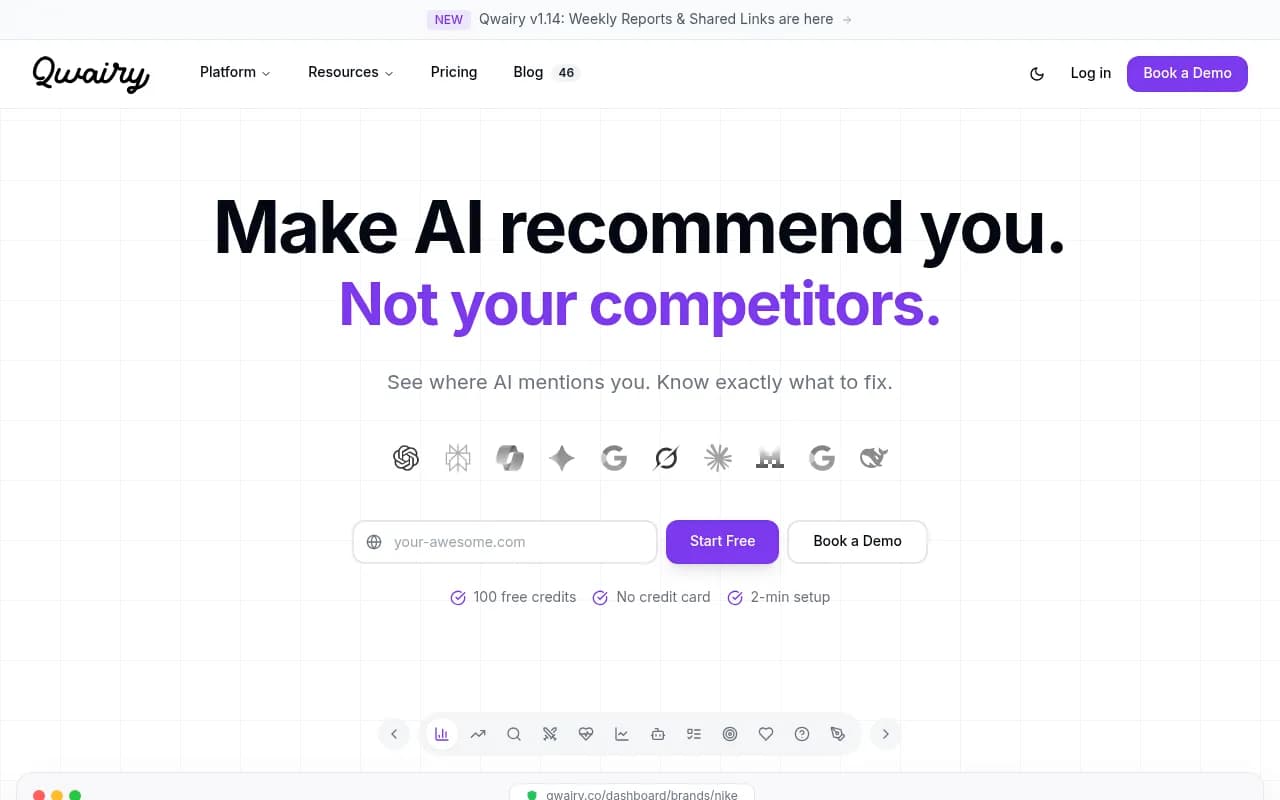
Qwairy
Pitches itself as a GEO strategy platform. Test whether the strategy outputs are specific to your prompts or generic advice.
Scorecard to fill in during the trial
Score each tool 1 to 5 on these, and write one sentence of evidence for each score:
| Criterion | What to look for |
|---|---|
| Real-interface data | Does it say how responses are collected? |
| Evidence | Can you open the full response and the cited sources? |
| Fan-outs | Does it show the sub-queries AI ran? |
| Stability | Same prompt, same day, similar result? |
| Per-engine view | No forced blended score |
| Diagnosis | Why are you missing: coverage, prominence or crawlability? |
| Action | Does it tell you what to publish or fix? |
| Measurement of the fix | Can you see whether a new page got crawled, cited and clicked? |
| Cost per response | Price divided by responses included, not prompt count |
| Export and API | Can you get data out? |
The last four rows are where tools separate. Almost all of them can show a mention rate. Far fewer connect a page you published to AI crawler hits and then to traffic.
What the results will probably look like
I can't promise numbers, but I can tell you what to expect, since it follows from how the tools are built:
- Brand-specific prompts will look fine on every tool. Your own name tends to appear when asked about directly.
- Category and problem-led prompts will diverge most between tools, because small differences in collection method and run count change the outcome.
- Cheap trackers and suites will agree with expensive ones on direction, and disagree on magnitude.
- Your own manual spot-checks will surface at least a few responses where a tool's mention call is debatable. This is where brand alias rules and analysis instructions matter.
If two tools give you opposite answers on the same prompt, check the response text before deciding who is right.
Picking a winner without a leaderboard
Match the tool class to the problem:
- You only need a recurring report for a client or a boss: a lightweight tracker like Otterly or LLMrefs is enough.
- You already pay for Semrush or Ahrefs and want a first look: use their add-on, but treat it as a starting point.
- You are an enterprise with security reviews and many stakeholders: shortlist Profound and Promptwatch (ISO/IEC 27001 certified), and ask both for a pilot.
- You need to move the numbers, not just watch them: favor the platform that includes content creation, crawler logs and measurement of published pages.
If you want to browse beyond these ten, the GEO software directory lists many more, and AI rank tracking tools covers the tracker side.
Run it in two weeks
Week one: set up the 50 prompts in two or three tools, pin country and language, and collect your manual ground-truth column. Week two: compare per engine, fill in the scorecard, and pick the one whose diagnosis you could hand to a content writer tomorrow.
Then publish the pages it recommends and see whether the tool can tell you if they worked. That last check is the honest test of this whole category.