Key takeaways
- Most GEO tools sold in 2026 are monitoring dashboards, not optimization platforms. They show you where you're invisible but offer no path to fixing it.
- Vague "AI visibility scores" with no methodology behind them are a major warning sign. If a vendor can't explain how the number is calculated, it's probably meaningless.
- Fixed prompt sets, no content gap analysis, and missing traffic attribution are three of the clearest signs a tool won't move the needle for your business.
- Before paying, always ask: does this tool help me do something, or just see something?
- The best tools close the loop between visibility data, content creation, and revenue attribution.
The GEO tool market has exploded. In the past 18 months, dozens of platforms have launched promising to track your brand across ChatGPT, Perplexity, Gemini, and the rest. Some of them are genuinely useful. Many are not.
The problem is that they all look similar from the outside. A clean dashboard, some charts, a mention count. You sign up for a trial, poke around for a week, and then either commit $200-600/month or walk away. Most marketers don't have a framework for telling the good from the bad before they've already wasted time and budget.
This guide gives you that framework. Here are the red flags to look for -- and what to look for instead.
Red flag #1: The tool only monitors, it doesn't help you act
This is the biggest one, and it's worth spending time on.
A huge portion of GEO tools on the market right now are essentially dashboards. They query AI models, record what comes back, and show you a visibility score or mention count. That's it. There's no answer gap analysis, no content recommendations, no way to understand why you're not being cited for a given prompt.
Monitoring data is useful, but it's table stakes. If a tool shows you that your brand appears in 12% of relevant AI responses and a competitor appears in 34%, that's interesting. But if the tool can't tell you what content you're missing, which prompts you should target, or what to write to close that gap -- you're stuck. You have a problem statement with no solution.
Before paying for any GEO tool, ask: "What do I do with this data?" If the answer is "you export it and figure it out yourself," that's a red flag.
The better tools are built around an action loop: find the gaps, create content that fills them, track whether it worked. Promptwatch is one of the few platforms that covers all three stages, including a built-in AI writing agent that generates content grounded in real citation data.

Red flag #2: Fixed prompt sets with no customization
Some tools come with a pre-built library of prompts they monitor. You pick your industry, they run their standard questions, and you get results. Sounds convenient. It's actually a serious limitation.
AI search is driven by how your customers actually ask questions -- not how a SaaS vendor imagined they might. A fixed prompt set almost certainly misses the specific, high-intent queries that matter most to your business. And if the tool doesn't let you add your own prompts, you're measuring visibility for questions your customers aren't asking.
Semrush and Ahrefs Brand Radar both have this problem. Their AI monitoring features use fixed prompt sets, which means you're stuck with their framing rather than your own.
A good GEO tool lets you define custom prompts, add competitor names, set personas, and monitor by region and language. If you can't configure it to match how your actual customers search, the data is only partially useful.
Red flag #3: No explanation of methodology
"Your AI visibility score is 42." Great. What does that mean? How is it calculated? Which models were queried? How often? With what prompts?
Vague scores without methodology are a classic sign of a low-quality tool. If the vendor can't clearly explain how their number is derived, you have no way to trust it -- and no way to know if an improvement in the score reflects a real change in AI behavior or just a shift in how they're sampling responses.
This matters more than it might seem. AI models give different answers depending on prompt phrasing, model version, time of day, and geography. A rigorous tool will be transparent about all of this. A sloppy one will just show you a number and hope you don't ask questions.
When evaluating a tool, ask: "Can you walk me through exactly how this score is calculated?" If the answer is evasive or vague, move on.
Red flag #4: No traffic attribution
Visibility is nice. Revenue is better.
A GEO tool that can't connect AI citations to actual website traffic is only telling half the story. You need to know whether being cited by Perplexity or ChatGPT is actually driving visitors to your site -- and whether those visitors convert.
The best platforms offer multiple attribution methods: a JavaScript snippet, Google Search Console integration, or server log analysis. This lets you close the loop between "we appear in AI responses" and "we got X visitors and Y conversions from AI search."
Without this, you're optimizing for a metric that may or may not correlate with business outcomes. That's a problem when you're trying to justify budget to a CFO or a client.
Red flag #5: No AI crawler log visibility
This one is less obvious but increasingly important.
AI models don't just respond to queries -- they crawl your website to build their knowledge of your content. If ChatGPT's crawler can't access your pages, or keeps hitting errors, or is blocked by your robots.txt, your content won't get indexed and you won't get cited. No amount of content creation will fix a crawling problem you don't know about.
Most GEO tools have no visibility into this at all. They can tell you whether you appear in AI responses, but they can't tell you whether AI crawlers are even reading your site.
A handful of platforms -- including Promptwatch at its Professional tier and above -- provide real-time crawler logs showing which AI bots visited your site, which pages they read, what errors they encountered, and how often they return. If a tool you're evaluating doesn't offer this, it's worth understanding what you're missing.
Red flag #6: Guaranteed results or unrealistic claims
"We'll get you cited by ChatGPT in 30 days." "Guaranteed top visibility across all AI models."
Run.
No one can guarantee placement in AI search results. AI models make probabilistic decisions based on hundreds of factors -- content quality, domain authority, citation patterns, prompt phrasing, and more. Anyone promising guaranteed outcomes either doesn't understand how these systems work or is being deliberately misleading.
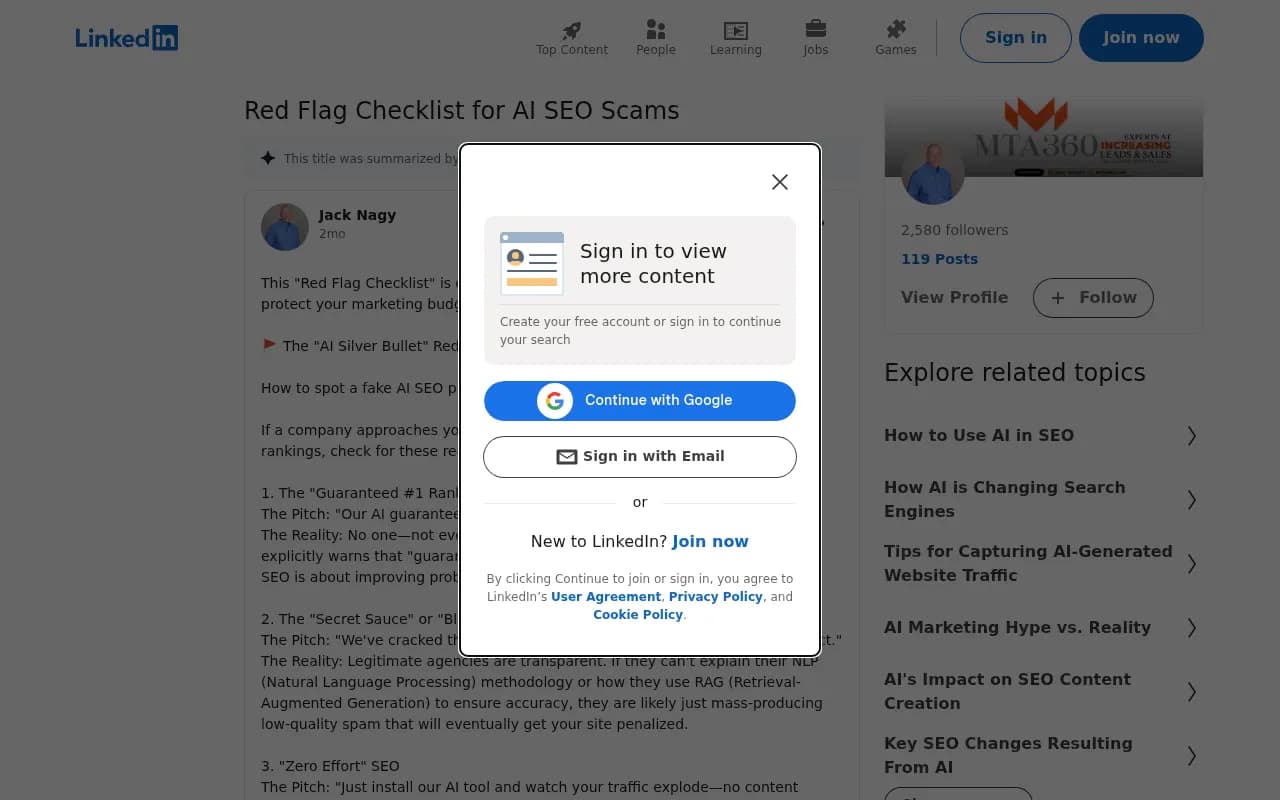
This is the same problem that plagued traditional SEO agencies for years, and it's showing up again in the GEO space. The red flag checklist that circulated on LinkedIn earlier this year (from Jack Nagy's post on AI SEO scams) specifically called out "guaranteed rankings" as the first warning sign to filter for.
Legitimate GEO tools and agencies will talk about improving your visibility over time, tracking progress, and iterating on content. They won't promise specific outcomes they can't control.
Red flag #7: No prompt intelligence or difficulty scoring
Not all prompts are worth targeting. Some are searched constantly by high-intent buyers. Others are niche edge cases that generate almost no traffic. A good GEO tool helps you prioritize.
Prompt intelligence means knowing the estimated volume for each query, how competitive it is (i.e., how hard it is to displace the current sources being cited), and how it branches into related sub-queries. Without this, you're guessing which content to create.
If a tool shows you a list of prompts where you're not visible but gives you no signal about which ones to prioritize, you'll waste time creating content for low-value queries while missing the ones that actually matter.
Look for tools that surface prompt volume estimates, difficulty scores, and query fan-outs. These features separate tools built for optimization from tools built for reporting.
Red flag #8: No competitor benchmarking
Your AI visibility score in isolation is almost meaningless. What matters is how you compare to competitors for the same prompts.
A tool that only shows your own data -- without letting you see which competitors are being cited instead of you, and for which prompts -- is missing a core piece of the puzzle. Competitor benchmarking tells you where the opportunity is, not just where the gap is.
Good tools offer heatmaps or side-by-side comparisons showing which brands appear most often across a set of prompts, broken down by AI model. This lets you see, for example, that a competitor dominates on Perplexity but you're ahead on Claude -- and adjust your strategy accordingly.
Red flag #9: No Reddit, YouTube, or third-party source tracking
Here's something a lot of marketers don't realize: AI models don't just cite brand websites. They cite Reddit threads, YouTube videos, review sites, and third-party publications. If you're only optimizing your own website, you're ignoring a significant chunk of the citation ecosystem.
A low-quality GEO tool will only show you domain-level citation data. A better one will surface the specific Reddit discussions, YouTube videos, and external pages that AI models are pulling from when answering questions in your category. That tells you where to publish, which communities to engage with, and what third-party content to create or influence.
Most tools in the market skip this entirely. It's a meaningful differentiator.
Red flag #10: No multi-model or multi-region support
If a tool only monitors one or two AI models, you're getting a partial picture. ChatGPT, Perplexity, Claude, Gemini, Grok, DeepSeek, Copilot, and Meta AI all have different citation patterns and user bases. A brand that dominates on ChatGPT might be nearly invisible on Perplexity -- and those are different audiences with different behaviors.
Similarly, if you operate in multiple markets, you need to monitor AI responses in different languages and regions. A tool that only monitors English-language responses in the US is useless if your customers are in Germany, Brazil, or Japan.
Before signing up, check: how many AI models does this tool actually query? Does it support your target languages and regions? Can you set custom personas to match different customer segments?
How to evaluate a GEO tool: a quick checklist
Use this before committing to any platform:
| Evaluation criteria | What to look for | Red flag |
|---|---|---|
| Action loop | Gap analysis + content creation + tracking | Monitoring only |
| Prompt customization | Custom prompts, personas, regions | Fixed prompt sets |
| Methodology transparency | Clear explanation of scoring | Vague "visibility score" |
| Traffic attribution | GSC, snippet, or log-based attribution | No revenue connection |
| Crawler log access | Real-time AI bot logs | No crawler visibility |
| Prompt intelligence | Volume, difficulty, fan-outs | No prioritization data |
| Competitor benchmarking | Side-by-side, per-model heatmaps | Your data only |
| Source tracking | Reddit, YouTube, third-party citations | Domain-only data |
| Model coverage | 8+ AI models supported | 1-2 models only |
| Honest claims | Realistic timelines, no guarantees | Guaranteed results |
A few tools worth looking at seriously
The market has a lot of noise, but some platforms are doing genuinely useful work. Here are a few worth evaluating -- with honest notes on what they're good for.
For full-stack GEO optimization (monitoring + content + attribution):
Promptwatch is the most complete platform I've seen for the full action loop. It covers 10+ AI models, includes answer gap analysis, has a built-in AI writing agent, and offers crawler logs and traffic attribution at higher tiers.
For monitoring with solid multi-model coverage:
Otterly.AI is a reasonable starting point if you're early in your GEO journey and mostly need to understand where you stand.

For enterprise teams with complex reporting needs:
Profound has a strong feature set and is worth evaluating if you're at a larger organization with budget to match.

For tracking AI crawler behavior specifically:
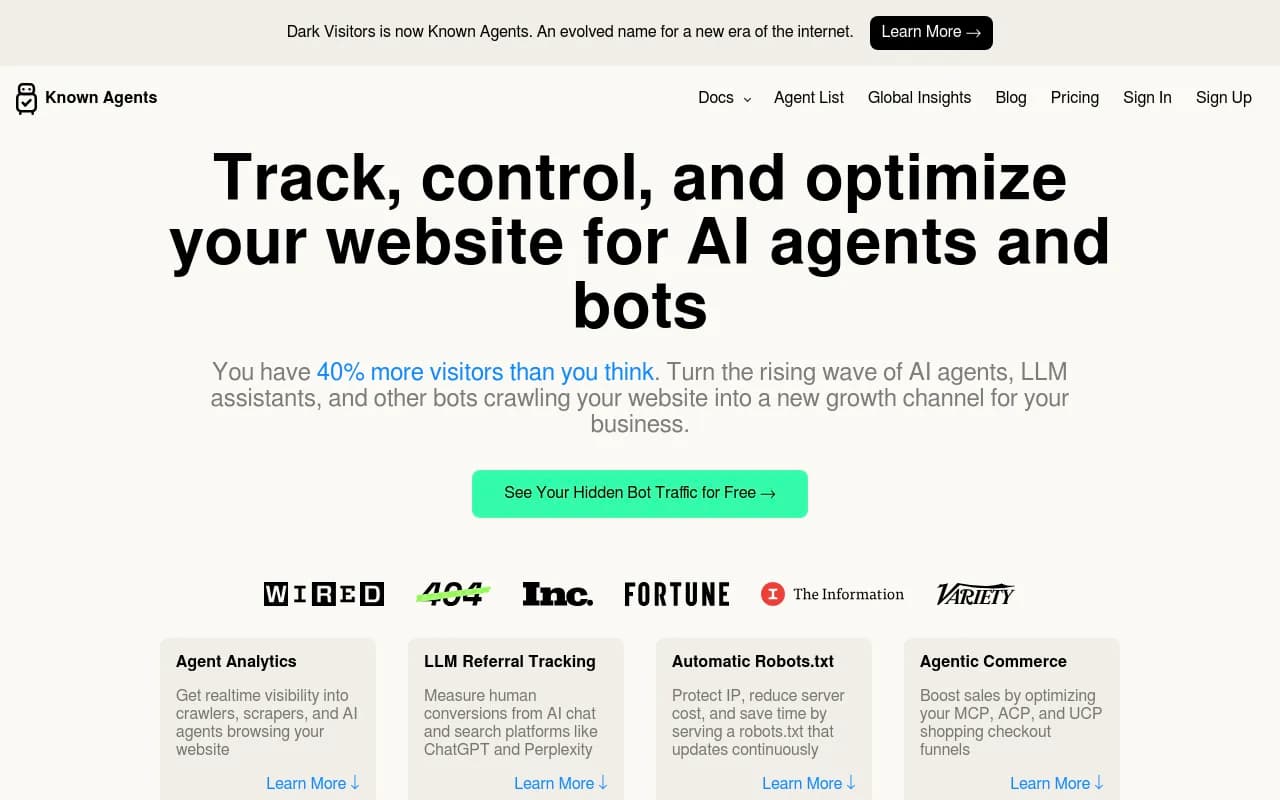
DarkVisitors is a focused tool for understanding which AI bots are hitting your site and what they're doing.
For brands that want page-level citation tracking:
Peec AI does solid work on multi-language monitoring and is worth a look if international coverage is a priority.

The bottom line
The GEO tool market in 2026 is full of dashboards dressed up as platforms. Most of them will show you data. Few of them will help you do anything with it.
The questions that matter before you pay: Can this tool tell me why I'm not being cited? Can it help me create content that fixes that? Can it show me whether that content actually drove traffic and revenue?
If the answer to any of those is no, you're buying a monitoring tool, not an optimization platform. That might be fine for where you are -- but go in with eyes open about what you're getting.
The tools that survive the next two years will be the ones that close the loop between data and action. Evaluate accordingly.