Key takeaways
- Take a baseline before the campaign launches, and run a control prompt set that the campaign shouldn't touch. Without both, you can't separate PR impact from model changes.
- Track four things: mentions (visibility), citations (which sources AI draws on), sentiment and accuracy, and downstream traffic or conversions.
- Earned news coverage fades fast in ChatGPT. Promptwatch Data shows news pages lose half their citations within 36 days, so re-measure at day 7, 30, 60 and 90.
- Report per engine and per prompt intent. Social and press tactics behave very differently in ChatGPT versus Google AI Overviews and Perplexity.
- Annotate everything. A dated marker for the launch, the press push and any platform change saves arguments with stakeholders later.
Why PR needs a different scoreboard
PR teams have long reported reach, coverage counts, backlinks and referral traffic. Those numbers still matter. But they miss what happens before the click, or when there is no click at all. Notified's October 2026 write-up cites Pew Research data (June 2026) showing 60% of Americans now read AI-generated summaries at the top of search results. If your campaign gets a brand named in an AI answer and nobody visits your site, a traditional report shows nothing.
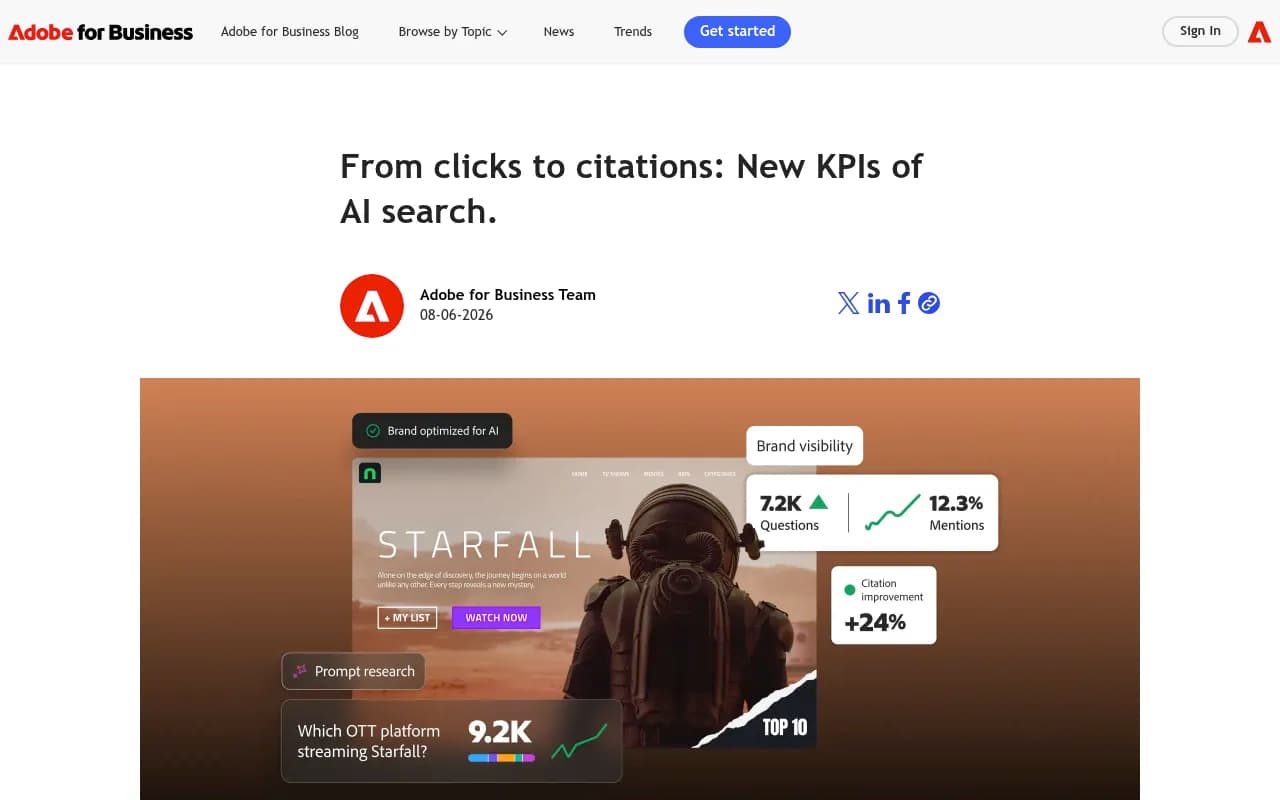
Adobe's AI search KPI framework makes a useful distinction. A brand can be mentioned in an answer, cited as a source, included in a recommendation, compared with competitors, or summarized in a way that shapes perception. Those are different outcomes, and a campaign can move one without moving the others.
This guide walks through how to measure a campaign end to end: what to capture beforehand, which metrics to watch, how long to keep watching, and how to report it without overclaiming.
The metrics that actually answer "did the campaign work?"
People propose long metric lists. I'd cut it down to the ones that answer a specific question.
| Metric | Question it answers | PR-specific read |
|---|---|---|
| Visibility Score | In what share of tracked prompts does the brand appear? | Did the campaign put the brand in more answers? |
| Share of voice | How much of all brand mentions are ours versus competitors? | Did we gain ground or just rise with the category? |
| Citation share | Which sources does AI use when it names us? | Did the earned coverage become the source behind mentions? |
| Source mention rate | How present are we across reviews, directories, comparisons, communities? | Did placements land where AI actually looks? |
| Sentiment and accuracy | How is the brand described, and is it correct? | Did the message carry through intact? |
| AI referral sessions and conversions | Did any of it produce visits and revenue? | Is there a business effect beyond awareness? |
The Cognizo write-up on AI visibility metrics defines Visibility Score simply: if you track 200 prompts and your brand appears in 60, you're at 30%. That simplicity is a feature. It's easy to explain to a CMO.
Mentions versus citations
Adobe puts it well: visibility is when the brand appears in an answer, while citations are when owned or earned content is used as a supporting source. Mentions show presence. Citations suggest your content, or coverage about you, is accessible and trusted enough to support the answer.
For PR this matters a lot, because campaigns usually earn third-party citations rather than owned ones. Cognizo splits these into owned citations (your domain) and earned citations (a review, comparison or press piece). Earned citations make up a large share of AI mentions in practice, so a PR campaign that lands in the right publications can move your numbers without touching your own site.
Sentiment and accuracy
Rising visibility with falling sentiment means AI is naming you more often but describing you worse. A raw mention count hides that. Track sentiment as a trend next to visibility, and read the actual responses. Semrush's guidance adds a useful angle: a citation that misrepresents your pricing or positioning can do more harm than no citation at all. For a launch or rebrand, check whether the key message survived, not just whether the name appeared.
Step 1: Build the baseline before you pitch anything
This is the step teams skip and then regret. Two weeks before the campaign, set up:
- A fixed prompt set. Include branded prompts ("what is [brand]"), category prompts ("best [category] tools"), and competitor comparison prompts. Tag each by intent: commercial, informational, branded.
- A control prompt set. Prompts in adjacent topics the campaign shouldn't affect. If control prompts move as much as your target prompts, the cause is probably the platform, not your PR.
- Engines and locations. Anchor on ChatGPT and Google AI Overviews, then add Perplexity, Gemini, Claude and Copilot where your buyers are. Segment every metric by engine rather than blending.
- Competitor set. Share of voice only means something against named rivals.
- A source map. Which domains does AI cite today for your category? Those are the targets for pitching, and the list you'll compare against later.
Intent tagging is worth the effort. Promptwatch Data's ChatGPT citation share by content type report (Sep 28 to Oct 4, 2026) shows each intent rewards a different content mix. Product pages are 22.4% of classified citations overall, but reviews reach 5.6% of branded-prompt citations, more than three times their overall share. Press releases hit 2.1% of branded-prompt citations, higher than across all prompts. So coverage will show up differently depending on which kind of prompt you look at.
Use a tool that runs the same prompts on a schedule
A one-off manual check isn't a baseline. You need consistent prompts, run across multiple engines, on a regular cadence. Semrush's own guidance says the same. Options in this space include Promptwatch, which tracks real AI interfaces across engines and adds citation, crawler and visitor data in one place.

Others worth a look depending on budget and team shape:

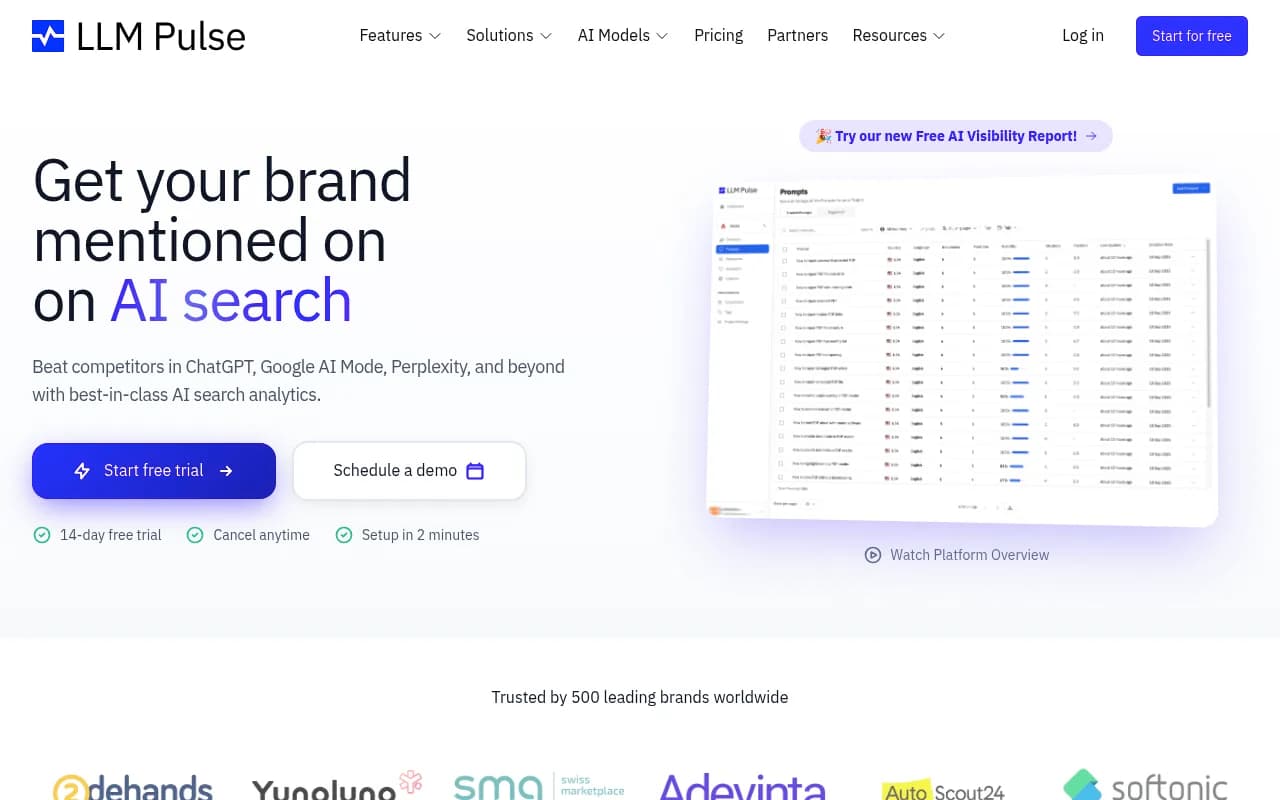

LLM Pulse specifically pitches PR and brand teams: dated markers on the visibility chart for the launch or press push, plus executive-level mention tracking. For wider options, the GEO software directory at bestgeosoftware.com lists more.
Step 2: Annotate the campaign
Put a dated marker on the visibility chart for every event: embargo lift, press release, byline publication, podcast airing, Reddit AMA, crisis statement. Semrush recommends annotating campaigns, launches and content updates for a reason. Months later, a spike sits next to the work that caused it. And when a competitor publishes a comparison page the same week, the annotation makes the threat visible.
Also annotate things you don't control. Three examples from Promptwatch Data:
- ChatGPT's average citations per response dropped around the GPT-5.3 rollout on March 4, 2026 (ChatGPT citation drop).
- reddit.com's share of ChatGPT citations fell from roughly 4% to 0.5% on August 14, 2026 (Reddit citations are dropping in ChatGPT).
- ChatGPT began using the site: operator at scale on August 8, 2026, jumping from about 0.4% to about 17% of fan-out queries (ChatGPT site: operator fanouts).
Any of those could have landed in the middle of a campaign window. If your Reddit-based PR push launched August 10, you'd have watched your ChatGPT citations vanish for reasons that had nothing to do with you. That's why the control set matters.
Step 3: Re-measure on a schedule, not once
How long to wait depends on the type of coverage. Two data points pull in different directions.
Notified's June 2026 study of more than 8,000 GlobeNewswire-distributed press releases found 99.3% were cited by ChatGPT or Claude within 30 days. Average time to first citation was eight hours, 17% of citations occurred in the first 24 hours, and releases cited on day one averaged 15 times more citations over the next 30 days. The same research says 25% of citations arrive by day seven and 50% by day 18. That's a vendor study of one wire service's releases, so treat it as directional.
Promptwatch Data's content half-life report (pages cited on July 6, 2026, tracked 90 days) paints a more cautious picture of news-type content. Almost a quarter of news pages were never cited again after day 0, half were gone after 36 days, and 41% were still cited at day 60. Landing pages and docs lasted longer: 78% of landing pages and 76% of docs were still cited at 30 days, and product pages, reviews and how-tos were still cited at 55% after 60 days.
Put those together and the practical advice is plain:
| Checkpoint | What to look for |
|---|---|
| Day 1 | Early citations. A day-one citation is a strong signal per Notified's data. |
| Day 7 | Initial lift in mentions and which pages are cited |
| Day 30 | Whether the spike is holding or decaying |
| Day 60 | Which assets are durable (landing pages, reviews, how-tos) versus fading (news) |
| Day 90 | Net lift against baseline and control |
Expect a citation spike from earned news to fade within about five weeks unless it points readers to a durable page. That's a design decision for the campaign itself: make sure the coverage links to or references a landing page, data page or doc that AI will keep citing.
Step 4: Trace where the mentions came from
A mention count tells you the result. The source list tells you why. For each tracked prompt, look at which pages AI cited and sort them into:
- Owned pages (your newsroom, landing pages, docs)
- Earned pages (the outlet that ran your story, a review, a roundup)
- Community sources (Reddit, YouTube, LinkedIn)
Then ask whether the placements you won are the ones AI actually uses. Semrush's Cited Sources view and similar reports in most tools list the domains mentioned alongside you. Compare that against your pre-campaign source map. If the campaign landed ten placements and none show up in citations, that's useful, painful information for the next pitch list.
Do per-engine reporting
Social and community tactics get very different results by engine. In Promptwatch Data's social media citations by AI model report (Oct 11 to Nov 9, 2026), social platforms were 13.16% of AI Overviews citations, 1.94% of Perplexity's and 0.64% of ChatGPT's. YouTube alone was 6.71% of AI Overviews citations. The October report covered seven days and November thirty, so the comparison isn't like for like, but the gap between engines is large either way. A Reddit or LinkedIn push can matter a lot for AI Overviews and Perplexity and very little for ChatGPT. Blend them and you'll hide both.
The same applies to industry. The software citation report shows GitHub, Microsoft docs and G2 lead ChatGPT citations for software prompts, with documentation and help centers earning the largest share. A SaaS PR campaign that ignores G2 and docs is aiming at the wrong shelf.
Step 5: Read sentiment and narrative, not just counts
After the campaign, read a sample of full responses. Look for:
- Is the campaign's key message repeated, or paraphrased into something else?
- Are old claims (a pricing complaint, a past incident) still dominant?
- Is a third-party source driving negative framing? Cognizo notes the fix then points to reputation work off your own domain.
Profound's walkthrough describes a sentiment dashboard with themes tied to positive and negative references, and full responses to inspect. Promptwatch's Brand Narrative extracts individual claims AI makes about you, groups them under themes like pricing or reputation, and scores each theme against competitors. If a claim is wrong, Fact Check can point to the page on your site that is teaching AI the wrong thing, which is a faster fix than another round of pitching.
If you also need classic media monitoring alongside AI tracking, tools like [tool:meltwater] and [tool:cisionone] cover traditional coverage. They don't replace prompt-level AI measurement, but they let you join the two views.
Step 6: Connect visibility to traffic and revenue
AI visibility often influences a decision without a click. Adobe says as much: the influence may not appear as a direct click, but it can still shape awareness, trust and demand. Still, report what you can measure:
- AI referral sessions and AI-referred users
- Engagement rate and time on site for those visitors
- Assisted conversions and conversion rate by AI source
- Branded search volume alongside citation share
Semrush gives a good example of credible framing: citation share improving from 18% to 26% in a quarter, paired with a 12% rise in branded search, is more convincing than either number alone.
Attribution is messier than it was. ChatGPT stopped sending a referrer on October 8, 2026, so tag campaign links with utm_source=chatgpt.com where you can, and consider a setting in your analytics that counts that tag as ChatGPT traffic. Promptwatch's attributing AI traffic guide covers the details. Also check AI crawler logs: if bots can't read the page your press coverage points to, no amount of earned coverage will turn into citations.
A simple campaign report template
A one-page structure that holds up in a leadership review:
- Campaign and dates, with annotated events.
- Baseline versus day 30 and day 90 for Visibility Score, share of voice, citation share and sentiment, per engine.
- Control set movement. One line. If it moved, say why.
- Top new cited sources. Which placements became citations, and which didn't.
- Message accuracy. What AI now says about the launch, and any errors.
- Traffic and conversions from AI sources, with the caveat on attribution.
- Next actions. Durable pages to build, outlets to target, claims to correct.
Keep claims modest. You can say the campaign coincided with a gain against baseline while the control stayed flat. You usually can't say it caused all of it.
Common mistakes
- No baseline. Any number after the fact is just a number.
- Counting one engine. A ChatGPT win and an AI Overviews loss average into nothing.
- Measuring once at day 3. Early spikes decay, and some benefits arrive late.
- Confusing mentions with citations. A mention without a source is fragile. A cited durable page is an asset.
- Ignoring platform changes. Check model rollouts and citation-source shifts before crediting or blaming the campaign.
- Trusting one vendor study blindly. The 99.3% press release citation figure comes from a newswire vendor measuring its own releases. Use it as a prompt to measure your own releases, not as a promise.
Choosing a tool for this job
| Need | What to look for |
|---|---|
| Baseline and re-measurement | Fixed prompts, multi-engine, scheduled runs, intent tags |
| Source tracing | Cited pages and domains per prompt, over time |
| Sentiment and accuracy | Per-response sentiment, claim-level view |
| Traffic proof | AI referral analytics, crawler logs |
| Reporting | Dated annotations, scheduled PDF or dashboard exports |
Promptwatch covers all five in one product, from prompt tracking to crawler logs and visitor analytics, which is why it fits PR teams that need to tie citations to traffic. You can start with the free AI visibility report to capture a rough baseline, or compare options in the AI rank tracking tools directory. Agencies running this for clients can check the agency plans, and anyone planning a bigger program can read the 90-day GEO program.
If you'd rather hand the whole thing to specialists, 1001 SEO Media runs GEO and digital PR programs and uses Promptwatch for the measurement side.
What to do this week
Pick 30 to 50 prompts tied to your next campaign, tag them by intent, add a 10-prompt control set, and run them for two weeks before anything goes out. Write down your current Visibility Score, citation share and the three sources AI cites most. That page is the thing you'll compare against in 90 days.