Key takeaways
- AI Overviews appear inline in standard Google Search results; AI Mode is a separate, fully conversational interface powered by Gemini 2.5
- AI Mode uses "query fan-out" -- breaking one question into multiple sub-queries -- which means your content needs to cover topics in depth, not just answer a single keyword
- Google AI Overviews and ChatGPT recommend different brands roughly 62% of the time, so visibility on one platform does not guarantee visibility on another
- Optimizing for AI Mode means earning citations, not chasing first-page rankings -- sources outside the top 10 get cited regularly
- Tracking your visibility across both surfaces (plus other AI engines) requires purpose-built tools, not traditional rank trackers
Google has always iterated fast, but 2024 and 2025 felt like two separate product launches dropped in quick succession. First came AI Overviews, the inline summaries that started appearing at the top of regular search results. Then came AI Mode, a completely separate search experience that looks more like ChatGPT than anything Google has shipped before.
If you're running SEO or content for a brand, the natural question is: do these need different strategies? The short answer is yes, and the gap between them is wider than most people realize.
This guide breaks down exactly how the two differ, what each one rewards, and how to adjust your visibility strategy accordingly.
What AI Overviews actually are (and aren't)
AI Overviews show up in standard Google Search when Google decides a query benefits from a synthesized answer. They sit above the organic results, pull from multiple sources, and link out to a handful of supporting pages.
The key word there is "decides." Google doesn't show an AI Overview for every query -- it's selective, appearing most often for complex, multi-part, or research-oriented questions. For simpler navigational or transactional queries, you still get the classic results page.
From a content perspective, AI Overviews reward structured, authoritative writing. Google's system prioritizes sources that are well-documented and credibly referenced. Average AI Overview responses run around 997 characters -- they're concise, designed to deliver a clear summary and then point users somewhere for more detail.
The user experience is mostly passive. You get a summary, you see the source links, you decide whether to click. There's no back-and-forth.
What Google AI Mode actually is
AI Mode is a different product entirely. It lives in its own tab in Google Search (or at google.com/aimode), and it replaces the standard results page with an AI-first layout. Think of it as Google's answer to the ChatGPT experience -- but with live web data, Google's Shopping Graph, Maps integration, and real-time sources baked in.
The model powering it is Gemini 2.5, specifically tuned for reasoning and exploration. A few things make AI Mode meaningfully different from AI Overviews:
Contextual memory across a session
AI Mode remembers what you asked earlier in the conversation. You can ask a follow-up question without re-explaining the context. This is the "agentic" behavior Google has been talking about -- the search engine reasoning through a problem with you rather than just returning a list.
Query fan-out
This is the one that matters most for content strategy. When you submit a query in AI Mode, Google doesn't just answer that one question. It breaks it into multiple sub-queries, pulls answers from several angles, and synthesizes them into a single response. One prompt becomes five searches happening simultaneously.
The implication: if your content only answers the surface-level question but doesn't address the related angles, you're less likely to get cited. Depth and topical coverage matter more here than they do in traditional SEO.
Real-time data sources
AI Mode taps into live data -- stock prices, restaurant availability, flight info, local business hours. This makes it more useful for time-sensitive queries, but it also means freshness of content matters more than it does for AI Overviews.
Multimodal input
Users can search with voice or images, not just text. This expands the range of queries AI Mode handles and changes the nature of the "prompts" your content needs to answer.
Side-by-side: AI Mode vs. AI Overviews
| Feature | AI Overviews | AI Mode |
|---|---|---|
| Where it appears | Inline in standard Search results | Separate tab / google.com/aimode |
| User interaction | Static response with source links | Conversational, supports follow-ups |
| Underlying model | Gemini (standard) | Gemini 2.5 (reasoning-optimized) |
| Query handling | Single query, single response | Query fan-out across multiple sub-queries |
| Data sources | Web index | Web index + live data (Maps, Shopping, stocks) |
| Response length | ~997 characters, concise | Longer, more exploratory |
| Multimodal input | Text only | Text, voice, image |
| Visibility driver | Authority + structured content | Citations from depth-first content |
| Opt-out available | Yes (via robots meta tag) | Separate opt-out mechanism |
How visibility works differently in each
This is where strategy gets interesting -- and where a lot of brands are getting it wrong by treating both surfaces as the same problem.
Visibility in AI Overviews
AI Overviews pull from pages that Google already trusts. High domain authority helps, but it's not the only factor. Structured content -- clear headings, direct answers to specific questions, schema markup -- increases your chances of being cited. Think of it as a more aggressive version of featured snippet optimization.
One thing worth noting: AI Overviews are selective. They appear on a fraction of queries, and Google can suppress them if user feedback is negative. Your content doesn't need to be "optimized for AI Overviews" in isolation -- good structured content that answers questions clearly tends to perform well here naturally.
Visibility in AI Mode
AI Mode is a different game. Because of query fan-out, the system is pulling from a much wider range of sources to construct its answer. Semrush's research confirms this directly: in AI Mode, visibility comes from citations, not first-page rankings. Sources outside the top 10 organic results get cited regularly.
This is a significant shift. A page that ranks #14 for a keyword but covers the topic comprehensively -- including the adjacent questions that fan-out generates -- can get cited in AI Mode while the #1 ranking page doesn't. Traditional rank tracking tells you almost nothing useful about your AI Mode visibility.
The content that performs well in AI Mode tends to:
- Cover a topic from multiple angles, not just the primary keyword
- Answer the follow-up questions a user would naturally ask
- Be updated regularly (freshness matters more here)
- Include specific, verifiable facts and data points that AI can cite with confidence
The cross-platform visibility problem
Here's something that doesn't get enough attention: Google AI Overviews and ChatGPT recommend different brands about 62% of the time. That's a striking number. It means that even if you've nailed your Google AI visibility, you could be nearly invisible on ChatGPT, Perplexity, or Claude -- and vice versa.
AI search is not one channel. It's a fragmented set of surfaces, each with its own citation logic, training data, and ranking signals. Google's systems prioritize structured authority. ChatGPT leans more toward brand mentions and narrative context. Perplexity weights recent web sources heavily. Each rewards something slightly different.
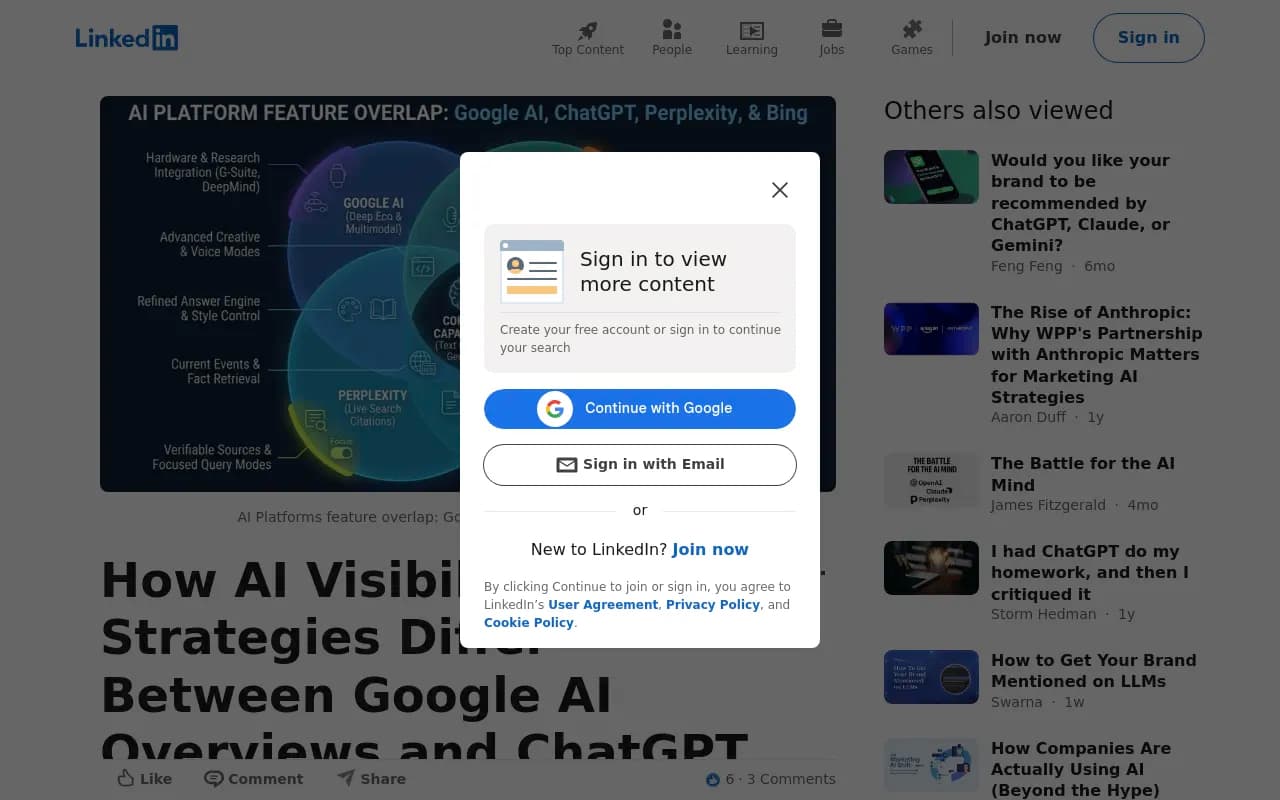
The practical implication: you need to monitor all of them, not just Google. A brand that's winning in AI Overviews but invisible in ChatGPT is leaving a significant portion of AI-driven discovery on the table.
What this means for your content strategy
Stop optimizing for rankings, start optimizing for citations
In traditional SEO, the goal is position 1. In AI search, the goal is to be the source an AI model reaches for when constructing its answer. Those are related but not the same thing.
Citation-worthy content tends to be:
- Specific (concrete data, named examples, clear claims)
- Comprehensive (covers the topic and the adjacent questions)
- Credible (linked to from authoritative sources, well-structured)
- Fresh (updated when facts change)
Build topical depth, not just keyword coverage
Because AI Mode uses query fan-out, a single piece of content that only answers one question is less valuable than content that maps the full territory of a topic. If you're writing about "project management software for remote teams," the AI isn't just looking for that exact phrase -- it's also pulling answers about async communication, time zone management, integration with other tools, and pricing comparisons.
Content hubs and topic clusters aren't a new idea, but they're more important now than they've ever been.
Technical foundations still matter
AI crawlers need to be able to read your content. Pages that block AI crawlers, have poor internal linking, or load slowly are less likely to be indexed and cited. This is an area where most brands have blind spots -- they don't know which AI crawlers are visiting their site, which pages are being read, or where errors are occurring.
Tools worth knowing for AI visibility tracking
Tracking your visibility across AI Mode, AI Overviews, and other AI engines requires tools built for this specific problem. Traditional rank trackers don't cut it.
Promptwatch monitors visibility across 10 AI models including Google AI Overviews, Google AI Mode, ChatGPT, Perplexity, Claude, and Gemini. What separates it from most monitoring tools is that it goes beyond showing you where you're invisible -- it includes Answer Gap Analysis to identify which prompts competitors are winning that you're not, and a built-in AI writing agent to create content engineered for citations. It also logs AI crawler activity on your site, so you can see exactly which pages ChatGPT, Claude, and Perplexity are reading.

For teams that want to track Google-specific AI visibility alongside traditional SEO metrics, Semrush has added AI Mode tracking to its platform.
Keyword.com has built specific tracking for AI Mode citations, which is useful if Google is your primary focus.
For broader AI search monitoring across multiple models, a few other platforms worth evaluating:



Here's a quick comparison of how these tools stack up on the features that matter most for the AI Mode / AI Overviews challenge:
| Tool | Google AI Mode tracking | AI Overviews tracking | Content gap analysis | AI content generation | Crawler logs |
|---|---|---|---|---|---|
| Promptwatch | Yes | Yes | Yes | Yes | Yes |
| Semrush | Yes | Yes | Limited | Limited | No |
| Keyword.com | Yes | Yes | No | No | No |
| Profound | Yes | Yes | Limited | No | No |
| AthenaHQ | Yes | Yes | No | No | No |
| Otterly.AI | Limited | Yes | No | No | No |
Practical steps to take right now
If you're not sure where to start, here's a reasonable sequence:
-
Audit your current AI visibility. Run your key queries through AI Mode and AI Overviews and note which competitors are being cited. This gives you a baseline and shows you who's winning the citation game in your category.
-
Map your content against query fan-out. For your top 10 target topics, think about what sub-questions AI Mode would generate. Are those questions answered somewhere on your site? If not, that's a content gap.
-
Check your technical setup. Make sure AI crawlers can access your content. Review your robots.txt and verify you haven't accidentally blocked the crawlers that matter.
-
Update stale content. Freshness matters more in AI Mode than in traditional SEO. Pages that haven't been touched in 18+ months are less likely to be cited for time-sensitive topics.
-
Track the right metrics. Citation rate, mention share across AI models, and which pages are being cited are the numbers that matter now. Page-1 rankings are still useful context, but they're not the whole story.
The bigger picture
AI search is growing fast -- one estimate puts it at 165 times faster than organic search growth. But the vast majority of search behavior still happens on Google, which means AI Mode and AI Overviews aren't replacing traditional search yet. They're layering on top of it.
The brands that will win in 2026 are the ones treating AI visibility as a distinct discipline alongside traditional SEO, not as an afterthought. That means understanding how each surface works, creating content that earns citations rather than just rankings, and tracking performance across all the places AI-driven discovery is happening.
The mechanics are different from what most SEO teams are used to. But the underlying principle is the same as it's always been: be the most useful, credible source for the questions your audience is asking.