Key takeaways
- AI visibility numbers are samples of a probabilistic system, so validate the measurement process, not just the score.
- Test four things separately: repeatability, prompt representativeness, citation verification and coverage.
- Engines change retrieval behaviour without warning. A sudden drop may be a platform change or a collection problem, not your brand.
- Normalise per engine, annotate known breaks, and keep raw evidence so another reviewer can audit the result.
- Run a pre-board checklist and show ranges and caveats, not a single clean number.
Why board-level AI visibility data needs validation
A board slide that says "visibility is 34%, up 6 points" invites one question: how do you know? If the honest answer is "the dashboard said so", you are exposed.
AI answers shift with prompt wording, model version, search mode, region, language, available sources and generation settings. That is not a flaw in your vendor. It is how the systems work. But it means accuracy has to be defined as a controlled, transparent process, not as identical answers on every run.
The PallasAI enterprise accuracy guide makes the same point well: no single score captures accuracy. A defensible program produces repeatable observations, uses prompts that represent the decision at hand, verifies citations against their source pages, covers the relevant markets, and keeps enough evidence for someone else to check the work.

The rest of this guide turns that idea into a workflow you can run before every board cycle.
The four dimensions to test
Treat these as separate tests. A platform can pass one and fail another, and the board report should only claim what you have actually verified.
| Dimension | Question it answers | Typical failure |
|---|---|---|
| Repeatability | Does the same design give a stable pattern across runs? | Silently dropped failed runs make data look stable |
| Prompt representativeness | Do the prompts reflect the decision you care about? | Brand-monitoring prompts used to claim category share |
| Citation verification | Do cited sources actually say what is claimed? | Citations counted without opening the page |
| Coverage | Are the right engines, markets and languages included? | One English-language market stands in for global |
Repeatability
Repeatability does not mean identical answers. It means the directional conclusion holds. Freeze a core prompt cohort, engine, model or search mode, market, language and reporting rules before you collect anything.
Then:
- Run a controlled paraphrase set to see whether the conclusion survives small wording changes.
- Repeat a sample at fixed intervals.
- Save every raw answer.
- Keep failed, empty and blocked runs in the dataset, flagged as such.
That last point matters more than it sounds. If missing runs vanish, your visibility rate looks steadier than the collection process really was.
Log these fields with each observation: prompt and paraphrase-family ID, engine and model, region and language, run timestamp, personalization state, raw answer, visible citation URLs, brand and competitor appearances, and run status.
Prompt representativeness
More prompts is not better intelligence. The question is whether the sample covers the decisions you want to influence. A set built for brand monitoring will not tell you much about category demand or product-level recommendations.
Before reporting, map each prompt to a buyer decision and a persona, and write down what the set does not cover. Prompt volume and difficulty data, where your tool provides it, helps you weight prompts by real demand instead of by whatever the team happened to type in. If you want to see how ChatGPT expands a single prompt into several searches, Promptwatch's query fanout data shows why a handful of wording variants is not enough to represent a topic.
Citation verification
A citation count is only as good as the citations. Pull a random sample, open each cited URL, and confirm three things: the page exists, it supports the claim in the answer, and it is attributed to the right domain. Do this by hand for a sample every cycle. It is tedious and it catches things dashboards do not.
Also separate mentions from citations. A brand named without a link is a different signal from a brand cited as a source, and mixing them inflates the story. The citations vs mentions explainer covers the distinction.
Coverage
List every engine, country and language the board assumes you are covering. Then check what is actually tracked. Real-interface monitoring and API-based collection can return different answers and different citations, so note which method each engine uses. If a region is missing, say so on the slide.
Know that the engines move under you
This is the part most teams skip. Your brand can look worse or better because the platform changed, not because anything about your content did.
Promptwatch Data has documented several of these breaks:
- ChatGPT began using the
site:operator at scale on August 8, 2026. It went from about 0.4% to about 17% of fanout queries overnight, and searches per response nearly doubled (report). - Average web searches per ChatGPT response fell from 2.15 in early December 2025 to about 1.84 by early March 2026, and fanout query length dropped from about 117 characters to the high 80s, then to roughly 53 in April (report).
- Average citations per ChatGPT response dropped across GPT-5.3, GPT-5.4 and GPT-5-Mini around the March 4, 2026 rollout (report).
If your tracked prompts feed on that retrieval behaviour, your numbers move with it. Re-baseline and annotate after major model or search updates.
A worked example: the Reddit cliff
Reddit held a steady 3.83% average share of ChatGPT citations from July 18 to August 7, 2026. On August 8 it slid to the mid-2s, and on August 14 it fell below 1%. The August 14 to 17 average was 0.52%, an 86.4% relative drop (Promptwatch Data).
In Google AI Overviews, Reddit eased only from about 2.37% to 2.10% (an 11.3% decline), and in AI Mode it fell 30.5%. Same domain, very different shapes by engine.
What I like about that report is its own caveat: Promptwatch states that a data-collection issue cannot be ruled out, so the size of the drop is provisional. That is exactly the posture you want in a board deck. Its suggested checks are simple:
- Look at response and citation collection volume around the date of the shift.
- Compare cited URLs before and after.
- Check whether the shift is specific to one engine.
- Prefer rolling trends over single-day comparisons for gradual movers.
If you would not present your own drop without those four checks, do not present a vendor's.
Normalise per engine
Engines cite very different numbers of sources, so raw counts do not compare across them. According to Promptwatch's sources-per-response data, ChatGPT cites about 5 sources per answer when web search triggers, Google AI Overviews about 10, and Perplexity almost exactly 10 every day. Copilot swung from under 2 to nearly 17 within a few weeks before settling low.
Practical consequences:
- Report share or visibility rates per engine, never a blended raw citation count.
- Use Perplexity as a relatively stable test bench. When your pickup moves there, it is more likely your content than engine noise.
- Judge Copilot on monthly trends, not weekly snapshots, and annotate it.
- Check the denominator. Promptwatch counts only responses with at least one citation toward share calculations. Vendors differ here, and the choice changes the number.
Questions to ask your vendor
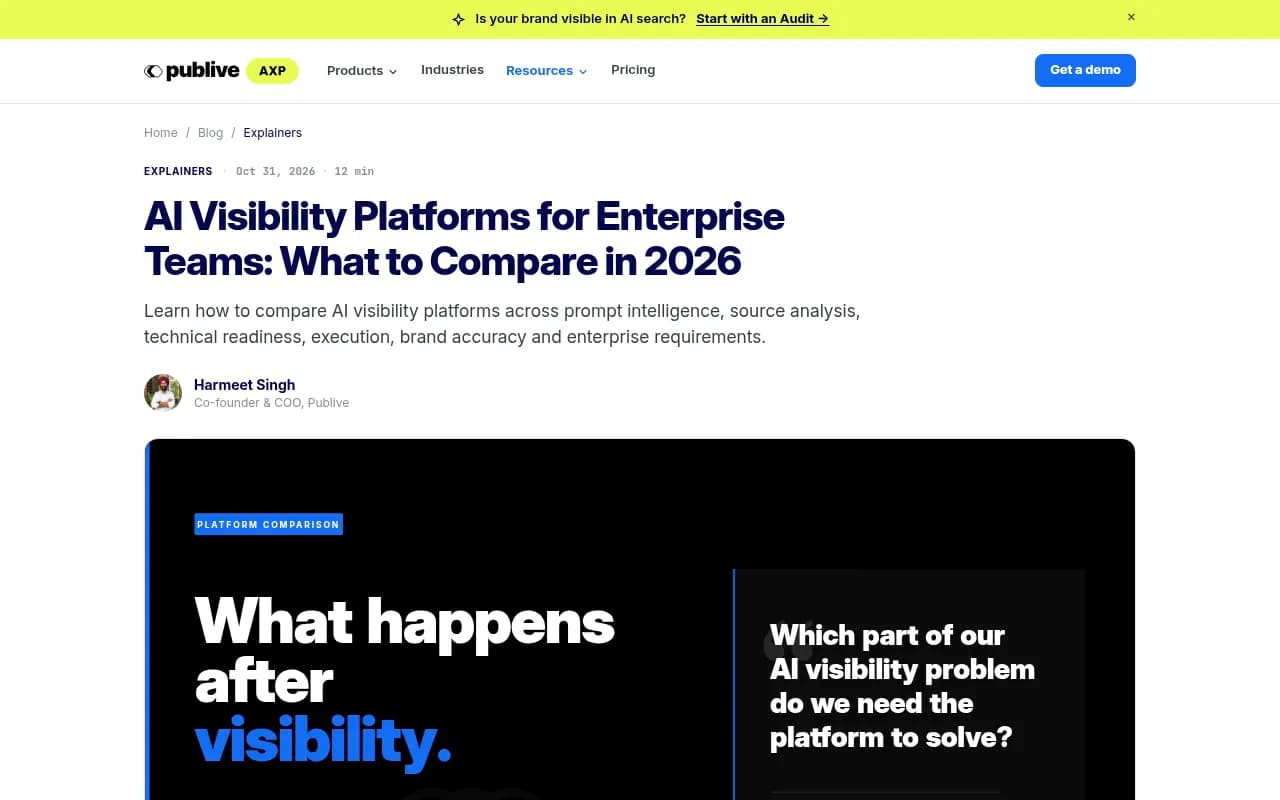
The Publive AXP comparison frames enterprise evaluation around six areas: prompt intelligence, source intelligence, technical readiness, execution, brand accuracy and enterprise fit, with claim governance as a seventh for regulated industries. Those make a good base for validation questions too.
Ask each vendor:
- Is data collected from the real user interface or an API, per engine?
- How are failed and empty runs stored and reported?
- What is the denominator for share metrics?
- Can I export raw responses and citation URLs?
- How do you flag model or search-behaviour changes in the time series?
- Can I see run timestamps, region and language per observation?
- Is there an audit log of who changed prompts, competitors or settings?
If the answer to raw export is no, you cannot validate independently, and that alone should affect how much weight the board gives the numbers.
Tools that help with validation
No tool validates data for you, but some make validation easier by exposing raw evidence, crawler data and exports.
Promptwatch is an end-to-end AI visibility platform that monitors the real interfaces of ChatGPT, Google AI Overviews, Gemini, Perplexity, Copilot and others by country and language. It is useful here because the evidence sits in one place: responses, citations, IP-verified AI crawler logs and visitor analytics. That lets you cross-check a visibility change against whether AI bots could reach the page and whether AI traffic moved. Exports of prompts, responses and citations support the audit trail.

Other platforms worth including in an enterprise shortlist:


For cross-checking whether AI crawlers actually visit your pages, a log-level tool is helpful:
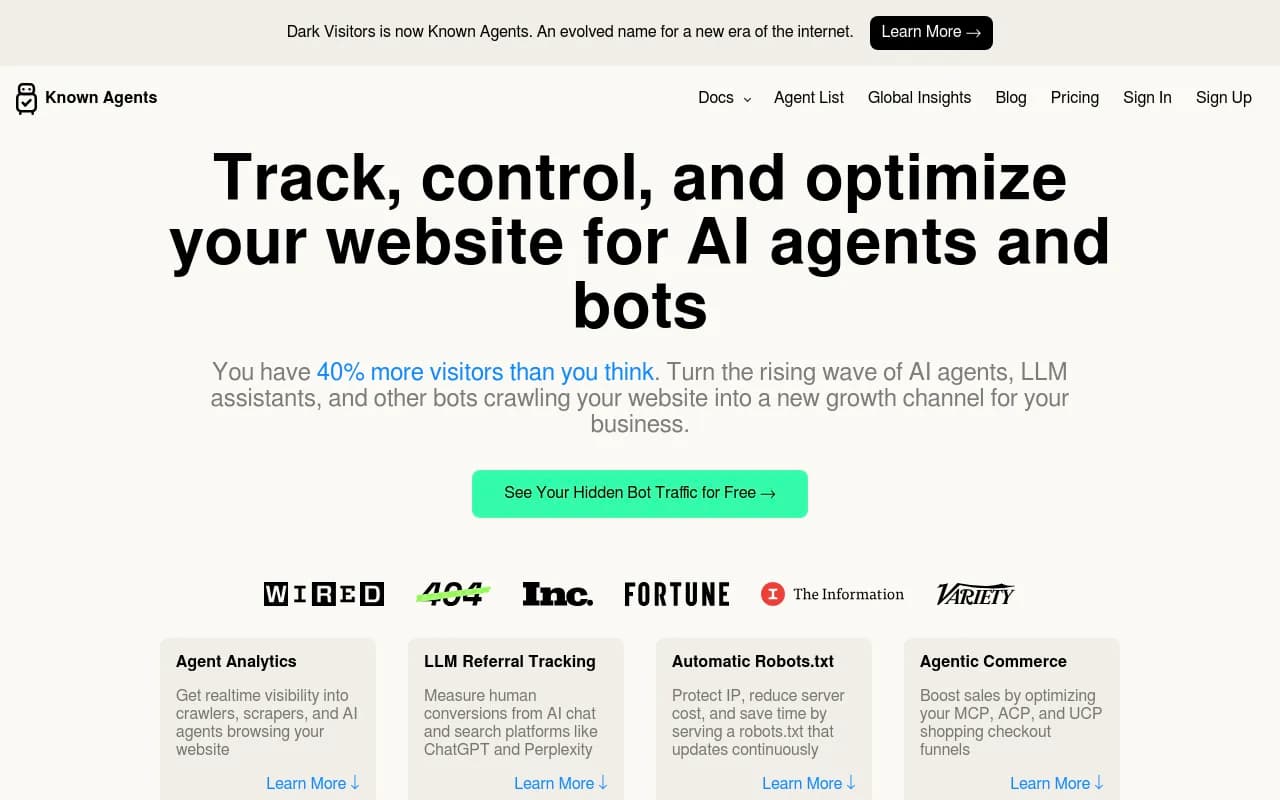
To browse more options by category, the GEO software directory at bestgeosoftware.com lists dozens of tracking platforms.
| Validation task | What to look for | Example evidence |
|---|---|---|
| Repeatability | Raw answers, run status, timestamps | CSV export of responses |
| Citation checks | Citation URLs per response | Sampled URL review |
| Technical readiness | Crawler access by AI bots | Crawler logs, site audit |
| Impact | AI-referred visits and conversions | Visitor analytics |
| Anomalies | Collection volume per day | Response counts around shift date |
Cross-check against first-party data
A visibility score is an outside-in estimate. Your own systems provide the inside-out check.
- Crawler logs show whether AI bots read the pages you claim are cited. A page that gets cited but never crawled is suspicious.
- Analytics show whether AI referrals moved in the same direction. Note that ChatGPT stopped sending a referrer on October 8, 2026, so referral-based reports can undercount unless you tag links, for example with utm_source=chatgpt.com. The attribution guide explains the setup.
- Search Console and Bing data show whether the pages rank where you expect.
If visibility rises but crawls, citations to your own domain and traffic stay flat, the headline number deserves a footnote.
A pre-board validation checklist
Run this about a week before the board meeting, so there is time to fix problems.
- Confirm the prompt cohort, engines, markets and languages are unchanged since the last report. If they changed, restate the previous period on the new basis.
- Check daily collection volume for gaps, spikes and failed runs.
- Re-run a sample and a paraphrase set. Does the direction hold?
- Hand-verify a random sample of 20 to 30 citations.
- List known engine changes in the period and mark them on the chart.
- Normalise metrics per engine and check the denominators.
- Compare against crawler logs, analytics and Search Console.
- Investigate any move larger than your normal run-to-run variation before explaining it.
- Write down what the data does not cover.
- Archive raw data and settings so the report can be reproduced.
How to present it to the board
Show the trend, not a single point. Use ranges or confidence language where variance is real. Put annotations on the chart where engines changed behaviour. Report per engine, then summarize.
Keep a short "data confidence" box on the slide: what was validated, what was sampled, and what is excluded. Directors rarely object to caveats. They object to learning about them later.
And tie the metrics to outcomes. A visibility score by itself is hard to defend. Visibility alongside AI-referred visits and conversions is much easier, because you can point at something that happened on your own site. If your team needs a framework for the metrics themselves, the metrics overview and Visibility Score definition are good references.
Common mistakes
- Treating one run as the truth. Single runs are anecdotes.
- Blending engines into a single citation count.
- Explaining a sudden drop with a content story before checking collection volume.
- Comparing numbers across vendors without matching denominators.
- Changing the prompt set mid-year and reporting the trend as if nothing happened.
- Ignoring regulated claims. If rates, eligibility or disclosures matter, validate what AI says about them, not just whether you are named.
Bottom line
Board-ready AI visibility data is controlled, annotated and reproducible. Validate repeatability, prompt coverage, citations and market coverage separately, account for engine changes you do not control, and corroborate with your own crawler and traffic data. Then present ranges and caveats alongside the headline. The goal is a number you can defend when someone asks how you got it.