Key takeaways
- Google AI Overviews appear automatically in standard search results for 60%+ of queries, while AI Mode is a separate, opt-in conversational search experience — they require different optimization strategies.
- AI Overviews favor short, self-contained passages (around 134-167 words) that Google can extract directly; AI Mode rewards deep, multi-angle content that handles complex, multi-step questions.
- Being cited in an AI Overview drives 35% more organic clicks and 91% more paid clicks compared to non-cited pages on the same query.
- Traditional ranking position matters less in both formats — a page outside the top 10 can still get cited if it's the clearest answer to a specific question.
- Tracking visibility across both surfaces requires dedicated tools, since standard rank trackers don't capture AI citations at all.
Most SEO conversations in 2026 treat "Google AI" as one thing. It isn't. Google has two distinct AI-powered search experiences running simultaneously, and they serve completely different user behaviors. Optimizing for one without understanding the other is like training for a sprint when you've been entered in a marathon.
This guide breaks down exactly how Google AI Overviews and Google AI Mode differ, why each one creates a separate visibility problem, and what you actually need to do to show up in both.
What Google AI Overviews actually are
AI Overviews launched broadly in the US in May 2024. By 2025, they were appearing in over 60% of all Google searches — up from just 25% in mid-2024. That's a dramatic shift in how most people experience search results.
The mechanic is simple: when you search for something like "best project management tools for remote teams," Google generates a synthesized answer at the top of the results page, above the traditional blue links. That answer pulls from multiple web sources and includes citation cards linking back to them.
Users don't opt in. The feature appears automatically whenever Google decides a summary adds value to the query. Most of the time, users read the summary and either click a citation or leave — they don't scroll down to the organic results at all.
That last part is the visibility problem. If your brand isn't mentioned in the AI-generated summary, you're essentially invisible for that query, even if you rank #3 in the traditional results below it.
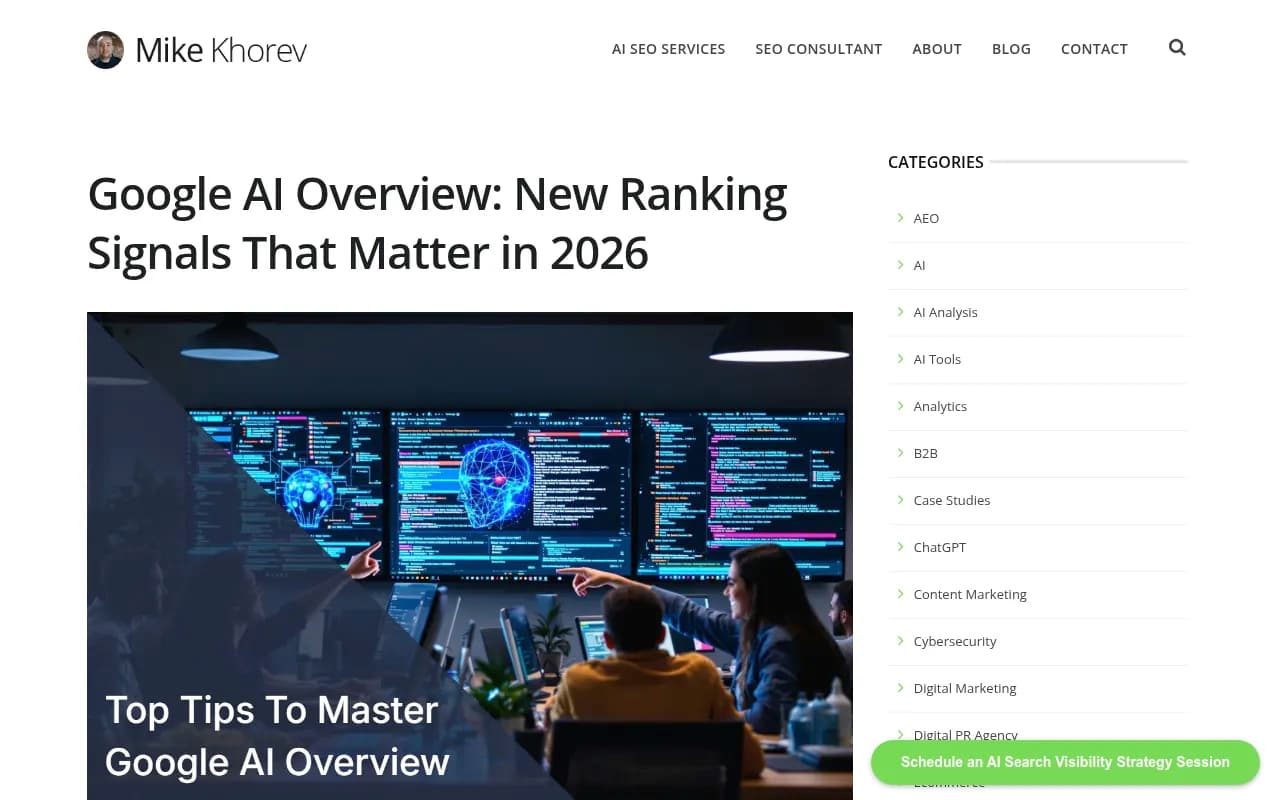
The data on citation impact is stark. Pages cited inside an AI Overview get 35% more organic clicks and 91% more paid clicks compared to non-cited competitors on the same query. Being in the summary isn't just a vanity metric — it's a meaningful traffic driver.
What Google AI Mode actually is
AI Mode is a different product entirely. Google rolled it out to all US users in May 2025 as a dedicated tab in search, sitting alongside Images, Videos, and News. Users actively choose to enter AI Mode — it's not something that appears automatically.
Think of it as Google's answer to Perplexity and ChatGPT. It's a full conversational interface powered by Gemini, built for complex, multi-step questions where a brief summary box wouldn't cut it. Where AI Overviews synthesize, AI Mode reasons. It connects related concepts, handles follow-up questions, and surfaces conclusions based on structured analysis of multiple sources.
The queries that trigger AI Mode tend to be longer and more exploratory: "I'm comparing CRM platforms for a 50-person B2B sales team that uses HubSpot for marketing — what should I consider?" That's not an AI Overview query. That's an AI Mode query.
And critically, visibility in AI Mode works differently. In AI Mode, citations come from trusted sources that Google's AI selects based on relevance and authority — not necessarily from pages that rank in the top 10 for that query. A page that sits at position 15 in traditional search can still get cited in AI Mode if it's the most thorough answer to a specific sub-question.
The core difference: passive vs. active search intent
The clearest way to separate these two products is by intent.
AI Overviews serve passive, informational intent. The user typed something into Google and got an answer before they even clicked anything. They weren't necessarily looking for a deep dive — they wanted a quick, reliable summary.
AI Mode serves active, exploratory intent. The user deliberately switched to a conversational interface because they have a complex problem to work through. They're going to ask follow-up questions. They want reasoning, not just facts.
| Feature | AI Overviews | AI Mode |
|---|---|---|
| User activation | Automatic (no opt-in) | User selects the tab |
| Query type | Informational, factual | Complex, multi-step, conversational |
| Response format | Brief summary with citations | Long-form, reasoned, conversational |
| Powered by | Gemini (integrated into search) | Gemini (dedicated interface) |
| Citation behavior | Pulls from indexed content + ranking signals | Selects sources based on depth and authority |
| Ranking dependency | Moderate — traditional signals still matter | Lower — non-top-10 pages can get cited |
| Follow-up queries | Not supported | Core feature |
| Best content format | Short, extractable passages | Deep, comprehensive, multi-angle coverage |
| Traffic impact | 35% more organic clicks when cited | Direct referral from citation links |
Why your current SEO strategy doesn't fix either problem
Traditional SEO is built around ranking for keywords. You find a query, you optimize a page, you track your position. That model still has value, but it doesn't map cleanly onto either AI surface.
For AI Overviews, the question isn't "do I rank #1?" — it's "does Google's AI extract my content as the clearest answer?" A page that ranks #7 but has a perfectly structured 150-word passage answering the exact question will often get cited over a #1 page that buries the answer in a wall of text.
For AI Mode, the question is even further removed from traditional ranking. AI Mode uses what Google calls "query fan-out" — it takes one complex question and breaks it into multiple sub-queries, then synthesizes answers from different sources for each sub-query. Your page might answer one part of a complex question really well and get cited for that specific piece, even if you'd never rank for the parent query in traditional search.
Both of these require you to think about content differently. Not "what keyword am I targeting?" but "what specific question does this passage answer, and does it answer it clearly enough for an AI to extract and use it?"
Fixing the AI Overviews visibility problem
The research on what gets cited in AI Overviews is fairly consistent at this point. A few things matter more than anything else.
Write extractable passages
Google's AI breaks your content into chunks. The summaries it generates average around 169 words with about 7 citation links. That tells you something about the granularity it's working at.
Put your main answer in the first 150 words of any section. Write section openers of 45-75 words under each subheading. Each passage should work as a standalone answer — if you pulled it out of context, it should still make sense.
Match the query's information need precisely
AI Overviews are heavily triggered by informational queries. "How does X work," "what is the best Y for Z," "what are the differences between A and B." Your content needs to match not just the keyword but the specific angle the user is coming from.
If someone searches "best email tools for nonprofits," a generic "best email marketing tools" page won't get cited. A section specifically addressing nonprofit use cases, pricing constraints, and relevant features will.
Structured data and clear formatting help
Headers, bullet points, numbered lists, and FAQ schema all make it easier for Google's AI to parse your content. This isn't about gaming the system — it's about making your answers legible to a machine that's trying to extract the clearest possible response.
Don't ignore E-E-A-T signals
Experience, expertise, authoritativeness, and trustworthiness still matter. AI Overviews pull from sources Google trusts. Author credentials, citations to primary sources, original data, and clear editorial standards all contribute to whether your content gets selected.
Fixing the AI Mode visibility problem
AI Mode requires a different approach because the queries are different and the citation logic is different.
Go deep on complex topics
AI Mode is built for questions that can't be answered in a paragraph. If your content is thin — 600-word posts that cover a topic at surface level — it won't get cited in AI Mode. The content that wins here is genuinely comprehensive: it covers the topic from multiple angles, addresses edge cases, and handles the follow-up questions a curious reader would naturally ask.
Structure content for query fan-out
Because AI Mode breaks complex queries into sub-queries, your content should be structured so that individual sections can answer specific sub-questions independently. A well-organized long-form guide with clear H2s and H3s is more likely to get cited for a specific sub-question than a dense, unstructured article.
Think about what sub-questions your topic naturally generates. If you're writing about choosing a CRM, the sub-questions might include: what features matter for small teams, how does pricing scale, what integrations are essential, how long does implementation take. Each of those deserves its own section with a clear, direct answer.
Build topical authority, not just individual pages
AI Mode seems to favor sources that cover a topic comprehensively across multiple pages, not just one well-optimized article. If Google's AI can see that your site has 15 pages covering different aspects of a topic, it's more likely to trust you as an authoritative source for that topic overall.
This is where content strategy matters more than individual page optimization.
Tracking visibility across both surfaces
Here's the practical problem: standard rank trackers don't tell you any of this. Knowing you rank #4 for a keyword says nothing about whether you're cited in the AI Overview for that query, or whether you appear in AI Mode responses to related conversational questions.
You need tools that actually query these AI surfaces and track citations. Promptwatch monitors both Google AI Overviews and Google AI Mode alongside other AI engines like ChatGPT, Perplexity, and Claude — and crucially, it goes beyond just showing you where you appear. Its Answer Gap Analysis shows you which prompts your competitors are being cited for that you're not, and its built-in content generation tools help you create the pages that fill those gaps.

For teams that want broader coverage of the AI visibility space, a few other tools are worth knowing about.
Semrush has added AI Overview tracking to its platform, which is useful if you're already in the Semrush ecosystem.
Ahrefs Brand Radar tracks brand mentions in AI search results, though it uses fixed prompts rather than custom query sets.
For teams focused specifically on Google's AI surfaces, Wellows offers AI search visibility tracking with a focus on AI Overviews optimization.
Nightwatch has also added AI search monitoring for marketers who want to track visibility alongside traditional rank data.
A practical comparison: what to optimize for each surface
| Goal | AI Overviews approach | AI Mode approach |
|---|---|---|
| Content length | 150-word extractable passages | Long-form, 1,500+ words per topic |
| Structure | Short sections, FAQ format, bullet points | Deep H2/H3 hierarchy, sub-question coverage |
| Query targeting | Informational, factual queries | Complex, multi-step, exploratory queries |
| Topical depth | Answer one question very clearly | Cover a topic from every relevant angle |
| Schema markup | FAQ, HowTo, Article schema | Article, BreadcrumbList, speakable |
| Content freshness | High — AI Overviews update frequently | Moderate — depth matters more than recency |
| Backlink signals | Still relevant | Less critical than content depth |
The ad visibility problem worth knowing about
One thing that often gets overlooked: AI Overviews don't just affect organic visibility. They push paid ads down the page significantly. In healthcare, for example, 64.6% of ads now appear below AI Overview summaries — meaning users often never see them at all.
If you're running paid search campaigns alongside organic efforts, this is a real budget efficiency problem. The fix isn't to stop running ads — it's to make sure your organic presence in AI Overviews is strong enough that you're getting the top-of-page visibility that ads used to guarantee.
Where to start
If you're new to optimizing for either surface, the priority order is roughly:
-
Audit your existing content for extractable passages. Most sites have good information buried in long, dense paragraphs. Restructuring that content into clear, self-contained sections is the fastest win for AI Overviews.
-
Identify which queries are triggering AI Overviews for your category. Search your main keywords manually and see what's showing up. If AI Overviews are appearing and your brand isn't in them, that's your gap.
-
Build out topical depth for AI Mode. Pick two or three core topics where you want to be seen as an authoritative source and create genuinely comprehensive content clusters around them.
-
Set up tracking. You can't improve what you can't measure. Get a tool that actually monitors AI citations, not just traditional rankings.
The two problems are related but distinct. Fixing one doesn't automatically fix the other. The brands that figure out how to optimize for both surfaces in 2026 will have a meaningful advantage over those still chasing traditional ranking positions.