Key takeaways
- Free AI visibility checkers from Semrush, Ahrefs, HubSpot, and Frase give you a one-time snapshot of how ChatGPT, Gemini, Perplexity, and AI Overviews talk about your brand, which is enough to decide if the problem is worth solving.
- Google Search Console and Bing Webmaster Tools now ship free native reports on AI Overviews, AI Mode, and Copilot citations, though neither shows clicks or competitors.
- Microsoft Clarity's free "AI Platform" channel grouping is the easiest way to see actual visits from ChatGPT, Claude, Gemini, and Perplexity without paying for anything.
- The single biggest mistake people make with these tools is treating a one-off check as ongoing monitoring. None of them track trends over time, which is the whole point of a real GEO platform.
- Only about 12% of URLs cited by ChatGPT overlap with Google's top 10 organic results for the same query, so a free AI-specific checker tells you something your classic SEO rank tracker never will.
Why free checkers exist, and why they're not a replacement for monitoring
Every AI visibility vendor wants you in their funnel, and the fastest way to get there is a no-signup tool that spits out a visibility score in under a minute. That's good news for anyone who just wants to know "am I even showing up in ChatGPT yet" without filling out a form or entering a credit card.
But there's a structural reason these free tools can't replace a paid platform, and it's worth understanding before you get attached to any single number. Promptwatch's research on citation volume shows ChatGPT typically cites around 5 sources per web-search answer, while Google AI Overviews cites roughly 10 and Perplexity sits at almost exactly 10 too (Average Sources Per Response). That's a tiny inventory of "slots" compared to a 10-blue-link Google page, and a one-time free check only samples it once. Microsoft Copilot is worse: average citations per response has swung from under 2 to nearly 17 within a few weeks, so a single free Copilot check can be flat-out misleading depending on what day you ran it.
There's also a fanout problem. ChatGPT doesn't answer one prompt with one search, it fans a question into multiple web searches, sometimes 3-8 of them during busy periods, and the average has bounced between roughly 1.0 and 2.15 queries per response over the past several months (How to use ChatGPT query fanouts). A free checker running one canned prompt per brand term is going to undercount real exposure versus a tool that tests prompt variations the way a real user would phrase them.
All that said, free tools are genuinely useful for a first pass. Here's what's actually worth trying before you open your wallet.
The no-signup, single-check tools
Semrush AI Overviews Visibility Checker
Semrush's free checker needs no account and can be run three times a day. You plug in a domain and get a visibility score, the specific queries where your brand shows up, and a side-by-side against competitors, including the gaps where a rival appears and you don't. The catch is that it draws from Semrush's own prompt database rather than prompts you choose, so it's testing what Semrush thinks people ask, not necessarily what your customers ask.
Ahrefs AI Visibility Checker (powered by Brand Radar)
This one has no signup, no credit card, and no limit on how many brands you can check, which makes it the most frictionless option on this list. It covers ChatGPT, Gemini, Perplexity, Copilot, AI Overviews, and AI Mode in one pass. The free version only shows a limited preview, the top 5 results per section, and it's a single snapshot with no trend line or competitor benchmarking built in. If you want to go further, the paid Brand Radar product adds historical data and custom prompts, but reviewers have flagged it as expensive and noted the prompt database leans on synthetic Google-search data rather than real AI search behavior, so treat its numbers as directional.
HubSpot AI Search Grader
HubSpot's grader is free, one-time, and doesn't require signup. It tells you what ChatGPT, Perplexity, and Gemini say about your brand, but it's pulling from training data rather than live retrieval, which matters because training data can be months stale. If you like what you see and want ongoing tracking, HubSpot's paid AEO product starts at $50/month for 25 prompts, or it's bundled into Marketing Hub Professional and Enterprise.
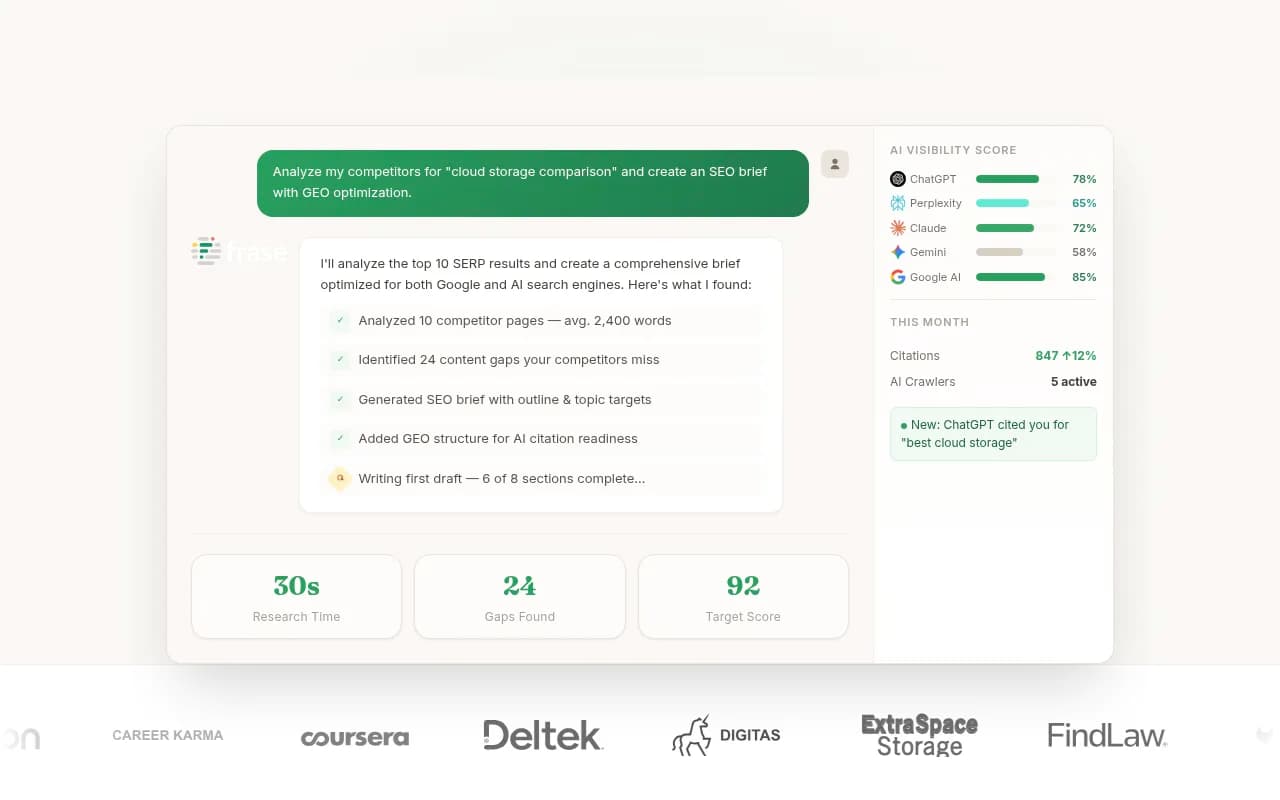
Frase's free tool suite
Frase offers three separate free tools: an AI Visibility Checker, a GEO Score that grades a page for citability, and an Agent Readiness Checker. None require a card. If any of those flag a problem worth fixing, Frase's paid plan comes with a 7-day free trial, also no card required.
Omnia's free AI Visibility Checker
Omnia runs 40 prompt tracking queries across 4 AI engines and delivers a full report in 3 to 5 minutes, no credit card needed. It's one of the more generous free checkers in terms of prompt volume. Paid Omnia plans start at €79/month for 25 ongoing prompts if you want to keep watching after the initial check.
The free tools that aren't "AI visibility checkers" but should be on your list anyway
This is the part people skip, and it's a mistake, because some of the most useful free data isn't coming from a dedicated vendor at all. It's sitting inside tools you probably already have access to.
Google Search Console rolled out a Search Generative AI performance report globally by the end of August 2026. It shows impressions for AI Overviews, AI Mode, and AI features inside Discover, broken down by page, country, device, and date, for free. The catch: no query data, no click-through rate, no position, and nothing for the standalone Gemini app. One site tracked in third-party research saw its AI impressions in Search Console jump from 411 in May 2026 to 5,650 by August, nearly 14x, while publishing almost no new content, just from existing pages getting picked up more often.
Bing Webmaster Tools launched an AI Performance report in public preview back in February 2026. It shows citations across Copilot, Bing AI summaries, and select partner integrations, plus the cited URLs and the exact grounding phrases used to retrieve them. No click-through data, and it won't show you which competitors are winning those same citations.
Microsoft Clarity is free and groups sessions into an "AI Platform" channel (organic clicks landing from ChatGPT, Claude, Gemini, Copilot, Perplexity) and a separate "PaidAIPlatform" channel for paid placements inside AI chat interfaces. It's the easiest free way to see actual human traffic arriving from AI tools, though it only sees what lands on your site, not whether you're being cited and simply not clicked.
If you want to get scrappy, ChatGPT has appended utm_source=chatgpt.com to its citation links since mid-2025, so a custom channel or regex rule in GA4 can isolate that traffic for free. Worth doing: one Seer Interactive study found ChatGPT referral traffic converting at 15.9% versus 1.76% for Google organic, which is reason enough to track it even with duct-taped GA4 rules.
Comparing the free options
| Tool | Signup required | What it covers | Biggest limitation |
|---|---|---|---|
| Semrush AI Overviews Checker | No | ChatGPT, AI Overviews, competitor gaps | Fixed prompt database, not your own prompts |
| Ahrefs AI Visibility Checker | No | 6 engines including Copilot, AI Mode | Top-5 preview only, no history |
| HubSpot AI Search Grader | No | ChatGPT, Perplexity, Gemini | Trained-data answers, not live retrieval |
| Frase free tools | No | AI visibility, GEO score, agent readiness | One domain check at a time |
| Omnia free checker | No | 40 prompts across 4 engines | One-time report, not continuous |
| Google Search Console AI reports | Yes (free GSC account) | AI Overviews, AI Mode, Discover AI impressions | No clicks, no query detail, no Gemini app |
| Bing Webmaster Tools AI report | Yes (free account) | Copilot, Bing AI summaries, cited URLs | No traffic data, no competitor view |
| Microsoft Clarity | Yes (free account) | Real AI-referred visits by platform | Misses citations without clicks |
What the free tools can't do for you
Here's the pattern across almost every source covering this: people run a free checker once, see a number, and assume that's their "AI visibility." It isn't. It's a photograph of one moment. None of the free tools above track whether your score is improving week over week, none of them let you test the full range of prompts your actual customers use, and none of them connect what AI cites to what you should publish next to fix it.
There's a second blind-spot problem too: the free tools don't overlap cleanly. Search Console shows AI impressions but no clicks. Bing shows Copilot citations but no traffic. Clarity shows AI-referred visits but misses citations that never convert into a click. You end up stitching together three different free dashboards just to approximate what one paid platform would show you in a single view.
And the stakes are higher than they look. Research on citation overlap found that only about 12% of URLs cited by ChatGPT match Google's top 10 organic results for the same query. That means your existing rank tracker, even a great one, is blind to roughly 88% of what AI search is actually citing. A free AI-specific checker closes part of that gap, but only as a snapshot.
When it's time to pay
If your free checks keep coming back empty, or you're seeing a competitor cited and you're not, that's the signal to move to continuous tracking. The entry-level paid tier across the market in late 2026 ranges from roughly $20 to $95 a month for 15 to 50 tracked prompts, depending on the vendor, which is a modest jump from free once you know the problem is real.
This is also where the tooling starts doing more than watching. Platforms like Promptwatch go past monitoring into content gap analysis, automated content generation, and CMS publishing, so instead of just getting an alert that you're missing from an answer, the platform's agents help you close that gap. If you're deciding between a basic tracker and something closer to an end-to-end GEO platform, that distinction, monitoring versus actually fixing, is the one to weigh.

For a broader look at what's on the market beyond the free tier, the GEO software directory at bestgeosoftware.com and the AI rank tracking comparisons at ai-rank-tools.com are worth a scroll before you pick a paid plan.
A practical starting sequence
Run these in order and you'll spend zero dollars figuring out whether you have a problem worth paying to solve.
- Run your brand through Ahrefs' free AI Visibility Checker to get a quick multi-engine snapshot.
- Run the same brand name through Semrush's free checker to see if the competitor-gap view surfaces anything Ahrefs missed.
- Check Google Search Console for AI Overviews impressions on your top pages, even a rough trend over the last three months tells you something.
- If you have Clarity installed, filter for the "AI Platform" channel and see how much real traffic is already arriving from ChatGPT or Perplexity.
- If two or more of those checks show gaps, that's your cue to look at a paid tracker that runs prompts continuously instead of once.
None of this takes more than an hour, and it beats guessing. The free tools won't tell you everything, but they'll tell you enough to know whether the next step is worth the money.