Key takeaways
- Traditional AI search visibility measures how often ChatGPT, Gemini, Perplexity, and Google AI Overviews mention or cite your brand when people ask questions. Coding agent visibility measures how often Claude Code, Codex, or Cursor recommend, install, or build on your product when someone asks them to build software.
- The measurement method is the same (run a prompt set, compare mentions, sentiment, and competitors). The audience, prompts, and consequences differ: a coding agent recommendation can become an install command in the same session.
- If you sell a developer tool, SDK, API, or infrastructure product, track both. If you sell to consumers or non-technical buyers, traditional AI search visibility is probably enough for now.
- Studies suggest coding agents often build custom solutions instead of picking a vendor, and different agents pick different tools. Treat their numbers as indicative, not gospel.
- Docs, quickstarts, a public GitHub presence, and an MCP server matter more here than listicles and PR.
Two things that sound the same but are not
Most marketers now understand AI search visibility. Someone asks ChatGPT "what's the best project management tool for a small agency?", the answer names four products, and your job is to be one of the four. Visibility is about mentions, citations, position in the answer, and sentiment.
Coding agent visibility is a newer problem. Per Promptwatch's glossary (updated October 28, 2026), it is how often Claude Code, Codex, or Cursor recommend, install, or build on your product when a user asks them to plan or build software. The user isn't reading an answer and then deciding. The agent is working inside a codebase, so the recommendation and the action happen together.
Say a developer types "add auth and a Postgres database to this app and scaffold it." The agent picks a library, writes the import, edits package.json, and runs the install. If your SDK isn't the pick, you didn't lose a click. You lost a dependency.
That's the core difference. I think it's easy to wave this away as niche, and for plenty of businesses it is. But if your buyers write code, it deserves a place on the roadmap.
How traditional AI search visibility works in 2026
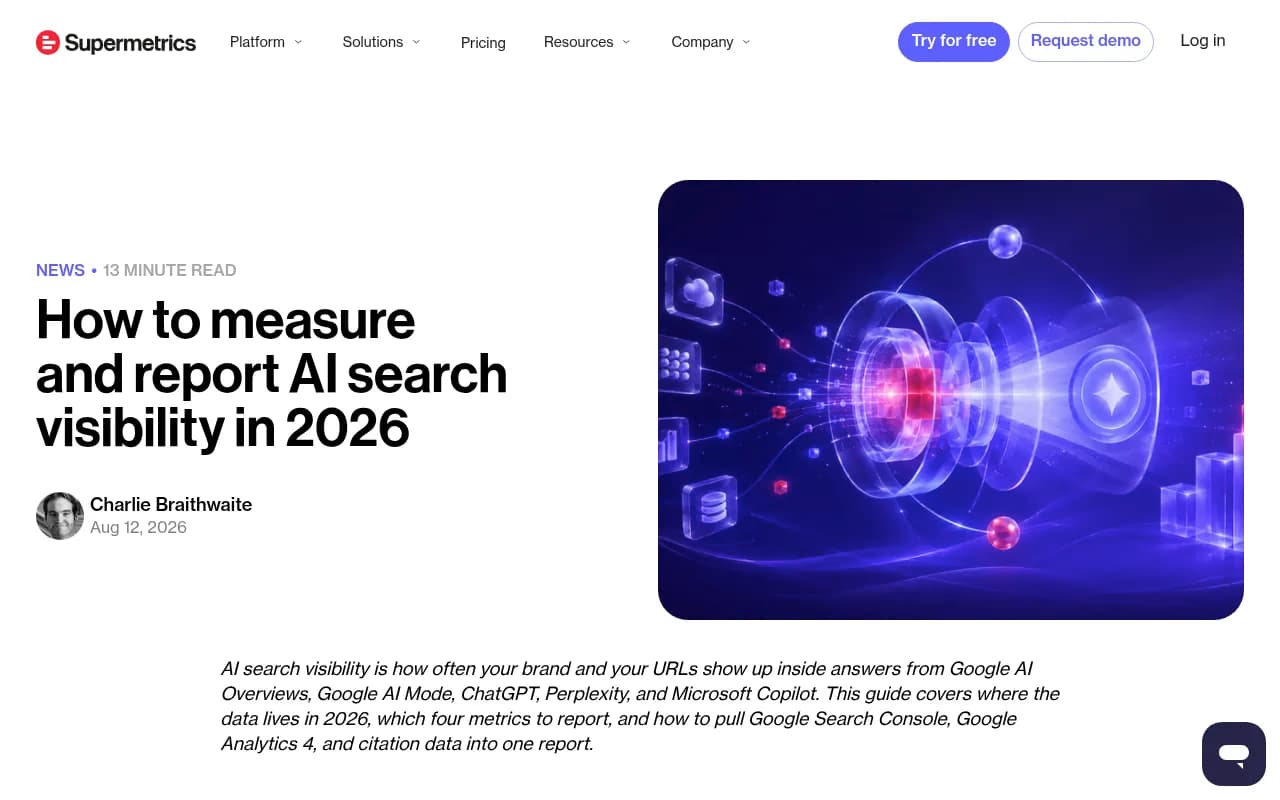
Traditional AI search visibility is how often your brand and URLs show up inside answers from Google AI Overviews, Google AI Mode, ChatGPT, Perplexity, and Microsoft Copilot. The Supermetrics guide on measuring it (August 2026) makes a point I agree with: the tools you used for a decade count positions and clicks, and AI surfaces don't report like a results page.
What has changed in the first-party data:
- Google announced Search Console generative AI performance reports in June 2026. They show impressions for AI Overviews, AI Mode, and AI features in Discover by page, country, device, and date. They carry no click, CTR, or query data, which Search Engine Land flagged at launch.
- Bing Webmaster Tools launched an AI Performance report in public preview in February 2026.
Useful, but partial. You still need a prompt-level view of who gets named, where, and why.
What the citation data says
Promptwatch's data on software prompts (September 28 to October 4, 2026) shows where ChatGPT looks for answers in the software category. GitHub was the most cited domain at 1.2% of software citations, followed by learn.microsoft.com at 0.98% and G2 at 0.73%. By source type, docs and help centers led at 2.64%, and vendor sites plus docs together earned 4.65%, about three times what review sites and analysts earned.
That tells you something useful even before we get to coding agents: for software prompts, your own documentation and GitHub presence carry real weight with AI search too.
Metrics that matter
The usual set applies: share of voice, position in the answer, sentiment, and citation rate. Platforms like Promptwatch track these across ChatGPT, Gemini, Perplexity, Claude, and AI Overviews using real-UI monitoring, and also cover Codex, Claude Code, and OpenCode.

How coding agent visibility works
The method is familiar. You run a prompt set, then compare mentions, sentiment, and competitors. What changes is what the prompts look like and what a win means.
Promptwatch's coding agent visibility guide frames it as four questions:
- Is your product in the plan?
- Is it the default, or one of several alternatives?
- Does the agent build a custom solution instead of using a vendor?
- How does it describe you?
Question three has no real equivalent in classic AI search. ChatGPT doesn't usually answer "what's the best CRM?" by writing you a CRM. A coding agent might.
What the early studies say
I haven't opened these studies directly, and each used its own prompt set, so read the numbers as directional. Promptwatch cites them in its glossary:
- Amplifying ran 2,430 open-ended prompts through Claude Code in February 2026. In 12 of 20 tool categories, the most common pick was a custom-built solution.
- Armature's September 2026 study of Claude Code, Codex, and Cursor found the three picked the same tool in 42% of cases. It separated tools an agent mentioned from tools it actually selected, which is a distinction worth stealing for your own tracking.
- Armature also reported that Codex used web search in 94% of sessions, versus about 30% for Claude Code. The glossary infers that Codex picks may react faster to new docs, while Claude Code leans more on training data.
Take the practical reading: your competitor isn't always another vendor. Sometimes it's "the agent just writes it." And different agents are different audiences.
What feeds an agent's pick
Per the glossary, four inputs shape a recommendation:
- The model's training data
- Live web search
- Project context such as AGENTS.md files (the glossary says over 60,000 projects use them)
- What the agent can run, such as MCP servers
You can influence the second, third, and fourth far faster than the first.
Side-by-side comparison
| Dimension | Traditional AI search visibility | Coding agent visibility |
|---|---|---|
| Who asks | Buyers, researchers, consumers | Developers delegating a build task |
| Surfaces | ChatGPT, Gemini, Perplexity, AI Overviews, AI Mode, Copilot | Claude Code, Codex, Cursor, OpenCode |
| Typical prompt | "Best tool for X?" | "Scaffold an app with auth and a database" |
| What a win looks like | Mention, citation, click | Product in the plan, import in the code, dependency installed |
| Main competitor | Other brands | Other vendors and custom-built code |
| Key content | Product pages, listicles, reviews, landing pages | Quickstarts, current docs, examples, MCP server |
| Traffic signal | AI referrals in analytics | Agent crawler hits on docs, package installs |
| Maturity of measurement | Established, with first-party data from Google and Bing | Early, third-party studies only |
Do you need to track both?
Here's my honest sorting.
Track both if you sell to developers
API companies, SDK vendors, databases, auth providers, payments, observability, and infrastructure products all sit in the zone where a developer's agent might choose for them. Your human buyers use ChatGPT to shortlist, and their agents use Claude Code to implement. You want to show up in both places.
Traditional AI search is enough if you sell to non-developers
A local dentist, a clothing brand, a bank, a travel site. Coding agents aren't choosing your product. Spend the effort on ChatGPT, AI Overviews, and the rest. Promptwatch Data shows how different the citation habits are across surfaces: ChatGPT got 0.46% of its citations from social platforms while Google AI Overviews got 12.2% (September 28 to October 4, 2026), so even within traditional AI search you can't treat the models as one channel.
Hybrid cases
If you're a SaaS with a public API and a mainstream buyer, you're in the middle. Start with AI search, then add a small coding-agent prompt set for integration and "build this with X" scenarios. A few dozen prompts will tell you whether this matters to you.
Why the signals overlap less than you'd hope
It's tempting to assume that ranking in ChatGPT means you rank in Claude Code. Not necessarily. Profound has claimed ChatGPT's sources overlap only 39% with Google's, though that is vendor-sourced and dated 2025, so verify before quoting it. Armature's 42% agreement across three coding agents is similar in spirit: different systems, different picks.
The crawler side shows the same fragmentation. Promptwatch's AI crawler traffic report (June 8 to September 6, 2026) shows OpenAI at 79.8% of IP-verified AI crawler requests in the week of August 31 to September 6, down from 94.8% in the week of June 8. The report's advice is blunt: check robots.txt, CDN, and WAF rules for every provider, and compare your own logs to that mix. A provider that is large in the chart but near zero in your logs suggests you are blocked.
If an agent can't fetch your docs, it can't read your quickstart, and it will recommend whatever it can read.
How to start tracking coding agent visibility
1. Build a prompt set that sounds like a developer
Skip marketing language. Write prompts the way a developer types them mid-task:
- "Add background jobs to this Node app. Pick a library and set it up."
- "Postgres or MongoDB? Pick one and scaffold it."
- "Add auth with email login and a free tier."
- Prompts about tools that ship an MCP server
Head-to-head prompts are especially revealing because they force a choice.
2. Separate mentioned from selected
Borrow Armature's distinction. An agent listing your SDK as an option is not the same as writing it into package.json. Check the output: did the dependency land?
3. Run across agents, not one
Claude Code is terminal-native, and Cursor is IDE-style with background agents, per a Wiz comparison. They behave differently, and so do Codex and OpenCode. A single-agent test misleads you.
4. Log the competitor that isn't a competitor
Count how often the agent writes custom code instead of using any vendor. If that is your biggest rival, the fix is an SDK path shorter than the custom-built path.
5. Watch the traffic side
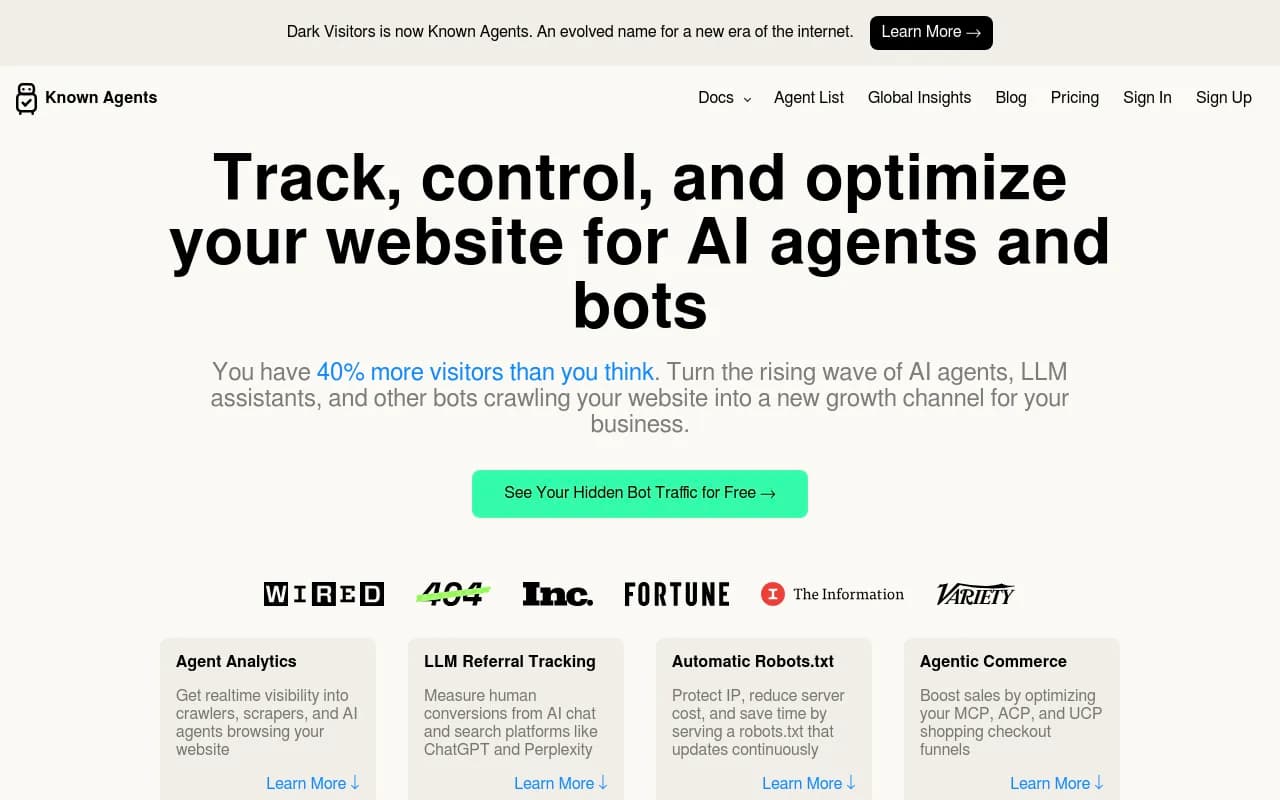
Agent crawlers hitting your docs are the leading indicator. IP-verified crawler logs show which agents read which pages and whether they hit errors. DarkVisitors is another option for spotting AI agents and bots on your site.
What to fix once you see the gaps
The tactics in the glossary are refreshingly unglamorous:
- Clear quickstarts and current docs
- A published MCP server
- Examples that are easy to copy
- An SDK path shorter than the custom-built path
- llms.txt "where useful"
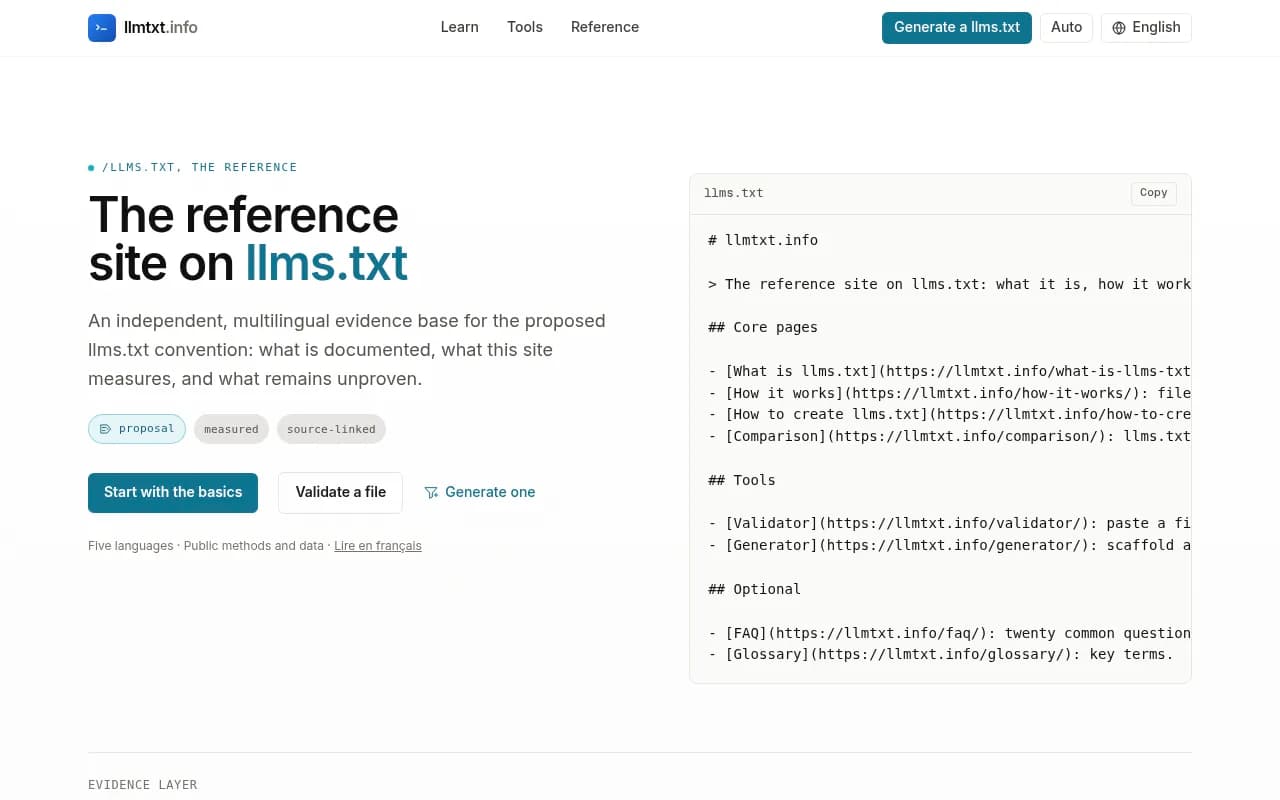
On that last one, be careful. The glossary itself notes that Google Search ignores llms.txt and no AI search engine says it ranks on it. A free generator like llmtxt.info is cheap to try, but don't expect miracles.
On the AI search side, Promptwatch's content-type data shows product pages are the most cited type in ChatGPT at 22.4% of citations (September 28 to October 4, 2026), and its half-life study found landing pages and docs stay cited longest, while news lost half its pages within 36 days. Evergreen docs pay off in both worlds. Also, markdown files make up just 0.05% of AI search citations, so markdown is for agents, not for AI search rankings.
Tools to consider
I didn't find tool pricing or feature comparisons for dedicated coding-agent visibility trackers, so I can't rank them. What I can say is that coverage is thin. Most AI visibility tools track chat assistants only.
| Tool | Tracks classic AI search | Coding agents | Notes |
|---|---|---|---|
| Promptwatch | Yes, real-UI monitoring across major models | Codex, Claude Code, OpenCode | Also has crawler logs and visitor analytics |
| Profound | Yes | Not a stated focus | Strong monitoring, enterprise pricing |
| Peec AI | Yes | Not a stated focus | Multi-language prompt tracking |
| Otterly.AI | Yes | Not a stated focus | Affordable monitoring |
| DarkVisitors | Agent and bot traffic | Detects agent visits | Traffic side only |



If you want to compare more options, the GEO software directory at bestgeosoftware.com is a reasonable starting point. Verify coding agent coverage on each vendor's site before you buy, since claims change quickly.
A simple decision framework
- Do developers choose, or influence the choice of, your product? If yes, add coding agent tracking.
- Is your product a library, API, or service an agent can install or call? If yes, add it.
- Is your docs site crawlable by AI bots? Fix that first regardless.
- Run a 30-prompt pilot across Claude Code, Codex, and Cursor. If you never appear and the agents write custom code, you have a docs and DX problem. If you appear but aren't the default, you have a positioning problem.
- Keep your regular AI search tracking running. It still drives most of the discovery for human buyers.
The bottom line
AI visibility isn't replacing traditional SEO. Frase's guide says the best strategy optimizes for both, and a Reddit thread in r/DigitalMarketing reaches a similar conclusion. Coding agent visibility is the same logic one layer further out. For most brands it's a footnote in 2026. For developer-tool companies it's a second channel with a shorter path from recommendation to revenue, and the first step is just a 30-prompt test you can run this week.