Key takeaways
- On August 8, 2026, the share of ChatGPT fanout queries using the site: operator went from 0.37% to 16.8% in a single day, per Promptwatch Data.
- Average fanouts per response rose from about 1.08 to about 1.83 the same day, so site: searches look additive, not a swap for generic ones.
- Reddit's citation share in ChatGPT fell around the same time, but the timing is suggestive, not proof of cause.
- Third-party measurements disagree on the size of the shift, and one counter-measurement found no rise at all. Treat exact percentages as provisional.
- The practical response: make your domain crawlable, indexed and easy to search, re-run fanout analyses, and do not rewrite your whole strategy on one shift.
What actually changed on August 8
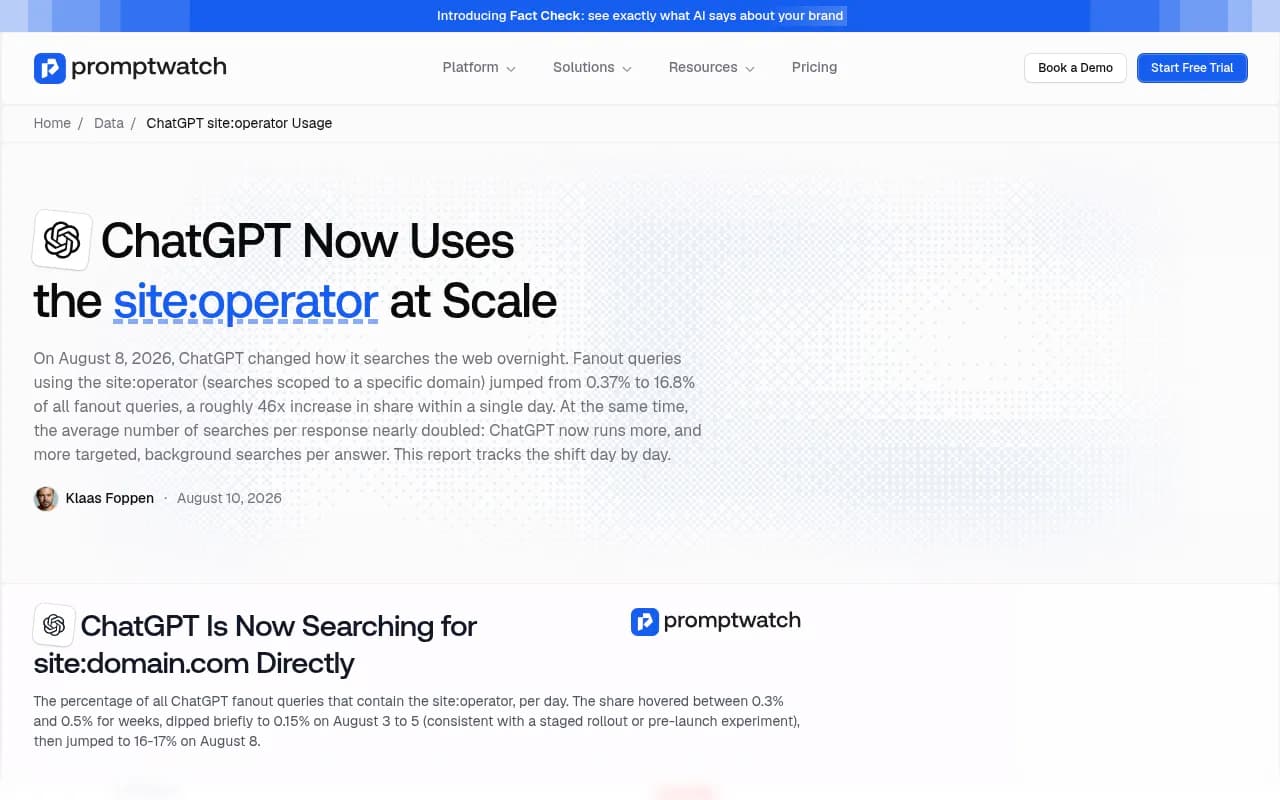
ChatGPT changed how it searches the web overnight. According to Promptwatch Data's report on the site: operator (published August 10, 2026), fanout queries scoped to a single domain went from 0.37% to 16.8% of all fanout queries. That is roughly a 46x jump in share in one day.
A quick refresher. When you send a prompt, ChatGPT does not hand it straight to a search engine. It splits your intent into several background searches, called query fanouts. A site: query is one of those searches restricted to a specific domain, like site:example.com pricing. For weeks that was a rounding error. Afterwards it was a regular part of how ChatGPT builds answers.
If you want the background on fanouts first, Promptwatch's Academy has a good query fan-outs explainer.
The timeline, week by week
The research gives a clean picture of the days around August 8 and a patchier one after. I will mark where the data runs out instead of papering over it.
| Period | What the data shows | Source |
|---|---|---|
| Weeks before Aug 3 | site: share hovers at 0.3% to 0.5%, about 1 in 280 fanouts | Promptwatch Data |
| Aug 3 to 5 | Brief dip to about 0.15%, consistent with a staged rollout or pre-launch experiment | Promptwatch Data |
| Aug 7 | 0.37% (Promptwatch) or 0.03% (Qwairy) | Promptwatch, Qwairy |
| Aug 8 | 16.8% (Promptwatch) or 9.7% (Qwairy) | Promptwatch, Qwairy |
| Aug 13 | 20.4% in Qwairy's data | Qwairy |
| Aug 14 to 16 | 23% to 24% in Qwairy's data | Qwairy |
| Aug 25 | A counter-measurement across 196,692 fanout queries reports no rise | seo-kreativ.de |
Week before: the quiet baseline
Through July and into early August, site: usage was background noise. Promptwatch puts it at about 1 in 280 fanouts. Nothing about it suggested a change was coming, apart from that odd dip on August 3 to 5. Promptwatch reads the dip as maybe a staged rollout or an experiment. I would call that plausible but unproven. A dip right before a jump is a nice story, and nice stories deserve suspicion.
Week of August 8: the step change
One day. That is the whole story of this week. A gradual behavior drift does not look like this. Promptwatch's reading is a model or system-prompt rollout on OpenAI's side, and that fits a change that lands everywhere at once. Qwairy, measuring a different sample, also saw the break on August 8, though at a lower starting level (9.7%).
One thing I would not do is assume the cause. Some third-party posts tie the change to GPT-5.6. That attribution is unverified, and I found no OpenAI confirmation. The ChatGPT release notes were not checked for August entries, so treat the model link as a rumor.
Week of August 14: climbing higher, or not
Here the sources split. Qwairy reports site: usage climbing to 20.4% by August 13 and 23% to 24% by August 14 to 16. Promptwatch's headline numbers describe the jump to roughly 16% to 17% on August 8, and its text does not give a week-by-week series after that. Its daily charts exist, but I could not extract later values from the report text.
That means I cannot honestly say whether the share stabilised around 17% or kept rising. If you are monitoring this yourself, check your own daily data instead of trusting a single figure from a blog post.
Late August: a dissenting measurement
One German SEO site, seo-kreativ.de, says its OpenAI fanout data "shows no rise in site: operator use" as of August 25, 2026, across 196,692 fanout queries. I have not seen its sample design or method. It may be sampling different prompts, a different surface, or a different time window. It conflicts directly with Promptwatch and Qwairy, so it goes in the disputed column until someone reconciles the three.
More searches, not different searches
The second half of the finding is arguably the more useful one. Promptwatch reports that average fanouts per response went from about 1.08 to about 1.83 on August 8 and stayed there. That is roughly a 70% increase.
The logic is simple. If ChatGPT had swapped generic queries for site: queries, the average per response would have stayed flat. It rose. So the domain-scoped searches look like they were layered on top of the generic ones. For brands, that means your existing paths into answers are intact, and there is a new one next to them.
Keep the baseline in perspective
Promptwatch's ChatGPT query fanouts data gives useful context. Average fanouts per response were 2.15 in early December 2025 and about 1.84 by early March 2026. Fanouts came back in April at exactly 1.0 per response after a gap in the data. So going from 1.08 to 1.83 in August is a partial return toward winter levels, not an all-time high. ChatGPT's search behavior moves around a lot, which is the argument for watching it continuously.
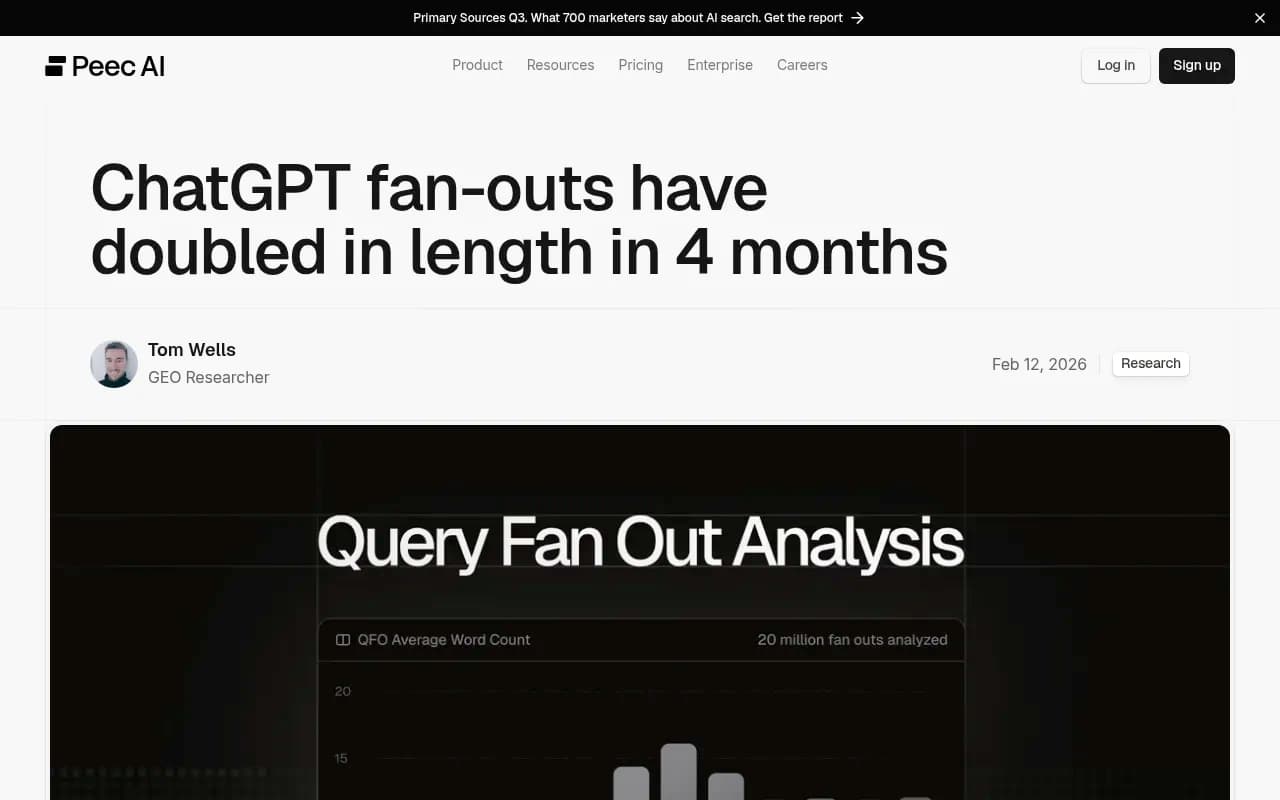
Separately, Peec AI analyzed 20 million fanout queries and found average fanout length rose from about 6 words in October 2025 to about 12 words by January 2026, peaking near 16 words. That is a different metric and a different period from August's operator shift, and Promptwatch's own character-length data shows queries getting shorter by April. Do not mix these series together. Length, count and operator usage are three separate dials.
Per query versus per response: keep the framing straight
You will see two ways of stating the same shift, and they are easy to confuse.
- Per query: 0.37% to 16.8% of all fanout queries used site:. This is Promptwatch's framing.
- Per response: roughly 1 in 280 responses to roughly 1 in 6 contained at least one site: fanout. This is how some third-party write-ups put it.
They are not interchangeable. A response with several fanouts can contain one site: query among them, so the two shares measure different things. When you compare vendors, check which denominator they use before concluding anyone is wrong.
The Reddit connection, and its limits
The same week, Reddit's visibility in ChatGPT dropped. Promptwatch's report on Reddit citations (covering July 7 to August 17) shows Reddit holding a steady 3.83% share of ChatGPT citations from July 18 to August 7. On August 8 it slid into the mid 2s, and on August 14 it dropped below 1%. The August 14 to 17 average was 0.52%, an 86.4% relative drop.
Qwairy measured the same collapse with different baselines:
| Period | Reddit share of ChatGPT citations (Qwairy) |
|---|---|
| Aug 1 to 7 | 2.04% |
| Aug 8 to 13 | 0.59% |
| Aug 14 to 18 | 0.10% |
Qwairy also says forums and UGC fell from 3.2% to 0.9% and directories from 2.3% to 0.2%, with citations shifting toward official sources. Its argument is that direct site: interrogation sends ChatGPT to official domains and away from discussion platforms.
I find that mechanism believable. It is also not established. Promptwatch is explicit that its chart shows when the changes happened, not why, and that a data-collection issue cannot be ruled out. The two reports use different baselines (3.83% versus 2.04% before the drop), so the sizes of the fall are not directly comparable. Google surfaces declined more gradually: AI Overviews averaged 2.37% in the first seven days and 2.10% in the last seven, while AI Mode went from 2.22% to 1.54%.
For broader context on how AI models treat social sources, see Promptwatch's social media citations by AI model report: from September 28 to October 4, 2026, ChatGPT got 0.46% of its citations from social platforms, against 12.2% for Google AI Overviews.
What this means for your site
When ChatGPT runs site:yourdomain.com [topic], it is using a search engine to look inside your site. That makes your own domain a retrieval surface. Promptwatch's advice from the report, which I mostly agree with:
- Make key pages crawlable and indexed. A site: query can only surface what search engines have indexed from your domain. Gaps in coverage become gaps in answers.
- Fix thin category pages and weak internal structure. They now cost you answers, not only rankings.
- Cover more angles per topic: comparisons, pricing, alternatives and domain-scoped lookups.
- Write headings that read like search queries, with the entity and category up front.
- Re-run fanout analyses for tracked prompts. Keyword mappings built before August 8 are stale.
- Do not rewrite your content strategy on one shift. This was a platform-wide rollout, not something individual sites did.
The free AI crawler URL inspector and AI SEO audit from Promptwatch are a cheap way to check basic crawl and index access.
Check indexing before anything fancy
The boring step matters most. Run site:yourdomain.com plus your core topics in Google and Bing and see what comes back. If your best comparison page does not show up, a site:-scoped fanout will not find it either. A crawler like Screaming Frog or Sitebulb can surface orphaned and non-indexable pages quickly.
How to monitor shifts like this
The real lesson of August 8 is that platform behavior can change in a day. A one-off audit would have been right on August 7 and stale on August 8. You need continuous tracking of prompts, fanouts and citations.
Promptwatch is an end-to-end AI visibility platform that tracks prompts across ChatGPT, Gemini, Perplexity and others from the real interfaces, shows query fan-outs per response, and traces which of your pages get cited. Its IP-verified AI crawler logs show whether bots actually read the pages you care about, and the Action Board and Content Agent turn gaps into published content. You can try the 7-day free trial or start with the free AI visibility report.

Other options exist, and which fits depends on whether you want pure monitoring or monitoring plus content work.
| Tool | Strength | Worth a look if |
|---|---|---|
| Promptwatch | Monitoring, crawler logs, fanouts, content agents, CMS publishing | You want to fix gaps, not only see them |
| Peec AI | Multi-language prompt tracking and fanout research | You want lightweight multi-country tracking |
| Qwairy | GEO monitoring with citation analysis | You want citation-level breakdowns |
| Profound | Enterprise AI visibility monitoring | You have a larger budget and monitoring focus |
| Otterly.AI | Affordable visibility monitoring | You need a basic tracker |




For a wider shortlist, the GEO software directory at bestgeosoftware.com lists more options.
What we still do not know
- Whether OpenAI confirmed or documented the change. I found no confirmation, and the release notes were not checked for August entries.
- Whether the fanout average of 1.83 held through late August.
- Why vendor measurements disagree: 16.8%, 9.7%, 23% to 24% and "no rise" are not reconcilable without comparing prompt sets, sampling and surfaces.
- Whether the site: shift caused the Reddit decline. The timing matches. The causal link is unestablished.
- Which model version, if any, introduced the behavior.
If any of these matter to a decision you are making, measure them in your own tracked prompts. A week of daily fanout data on 50 prompts will tell you more than any of the blog posts above, including this one.
A practical checklist
- Compare your tracked fanouts before and after August 8, and flag prompts whose queries changed.
- Search
site:yourdomain.comfor your top ten topics and note what is missing. - Check robots.txt and crawler access for AI bots, and confirm key pages are in your sitemap.
- Add pages for comparison, pricing and alternatives angles where you have none.
- Watch citation share by domain, not only mentions, for the next quarter.
The operator shift is real in at least two independent datasets, it is probably a platform rollout, and its exact size is still argued over. Prepare for it by making your own site easy to search, and keep measuring.