Key takeaways
- ChatGPT Shopping carousels are triggered by purchase-intent queries, but only on roughly 9% of all shopping-related prompts -- so targeting the right query types matters a lot.
- Products appear based on relevance, review quality, and structured data -- not price or shipping cost (though those can filter results out).
- The biggest reason products don't show up isn't content -- it's technical feed compliance. Missing GTINs, stale inventory data, and broken feed structures disqualify products before any ranking logic kicks in.
- Walmart and Target dominate buy-link clicks despite not always winning on product quality, because their feed infrastructure is solid.
- Tracking your brand mentions in AI is not the same as tracking your product visibility in ChatGPT Shopping -- they're powered by different systems entirely.
What ChatGPT Shopping actually is
In April 2025, OpenAI quietly launched product carousels inside ChatGPT. No ads. No paid placements. No sponsored slots. Just products that the model decides are relevant to what you asked.
When a user types something like "best waterproof hiking boots under $150," they now see a visual carousel with product images, prices, ratings, and direct links to buy. They can click into individual listings to see review summaries, additional images, and reasons the model thinks they'd like the item. It looks a lot like Google Shopping, but the selection logic is different -- and so is the opportunity.
For e-commerce brands, this is genuinely new territory. Unlike Google Shopping, you don't bid for placement. Unlike affiliate channels, there's no revenue share. If your product shows up, it shows up because the model decided it should. That's either exciting or terrifying depending on how your product data is set up right now.
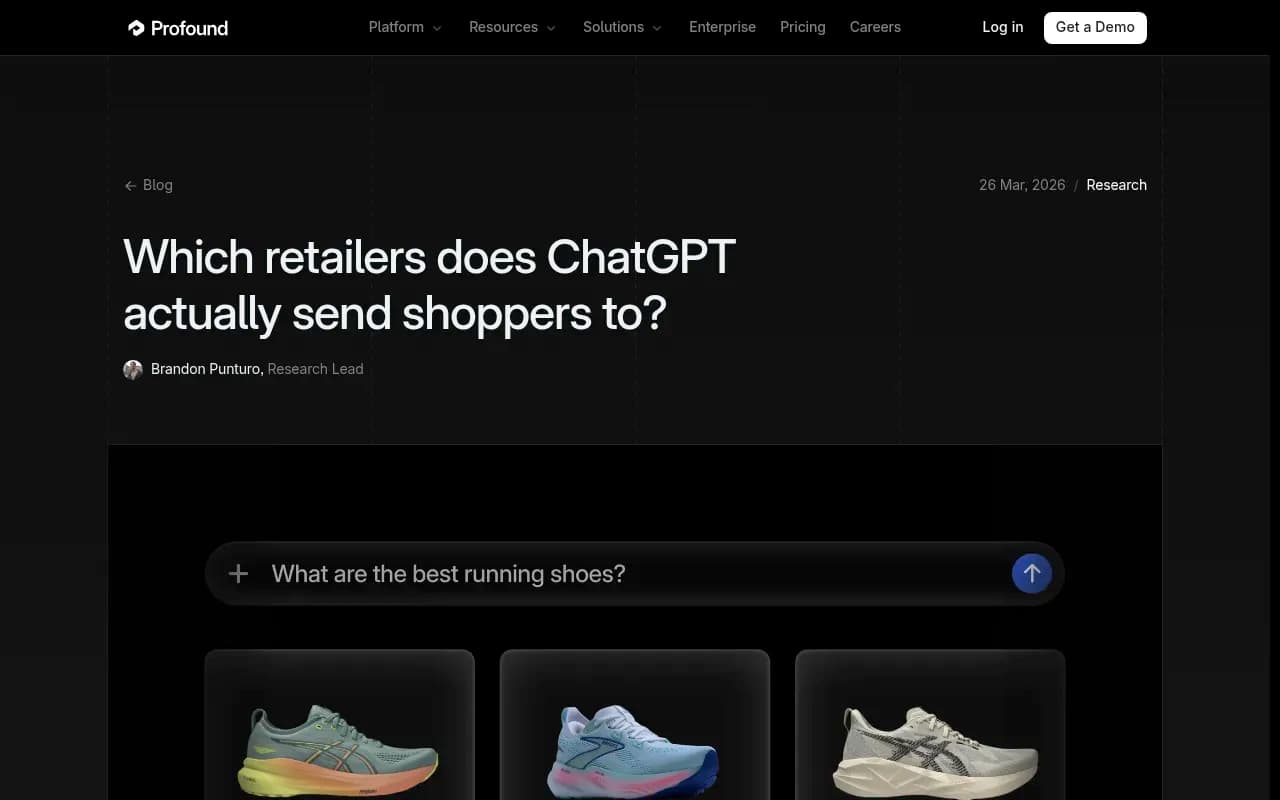
How the carousel gets triggered
Not every product query produces a carousel. Research tracking 260 million ChatGPT prompts found that shopping carousels trigger on only about 9% of queries -- even among prompts that clearly involve products.
The trigger logic comes down to purchase intent. ChatGPT distinguishes between someone researching a category ("what should I look for in a running shoe") and someone ready to buy ("best running shoes for flat feet under $120"). The latter is far more likely to produce a carousel.
Queries that tend to trigger carousels:
- Specific product requests with price constraints ("noise-canceling headphones under $200")
- Comparative shopping queries ("best standing desk for small spaces")
- Gift-finding queries ("birthday gift for a 10-year-old who likes science")
- "Where to buy" queries for specific products
Queries that usually don't trigger carousels:
- General category research without buying signals
- Brand reputation or review questions
- How-to or educational queries about products
The 9% figure is worth sitting with. It means the vast majority of product-adjacent conversations don't produce carousels at all. So if you're optimizing for ChatGPT Shopping specifically, you need to understand which prompts your category actually triggers -- not just whether ChatGPT mentions your brand.
How products get selected for the carousel
Once a carousel is triggered, ChatGPT decides which products to show. According to OpenAI's own documentation, a product appears when ChatGPT perceives it as relevant to the user's intent, considering the query and context.
The factors that influence selection include:
- Relevance to the specific query (product type, use case, specifications)
- Review quality and volume
- Structured product data (clear titles, accurate descriptions, variant-level details)
- Price and policy fit -- if a user specifies a budget or return policy requirement, products that don't meet those criteria get filtered out
- Feed freshness and accuracy
What ChatGPT explicitly does not rank on: price alone, shipping cost alone, or return policy alone. These aren't ranking factors -- they're filters. A product with a $30 shipping fee won't rank lower than a product with free shipping unless the user specifically asked for free shipping.
This is a meaningful distinction. It means you can't "win" by being cheapest. You win by being the most clearly relevant, best-documented product for the specific query.
The real reason your products aren't showing up
Here's where most e-commerce brands get this wrong. They assume the problem is content -- that they need more blog posts, better product descriptions, or more AI mentions. That's not the bottleneck.
The bottleneck is technical protocol compliance.
ChatGPT Shopping (and the broader agentic commerce ecosystem) runs on two technical standards: OpenAI's Agentic Commerce Protocol (ACP) and Google's Universal Commerce Protocol (UCP). These are hard gates. A product feed that doesn't satisfy the requirements of these protocols gets skipped entirely -- before any relevance ranking happens.

The most common compliance failures that merchants don't know about:
- Missing GTINs at the variant level (a GTIN for the product isn't enough -- each size/color variant needs its own)
- Stale inventory data (feeds that update infrequently show products as available when they're not)
- Absent or broken policy URLs (return policy, shipping policy pages that 404 or aren't linked in the feed)
- Broken feed structure (malformed XML, missing required fields, encoding errors)
- Incomplete product attributes (missing material, gender, age group fields for apparel; missing compatibility data for electronics)
The uncomfortable truth: most AEO and GEO tools on the market track brand mentions in AI responses. That's useful for B2B companies and publishers. For e-commerce brands, it's measuring the wrong thing. Brand mention tracking cannot diagnose a non-compliant feed. You need SKU-level feed auditing -- a different problem entirely.
Research analyzing 8,520 ChatGPT shopping queries found that AI traffic currently converts 86% worse than affiliate links for the average e-commerce merchant. That's not a content problem. It's an eligibility problem. Shoppers are clicking through from carousels and landing on products that don't match what was shown, or hitting out-of-stock pages, or encountering checkout friction that the AI couldn't anticipate.
Who's actually winning in ChatGPT Shopping right now
Research from Profound tracking which retailers receive buy-link clicks from ChatGPT carousels reveals something counterintuitive: Walmart and Target don't always win on product quality or price, but they dominate click share because their feed infrastructure is solid.
The brands showing up reliably aren't winning because ChatGPT likes them more. They're winning because their product data is clean, their feeds update frequently, their GTINs are complete, and their policy pages are intact. The model can confidently recommend them because the data it has access to is trustworthy.
Smaller brands and DTC companies often have the better product but the worse infrastructure. They lose not because the AI doesn't know about them, but because the AI can't reliably surface their products in a structured, transactable way.
A January 2026 survey of 800+ shoppers by When and The Pixel found that 10.5% already use AI tools like ChatGPT and Gemini as a discovery channel. That number is growing. The brands building compliant feed infrastructure now are the ones who will capture that traffic as it scales.
The Google Shopping feed connection
One thing that surprises many merchants: your Google Shopping feed is already partially powering ChatGPT product results.
OpenAI has been pulling structured product data from sources that include Google's shopping ecosystem. This means if your Google Shopping feed is well-maintained, you have a head start. It also means that if your Google feed has errors -- and most do, at some level -- those errors propagate into ChatGPT's product data.
The practical implication: fixing your Google Shopping feed isn't just a Google problem anymore. It's a ChatGPT problem. Audit your feed for the compliance issues listed above, and you're improving your visibility across both platforms simultaneously.
A practical checklist for getting your products into carousels
Feed and data hygiene
- Audit GTINs at the variant level, not just the parent product level
- Set up automated feed refresh (at minimum daily; real-time is better for inventory)
- Verify all policy URLs return 200 status codes and contain the expected content
- Validate your feed structure against Google Merchant Center requirements (these align closely with ACP/UCP requirements)
- Complete all optional attributes for your category -- they're not optional if you want carousel placement
Product content
- Write product titles that include the specific use case, not just the product name ("Waterproof Hiking Boot for Wide Feet" beats "Trail Boot Model X")
- Include structured specifications (weight, dimensions, compatibility, materials) in a consistent format
- Aggregate and respond to reviews -- products with more reviews and higher ratings get selected more often
- Use high-quality images with multiple angles; the carousel shows images prominently
Monitoring
- Track which of your products are actually appearing in carousels, not just whether your brand gets mentioned
- Monitor which queries trigger carousels in your category
- Watch competitor carousel appearances to understand what feed quality looks like for products that do get shown
For tracking your overall AI visibility and understanding which prompts are driving product discovery, tools like Promptwatch can help you see where your brand appears across AI models and identify gaps in your coverage.

For enterprise brands that need dedicated ChatGPT Shopping monitoring, Azoma is built specifically for AI shopping optimization across ChatGPT, Amazon Rufus, and similar platforms.
Profound also tracks shopping-specific carousel data and buy-link click attribution, which is useful if you want to understand which retailers are winning clicks for your category.

How ChatGPT Shopping compares to Google Shopping
| Factor | Google Shopping | ChatGPT Shopping |
|---|---|---|
| Paid placement | Yes (Shopping Ads) | No |
| Organic placement | Yes (free listings) | Yes |
| Ranking factors | Bid, relevance, feed quality | Relevance, reviews, feed compliance |
| Feed requirement | Google Merchant Center | ACP/UCP compliance (overlaps with GMC) |
| Carousel trigger | Most product queries | ~9% of product queries |
| Click volume | High | Growing, currently lower |
| Purchase intent | Mixed | High (users in buying mode) |
| Checkout | External (redirect) | External now; in-chat checkout coming |
The key difference isn't the mechanics -- it's the intent. Someone using ChatGPT to find a product is typically further along in the decision process than someone browsing Google Shopping. They've already had a conversation, narrowed their options, and are asking for a specific recommendation. The conversion potential per click is higher, even if the raw click volume is currently lower.
What's coming: ChatGPT Instant Checkout
OpenAI is building toward in-chat purchasing through the Agentic Commerce Protocol. When ChatGPT Instant Checkout rolls out fully, users will be able to complete a purchase without leaving the conversation.
This changes the stakes considerably. Right now, a carousel click sends a user to your product page, where your normal conversion rate applies. With in-chat checkout, the entire transaction happens in ChatGPT's interface. Brands that aren't ACP-compliant won't be able to participate at all -- they won't just miss carousel placement, they'll miss the transaction entirely.
Getting your feed compliant now isn't just about winning carousels in 2026. It's about being eligible for the commerce channel that's being built on top of them.
The monitoring gap most brands have
There's a distinction worth being clear about: tracking whether ChatGPT mentions your brand in a paragraph is not the same as tracking whether your products appear in shopping carousels. These are powered by different systems.
Brand mentions come from training data and web citations. Shopping carousels come from structured product feeds and protocol compliance. A brand can have excellent AI mention rates and zero carousel appearances -- and vice versa.
Most AI visibility tools on the market track brand mentions. Very few track product-level carousel appearances. If you're an e-commerce brand, you need both, but you especially need the latter -- because that's where the revenue is.
The monitoring loop that actually works for e-commerce looks like this:
- Audit your feed for compliance failures (this is the prerequisite -- nothing else matters if your feed is broken)
- Track which prompts in your category trigger carousels
- Monitor which of your products appear in those carousels
- Track click-through and conversion from AI-referred traffic separately from other channels
- Identify which competitors are appearing for prompts where you're not, and diagnose why
That last step -- understanding why competitors appear and you don't -- is where tools that combine citation analysis with content gap analysis become useful. Promptwatch's Answer Gap Analysis, for instance, shows which prompts competitors are visible for that you're not, which can help identify both content gaps and feed coverage gaps.
Bottom line
ChatGPT Shopping carousels are real, they're growing, and they're free. But they're not a content marketing problem -- they're a data infrastructure problem first, and a content problem second.
If your products aren't showing up, the most likely culprit is somewhere in your feed: missing variant-level GTINs, stale inventory data, broken policy URLs, or incomplete product attributes. Fix those before you spend another hour on product descriptions or AI-optimized content.
The brands winning in ChatGPT Shopping right now aren't necessarily the ones with the best products or the biggest marketing budgets. They're the ones with the cleanest product data. That's a solvable problem -- and it's worth solving before in-chat checkout makes feed compliance the difference between being in the transaction and being invisible to it.