Summary
- ChatGPT and other AI models are reshaping how customers discover brands -- if you're not visible in AI search results, you're losing customers to competitors who are
- Manual testing is unreliable because AI responses are probabilistic -- the same prompt can return different answers each time
- These 12 prompts cover the most critical visibility scenarios: direct recommendations, comparisons, problem-solving queries, and sentiment checks
- Testing once isn't enough -- run each prompt 10-20 times to get statistically meaningful data on your actual mention frequency
- Tools like Promptwatch automate this process and track changes over time, but you can start with manual testing today
Why ChatGPT brand visibility matters more than you think
Your potential customers are asking ChatGPT questions right now. "What's the best project management tool for remote teams?" "Which CRM should a startup use?" "Alternatives to Salesforce for small businesses?"
If your brand isn't in those responses, you don't exist. It's that simple.
The shift is real: 98% of employers now check online presence before interviews, and business owners with visible personal brands generate 77% more leads. But here's the part most companies miss -- Google visibility doesn't guarantee AI visibility. ChatGPT, Claude, Perplexity, and Gemini pull from different sources, weight authority differently, and respond to different optimization signals.
You can rank #1 on Google and still be invisible in ChatGPT.

The probabilistic problem: why one test tells you nothing
Here's what makes AI visibility tracking tricky: ChatGPT isn't deterministic. Ask it the same question twice and you'll get different answers. This is by design -- AI models use "temperature" settings to control randomness, making responses more creative but less consistent.
What this means for you: if you manually check "best CRM software" once and see your brand mentioned, that doesn't mean you're consistently visible. You might show up 20% of the time, 80% of the time, or anywhere in between. One test is statistically meaningless.
To get real data, you need to run each prompt 10-20 times minimum and calculate your mention frequency. If your brand appears in 12 out of 50 responses, your visibility for that prompt is 24%. That's your baseline.
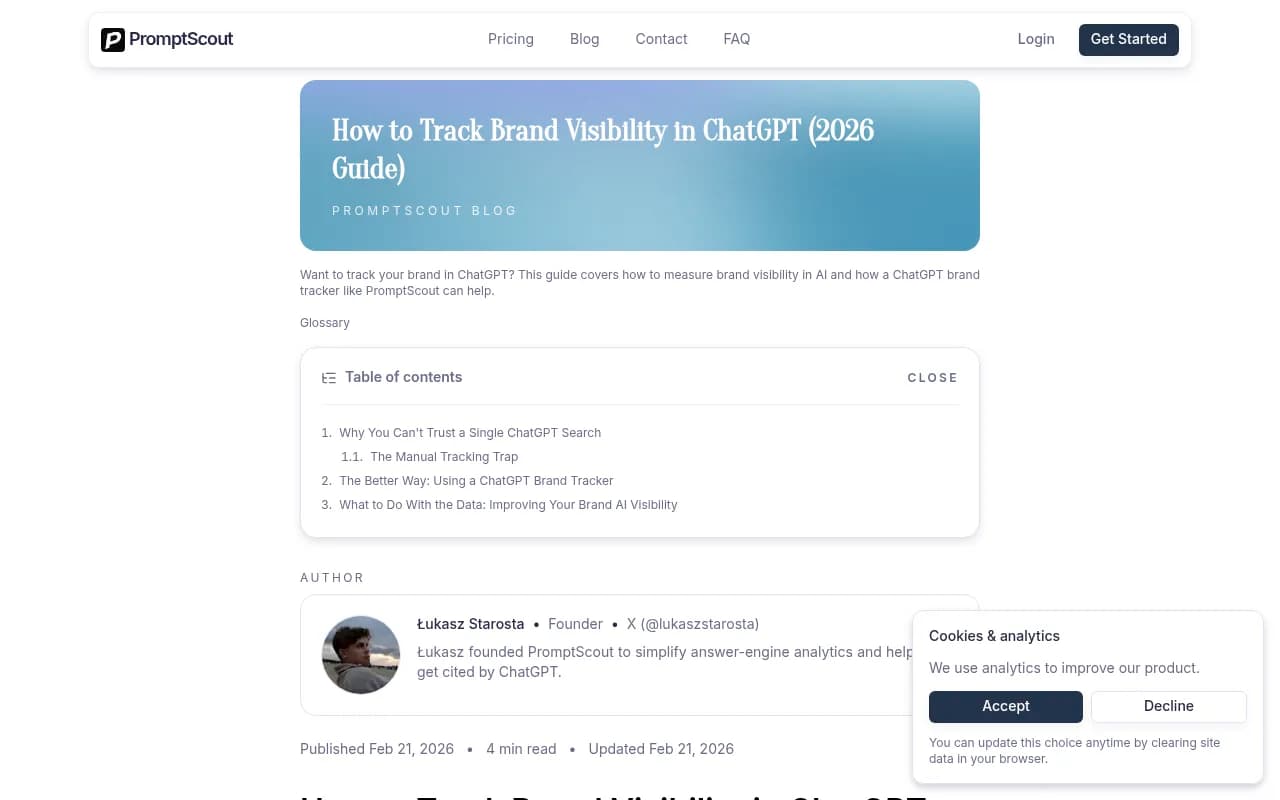
The 12 prompts every brand should test
These prompts cover the core scenarios where customers discover and evaluate brands in AI search. Test all 12 to get a complete picture of your visibility.
Direct recommendation prompts (1-3)
These are the highest-intent queries -- users asking for specific tools or solutions.
1. "What is the best [product category] for [use case]?"
Example: "What is the best email marketing software for ecommerce brands?"
Why it matters: This is the most common discovery prompt. If you're not in this response, you're losing customers at the top of the funnel.
2. "Recommend [number] [product category] for [specific need]"
Example: "Recommend 5 CRM tools for B2B SaaS companies under 50 employees"
Why it matters: Users asking for multiple options are actively comparing. Being in this list means you're in the consideration set.
3. "What [product category] do [persona] use?"
Example: "What project management tools do remote-first startups use?"
Why it matters: This prompt surfaces social proof and peer recommendations -- extremely influential for B2B buyers.
Comparison prompts (4-6)
Users asking these questions are deeper in the funnel and actively evaluating options.
4. "[Your brand] vs [competitor]"
Example: "Asana vs Monday.com"
Why it matters: If ChatGPT doesn't know enough about your product to compare it, that's a massive content gap. These comparisons shape final purchase decisions.
5. "Alternatives to [competitor name]"
Example: "Alternatives to HubSpot for small businesses"
Why it matters: You want to show up when users search for competitor alternatives. This is how you steal market share.
6. "[Your brand] vs [competitor 1] vs [competitor 2]"
Example: "Slack vs Microsoft Teams vs Discord for remote teams"
Why it matters: Three-way comparisons show whether you're considered a serious player in your category.
Problem-solving prompts (7-9)
These prompts don't mention product categories -- users are describing problems, not solutions.
7. "How do I [solve specific problem]?"
Example: "How do I track marketing attribution across multiple channels?"
Why it matters: If ChatGPT recommends your tool as the solution to a problem, you're capturing demand before users even know what category to search for.
8. "I'm struggling with [pain point]. What should I use?"
Example: "I'm struggling with managing client projects across multiple time zones. What should I use?"
Why it matters: This is how real users prompt AI -- conversationally, describing pain points. If you're not in these responses, you're missing high-intent traffic.
9. "What's the easiest way to [achieve outcome]?"
Example: "What's the easiest way to automate email sequences for new leads?"
Why it matters: "Easiest" signals a user looking for low-friction solutions. If your product is actually easy to use, you should be recommended here.
Sentiment and authority prompts (10-12)
These prompts reveal how AI models perceive your brand's reputation and authority.
10. "Is [your brand] good?"
Example: "Is Notion good for project management?"
Why it matters: Simple sentiment check. Does ChatGPT have enough positive signal to recommend you, or does it hedge with "it depends" language?
11. "What do people say about [your brand]?"
Example: "What do people say about Airtable?"
Why it matters: This surfaces the sentiment and themes ChatGPT associates with your brand. Negative sentiment here means you have a content or reputation problem.
12. "Who are the leaders in [your category]?"
Example: "Who are the leaders in AI-powered analytics?"
Why it matters: If you're not mentioned as a category leader, you're not top-of-mind for AI models. This is a brand authority issue.
How to run the test (manual method)
If you're just starting, you can test these prompts manually. Here's the process:
- Open ChatGPT in an incognito window (to avoid personalization based on your account history)
- Run each prompt 10 times -- yes, 10 times, copy-pasting the exact same prompt
- Record the results in a spreadsheet: Did your brand appear? What position? What competitors were mentioned?
- Calculate mention frequency: If your brand appeared in 6 out of 10 responses, your mention frequency is 60%
- Note sentiment and context: When your brand is mentioned, is it positive, neutral, or negative? Is it recommended or just listed?
This will take 2-3 hours for all 12 prompts, but you'll have a baseline understanding of your AI visibility.
The tracking problem: manual testing doesn't scale
Manual testing works for a one-time audit, but it breaks down fast:
- You need to test across multiple AI models (ChatGPT, Claude, Perplexity, Gemini, Copilot)
- You need to test in different languages and regions
- You need to track changes over time -- did your visibility improve after publishing new content?
- You need to test dozens or hundreds of prompts, not just 12
- You need to run each prompt 20-50 times for statistical significance
Doing this manually is impossible. This is why dedicated AI visibility platforms exist.
What to track: the metrics that matter
Once you're testing regularly (manually or with a tool), focus on these core metrics:
| Metric | What it measures | Why it matters |
|---|---|---|
| Mention frequency | % of responses where your brand appears | Your baseline visibility -- are you in the conversation at all? |
| Position | Where you appear in lists (1st, 3rd, 5th) | Higher positions get more clicks and consideration |
| Share of voice | Your mentions vs competitor mentions | Relative visibility -- are you winning or losing to competitors? |
| Sentiment | Positive, neutral, or negative mentions | Sentiment shapes purchase decisions -- negative mentions kill conversions |
| Context | How you're described (leader, alternative, niche) | Positioning matters -- are you framed as a premium option or a budget alternative? |
How to improve your ChatGPT visibility
Once you know where you stand, here's how to improve:
1. Create entity-focused content
AI models need structured information about your product. Create dedicated pages for:
- Use cases ("[Your product] for [specific industry]")
- Comparisons ("[Your product] vs [competitor]")
- Feature explanations ("How [feature] works in [your product]")
- Customer stories and case studies
These pages give AI models the context they need to recommend you accurately.
2. Build authority signals
AI models weight authoritative sources heavily. Focus on:
- Getting mentioned in industry publications and review sites (G2, Capterra, TrustRadius)
- Publishing thought leadership content on your blog
- Earning backlinks from high-authority domains
- Building a presence on Reddit and niche forums where your audience hangs out
3. Optimize for prompt patterns
Look at the prompts where you're NOT visible and reverse-engineer what's missing. If "best CRM for startups" doesn't mention you, create a page titled "Why [Your Product] is Built for Startups" that explicitly addresses startup pain points.
4. Monitor and iterate
AI visibility changes as models retrain and new content gets indexed. Track your metrics weekly or monthly and adjust your content strategy based on what's working.
Tools that automate AI visibility tracking
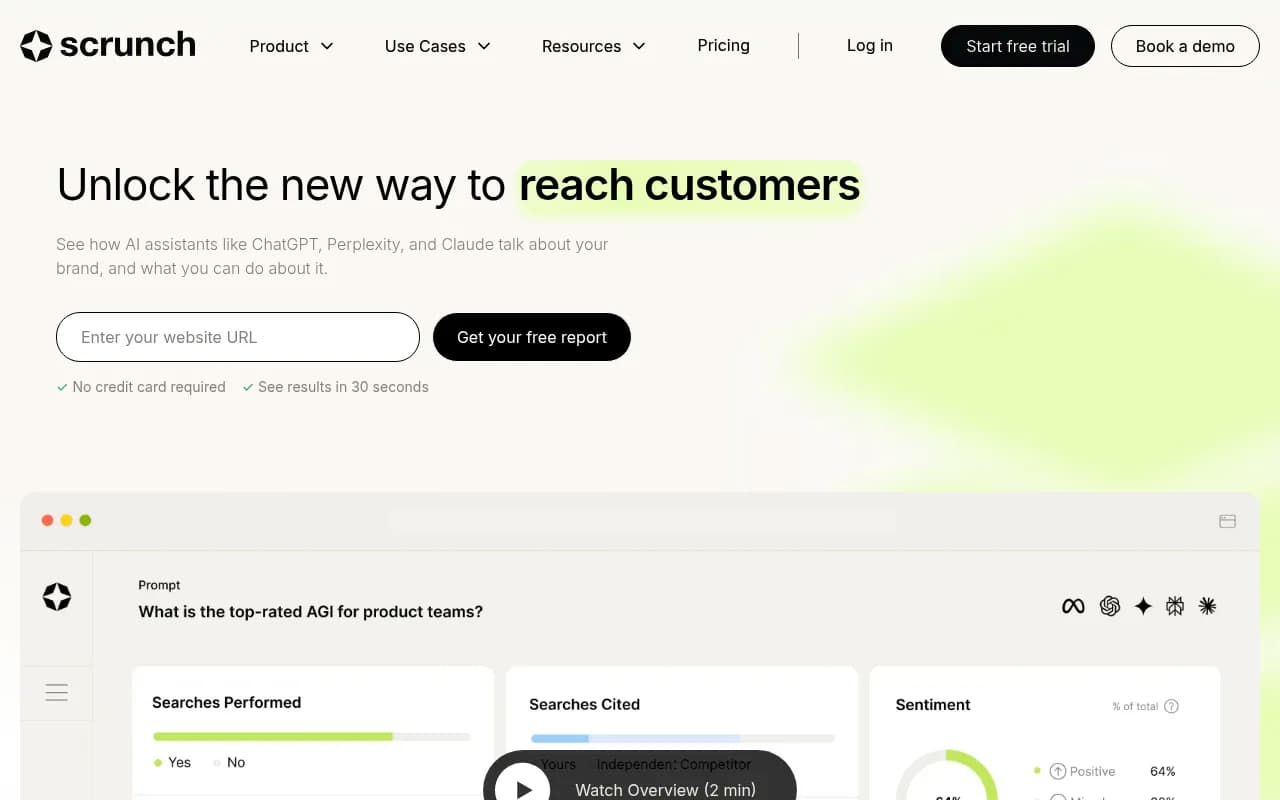
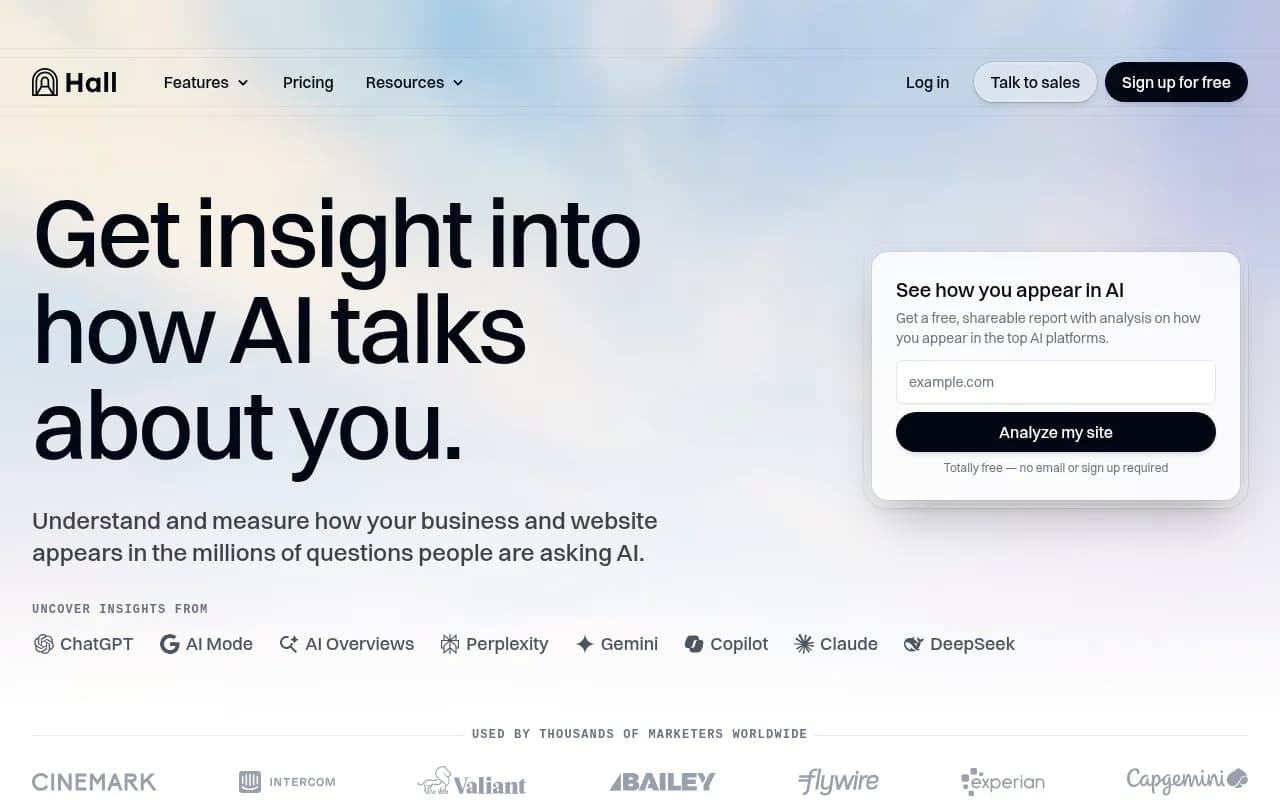
If you're serious about AI visibility, manual testing won't cut it. Here are platforms that automate the process:




Comparison: manual testing vs automated platforms
| Feature | Manual testing | Automated platforms |
|---|---|---|
| Cost | Free (just time) | $99-$579/mo |
| Time per audit | 2-3 hours | 5 minutes |
| Prompts tracked | 10-20 max | 50-500+ |
| AI models covered | 1-2 (ChatGPT, Claude) | 8-10 (ChatGPT, Claude, Perplexity, Gemini, Copilot, etc.) |
| Historical tracking | Manual spreadsheet | Automatic dashboards |
| Competitor comparison | Manual | Built-in heatmaps |
| Content gap analysis | None | Automated |
| Best for | One-time audit | Ongoing optimization |
Start testing today
You don't need a paid tool to start. Pick 3-5 of the 12 prompts above that matter most to your business and run them manually in ChatGPT today. Record the results. See where you stand.
Then decide: is this a one-time curiosity, or is AI visibility a strategic priority? If it's the latter, invest in a platform that can track at scale and help you close the gaps.
Because here's the reality: your competitors are already testing these prompts. They're already optimizing for AI visibility. The question isn't whether AI search matters -- it's whether you'll be visible when your customers start asking.