Key takeaways
- There is no first-party evidence yet that publishing a changelog directly raises AI citations. The case for changelogs is about giving AI engines precise, dated, first-party facts to retrieve, not a ranking trick.
- Promptwatch Data shows docs and landing pages stay cited in ChatGPT far longer than news. Release notes are dated and news-like, so expect them to decay faster unless you connect them to durable pages.
- Freshness is about whether claims are still true, not only the date at the top of the page. A stale pricing or feature page does more damage than a missing changelog.
- The best setup: a crawlable changelog that feeds updates into docs, pricing, and feature pages, then tracking whether any of it gets crawled and cited.
The short answer
Do changelogs help dev tools stay cited in AI search? Sort of. Indirectly. And only if you do them well.
I want to be upfront about this, because most articles on the topic oversell it. I could not find a study that isolates changelogs or release notes as a variable and shows a citation lift. Promptwatch's content-type reports don't even have a "changelog" category. So anyone promising that shipping release notes will bump you in ChatGPT is guessing.
What we do have is a decent chain of reasoning backed by real data on how AI engines treat freshness, content type, and software sources. Follow the chain and the answer becomes practical rather than mystical.
Why freshness matters to AI engines at all
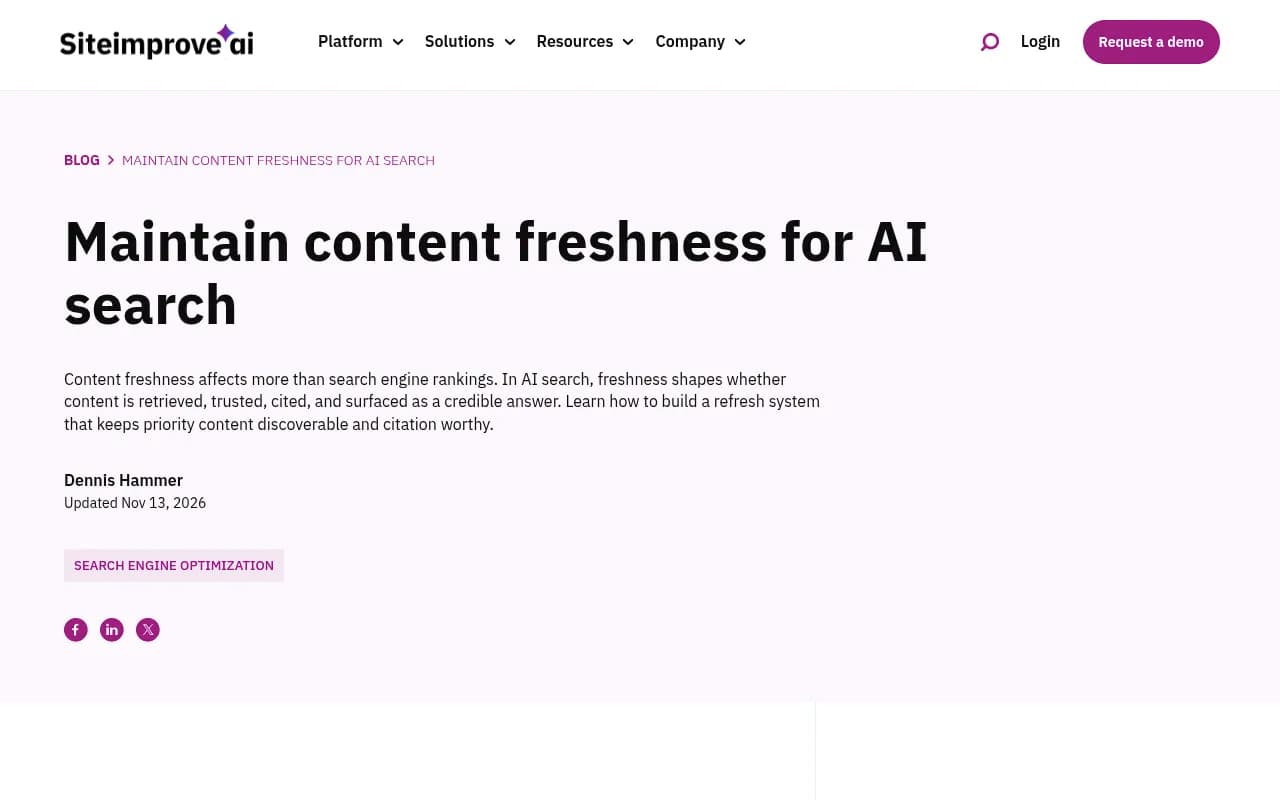
AI search systems retrieve pages, read them, and decide whether they are reliable enough to cite. Siteimprove's guide on maintaining content freshness for AI search (updated Nov 13, 2026) makes a point I think is underrated: a page that earned strong visibility last year can lose its place in AI answers because the data is two years old or the product it describes has changed. There is no notification. The page just stops getting retrieved.
For dev tools this is brutal, because your product changes constantly. Pricing, API limits, SDK versions, supported integrations, deprecated endpoints. Each one is a fact an AI answer might state, and each one can go stale.
A caveat from the research: recency alone will not make a page a preferred source. Screpy's write-up on freshness and citations says fresh content helps when a query depends on current information, but it is not a substitute for being the page that actually answers the question. Freshness is a condition, not a strategy.
What a changelog actually gives an AI engine
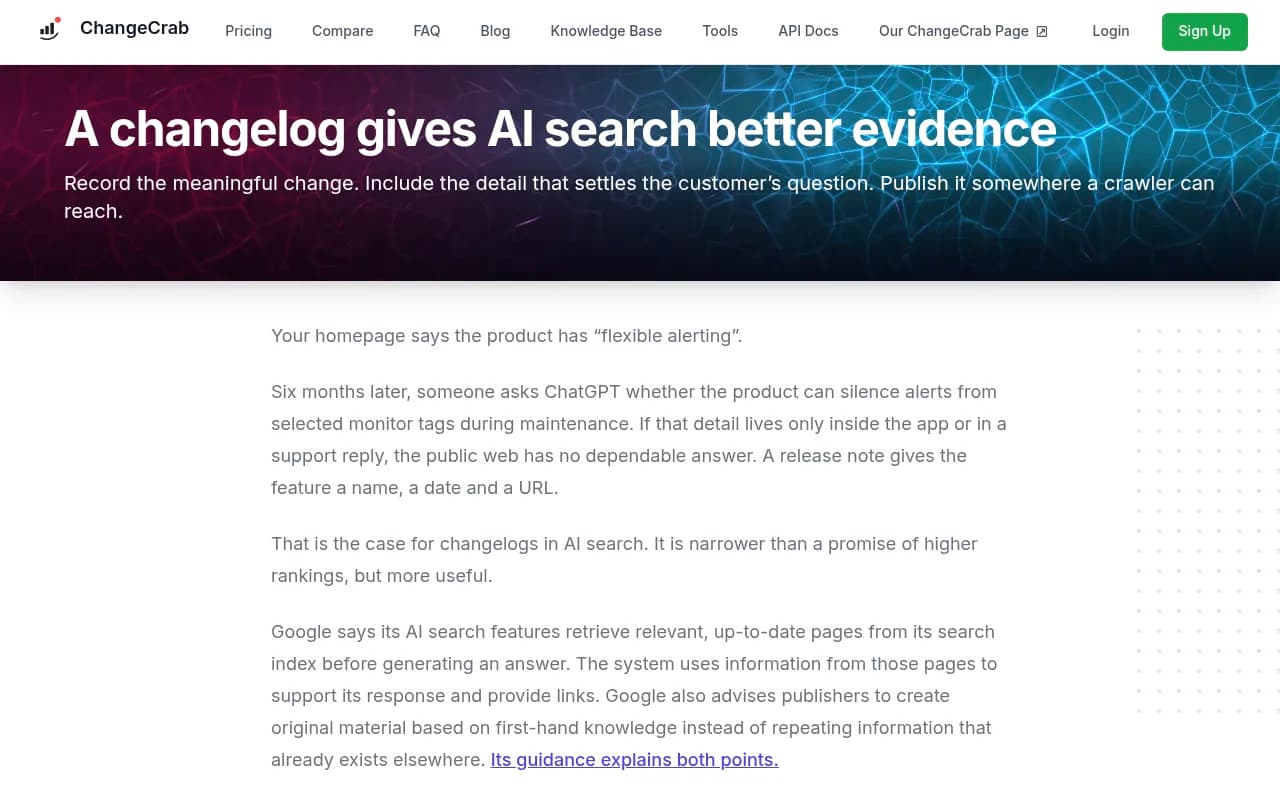
ChangeCrab makes the most grounded argument I found. Imagine your homepage says "flexible alerting". Six months later someone asks ChatGPT whether your product can silence alerts from selected monitor tags during maintenance. If that detail only lives inside the app or in a support reply, the public web has no dependable answer. A release note gives the feature a name, a date, and a URL.
That is the real value. Compare two ways of describing the same thing:
- Marketing copy: "Advanced notification controls."
- Release note: "You can now mute alerts from selected monitor tags until a maintenance window ends. Alerts from other monitors continue as normal."
The second one says what is selectable, how long it lasts, and what is unaffected. A buyer can decide if it fits. A retrieval system has something specific to match against a specific question.
The same logic covers vague entries. "Various improvements and bug fixes" records that work happened and nothing else. Useful entries resolve uncertainty: a new integration, a changed API limit, a removed restriction, a workaround that is no longer needed.
Google's own guidance for AI features, as ChangeCrab summarizes it, favors original material based on first-hand knowledge over repeated information. You are the only one who knows exactly when a feature shipped. A comparison site or affiliate post cannot reproduce that with the same authority.
What Promptwatch Data says about decay
Here is where I'd temper the enthusiasm. Release notes are dated, time-stamped, and news-like. How does news-like content hold up in ChatGPT?
Promptwatch's content half-life report tracked every classified page ChatGPT cited on July 6, 2026 through October 4, 2026. The pattern:
| Content type | Still cited after 30 days | Still cited after 60 days | Notes |
|---|---|---|---|
| Landing pages | 78% | 69% | Last longest |
| Docs | 76% | 67% | 93% were cited again after day 0 |
| Comparisons | 72% | 63% | Durable |
| Listicles | n/a | 60% | Slower decay |
| Product pages, reviews, how-tos | n/a | 55% | Half-life of 74 to 77 days |
| News | n/a | 41% | Half gone after 36 days; almost a quarter never cited again |
Two caveats from the report itself. The lines drop in the final week because the observation window ends, so landing page, docs, comparison, and listicle half-lives are probably at or beyond 90 days. And the report has no changelog category.
So what follows is my inference, not Promptwatch's claim: individual release note entries probably behave more like news than like docs. They are tied to a moment. The durable assets are the pages that always describe the current state of the product.
That changes how you should think about the job. A changelog entry is not the thing you want cited forever. It is the source of truth that keeps your durable pages accurate, and a dated record AI can reach when a question is about when or whether something changed.
Which content types ChatGPT actually cites for software
For the week of Sep 28 to Oct 4, 2026, Promptwatch's citation share by content type put product pages at 22.4% of classified ChatGPT citations, landing pages at 16.8%, listicles at 13.6%, how-tos at 8.7%, documentation at 7.5%, and news at 5.7%. On informational prompts, docs earned 8.5% and how-tos 10.7%.
Software prompts specifically look different. In the software citation report for the same week, the leading domains were github.com (1.2%), learn.microsoft.com (0.98%), g2.com (0.73%), docs.aws.amazon.com (0.41%), and docs.cloud.google.com (0.35%). By source type, docs and help centers took the largest share at 2.64%, then vendor sites at 2.01%, review sites and analysts at 1.57%, and GitHub at 1.2%.
Notice what is on that list. Release notes from the big vendors live inside those doc domains. Google Cloud publishes its release notes at docs.cloud.google.com/release-notes, OpenAI at help.openai.com, and Chrome at developer.chrome.com. Those are domains ChatGPT already treats as authoritative for software questions. I can't tell you the release notes pages themselves are what get cited, but they sit on the right domains, in the right format, with clear dates.
What good release notes look like: three real examples
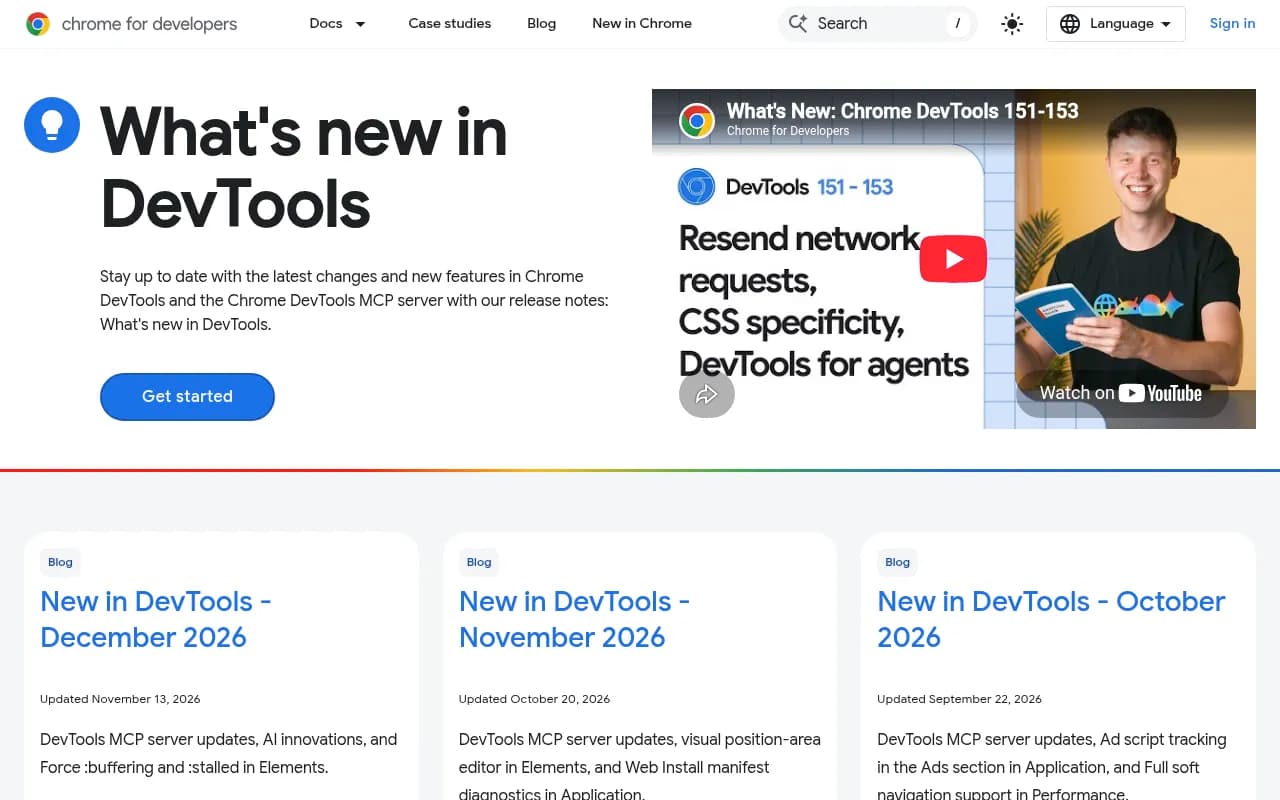
Chrome DevTools' release notes are a good model. Each entry has a dated post (for example, a monthly "New in DevTools" with an updated date), a one-line summary of what changed, and a link to details. The page is in multiple languages and is easy to crawl.
A useful checklist for your own changelog:
- One URL per significant release or feature, not just a single endless scroll
- A visible date, plus the version number for SDKs and APIs
- A plain description of what changed, who can use it (plan, region, version), and what stays the same
- Links to the docs page that now describes the feature
- Deprecations and removals stated explicitly, with the replacement
- Server-rendered HTML, no login wall, not blocked in robots.txt for AI crawlers
That last point is where many dev-tool changelogs fail. If a widget loads entries client-side or the page sits behind an app login, the public web gets nothing. You can check what AI crawlers can read with Promptwatch's free Agentic Readiness Check or the AI crawler URL inspector.
Which date supports the claim?
One more angle that gets missed. A piece on Medium makes a sharp point: for freshness in AI search, check when the important claim was verified and when it applies, not just the date at the top of the page.
This matters a lot for dev tools. Suppose your pricing page was edited yesterday but still says the API limit is 1,000 requests per minute, and the changelog says it moved to 5,000 in March. Now you have two dated sources that disagree. An AI engine may pick either, or hedge, or cite a third party instead.
The fix is boring and effective:
- When a changelog entry changes a fact, update every page that states that fact. Pricing, docs, feature pages, FAQ, comparison pages.
- Put a "last verified" date on pages with volatile claims like limits, pricing, and supported versions.
- Link the changelog entry and the docs page to each other.
- Retire or redirect old pages that describe removed features, rather than leaving them to rot.
Promptwatch's own advice from the half-life data points the same direction: treat landing pages, docs, and pricing pages as long-term citation assets, keep prices, features, and specs accurate, and use news and press for short bursts of visibility.
A practical refresh cadence
Salespeak's freshness piece argues that around half of AI citations point at content under 13 weeks old and suggests refreshing high-traffic content every 12 to 16 weeks. Treat that as a third-party heuristic, not a law. Promptwatch's data on docs and landing pages suggests the best-performing types can hold for longer than that, as long as they remain accurate.
A workable cadence for a dev tool:
| Asset | Update trigger | Review cadence |
|---|---|---|
| Changelog entries | Every shipped change | Ongoing |
| Docs for changed features | Same release | Every release |
| Pricing and plan pages | Any price or limit change | Monthly check |
| Comparison and alternatives pages | Competitor or feature change | Every 12 to 16 weeks |
| Landing and product pages | Positioning or feature change | Quarterly |
| Old blog posts with stale specs | Spotted in audits | Twice a year |
Honestly, the monthly pricing check is the one most teams skip, and it is probably the highest value item in the table.
Measuring whether any of this works
Since no one can promise a citation lift, measure your own. You want to answer three questions:
- Are AI crawlers reading the changelog and docs pages at all?
- Are those pages being cited for the prompts your buyers use?
- Does the traffic show up, and does it convert?
Promptwatch covers that loop in one place: IP-verified AI crawler logs show whether bots reach a page, Page Tracker shows which prompts and responses cite a given URL, and visitor analytics show AI-referred traffic. For a dev-tool company it also tracks how coding agents like Codex, Claude Code, and OpenCode recommend tools and docs, which is where a lot of developer discovery now happens. You can watch a release note URL for a few weeks and see whether it earns citations or just crawls. Weekly site audits catch orphaned pages and broken links in your changelog too.

If you want to compare options first, the directory at bestgeosoftware.com lists GEO platforms side by side. A few other tools in our catalog cover pieces of this workflow:
| Need | Tools to look at |
|---|---|
| Crawl and audit changelog pages | Screaming Frog, Sitebulb, Lumar |
| Watch for content going stale | ContentKing, Siteimprove |
| Track AI bot visits | DarkVisitors |
| Monitor AI citations | Promptwatch, Profound, Peec AI, Otterly.AI |

Pick based on whether you only need reports or also want help acting on them. Many tools in the list stop at monitoring.
Common mistakes
Treating the changelog as marketing
Blog-style hype entries ("We're thrilled to announce...") tell an AI nothing. Lead with the fact.
Hiding it in the product
In-app "what's new" modals are invisible to crawlers. Mirror every entry on a public URL.
One giant page
A single infinite-scroll page makes it hard to cite a specific change. Give significant entries their own URL and anchors.
Updating the changelog but not the rest
This is the big one. A changelog that contradicts your pricing page creates doubt instead of evidence.
Faking freshness
Bumping the date on a page without changing the content is a risk. Siteimprove's guidance is about whether facts, examples, and references still reflect reality, not whether a timestamp moved. Date manipulation doesn't fix wrong claims.
A simple playbook for dev tool teams
- Publish release notes on a public, crawlable URL, one entry per meaningful change.
- Write each entry so it answers a question a buyer might actually ask an AI.
- Update the docs, pricing, and feature pages the same day, and cross-link them.
- Add last-verified dates to volatile claims.
- Keep your GitHub presence and docs open to crawlers, since GitHub and documentation sites dominate software citations in Promptwatch's October 2026 data.
- Check crawler access, then track citations for the pages you updated.
- Review what the data says after 6 to 8 weeks and adjust.
For more on how AI engines pick sources, the Promptwatch Data hub has the underlying reports, and the Academy guide on query fan-outs explains why specific, narrow facts matter: AI engines often run several narrow searches per answer, and a precise release note can match one of them.
Bottom line
Changelogs are not a citation hack. They are a cheap way to put precise, dated, first-party facts on the public web, and those facts feed the pages AI engines actually keep citing. Docs and landing pages last the longest in ChatGPT, news-like content fades, and stale claims cost you quietly. Ship the changelog, but spend the real effort making sure every durable page agrees with it.