Key takeaways
- Tracking MCP server recommendations means measuring whether coding agents like Claude Code and Codex suggest or connect your server when a developer asks for a capability. It is a different job from observing your own agent's MCP calls.
- Promptwatch is the one tool in our catalog that tracks Claude Code, Codex and OpenCode with a dedicated MCP servers prompt category, alongside ChatGPT, Gemini and Perplexity.
- Observability tools such as Braintrust, LangSmith, Helicone and Datadog trace the MCP calls your own agents make. They cannot tell you if third-party agents recommend you.
- Mentions and selections are not the same. In one 2026 study, PayPal was mentioned 139 times by coding agents and never selected.
- A good setup combines a recommendation tracker, AI crawler logs, and a well-maintained docs site and GitHub repo.
Why recommendation tracking is its own problem
A developer opens Claude Code and types something like "connect my agent to an expense management tool that has an MCP server." The agent picks one. The developer rarely second-guesses it. If your server is the one that gets installed, you are now part of their stack. If it isn't, you never knew the conversation happened.
That is the problem. MCP server discovery used to happen through awesome-lists, Reddit threads and blog roundups. Now a growing share of it happens inside the agent, in a session you cannot see.
Promptwatch defines this as coding agent visibility: how often an agent recommends, installs or builds on your product when asked to plan or build software. Its guide breaks that into four questions. Is your product in the plan? Is it the default? Does the agent build instead of buy? How does the agent describe you? Swap "product" for "MCP server" and those still hold.
The stakes are the same as with any dependency. Replacing something an agent wrote into a project costs developer time, so day-one picks tend to stick.
Recommendation tracking vs agent observability
These two categories get mixed up constantly, because both involve "MCP" and "agents" and "tracking." They answer opposite questions.
| Recommendation tracking | Agent observability | |
|---|---|---|
| Question answered | Do other people's agents pick my MCP server? | What did my agent do with the MCP tools it called? |
| Whose agent | Third-party (Claude Code, Codex, Cursor users) | Your own |
| Data source | Prompts run against the agents, citations, crawlers | Traces, spans, token and cost logs |
| Who uses it | MCP server vendors, dev-tool marketers, DevRel | Engineers running agents in production |
| Example tools | Promptwatch and other AI visibility platforms | Braintrust, LangSmith, Helicone, Datadog |
If you build a product with an MCP server, you probably need both, but they sit on different teams' desks. The rest of this guide covers recommendation tracking first, then the observability side briefly so you can tell which bucket a tool belongs in.
What the research says about how agents choose
Before picking a tool, it helps to know what you are measuring. Two third-party studies, both cited in Promptwatch's coding agent guide, give a rough picture. I did not review either study directly, so treat the figures as secondhand.
- Amplifying's "What Claude Code Actually Chooses" (Feb 2026) ran 2,430 open-ended prompts through Claude Code across 20 tool categories and 3 Claude models, naming no tool. In 12 of 20 categories the most common pick was a custom-built solution. GitHub Actions took 93.8% of CI/CD picks and Stripe took 91.4% of payments picks.
- Armature's study (Sep 3, 2026) of Claude Code, Codex and Cursor found Claude Code built in-house in 19% of sessions, versus 10% for Codex and Cursor. The three agents chose the same tool in only 42% of cases. Codex used web search in 94% of sessions, while Claude Code searched in roughly 30% overall.
Three things follow. Agents often decide to build rather than buy, so "not recommended" can really mean "not needed." Different agents disagree, so you have to track each one separately. And web search matters a lot, which means your public docs affect what Codex says about you.
Tools that track MCP server recommendations
Promptwatch
Promptwatch tracks Claude Code and Codex on every plan, using the same visibility, mention, sentiment and competitor metrics it applies to ChatGPT, Gemini and Perplexity. It also covers OpenCode. Its prompt categories include an "MCP servers" group, which is the one that matters here: prompts about which MCP server an agent should connect to.
The part I find most useful is the intent mapping. Most coding agent prompts land in the Transactional stage even when no brand is named, which matches how developers actually ask. "Set up billing for my app" is a buying decision, and nobody typed a vendor name.
Beyond tracking, it closes the loop. IP-verified AI crawler logs show whether agents' crawlers can read your docs. The Content Agent and Action Board turn gaps into work. For an MCP vendor, that means finding the prompts where a competitor is recommended and you are absent, then fixing the docs or comparison pages that feed those answers.

Pricing starts with a free Explore plan (ChatGPT only) and paid plans from $95/month, but check promptwatch.com/pricing before you commit. A caveat from my research notes: I could not verify pricing or coding agent coverage for the other AI visibility tools below, so I won't make claims about them.
Other AI visibility platforms worth checking
Most tools in this category monitor ChatGPT, Gemini, Perplexity and Google AI Overviews. Whether they cover coding agents specifically is something you need to ask each vendor. These are the ones in our catalog that are worth a look if you are comparing:

Profound is a well-known monitoring platform for brand visibility in AI search engines.

Peec AI offers multi-language AI visibility tracking at a lower price tier.

Otterly.AI is an affordable monitor for AI search mentions.
AthenaHQ tracks brand visibility across 8+ AI search engines.
If you want a broader list, the GEO software directory at bestgeosoftware.com and the AI rank tracker directory at ai-rank-tools.com are the places to compare more options.
| Tool | Tracks coding agents | Crawler logs | Content workflow | Best for |
|---|---|---|---|---|
| Promptwatch | Yes (Claude Code, Codex, OpenCode) | Yes, IP-verified | Yes (Content Agent, Action Board) | MCP vendors who want to fix gaps, not just see them |
| Profound | Confirm with vendor | Confirm with vendor | Confirm with vendor | Enterprise monitoring |
| Peec AI | Confirm with vendor | Confirm with vendor | Confirm with vendor | Multi-language tracking |
| Otterly.AI | Confirm with vendor | Confirm with vendor | Confirm with vendor | Budget monitoring |
| AthenaHQ | Confirm with vendor | Confirm with vendor | Confirm with vendor | Multi-engine brand tracking |
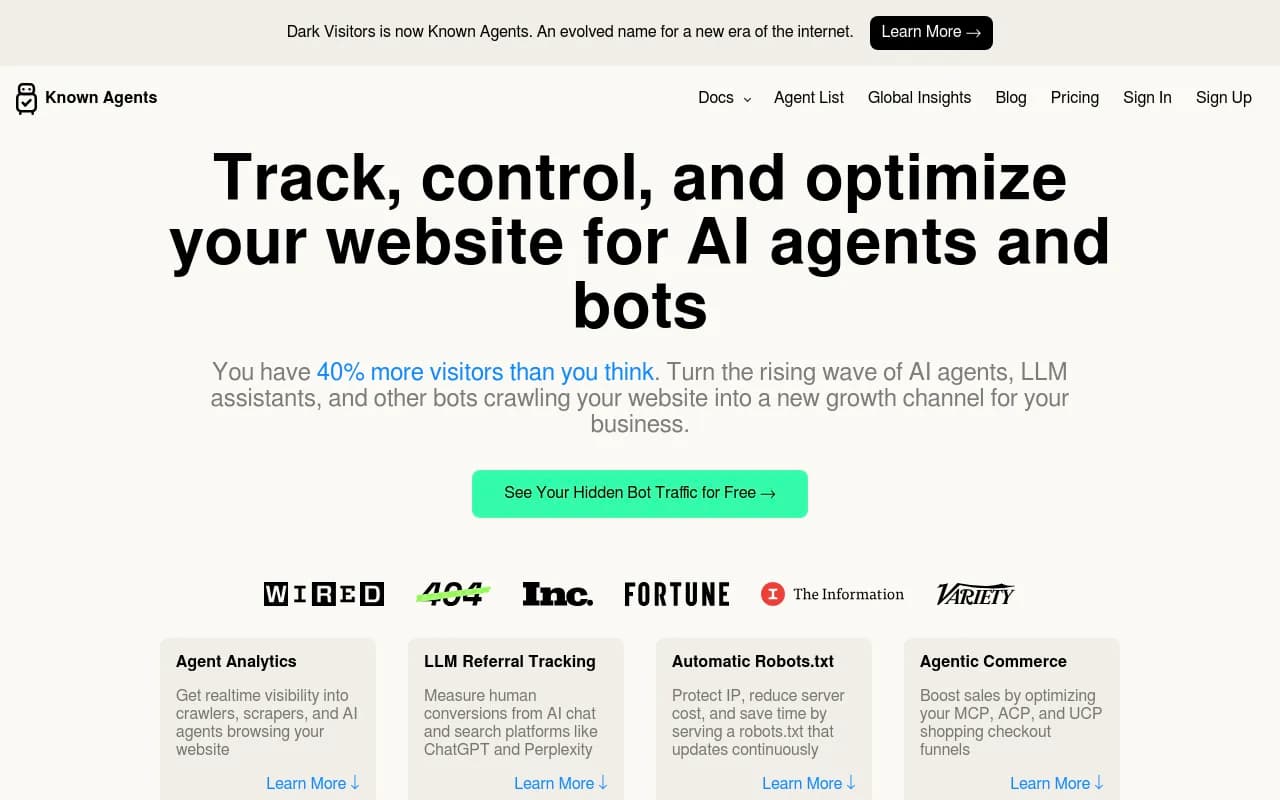
DarkVisitors for agent traffic
Recommendation tracking tells you what agents say. Traffic tools tell you who actually shows up. DarkVisitors tracks AI agents, bots and LLM referrals visiting your website, which is useful as a cross-check on whether agents are reading your MCP docs.
The adjacent category: observability for your own agents
If your goal is to understand how your own agent uses MCP servers, you want a different tool. An Augment Code roundup of 2026 agent observability platforms covers Braintrust, LangSmith, Arize Phoenix/AX, Helicone, Galileo, Maxim and Datadog LLM Observability. Some highlights from that roundup:
- Braintrust's MCP server was described as the most mature for IDE-native trace querying inside Cursor, Claude Code or VS Code.
- LangSmith starts at $0/month for 5K traces, then $39 per seat per month, and gives step-level cost attribution.
- Helicone logs per-request prompts, completions, latency and cost, and has the strongest cost tracking in that review, though it is reportedly in maintenance mode under Mintlify.
- Datadog LLM Observability had the strongest MCP client tracing, with correlated APM data.
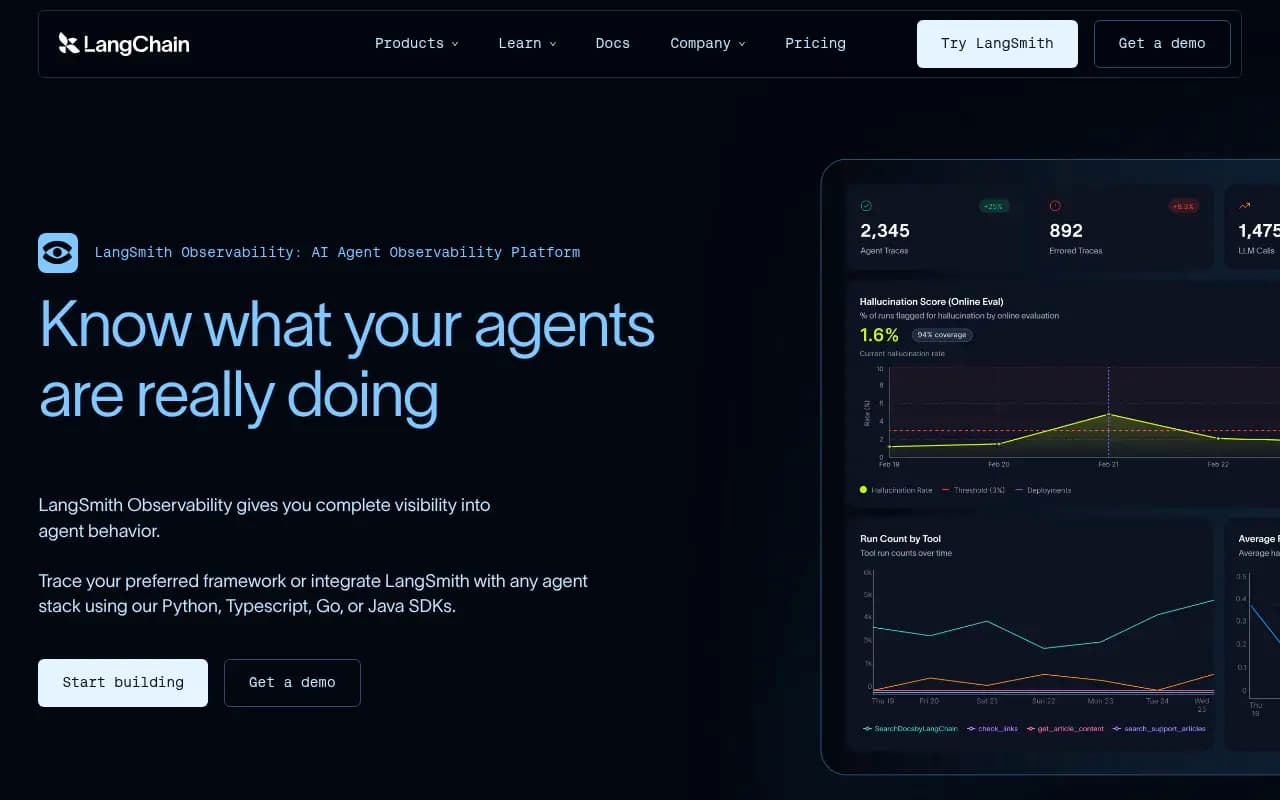

These are excellent at what they do. They trace calls your agents make. They cannot see a developer on another continent asking Codex which MCP server to use.
Why docs and GitHub are your main levers
Promptwatch Data's report on most cited sites in ChatGPT for software prompts covers Sep 28 to Oct 4, 2026. GitHub was the most cited software domain at 1.2% of software citations. learn.microsoft.com sat at 0.98% and G2 at 0.73%. By source type, docs and help centers earned the largest share at 2.64%, with vendor sites at 2.01% and GitHub at 1.2%.
Two caveats. This is ChatGPT data, not coding agent data. And the link to MCP servers is my inference: an MCP server's docs and GitHub repo are probably its main citable assets. The report's own takeaways point the same direction, though: publish crawlable docs and help pages, keep a public GitHub presence for developer tools, and keep review profiles current.
Since Codex searches the web in most sessions, according to Armature, a docs site that blocks crawlers or buries the install command is a real risk. Promptwatch's AI crawler traffic data shows weekly verified requests from OpenAI, Anthropic, Google, Perplexity and Mistral, which gives you a sense of who is reading.
A practical setup
- Write 20 to 30 prompts developers would actually type. Group them by task, such as payments, email, browser automation, database, docs lookup. Do not name your brand in most of them.
- Add prompts that name competitors, like "Firecrawl vs Exa for my agent," to see comparison framing.
- Run them across Claude Code, Codex, Cursor-style assistants and the chat models. Do this daily in a tracker, since answers shift.
- Record three separate things: mentioned, recommended, installed or configured. They diverge more than you expect.
- Check your crawler logs for the agents' user agents hitting your docs. If a crawler gets errors, fix that before touching content.
- Rewrite your docs quickstart so the exact MCP config snippet is near the top, in plain HTML, with the server URL and auth method stated.
- Review monthly, per agent. Armature found the three agents agreed only 42% of the time, so a blended score hides problems.
What to watch out for
Small samples lie. Agents are non-deterministic, so a single run tells you little. Aggregate over many runs and days.
Build-versus-buy is a real result. If agents write their own solution in a category, the fix may be making your server trivially easy to adopt, not winning a ranking.
API answers differ from real agent behavior. Prefer tools that monitor the actual agent interfaces over ones that only call model APIs.
Also be skeptical of any roundup ranking MCP servers by popularity. The AgentMail list, for example, is useful for picking servers (Context7, GitHub and Playwright come up repeatedly as first installs), but its author openly ranks its own product first. That is a human editorial list, not a measure of what agents choose.
Which one should you pick?
- You ship an MCP server or developer tool and want to know if agents pick you: Promptwatch, because it covers Claude Code, Codex and OpenCode with an MCP servers prompt category.
- You already pay for a general AI visibility monitor: ask your vendor whether coding agents are in scope before adding another tool.
- You run agents in production and want to debug their MCP calls: Braintrust, LangSmith, Helicone or Datadog, depending on your stack.
- You just want to know who is crawling your docs: DarkVisitors or the crawler logs in an AI visibility platform.
For general software tools beyond this category, surferstack.com is a good place to keep browsing. Start with a prompt list, run it for two weeks, and look at which agent skips you most often. That gap is your first job.