Key takeaways
- Local GEO tools split into two camps. Prompt trackers show what ChatGPT, Gemini, and AI Overviews say about each location. Listings and reviews platforms fix the data those answers are built from.
- Franchises usually need both, but the order matters. Start with measurement so you know which locations and prompts are broken, then spend on cleanup where the gaps are.
- Ask every vendor which prompt shapes sit behind its numbers. "Best X" prompts, "near me" prompts, and named-city prompts behave very differently.
- Location landing pages and FAQs are the content types most likely to earn citations. Social profiles matter mostly for Google AI Overviews, and barely at all for ChatGPT.
- Pricing in this category changes often. Treat every figure here as a starting point and confirm it on the vendor's own page.
Why franchises have a different problem than single-location shops
A single dentist or plumber has one Google Business Profile, one set of reviews, and one address to get right. A franchise with 80 locations has 80 of each, plus a brand site, plus franchisees who edit things without telling anyone.
That creates three problems a normal AI visibility tool does not solve on its own.
- Inconsistent data. One location lists the old phone number, another has the wrong hours, a third was never claimed on Apple Maps. AI assistants pull from these sources and repeat whatever they find.
- Uneven visibility. The flagship location in a big city may show up constantly while the suburban one never appears. A brand-level score hides that.
- Unclear ownership. When the report says "Location 47 is invisible," someone has to own the fix. Is it corporate, the franchisee, or the agency?
That is why the best local GEO setup for a franchise is rarely one tool. It is a measurement layer plus an execution layer, with a clear owner for each location.
The two categories explained
Prompt tracking: what AI actually says
Prompt trackers run a panel of questions against the AI engines on a schedule and record whether your brand appears, where, what sources get cited, and which competitors show up instead. For franchises, the useful versions let you separate results by location, market, and service line.
The prompt set matters more than most buyers realize. In a production panel of 13 home-services companies covering the 28 days ending September 2, 2026, Cheers found that "best or top" list prompts without a place name, excluding questions that name the company, produced a 28.4% pooled appearance rate. Cheers is a vendor in this space, so read it as one data point. But the more interesting detail is what they did not publish: no rate for "best near me" or named-place prompts, because too few companies track those shapes. That is the gap franchises most need filled, and it is worth asking any vendor how they handle it.
Listings and reviews management: fixing the inputs
Listings platforms push consistent name, address, phone, hours, and category data to directories and map platforms. Reputation tools collect and respond to reviews across locations. Neither tells you what ChatGPT says today, but both change what the models find when they go looking.
The Cheers checklist makes the same split: monitoring platforms show where a brand appears and which competitors win, but the next fix stays with you. Done-for-you services add the reviews, profiles, pages, and citations behind the answers.
What the citation data says about local content
If you are deciding where to invest, it helps to know what AI engines cite. Promptwatch Data's report on which content types ChatGPT cites most (Sep 28 to Oct 4, 2026) found product pages at 22.4% of classified citations and landing pages at 16.8%. That is about 39% of citations going to pages describing what a company sells. Listicles were 13.6%, documentation 7.5%, FAQ pages 3.3%, and reviews 1.7%.
For commercial prompts like "best X for...", product pages hit 26.0%, landing pages 20.6%, and listicles 15.0%. Branded prompts shifted the mix: reviews rose to 5.6%, more than three times their overall share, and FAQ pages reached 4.8%.
I would not stretch this too far, because the report is not franchise-specific. But the practical reading is reasonable: a well-built page per location, with a plain FAQ and reviews collected on trusted sites, fits the content types that get cited. Treat that as inference, not a finding.
Permanence matters too. Promptwatch's content half-life report shows landing pages and docs staying cited for months while news loses half its pages in about five weeks. Location pages are the durable kind of asset.
Where social profiles fit
Franchises love their Facebook and Instagram pages. The data says to be careful about expecting AI payoff. In Promptwatch's November 2026 social citation report (Oct 11 to Nov 9, 2026), social platforms made up 13.16% of Google AI Overviews citations, 1.94% of Perplexity's, and 0.64% of ChatGPT's. Within AI Overviews, YouTube alone was 6.71%, more than the other six platforms combined. Facebook was 2.34% and Instagram 1.02%.
So social work pays off mostly through Google's surfaces. For ChatGPT, don't count on it.
Comparison: prompt tracking vs listings management
| Prompt tracking | Listings and reviews management | |
|---|---|---|
| Core question | What do AI engines say about each location? | Is our location data accurate and consistent everywhere? |
| Output | Visibility, citations, competitors, sentiment | Synced listings, review inbox, local rankings |
| Strength | Shows real AI answers per market | Fixes the underlying data at scale |
| Weakness | Does not fix NAP errors or thin reviews | Does not tell you what AI says today |
| Typical buyer | Marketing and SEO leads, agencies | Franchise ops, local marketing managers |
| Pricing pattern | Per prompt or response volume | Per location |
| Start here if | You do not know where you are invisible | Your listings disagree or reviews are thin |
Prompt tracking tools worth considering
Promptwatch
Promptwatch is the option I would look at first when a franchise wants measurement and action in one place. It tracks ChatGPT, Gemini, Perplexity, Google AI Overviews, AI Mode, Copilot, and others through their real interfaces, and a monitor's country, language, and location are fixed when it is created, so markets never blur together. On Business and above, local GEO/SEO targeting pins a monitor to exact coordinates (accuracy radius 20 m to 5 km), so ChatGPT, AI Overviews, and AI Mode answer as if asked from that spot. State and city tracking is also on Business and up, and agency plans include country, state, and city tracking.

What separates it from a pure dashboard is the work after the report. Content gap analysis shows which prompts you have no page for, the Content Agent can write and publish to WordPress, Webflow, or Framer, and IP-verified crawler logs show whether AI bots can even read your location pages. Pricing runs from Essential at $95/mo to Business at $579/mo (350 prompts, 5 projects, the Content Agent, and local targeting); agencies managing franchise clients can look at Kick-off ($199), Growth ($399), or Scale ($799, which adds local targeting). Confirm current numbers at promptwatch.com/pricing. There is a 7-day free trial on monthly billing, and a free AI visibility report if you want a quick read first.
One limit to be honest about: Promptwatch does not manage your Google Business Profiles or sync listings. Pair it with a listings tool.
Profound
Profound runs large prompt panels and trends share of voice against competitors. It is strong on monitoring, and generally aimed at larger budgets.

Peec AI and Otterly.AI
Both are cleaner, cheaper monitoring options. A source in the research describes Peec as monitoring only, with prompt quotas that scale with price. Otterly was listed from $29/month in one third-party roundup, though I haven't confirmed that. Either can work for a small franchise group that just wants a baseline, but neither will touch your listings.


Semrush and Ahrefs Brand Radar
If your team already lives in these suites, the AI add-ons are convenient. The trade-off is that prompt sets tend to be more fixed and the AI-specific data shallower than in dedicated platforms.

Listings and reputation tools worth considering
BrightLocal
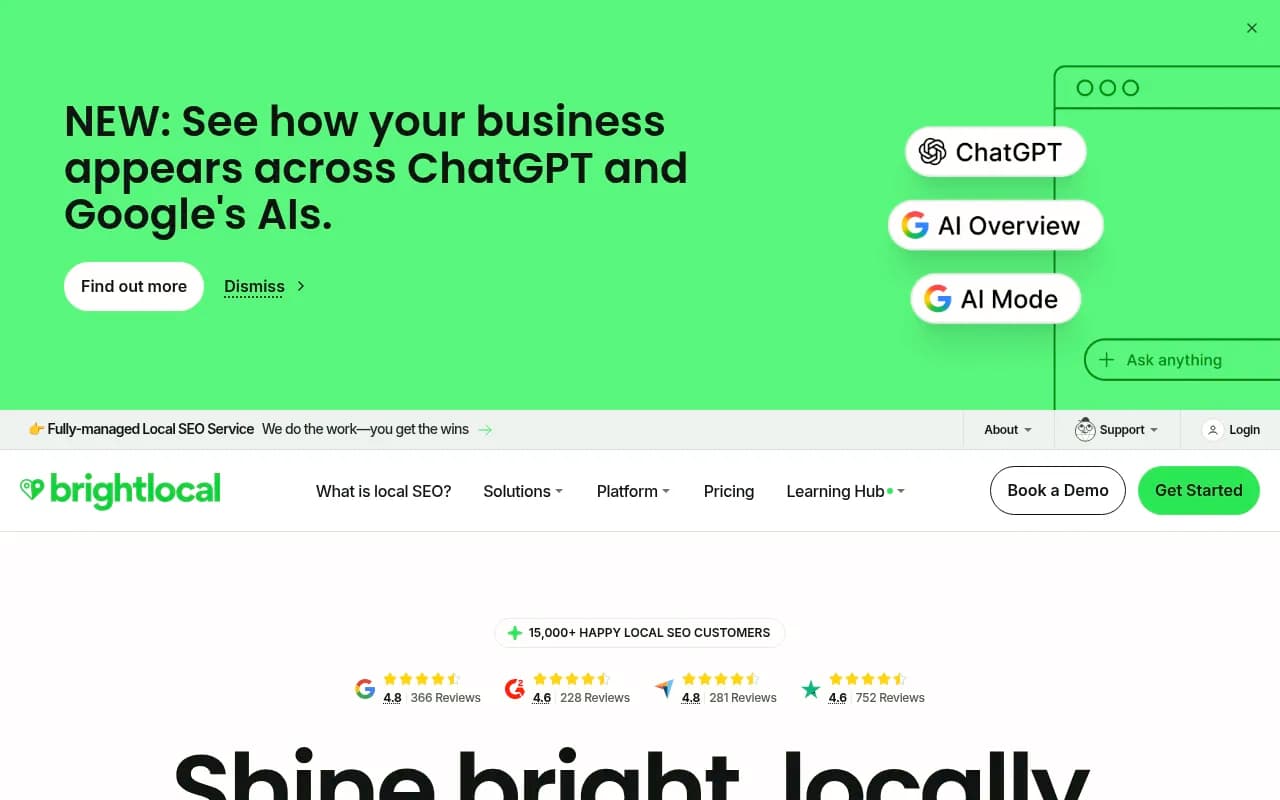
BrightLocal combines local rank tracking, citations, reviews, and some tracking of ChatGPT and Google's AI answers. According to a Speaklocal roundup, Track starts at $41 a month for one location billed monthly, or $31 billed annually. The Manage plan adds listing sync, Grow adds review management, and the Citation Builder is pay-as-you-go from $2 per citation. Pricing rises with locations, which matters at franchise scale. I have not verified these numbers on BrightLocal's own site, so check before you budget.
Yext
Yext is the heavyweight for multi-location listing management and is positioned as a digital presence platform for search and AI answers. Expect enterprise-style, quote-based buying. It suits franchisors who want centralized control over location data.
Reputation.com, Birdeye, and SOCi
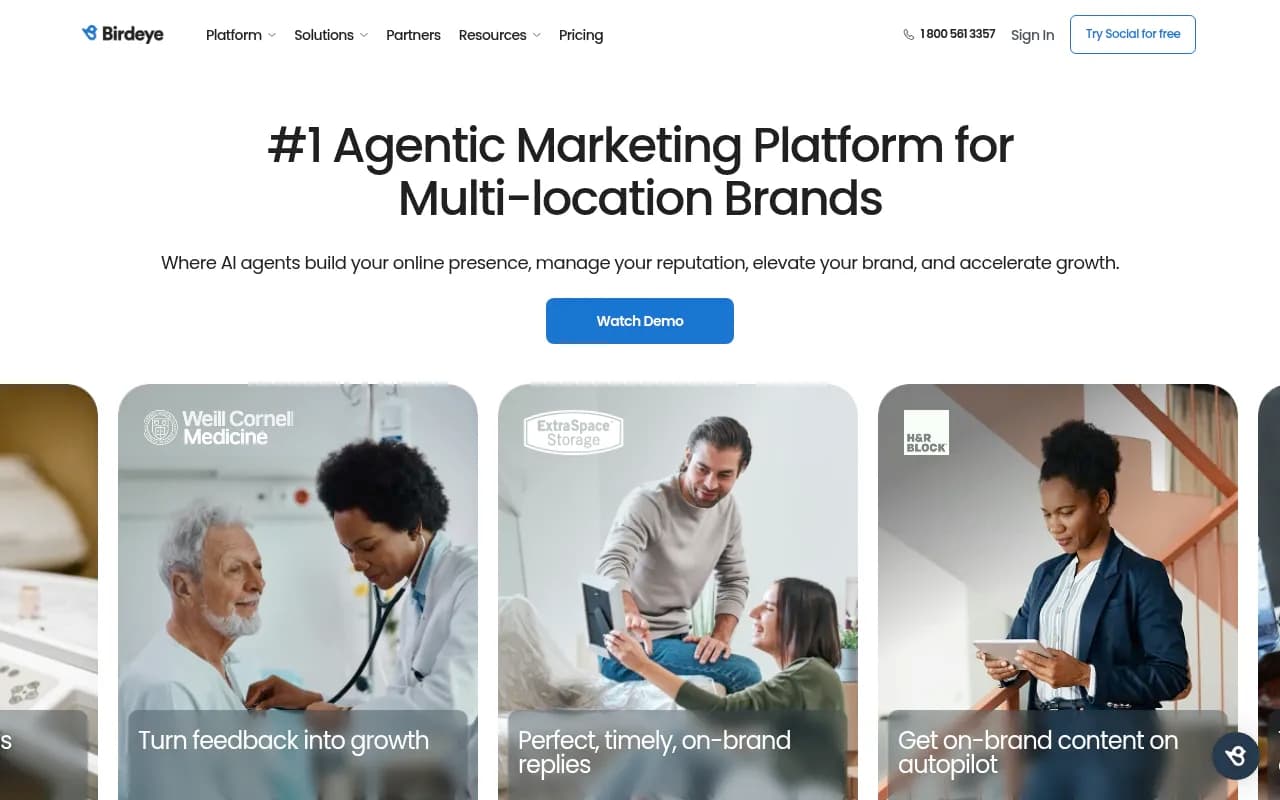
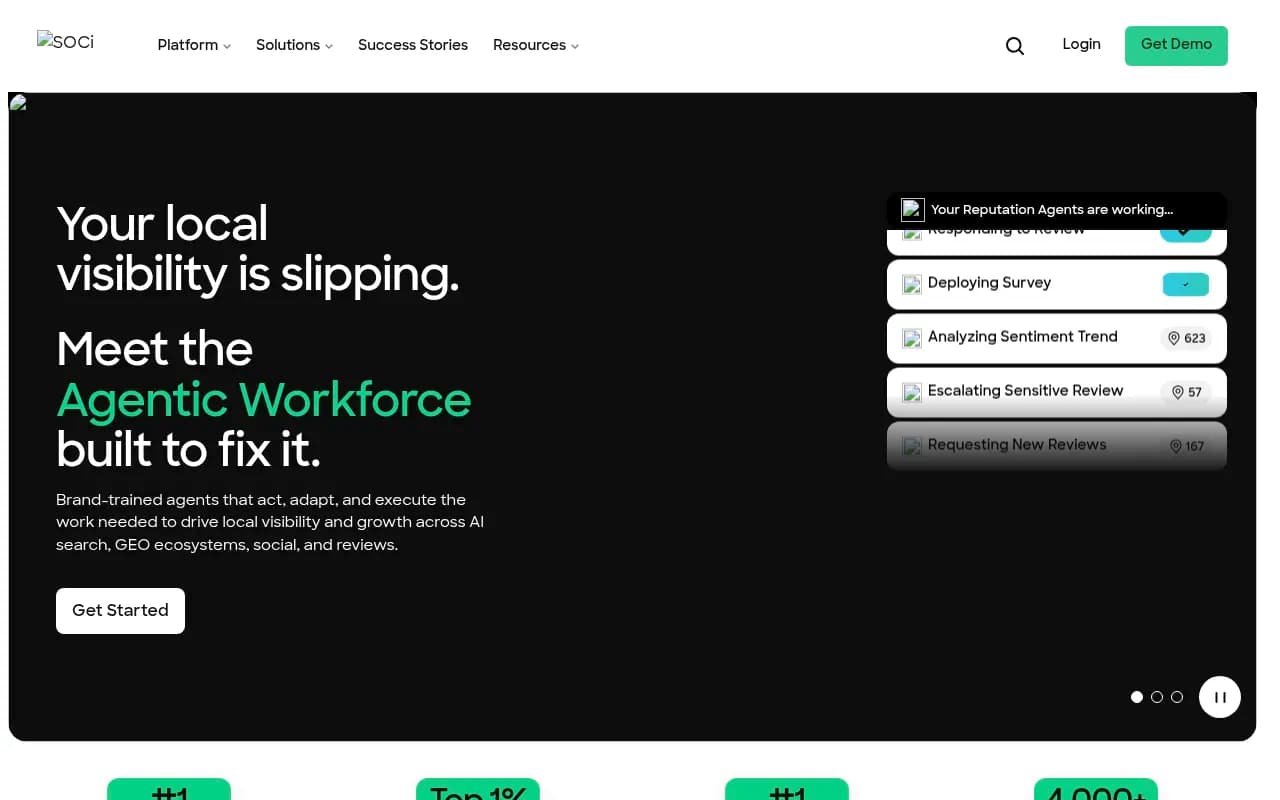
These three bundle reviews, messaging, and local presence, with SOCi aimed squarely at local search, social, and reviews for multi-location brands. They fit when review volume and response speed are your weakest link.
Review-focused add-ons
If the main issue is thin reviews, tools like [tool:gatherup] and [tool:reviewtrackers] concentrate on collecting and analyzing reviews across locations, and [tool:nicejob] targets smaller local operators.
Quick comparison of the shortlist
| Tool | Built around | Location handling | Fixes data? | Best for |
|---|---|---|---|---|
| Promptwatch | AI visibility and GEO execution | Country, state/city, exact-coordinate targeting (Business and up) | Content, not listings | Franchises and agencies wanting tracking plus content action |
| Profound | Prompt panels, share of voice | Enterprise setups | No | Large brands with budget |
| Peec AI / Otterly.AI | Monitoring | Basic | No | Small groups needing a baseline |
| BrightLocal | Listings, reviews, local rank | Per-location pricing | Yes | Cleanup of citations and reviews |
| Yext | Multi-location listings | Centralized control | Yes | Franchisors with strict brand data |
| SOCi / Birdeye / Reputation.com | Reviews and local presence | Multi-location | Partly | Review-heavy operations |
How to choose and sequence your stack
Step 1: Measure before you buy cleanup
Run a free scan or trial first. Build prompts in three shapes: generic category prompts ("best pizza chain"), "near me" prompts, and named-city prompts. Tag each by location and service line. Without that, you will average a great flagship with a dead suburban store and learn nothing.
Step 2: Find out whether it is a data problem or a content problem
If AI names competitors and cites directories where your listings are wrong, you have a data problem and need a listings tool. If AI cites your site but never your location pages, or never visits them, you have a content or crawlability problem. Crawler logs help separate the two.
Step 3: Assign an owner per location
The Cheers criteria say it well: the tool should make the next owner obvious. Decide upfront what corporate handles (brand pages, schema, listings sync) and what franchisees handle (review requests, local photos, responding to reviews).
Step 4: Build location pages that deserve citation
Give every location a real landing page with services, hours, staff, a short FAQ, and local specifics. Keep them current. Based on the content-type data, these are the pages with the best shot, though this is my reading rather than a franchise study.
Step 5: Re-measure monthly
AI answers shift. ChatGPT's social citations, for example, moved noticeably between October and November. Re-run the panel, compare by location, and feed the weakest ones back into Step 2.
Questions to ask any vendor
- Which prompt shapes sit behind your visibility number?
- Can I split results by location, and by exact place or only by city?
- Do you preserve the cited sources for each answer?
- What does a location cost, and how does pricing scale at 50 or 200 sites?
- Who gets the task when something is broken?
- Are your benchmark claims vendor data? Be wary of splashy citation stats. One vendor claims 71.5% of citations come from blog and editorial content, while Promptwatch's measured figure for editorial content is 43%. Different methods, very different conclusions.
When to hire help
A 150-location franchise with inconsistent data and no in-house local team may be better off with a managed approach than another dashboard. An agency such as 1001 SEO Media, which works across local SEO and AI search, can run the audit, set up tracking, and coordinate fixes. It is an option, not a requirement, and many teams run the stack themselves once ownership is clear.
Where to look next
If you want to compare more options, the GEO software directory at bestgeosoftware.com lists many of these platforms side by side.
Bottom line
For most franchises, start with a prompt tracker that separates locations, then add a listings or review tool where the data shows real damage. Promptwatch is a strong first pick if you want tracking and content execution together; BrightLocal or Yext cover the listings side. Whatever you choose, test it against "near me" and named-city prompts, because that is where franchise visibility is won or lost.