Key takeaways
- The core decision isn't "which tool has the most features," it's whether the platform expects your team to do the fixing or does the fixing itself. In-house teams with writers can use analytics-first tools like Profound; teams without dedicated content ops lean toward execution platforms like Writesonic or Promptwatch.
- Profound's self-serve pricing disappeared in September 2026. If you're comparing based on an older roundup quoting $99-$399/mo plans, that pricing no longer exists for brands.
- Promptwatch's own data shows mid-authority domains (DR 46-75) now pull in nearly half of all ChatGPT citations, which matters a lot for how you brief your writers.
- A small in-house team (1-2 writers, maybe a contractor SEO) should optimize for low workflow friction, not feature depth. The tool that reduces brief time and publishes without a new ritual beats the one with the prettiest dashboard.
- Monitoring-only tools (Otterly, Peec, Searchable, HubSpot AEO) are fine if your team already knows how to turn a citation gap into a brief. If they don't, you need a platform that closes the loop.
Why "pairing with an in-house team" changes the shortlist
Most GEO buying guides rank tools by feature count. That's the wrong lens if you already employ people who write. The real question is where the tool's job ends and your team's job begins.
Some platforms, Profound being the clearest example, are built as research and measurement layers. They tell you what's happening in AI answers with real depth, Conversation Explorer-style prompt volume estimates, shopping analysis, a node-based drafting workflow, and leave the actual content production, outreach, and prioritization to you. That's a great fit if you have a content team that can translate a chart into a brief without hand-holding.
Other platforms, Writesonic and Promptwatch among them, try to close the loop themselves: detect the gap, generate or refresh the page, chase third-party citations, and track whether the fix actually moved the needle. If your in-house team is thin, one or two writers wearing multiple hats, that execution layer is worth more than another analytics tab.
I'd put it this way: an in-house content team is leverage, but only if the tool gives them something actionable to do. A tool that reports "your citation share dropped 4%" and stops there is not pairing with your team, it's generating homework for them.
What actually moves citations (so you know what to brief your team on)
Before picking a tool, it helps to know what the data says drives citations, because that's what your writers need to act on, not just what the dashboard flags.
Promptwatch's citation-types data for ChatGPT in August 2026 shows product pages still lead at roughly 28.7% of citations, but how-to content more than doubled over the month, from 4.3% to 9.1%, landing it level with listicles. Documentation jumped from 3.3% to 8.2%. Meanwhile social posts collapsed from 4.4% to under 1% after August 14, the same day Reddit's share of ChatGPT citations cratered from about 4% to 0.5%. If your content calendar still leans on "get mentioned on Reddit," that bet got a lot weaker, fast.
Domain authority matters less than people assume. Promptwatch's citation share by domain rank data shows DR 46-60 and DR 61-75 sites together earning almost half of all ChatGPT citations in August, while top-tier DR 91-100 domains shrank from roughly 7% to 3% share. A separate AirOps fan-out study found something similar from a different angle: pages that always get cited average DA 53, pages that never get cited average DA 56, basically no correlation. What did correlate: retrieval rank (position 1 gets cited 58% of the time, position 10 only 14%), heading match (41% vs 29%), and the presence of JSON-LD schema (+6.5 percentage points).
That's useful because it tells your writers exactly what to fix: answer the question in plain HTML within the first 500 words, under a heading that reads like the actual query, and keep the schema tidy. None of that requires an enterprise AI platform to know. It just requires someone to brief it correctly, which is the whole point of pairing a tool with people who write.
The shortlist, by how much execution they hand off
Analytics-first platforms (you do the writing and prioritizing)
Profound Profound is the deepest research layer on the market. Conversation Explorer estimates prompt-level AI search volume from a clickstream panel, Shopping Analysis tracks product recommendation surfaces, and an Agents workflow builder helps draft content, but there's no third-party citation outreach, no author contact data, and no impact tracking once a change ships. The catch for 2026: Profound removed its self-serve Starter ($99/mo) and Growth ($399/mo) brand plans around its September Series D. Brands now get a 7-day free trial (50 prompts/day, no history or exports) or a custom Enterprise quote, which one competitor estimates lands between $2,000 and $5,000+/mo. If you saw Profound pricing in an older article, it's stale.

Otterly.AI A straightforward monitoring tool with tiers from $29/mo (Lite) to $489/mo (Premium), plus a custom Enterprise plan. It covers ChatGPT, AI Overviews, Perplexity, and Copilot natively, with AI Mode, Gemini, and Claude as paid add-ons. There's an Agency Partner program once you're on Standard or above. Fine for tracking, but it won't write anything for you.

Peec AI Repriced in August 2026 and now reported inconsistently across comparison sites, verify current numbers on peec.ai/pricing before you commit. What's consistent: it's monitoring-only, with no content or schema optimization built in.

Semrush, Ahrefs Brand Radar, HubSpot AEO All three bolt AI visibility tracking onto an existing SEO suite. Semrush AI Visibility Toolkit starts around $139.95/mo on top of a Pro plan and adds a "Prompt Volume" feature plus model volatility tracking. Ahrefs Brand Radar adds entity association and unlinked mention tracking inside Ahrefs' existing tiers (from $129/mo). HubSpot AEO is cheap at $50/mo but track-only. Good if you already live in one of these suites and don't want another login; weak if AI visibility is your primary job.
Execution-first platforms (the tool does more of the fixing)
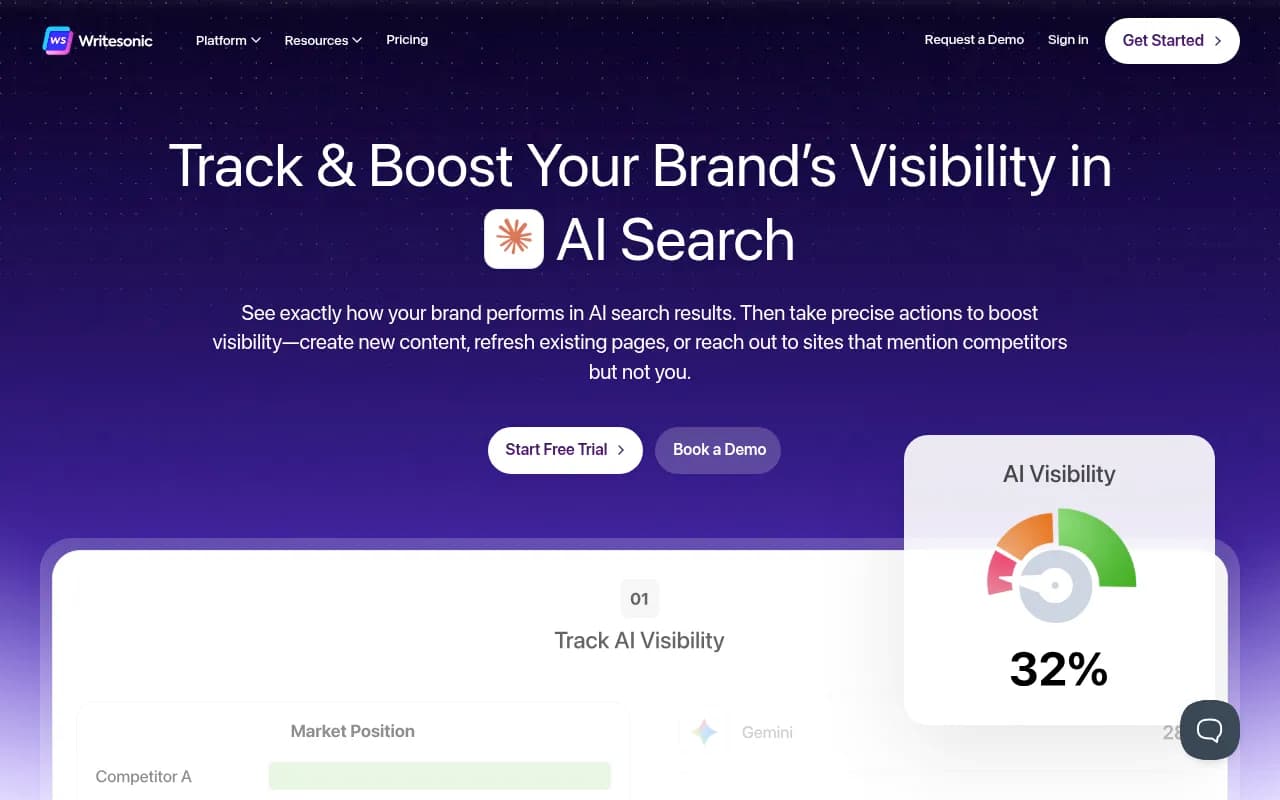
Writesonic Built around a six-criterion rubric (closed-loop execution, platform coverage, SEO+GEO depth, data freshness, customer evidence, pricing range) that Writesonic itself ran against 10 competitors, so take the framing with a grain of salt, but the underlying claim checks out: it's one of the only tools that does gap detection, third-party author outreach with contact details, and post-publish impact tracking ('share of answer') in one surface, called the Action Center. Entry price is $79/mo with a 7-day trial (card required). SOC 2 Type II, HIPAA, GDPR certified, which matters if you're in a regulated industry.
Promptwatch Promptwatch sits closer to the execution end too, but goes further on the crawler and citation-data side than most of the tools above. It runs AI crawler log analysis (which bots hit your pages, what they read, whether they errored), content gap analysis with briefs, and Content Agents that draft and publish straight to Webflow, Framer, or WordPress on a schedule, plus Unified Actions, a prioritized to-do list generated from your own visibility and crawler data. It tracks the full set of engines, ChatGPT, Claude, Gemini, Perplexity, Grok, Copilot, DeepSeek, Mistral, Meta Llama, Google AI Overviews and AI Mode, and adds Reddit and YouTube citation tracking that most monitoring-only tools skip entirely. Pricing starts at a free Explore tier and $95/mo for Essential, with Professional at $245/mo adding automated content generation and shopping insights. For a small in-house team, the useful bit is that it doesn't just flag the gap, it hands your writer a brief with brand instructions, internal linking suggestions, and competitor context already attached.

Scrunch AI Scrunch pivoted in mid-2026 toward an "Agent Experience Platform": instead of helping you write content, it detects AI agent traffic at the edge and serves a stripped-down, token-light version of your existing pages to bots like ChatGPT-User while humans get the normal site. Pricing runs from roughly $83/mo (Starter) up to $417/mo (Growth) depending on the source, Enterprise is custom. By Scrunch's own FAQ, this layer doesn't answer agent queries, converse with buyers, or sync to a CRM, it's a serving transform, not a content tool. Worth knowing if your bottleneck is technical delivery rather than writing.
Comparison table
| Tool | Entry price (2026) | Closes the loop? | Best fit for in-house teams |
|---|---|---|---|
| Profound | Trial only / custom Enterprise (self-serve plans removed Sept 2026) | No (analytics + light drafting) | Teams with strong content ops who just need deep research |
| Writesonic | $79/mo | Yes (gap detection, outreach, impact tracking) | Lean teams that need the tool to do the chasing |
| Promptwatch | Free tier, $95/mo Essential | Yes (crawler logs, content agents, CMS publishing) | Teams wanting prompt data, crawler visibility, and automated briefs in one place |
| Otterly.AI | $29/mo | No (monitoring only) | Small teams already confident in their own workflow |
| Peec AI | Varies, verify directly | No (monitoring only) | Teams in regulated or multi-language markets wanting a simple tracker |
| Scrunch AI (AXP) | ~$83/mo | No (technical serving layer, not content) | Teams whose bottleneck is bot-facing page delivery, not writing |
| Semrush AI Visibility Toolkit | ~$139.95/mo + base plan | No | Teams already on Semrush who want one extra tab |
How to actually choose
Start with a blunt audit of your team. If you have someone whose job is to turn a citation gap into a brief, an edit, and a published page within a week, lean toward the analytics-heavy tools, Profound if you can clear the enterprise budget, or a cheaper monitoring tool like Otterly paired with your existing content process. If that translation step is the part that keeps stalling, pay for a platform that does it for you. Writesonic and Promptwatch both aim at that gap, with different strengths: Writesonic leans harder into third-party author outreach, Promptwatch leans harder into crawler-level visibility, prompt volume and difficulty scoring, and native CMS publishing.
Two more things worth checking before you sign anything. First, confirm the pricing you're looking at is current, GEO tool pricing moved fast in 2026 (Profound's repricing and Peec's August restructure are proof), so a comparison article from even three months ago can be wrong. Second, ask whether the tool treats "all citations" as one bucket or separates signal from noise. One widely cited study split AI citation data into three groups: about 25% SEO-gated, 17% repeatable and genuinely optimizable through page-level GEO work, and 58% fuzzy-retrieval noise that no tool can reliably influence. A platform that reports on the full 100% without flagging which slice is addressable will have your team chasing numbers that were never going to move.
If you want to browse beyond this shortlist, the GEO software directory at bestgeosoftware.com covers a wider set of platforms by category, and agenticseotools.com is worth a look if you're specifically after tools that automate execution rather than just reporting on it.