Key takeaways
- Logistics buyers now ask ChatGPT, Gemini and Perplexity who to ship with, which 3PL fits a lane, and which TMS to shortlist. A GEO tool shows whether your company is in those answers.
- Pick tools that track by prompt type (organic, branded, competitor comparison) and show which third-party domains share the answer with you. Dashboards that only report a score leave you guessing.
- In Promptwatch Data for Sep 28 to Oct 4, 2026, product pages (22.4%) and landing pages (16.8%) earned 39% of ChatGPT citations. Your service, lane and capability pages matter most.
- Monitoring-only tools suit small teams on a budget. Platforms that also write content, read crawler logs and measure AI traffic suit teams that want to change the outcome, not just watch it.
- No GEO report covers logistics specifically. Treat any vendor claiming logistics-specific benchmarks with some suspicion and test with your own prompts.
Why logistics companies need GEO at all
A shipper evaluating a new freight partner used to type a query into Google and open six tabs. Now plenty of them ask an AI assistant: "best 3PL for cold chain in the Midwest" or "freight visibility platforms that integrate with SAP." The assistant answers with a short list of names and a handful of cited sources. If you are not on the list, you were not considered. You will never see that lost deal in your analytics.
Logistics is an awkward category for this. Buying cycles are long, the buyer is often a committee, and the shortlist gets formed early. AI answers shape that first shortlist. Supply chain software vendors have the same problem: the research data for this guide includes several buyer guides (Deposco, Mindcore, Rework) that rank AI supply chain platforms, and those listicles are exactly the kind of third-party page AI engines pull from.
This guide is about GEO tools, meaning software that measures and improves how AI engines mention and cite your company. It is not about AI tools you use to run logistics operations, like route optimization or freight visibility networks. Those are a different shopping list, though the same listicle ecosystem feeds both.
What the citation data says about logistics-style queries
No Promptwatch report covers logistics specifically, so I will not pretend otherwise. Two reports apply to any B2B category, and they shape what you should demand from a tool.
First, Promptwatch's data on ChatGPT citation share by content type (Sep 28 to Oct 4, 2026) found product pages were the most cited type at 22.4% of classified citations, with landing pages next at 16.8%. For commercial prompts, where someone is comparing options before buying, product pages hit 26.0% and landing pages 20.6%. Listicles added 15.0% and comparisons 7.9%. Those four types make up almost 70% of commercial citations.
Translate that to logistics: your lane pages, service pages, capability pages and integration pages are the main citation surface. So are the "best freight brokers" and "top 3PLs" roundups written by other people.
Second, Promptwatch's data on unique domains per ChatGPT response found 47.6% of responses with citations cite 10 or more domains. For organic prompts where no brand is named, 52.5% cite 10 or more. You will share every answer with a crowd of other sources. Winning means appearing across several of them, not owning one.
One more point: the content half-life data shows news losing half its cited pages in about five weeks, while landing pages and docs hold on for months. A press release about a new terminal is a weak GEO asset. A well-built service page is a durable one.
What a GEO tool should do for a logistics company
Before comparing products, write down what you need. Based on the data above, here is my short list. These are my inferences, not vendor claims.
- Track prompts by type: organic ("best cross-border LTL carriers"), branded ("is [your company] reliable"), and competitor comparison.
- Show citation sources, so you can see which listicles, review sites and forums appear next to you.
- Cover multiple engines: ChatGPT, Gemini, Perplexity, Google AI Overviews and AI Mode at minimum.
- Support multiple regions and languages. A forwarder serving Rotterdam and Singapore gets different answers in each.
- Tell you what to fix. A score with no next step is a report, not a tool.
- Show whether AI crawlers can reach your service pages. Many logistics sites are heavy on JavaScript quote widgets and gated rate calculators that bots never see.
- Connect AI visibility to traffic and leads, because a freight sales team will ask about pipeline, not Visibility Score.
Best GEO tools for logistics and supply chain companies
Promptwatch
Promptwatch is the option I would start with for teams that want to act on the data, not just collect it. It tracks ChatGPT, Gemini, Perplexity, Google AI Overviews, Google AI Mode, Copilot and others from the real interfaces, by country and language. Then it goes further than most trackers: IP-verified AI crawler logs show whether bots read your lane and service pages, citation tracking shows which third-party pages AI leans on, and a Content Agent writes and publishes pages to WordPress, Webflow or Framer to fill the gaps.

For logistics specifically, a few features stand out. Prompt tracking by type separates "best 3PL for apparel" from "[Your Brand] vs [Competitor]". Offsite Mentions find third-party pages that name you without linking, which is common in industry roundups. Brand Narrative pulls out the claims AI makes about you ("slow onboarding", "strong in reefer") and Fact Check on Business plans flags pages teaching the wrong thing. Local GEO targeting on Business plans lets multi-terminal or multi-branch operators test "near me" style queries from exact coordinates. Visitor analytics measure AI-referred traffic and conversions.
Pricing, to confirm at promptwatch.com/pricing: Essential is $95/mo, Professional $245/mo, Business $579/mo. Agency plans run $199, $399 and $799/mo. The Content Agent starts at Business. There is a 7-day free trial and a free AI visibility report if you want a first look without committing. Agencies serving logistics clients should look at the agency solutions page.
Profound
Profound is a well-known enterprise monitoring platform. It suits large carriers or software vendors with big budgets and a dedicated analyst. Compared with Promptwatch it is monitoring-heavy, with higher price points and no Reddit tracking or agentic execution. See Promptwatch vs Profound for the detail.

Peec AI
Peec AI is a clean, multi-language prompt tracker. If you run a regional logistics brand across several European markets and just need to know where you stand, it does that job. It does not read crawler logs or write content.

Otterly.AI
Otterly.AI is an affordable monitor. It fits a small freight broker that wants a weekly look at mentions and does not have the team to act on deep data yet.

AthenaHQ
AthenaHQ tracks several AI engines and aims at brand teams. It is monitoring-focused, so expect to handle content and technical fixes elsewhere.
Semrush and Ahrefs Brand Radar
If your team already lives in Semrush or Ahrefs, their AI visibility add-ons are the lowest-friction start. The trade-off is shallower AI-specific data and, per our comparison notes, fixed prompt sets and no crawler logs or AI traffic attribution.

Scrunch
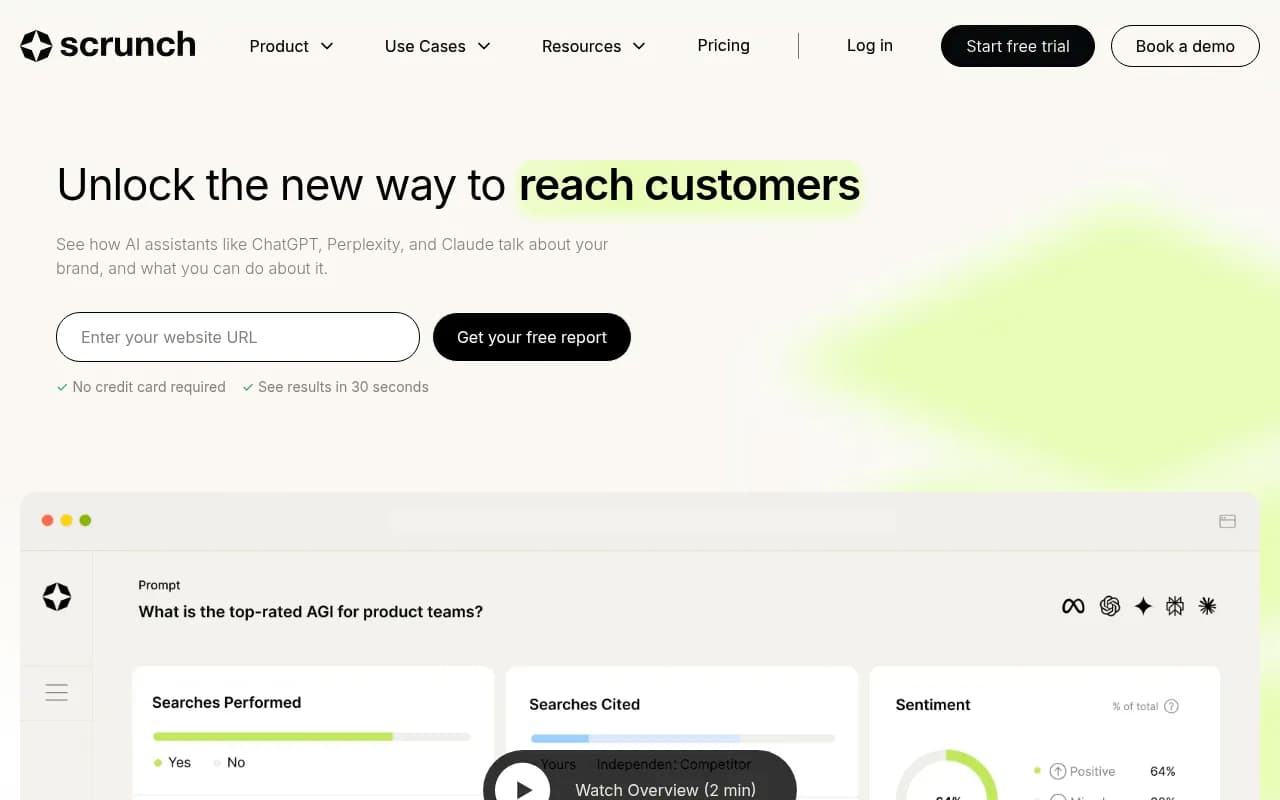
Scrunch is an AI visibility platform with a strong monitoring feature set. It sits in the same bracket as Profound on cost and scope.
Technical SEO and crawl tools
GEO tools do not replace crawlers. If your rate pages and lane pages are hidden behind scripts, tools like Screaming Frog or Botify show what a bot sees. Pair them with AI crawler logs to separate an access problem from a content problem.
Comparison table
| Tool | Tracks real AI interfaces | Fixes content gaps | AI crawler logs | Best for |
|---|---|---|---|---|
| Promptwatch | Yes | Content Agent, Action Board, CMS publishing | Yes, IP-verified | Teams that want to act and measure |
| Profound | Yes | Limited | Not a focus | Large enterprises with analysts |
| Peec AI | Yes | No | No | Multi-market monitoring |
| Otterly.AI | Yes | No | No | Small brokers on a budget |
| AthenaHQ | Yes | Limited | No | Brand teams wanting monitoring |
| Semrush / Ahrefs | Add-on tracking | No | No | Existing suite users |
For more options, the directory at bestgeosoftware.com lists GEO software in one place.
What about GEO agencies?
The research for this guide turned up a Web Tonic roundup of GEO agencies for logistics. Orvio, a Prague-based AI visibility company, lists a Growth plan at USD $800 per month. That is an agency retainer price, not a software price, so do not compare it directly to a $95 tool. Agencies make sense when your marketing team is two people and one of them also runs trade shows.
If you want a partner that combines technical SEO, content and GEO, 1001 SEO Media is a full-service SEO agency that works on AI search visibility and uses Promptwatch as its GEO platform. Whichever route you take, ask the agency which tool they use and whether you get access to the data.
How to set up GEO tracking for a logistics brand
Build a prompt set around buyer questions
Start with 30 to 50 prompts across three groups. Organic: "best freight forwarders for electronics from Shenzhen". Branded: "[Your company] reviews". Competitor: "[You] vs [Competitor] for FTL." Add personas, because a logistics manager, a procurement lead and a CFO ask very different questions.
Audit the pages AI should cite
Promptwatch's data points to product and landing pages as the main citation surface. For logistics, that means each service, lane, industry vertical and integration needs its own factual page: equipment types, coverage, certifications, transit times, systems you integrate with. Vague "solutions" pages get skipped.
Get into the roundups
Listicles earn 13.6% of ChatGPT citations overall and 15.0% for commercial prompts. Find the "best 3PLs" and "top freight visibility platforms" pages your tracker shows AI citing, then pitch for inclusion or publish a comparison of your own.
Check crawler access
Open your crawler logs. If GPTBot or PerplexityBot are hitting errors on your quote tools or getting blocked by a CDN rule, no amount of content work will help. The free Agentic Readiness Check is a quick first test.
Measure what matters to sales
Track AI-referred visits and quote requests, not only mentions. Promptwatch's guide to attributing AI traffic explains the setup, including the ChatGPT referrer change in October 2026.
Mistakes I see logistics teams make
- Tracking only their brand name. Most shipper discovery happens on organic prompts where no brand is named.
- Treating one prompt run as truth. Answers vary, so measure across many prompts.
- Publishing news posts and expecting lasting citations. News decays fast.
- Hiding rates and capabilities behind forms. AI cannot cite what it cannot read.
- Buying on demo polish. The Mindcore piece makes a similar point about logistics AI software: measure against your own data before signing. The same logic holds here, so run your own prompts during the trial.
Which tool should you pick?
- Small broker or regional carrier, tight budget: start with the free AI visibility report, then Otterly.AI or Promptwatch Essential.
- Mid-market 3PL or software vendor with a content team: Promptwatch Professional or Business, so tracking connects to content and crawler data.
- Enterprise with a dedicated analyst: compare Promptwatch and Profound on your own prompts, since both have the depth.
- Agency serving logistics clients: Promptwatch agency plans, or Peec AI if you only need reporting.
Run the same 30 prompts through two tools for a week. The one that tells you what to do on Monday morning is the one to keep.