Key takeaways
- A 2026 study analyzing 43,000+ ChatGPT carousel products found that over 83% match organic results from Google's top 40 shopping positions -- meaning Google Shopping optimization is still the most direct path into ChatGPT carousels.
- Most GEO tools track brand mentions in AI chat responses but very few specifically monitor product carousel appearances or ChatGPT Shopping results.
- For e-commerce brands, the gap between "AI visibility" and "AI shopping visibility" matters enormously -- a tool that tracks whether your brand name appears in a ChatGPT answer is not the same as one that tracks whether your products appear in a shopping carousel.
- The platforms best suited to e-commerce GEO combine product feed health, structured data monitoring, and AI citation tracking in one workflow.
- Content gaps -- the specific product questions AI models answer without citing your site -- are where most e-commerce brands lose ground silently.
Why e-commerce GEO is different from regular GEO
Most GEO content focuses on brand mentions: does ChatGPT say your company name when someone asks about your category? That matters. But for e-commerce, there's a second, more commercially direct question: does your product appear when someone asks an AI to recommend something to buy?
These are different problems. Brand mention tracking tells you about awareness. Product carousel tracking tells you about purchase intent. If you're selling running shoes and ChatGPT shows a carousel of "best trail running shoes under $150," whether your product appears there is worth real money. Whether your brand name appears in a paragraph about running shoe brands is worth much less.
The research makes this concrete. A study published by Search Engine Land in early 2026, using data from Peec AI, analyzed more than 43,000 ChatGPT carousel products across 10 product verticals. The finding: over 83% of ChatGPT's carousel products match organic results from Google's top 40 shopping positions.
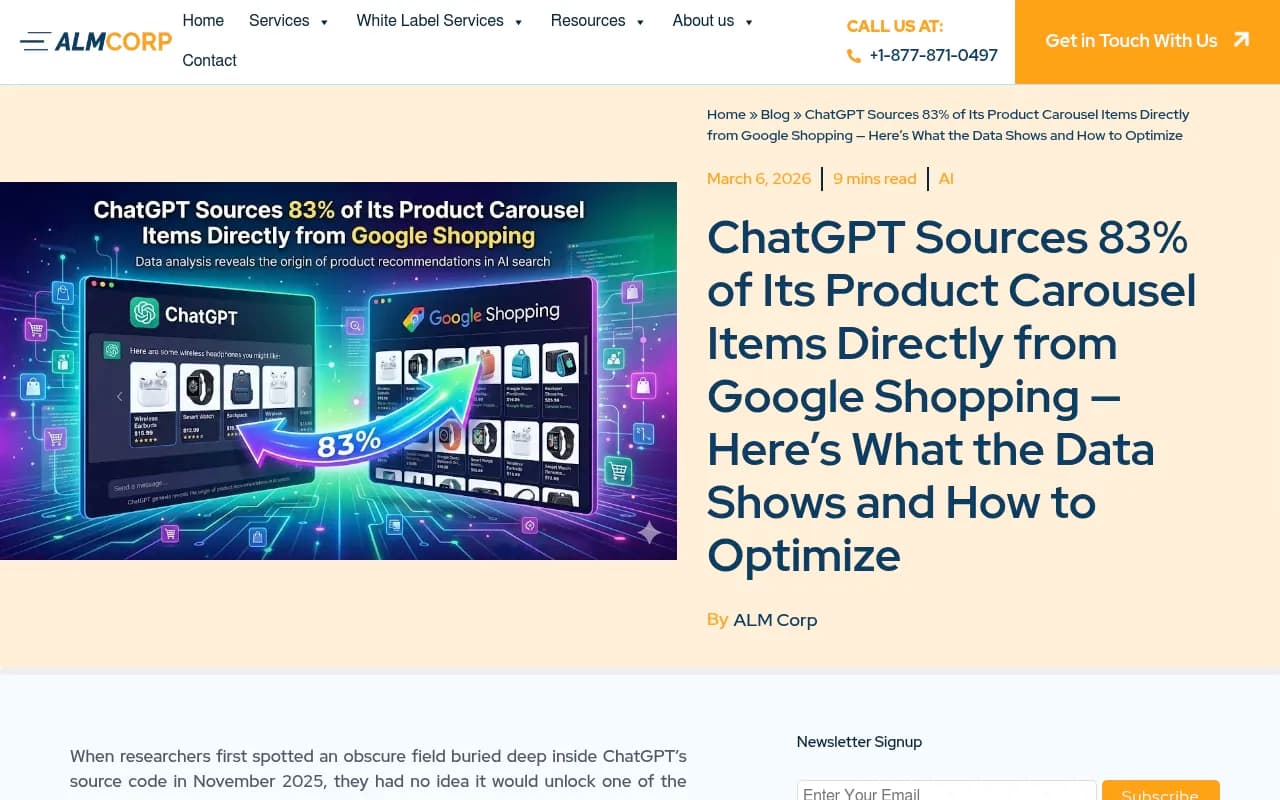
That number is striking. ChatGPT isn't building product carousels from some independent AI knowledge base. It's essentially pulling from Google Shopping. The researchers even found a hidden field in ChatGPT's source code -- id_to_token_map -- that, when decoded, contained Google Shopping parameters like productid and offerid. They could reconstruct a valid Google Shopping URL from the extracted data.
What this means practically: if you're not in Google's top 40 organic shopping results for a query, you're almost certainly not in ChatGPT's carousel for that query either. And for Bing? Only 11% of carousel matches came from Bing, with just 70 products across the entire dataset appearing exclusively in Bing and not Google.
So the first layer of e-commerce GEO is still traditional: product feed quality, Google Merchant Center health, structured data, and Shopping campaign performance. But the second layer -- tracking whether you're actually appearing in AI shopping results, and understanding why you're not -- requires dedicated GEO tooling.
What to look for in a GEO tool for e-commerce
Not every GEO platform is built with e-commerce in mind. Here's what separates genuinely useful platforms from generic brand mention trackers when your goal is product visibility in AI:
ChatGPT Shopping tracking. Can the tool detect when your products appear in ChatGPT's shopping carousels specifically? This is distinct from tracking whether your brand appears in a text response.
Prompt coverage for product queries. The tool should let you monitor commercial-intent prompts like "best [product type] for [use case]" -- not just informational brand queries.
Answer gap analysis. Which product questions is your competitor being cited for that you're not? This is where most e-commerce brands find their biggest opportunities.
Citation source tracking. Where are AI models pulling product information from? Reddit reviews, YouTube unboxings, Google Shopping, your own product pages? Knowing the source tells you where to invest.
Structured data and crawler insights. Can the tool show you how AI crawlers are reading your product pages? If they're hitting errors or skipping pages, that's a direct cause of missing citations.
Traffic attribution. Can you connect AI visibility improvements to actual sessions and revenue? Without this, you're optimizing blind.
The tools worth knowing about
Promptwatch -- the most complete option for e-commerce GEO
Promptwatch is one of the few platforms that explicitly tracks ChatGPT Shopping appearances, which puts it in a different category from most GEO tools for e-commerce brands. Most platforms track text-based brand mentions. Promptwatch tracks when your brand or products appear in ChatGPT's product recommendation carousels -- the commercially valuable placements that most tools miss entirely.

Beyond Shopping tracking, Promptwatch covers the full optimization loop that e-commerce teams actually need. The Answer Gap Analysis shows exactly which product prompts competitors are being cited for but you're not -- specific queries, specific gaps, specific content you're missing. The built-in AI writing agent then generates content grounded in real citation data (over 880 million citations analyzed) to fill those gaps. And AI Crawler Logs show which of your product pages AI crawlers are reading, how often, and what errors they're encountering.
For e-commerce specifically, the Reddit and YouTube tracking is underrated. A significant portion of AI product recommendations are influenced by Reddit threads and YouTube reviews -- sources most GEO tools ignore. Promptwatch surfaces these discussions, which tells you where to seed content or engage communities to influence AI recommendations upstream.
Pricing starts at $99/month for the Essential plan (1 site, 50 prompts), with the Professional plan at $249/month adding crawler logs and city-level tracking. For agencies managing multiple e-commerce clients, custom pricing is available.
Profound -- strong monitoring, less action

Profound has solid brand tracking across ChatGPT, Claude, Perplexity, and other models. It's well-regarded for enterprise-level monitoring and has been cited in several 2026 GEO tool roundups as a leading platform. The gap for e-commerce teams is that it leans toward monitoring rather than optimization -- it shows you where you stand but doesn't generate content to improve your position or provide the kind of answer gap analysis that tells you what to create next.
Peec AI -- useful for research, less for ongoing optimization

Peec AI is worth mentioning specifically because their data powered the ChatGPT Shopping carousel study referenced above. Their research capabilities are clearly strong. As a day-to-day optimization platform for e-commerce teams, it's more limited -- multi-language tracking is a genuine strength, but the content optimization layer is thin.
AIClicks -- accessible entry point
AIClicks tracks brand visibility across ChatGPT, Google AI Overviews, Gemini, and Perplexity. It's a reasonable starting point for smaller e-commerce brands that want to understand their AI visibility without a large budget. The platform doesn't have the depth of Shopping-specific tracking or content generation that larger operations need, but it covers the basics.
Azoma -- purpose-built for AI shopping
Azoma is specifically focused on AI shopping optimization -- ChatGPT, Amazon Rufus, and similar shopping-oriented AI experiences. If your primary concern is product visibility in AI shopping interfaces rather than general brand mentions, Azoma is worth evaluating. It's more narrowly scoped than a full GEO platform but goes deeper on the shopping-specific use case.
Semrush -- traditional SEO with AI monitoring bolted on
Semrush has added AI visibility features to its platform, but the implementation uses fixed prompts rather than letting you customize the queries you track. For e-commerce brands with specific product categories and long-tail commercial queries, fixed prompts are a real limitation. Semrush remains excellent for traditional SEO work that feeds into AI visibility (product page optimization, structured data, Shopping feed health), but as a standalone GEO tool it's not purpose-built for the job.
Ahrefs Brand Radar -- similar limitations
Ahrefs Brand Radar tracks brand mentions in AI search results and has the advantage of integrating with Ahrefs' existing SEO data. Like Semrush, the prompts are fixed and there's no AI traffic attribution, which limits its usefulness for e-commerce teams trying to connect AI visibility to revenue.
Tool comparison: e-commerce GEO features
| Tool | ChatGPT Shopping tracking | Answer gap analysis | AI content generation | Crawler logs | Reddit/YouTube tracking | Traffic attribution |
|---|---|---|---|---|---|---|
| Promptwatch | Yes | Yes | Yes | Yes | Yes | Yes |
| Profound | No | Limited | No | No | No | Limited |
| Peec AI | No | No | No | No | No | No |
| AIClicks | No | No | No | No | No | No |
| Azoma | Yes (shopping-focused) | No | No | No | No | No |
| Semrush | No | No | No | No | No | No |
| Ahrefs Brand Radar | No | No | No | No | No | No |
The e-commerce GEO workflow that actually works
Understanding the tools is one thing. Knowing how to use them is another. Here's a practical workflow for e-commerce teams:
Step 1: Audit your Google Shopping presence first
Because 83% of ChatGPT carousels pull from Google Shopping, your Google Merchant Center health is foundational. Before worrying about AI-specific optimization, make sure your product feeds are clean, your structured data is correct, and your products are ranking in Google's top 40 for your target queries. This isn't glamorous GEO work, but it's the highest-leverage action most e-commerce brands can take right now.
Step 2: Map the commercial prompts in your category
What are customers actually asking AI models when they're ready to buy? "Best [product] for [use case]" queries, comparison prompts ("X vs Y"), and "where to buy" queries are the commercially valuable ones. Build a list of 30-50 prompts that represent real purchase intent in your category. Tools with prompt volume data help prioritize which ones are worth targeting.
Step 3: Run an answer gap analysis
For each of your target prompts, check which brands are being cited and which aren't. The gaps -- prompts where competitors appear and you don't -- are your content roadmap. Each gap represents a specific piece of content your site is missing that AI models want to cite but can't find.
Step 4: Create content engineered for AI citation
This is where most e-commerce brands underinvest. Product pages alone aren't enough. AI models cite content that directly answers questions -- comparison articles, buying guides, use-case specific content, and FAQ-style pages that match the conversational queries people are asking. The content needs to be specific, factual, and structured in a way that makes it easy for AI models to extract and cite.
Step 5: Check your AI crawler logs
Are AI crawlers actually reading your new content? Crawler logs tell you which pages are being visited, how often, and whether they're hitting errors. A product page that returns a 404 or loads too slowly for a crawler to process won't get cited regardless of how good the content is.
Step 6: Track the results and close the loop
Monitor your visibility scores for target prompts over time. As AI models start citing your new content, you should see your citation rates improve. Connect this to traffic data -- either through a code snippet, Google Search Console integration, or server log analysis -- to understand which AI visibility improvements are actually driving sessions and revenue.
The structured data angle most e-commerce brands miss
One thing the ChatGPT Shopping research makes clear: structured data matters more than most e-commerce brands realize. The id_to_token_map field that researchers found in ChatGPT's source code contained product identifiers that map directly to Google's product ecosystem. This means ChatGPT isn't just reading your product page text -- it's reading structured product data.
For e-commerce brands, this means:
- Product schema markup (name, price, availability, reviews, SKU) needs to be accurate and complete
- Google Merchant Center product data needs to match your on-site structured data
- Review schema matters -- AI models weight products with verified reviews differently from those without
- Brand entity markup helps AI models understand your brand's relationship to specific product categories
Most GEO tools don't audit structured data directly, but the crawler log features in more advanced platforms will show you whether AI crawlers are successfully parsing your product pages or encountering errors that prevent them from reading your structured data.
What "AI-ready" actually means for e-commerce in 2026
The shift from traditional SEO to GEO isn't about abandoning what works. Google Shopping optimization, product page quality, and structured data are still the foundation. What's changed is the layer on top: AI models are now making product recommendations based on a combination of structured data, content quality, citation patterns, and entity authority -- and most e-commerce brands have no visibility into how they're performing on any of these dimensions.
The brands winning in AI shopping results in 2026 are the ones treating GEO as a continuous optimization process rather than a one-time project. They're monitoring which prompts they appear in, identifying gaps, creating content to fill those gaps, and tracking whether it works. That loop -- find gaps, create content, measure results -- is what separates brands that grow their AI visibility from those that watch competitors take their space.
The tools exist to run this process systematically. The question is whether your team is using them.