Key takeaways
- Product pages are now the single most-cited content type in ChatGPT Search (32.8% of citations in July 2026, up from ~18% in March), so your product pages, not just blog content, are what AI is quoting.
- Otterly.ai looks like the cheapest entry point at $29/mo, but Claude, Gemini, and Google AI Mode are paid add-ons on every tier. Add all three and a solo user pays closer to $76/mo, not $29.
- Reddit's share of ChatGPT citations collapsed from 3.8% to under 1% in a single week in mid-August 2026, which matters a lot if your growth plan leans on Reddit seeding.
- Only a handful of tools document SKU-level tracking or revenue attribution at all. Most "AI visibility" platforms were built for SaaS brand-mention monitoring and bolted ecommerce features on afterward.
- For a startup budget, a lean stack of one AI visibility tracker plus disciplined product-page optimization beats buying an expensive all-in-one platform you'll only use 20% of.
Why this category is confusing for ecommerce founders right now
Most of the tools that show up when you search "AI visibility tool" were not built with a Shopify store in mind. They were built to answer "did ChatGPT mention my SaaS brand in a list of best CRMs." That's a fine question if you sell software. If you sell 4,000 SKUs across six collections, knowing that your brand name got mentioned once tells you almost nothing. You still don't know which product was recommended, whether the price shown was current, or whether anyone actually clicked through and bought.
So before spending a dollar, it's worth being honest about what you're actually trying to answer. Is it "does ChatGPT know my brand exists," or is it "is my $48 candle showing up with the right price when someone asks for gift ideas under $50"? Those are different problems, and most budget tools only solve the first one.
What's actually changed in AI search that matters for product brands
A few shifts from 2026 data change how I'd advise a bootstrapped brand to spend its limited AI-visibility budget.
First, product pages have become citation magnets. According to Promptwatch's citation-type breakdown, product pages made up 32.8% of all ChatGPT Search citations in July 2026, nearly double their March share. Listicles, how-tos, and comparison pages are growing too, but from a much smaller base. If your product pages don't have clean specs, current pricing, and clear availability, you're leaving the highest-value citation slot on the table. See ChatGPT Citation Types Over Time - July 2026.
Second, shopping features in ChatGPT are rare but not random. Across all prompts, product cards and price comparisons attach to a low single-digit percentage of ChatGPT Search responses, but that rate roughly doubled overnight in late May 2026 before pulling back. OpenAI is clearly testing when and how shopping triggers, which means the eligibility groundwork, Product schema, accurate merchant feeds, current pricing, needs to be in place before your category gets turned on, not after. Details in ChatGPT Shopping Feature Usage.
Third, ads inside ChatGPT Search are ramping fast. Ads appeared in an average of 20.1% of citation-enabled ChatGPT Search responses over a 90-day window through mid-August 2026, and the daily rate has spiked as high as 43.9%. ChatGPT served zero ads before May 27, 2026. If you're a startup relying on organic AI visibility, that's a shrinking window, worth tracking now rather than later. See ChatGPT Ads Over Time.
Fourth, and this one surprised me: Reddit's share of ChatGPT citations fell off a cliff. It sat steady around 3.8% from mid-July through early August 2026, then dropped to under 1% by August 14, an 86% relative collapse in about a week. Google's AI Overviews and AI Mode only declined gradually over the same window. If your GEO strategy has been "seed Reddit threads and wait," that channel just got a lot less reliable for ChatGPT specifically. Full numbers at Reddit Citations Are Dropping in ChatGPT.
Worth noting too: ChatGPT typically cites only around 5 sources per web-search answer, versus roughly 10 for Google AI Overviews and Perplexity. Fewer slots means more competition per citation on ChatGPT, and it's why AI Overviews is often described as the more forgiving engine to break into for a newer or mid-authority domain. See Average Sources Per Response.
The budget tools worth actually considering
Here's where I'll be blunt: several of the "cheap" options in this category are cheap on the pricing page and not cheap once you add the engines you need.
Otterly.ai: cheapest sticker price, watch the add-ons
Otterly.ai's Lite tier is $29/mo for 15 tracked prompts across 4 base engines. That's the lowest self-serve entry point in the category, and it comes with unlimited team seats even on that tier, which is unusual. The catch: Claude, Gemini, and Google AI Mode are paid add-ons on every plan. On Lite, Gemini and AI Mode run $9/mo each and Claude is $29/mo, so a solo founder wanting full coverage of all 7 engines is really paying around $76/mo, not $29. On the Premium tier, stacking all three add-ons pushes the real monthly cost to roughly $1,226, above what Otterly advertises as its Enterprise "starting from $1,000/mo" price. If you only care about ChatGPT and one or two other engines, Otterly is genuinely the cheapest option out there. If you want full multi-model coverage, do the math first.

Peec AI: repriced down, a real budget contender now
Peec AI dropped its prices in 2026, and the new structure is worth a look. Starter is $95/mo for 50 prompts, one project, and your choice of 3 out of 6 engines. Pro is $245/mo for 150 prompts and two projects, with sentiment tracking included from Pro upward. Every tier has unlimited users. Additional engines beyond your chosen set cost extra ($35/mo on Starter, scaling up on higher tiers), so again, budget for the engines you'll actually need, not just the sticker price.

SE Visible / SE Ranking: two confusing ways to buy the same thing
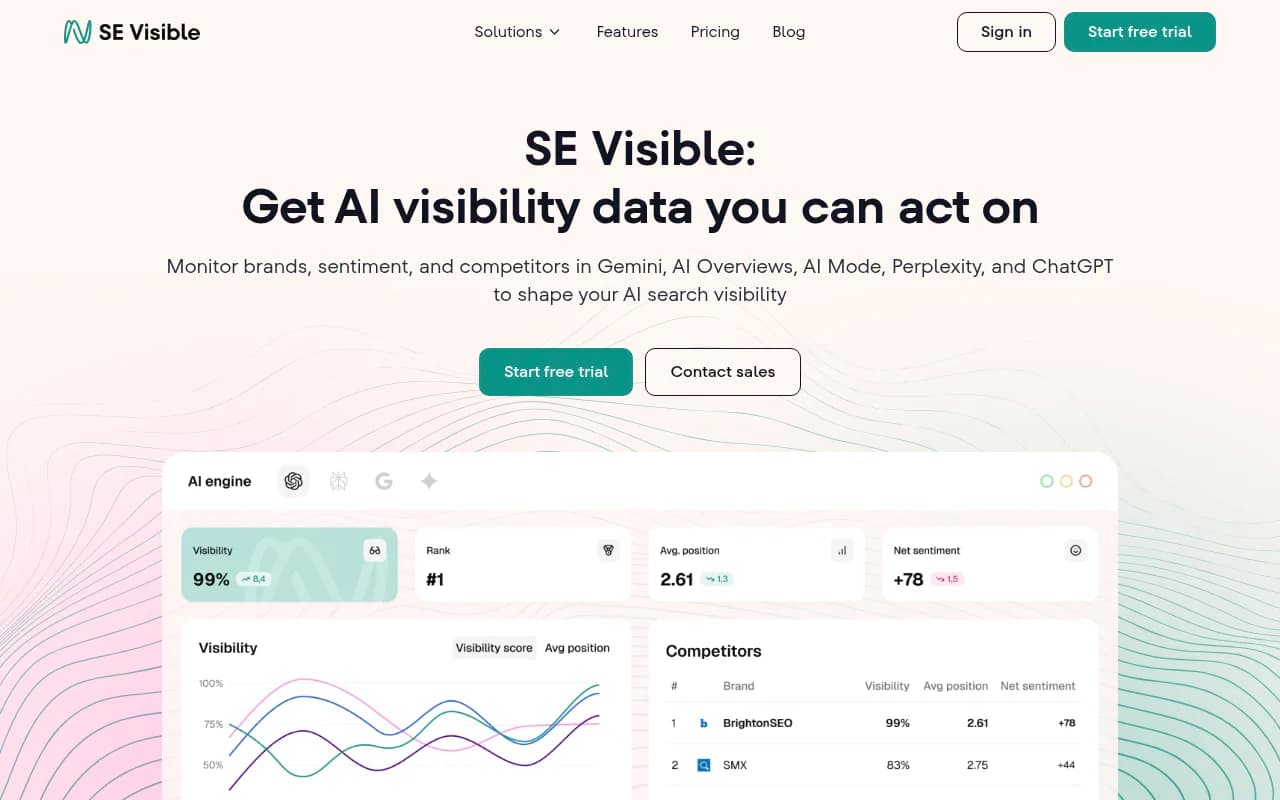
SE Ranking sells AI visibility two different ways, which trips people up. You can buy the core SE Ranking plan ($129/mo Core or $279/mo Growth) and bolt on an AI Search add-on for roughly $71 to $89/mo, or you can buy the standalone SE Visible product directly at $99/mo for 200 prompts across 5 engines, scaling to $355/mo for 1,000 prompts. If you already use SE Ranking for traditional SEO, the add-on route makes sense. If you don't, go straight to SE Visible and skip the core platform. There's also a free checker with 5 checks a day if you just want a quick gut check before committing to anything.
Semrush: bundled, not standalone
Semrush folds AI visibility into its broader SEO plans rather than selling it as its own product. The $139/mo Pro tier is SEO-only; AI visibility across ChatGPT, Perplexity, Gemini, and Google Search shows up starting at the $199/mo Pro+ tier. If you're already paying for Semrush for keyword research and site audits, this is a reasonable add. If AI visibility is your only reason to buy, it's not the cheapest path in.
What the ecommerce-specific tools do differently
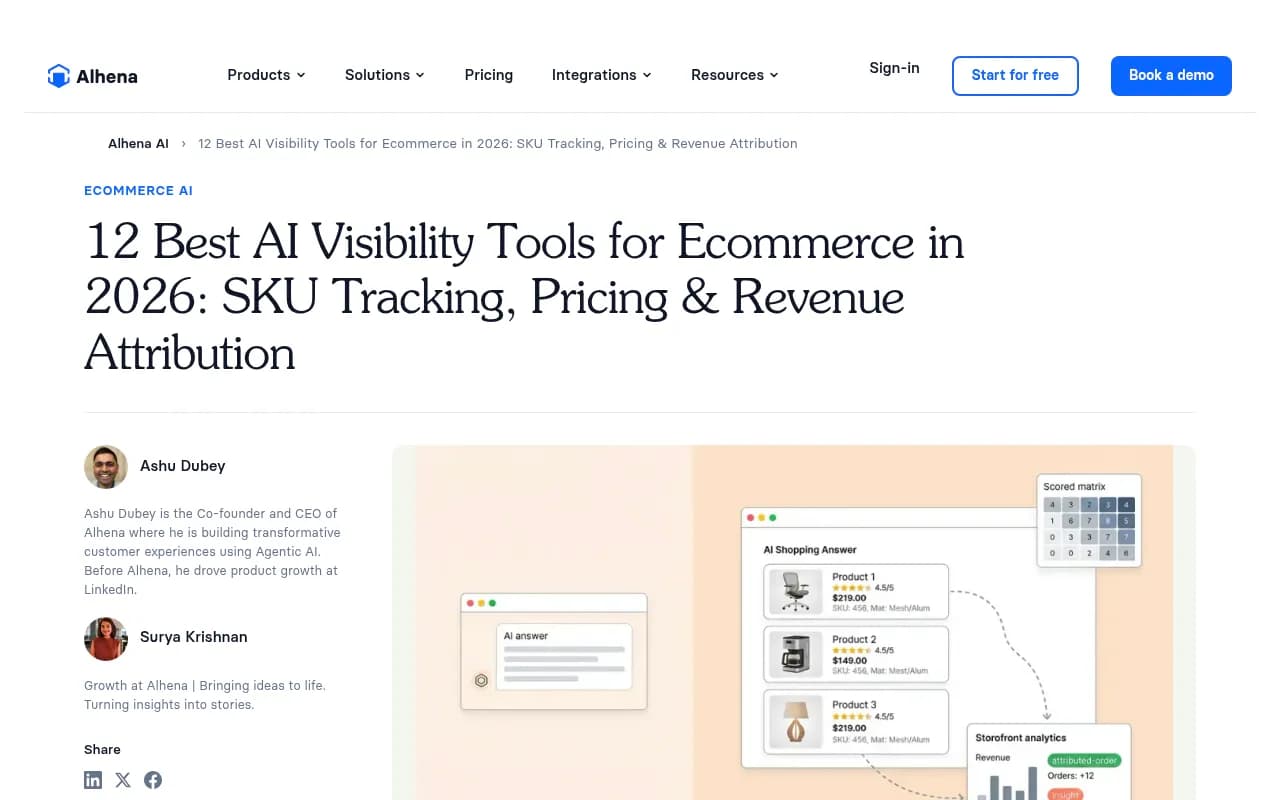
A smaller group of tools were actually built around product catalogs rather than brand mentions. Alhena AI Visibility documents native SKU-level tracking, a live catalogue sync, and revenue attribution together, which none of the general-purpose visibility trackers claim to do. Profound offers SKU tracking through a Shopping Analysis add-on, and Authoritas supports it through manual product uploads, both more limited than a live feed. Yotpo Discover leans into "active agents" for onsite optimization and content, aimed specifically at DTC brands already using Yotpo for reviews and loyalty.

The tradeoff is price. These ecommerce-native platforms generally sit well above the $95-$250/mo range that budget-conscious founders are looking at, and several don't publish self-serve pricing at all, you have to talk to sales. For a brand doing under a few million in revenue, that's probably out of reach in year one.
Comparison table
| Tool | Starting price | Engines covered | SKU-level tracking | Best for |
|---|---|---|---|---|
| Otterly.ai | $29/mo (add-ons extra) | 4 base + paid add-ons | No | Solo founders tracking ChatGPT only |
| Peec AI | $95/mo | Choose 3 of 6 | No | Small teams wanting sentiment + multi-model |
| SE Visible | $99/mo | 5 | No | Brands already inside the SE Ranking ecosystem |
| Semrush (Pro+) | $199/mo | 4-5 | No | Teams already paying for Semrush SEO tools |
| Promptwatch (Essential) | $95/mo | All major LLMs | Not documented for SKUs | Brands wanting monitoring + content fixes in one tool |
| Alhena AI Visibility | Not published | 4 | Yes, native + revenue attribution | Catalog-heavy DTC brands past the bootstrap stage |
Where Promptwatch fits for a budget-conscious brand
Worth a mention here even though it wasn't built ecommerce-first: Promptwatch starts at $95/mo for the Essential plan (1 site, 50 prompts, 6,000 responses, 5 AEO articles, tracking across ChatGPT, Gemini, Claude, Perplexity, Grok, and Google AI Overviews/AI Mode), with a 7-day free trial. What separates it from most trackers in this price range is that it doesn't stop at telling you where you're invisible. It also shows AI crawler logs, so you can see whether ChatGPTBot or PerplexityBot is actually reading your product pages and whether they're hitting errors, and it has content agents that draft and publish optimization fixes to your CMS instead of leaving you a spreadsheet of problems to solve manually. For a small team without a dedicated content person, that automation piece matters more than another dashboard.

Given that product pages are now the top-cited content type in ChatGPT, a tool that connects citation data back to your actual page-level performance, rather than just brand-mention counts, is worth the extra spend over the cheapest pure trackers.
A practical budget stack for year one
If I were running a DTC brand doing under $5M a year and had to pick a stack today, here's roughly how I'd think about it:
- Pick one AI visibility tracker, not three. Tool sprawl, running separate SERP trackers, AI trackers, and social listening tools that don't talk to each other, quietly costs more in wasted time than any single subscription. Otterly.ai if you only care about ChatGPT, Peec AI or Promptwatch if you want broader model coverage and some content help.
- Fix your product pages before chasing new tools. Structured specs, current pricing, clear availability. Given that product pages are ChatGPT's most-cited format, this is higher leverage than most GEO advice out there.
- Deprioritize Reddit-seeding as a standalone AI-search strategy, at least for ChatGPT. The citation collapse in August 2026 suggests it's not a stable channel to build a plan around, whatever it might still do for brand awareness elsewhere.
- Watch, don't panic about, ads in ChatGPT Search. A 20-30% average appearance rate over the last quarter means organic visibility still matters, but the runway for pure organic is shrinking.
- Treat sentiment scores with some skepticism. A brand mention with an outdated price or a discontinued product listed can still register as "positive" sentiment in most tools. For ecommerce, that's a blind spot worth manually checking every so often.
A note on where to go deeper
If you want to browse a wider set of AI visibility and GEO platforms beyond the handful covered here, the directory at bestgeosoftware.com is a decent starting point for comparing more niche and enterprise options side by side. For rank tracking specifically, ai-rank-tools.com covers a narrower slice focused just on tracking, useful if content optimization isn't something you need bundled in yet.
Most startup budgets in this category max out somewhere between $95 and $250 a month once you account for the engine add-ons every vendor seems to bolt on. Pick the tool that matches the two or three AI platforms your actual customers use, not the one with the longest engine list on its pricing page.