Key takeaways
- Most AI visibility tools were built for single brands, not agencies managing multiple clients -- the differences matter more than vendors admit.
- Promptwatch is the only platform in this comparison that closes the full loop: find gaps, generate content, track results. Others stop at monitoring.
- Profound has the strongest enterprise-grade analytics and a dedicated agency mode, but comes at a significantly higher price point.
- Otterly.AI and Peec.ai are solid entry-level options -- Otterly for budget-conscious agencies, Peec for clients with multilingual needs.
- The right choice depends on how many clients you manage, whether you need content generation, and how much you can charge for AI visibility as a service.
AI search is no longer a side experiment. ChatGPT, Perplexity, Claude, and Google's AI Overviews are now meaningful traffic sources for most of your clients -- and in some niches, they're already the primary discovery channel. The problem is that traditional SEO tools don't track any of this. You can rank #1 on Google and be completely invisible in AI responses.
That's why AI visibility platforms have become a real line item for agencies. But the market has exploded fast, and most tools were built for a single brand's marketing team, not an agency juggling 10 or 20 clients. The agency use case is genuinely different: you need multi-client dashboards, white-label reporting, scalable pricing, and ideally something you can productize as a service.
This guide breaks down four of the most-discussed platforms -- Promptwatch, Profound, Otterly.AI, and Peec.ai -- with an honest look at where each one fits.
What agencies actually need from an AI visibility tool
Before getting into the platforms, it's worth being specific about what makes the agency use case distinct.
Single-brand teams care about their own visibility. Agencies care about visibility across a portfolio, plus the ability to show clients what's happening and why it matters. That means:
- Multi-client workspaces or brand configurations (not just switching between accounts manually)
- White-label or client-ready reporting
- Scalable pricing that doesn't charge per-seat at enterprise rates for every client
- Enough data depth to justify the service to clients who are skeptical
- Ideally, some way to take action -- not just show dashboards
The last point is the one most platforms miss. Showing a client that they're not being cited by ChatGPT is step one. Telling them what to do about it is the actual service. Tools that stop at monitoring leave agencies doing the hard work manually.
The four platforms compared
Promptwatch
Promptwatch is built around what it calls the "action loop": find gaps, create content, track results. It's the most complete platform in this comparison for agencies that want to offer AI visibility as an end-to-end service rather than a reporting add-on.

The core differentiator is the Answer Gap Analysis. It shows you exactly which prompts your competitors are being cited for that your client isn't -- not just "you're missing visibility" but "here are the specific questions AI models are answering with your competitor's content instead of yours." That's a much more useful starting point for an agency conversation.
From there, Promptwatch has a built-in AI writing agent that generates content specifically engineered to get cited -- articles, listicles, and comparisons grounded in citation data from over 880 million citations analyzed. This isn't a generic content tool bolted on; it's designed around what AI models actually cite.
For agencies, the platform monitors 10 AI models: ChatGPT, Perplexity, Claude, Gemini, Google AI Overviews, Google AI Mode, Meta/Llama, DeepSeek, Grok, Mistral, and Copilot. It also includes AI crawler logs (real-time visibility into which AI bots are crawling which pages), Reddit and YouTube citation tracking, ChatGPT Shopping monitoring, and traffic attribution via GSC integration or server log analysis.
Pricing runs from $99/month (Essential: 1 site, 50 prompts) to $579/month (Business: 5 sites, 350 prompts, 30 articles/month). Agency and enterprise plans are available on custom pricing, which is where the multi-client setup lives. The Business plan is a reasonable starting point for small agencies; larger agencies will want to talk to their sales team.
The one thing to know going in: Promptwatch is a Dutch company (Promptwatch B.V.) with 6,700+ brands using it, including Booking.com and Center Parcs. It's not a startup with 200 users -- the data infrastructure is real.
Profound
Profound is the most enterprise-oriented platform in this group. It has a dedicated agency mode with brand configurations and what they call "pitch environments" -- essentially client-facing views you can use in new business presentations. For agencies that are actively selling AI visibility as a service, that's a genuinely useful feature.

The analytics depth is strong. Profound tracks prompt volumes, has agent analytics (tracking AI agent behavior, not just responses), and covers shopping visibility in AI. The research output -- their AEO Report and Profound Index -- is cited by practitioners as legitimately useful for understanding the broader AI search landscape.
Where Profound falls short for most agencies is price. It's positioned at the higher end of the market, and the cost-per-client math gets uncomfortable quickly if you're managing smaller accounts. It's a better fit for agencies with a handful of large enterprise clients than for shops running 15-20 mid-market accounts.
Profound also doesn't have built-in content generation. You get excellent monitoring and analysis, but the "what do we do about it" answer still requires your team to do the work manually. That's fine if your agency has strong content capabilities; it's a gap if you're trying to scale the service.
Otterly.AI
Otterly.AI is the budget-friendly option in this comparison, with plans starting around $29/month. For agencies that are just starting to offer AI visibility tracking and need something to show clients without a major platform investment, it's a reasonable entry point.

The standout feature is the GEO Audit, which gives a structured assessment of how well a site is positioned for AI search. That's a useful deliverable for client conversations -- something concrete to hand over rather than just a dashboard screenshot.
The honest limitation: Otterly.AI is primarily a monitoring tool. It tracks visibility across major AI models and gives you data, but it doesn't have crawler logs, content generation, traffic attribution, or the depth of prompt intelligence you'd find in Promptwatch or Profound. For agencies that want to charge a premium for AI visibility services, the data depth may not be enough to justify the price to sophisticated clients.
That said, for agencies testing the waters or working with clients who have modest budgets, Otterly.AI is a low-risk way to get started.
Peec.ai
Peec.ai's main differentiator is multilingual support -- 115+ languages, which is genuinely impressive and largely unmatched in this category. If your agency works with international brands or clients targeting non-English markets, Peec.ai deserves serious consideration.

Beyond the language coverage, Peec.ai tracks AI visibility across major models and provides monitoring data with reasonable depth. It has agency bundle pricing, which helps with the multi-client math.
The limitation is similar to Otterly.AI: it's a monitoring platform. There's no built-in content generation, no crawler logs, and no traffic attribution. You get good data on where clients stand, but the optimization work is still on your team. For agencies with strong multilingual content capabilities, that's workable. For agencies looking for a platform that does more of the heavy lifting, it's not the right fit.
Feature comparison
| Feature | Promptwatch | Profound | Otterly.AI | Peec.ai |
|---|---|---|---|---|
| AI models tracked | 10 | Multiple | Multiple | Multiple |
| Multi-client management | Yes (agency plans) | Yes (agency mode) | Limited | Yes (agency bundles) |
| Content generation | Yes (built-in AI writer) | No | No | No |
| Answer gap analysis | Yes | Partial | No | No |
| AI crawler logs | Yes | No | No | No |
| Traffic attribution | Yes (GSC, server logs) | No | No | No |
| Reddit/YouTube tracking | Yes | No | No | No |
| ChatGPT Shopping | Yes | Yes | No | No |
| Multilingual support | Yes | Limited | Limited | Yes (115+ languages) |
| White-label reporting | Agency plan | Yes | Limited | Limited |
| GEO audit feature | No | No | Yes | No |
| Pitch/client environments | No | Yes | No | No |
| Starting price | $99/mo | Higher (demo required) | ~$29/mo | Mid-range |
| Free trial | Yes | Demo | Yes | Yes |
How to choose
The honest answer is that the right tool depends on what kind of agency you are and what you're trying to sell.
If you want to offer AI visibility as a full-service offering -- gap analysis, content creation, tracking, attribution -- Promptwatch is the only platform here that supports that end-to-end. The action loop is real: you can find what's missing, generate content to fill it, and show clients their visibility scores improving over time. That's a productizable service.
If you have a small number of large enterprise clients and strong internal content capabilities, Profound's analytics depth and agency mode are worth the premium. The pitch environments are a nice touch for new business.
If you're just starting out and need something affordable to show clients that AI visibility matters, Otterly.AI gets you in the door without a major commitment. The GEO Audit is a useful client deliverable.
If you work with international brands and multilingual content is a core part of your service, Peec.ai's language coverage is hard to beat.
One thing worth saying plainly: the monitoring-only tools (Otterly.AI and Peec.ai in this comparison) are fine for reporting, but they leave the hard work to your team. As AI visibility becomes a more competitive service offering, the agencies that can show clients a clear path from "here's where you're invisible" to "here's the content we created and here's how your visibility improved" will have a stronger value proposition than those showing dashboards.
A note on the broader market
These four platforms are a reasonable starting point, but the AI visibility tool market has grown fast. There are now well over a dozen serious players, and the landscape looks different depending on your specific needs.
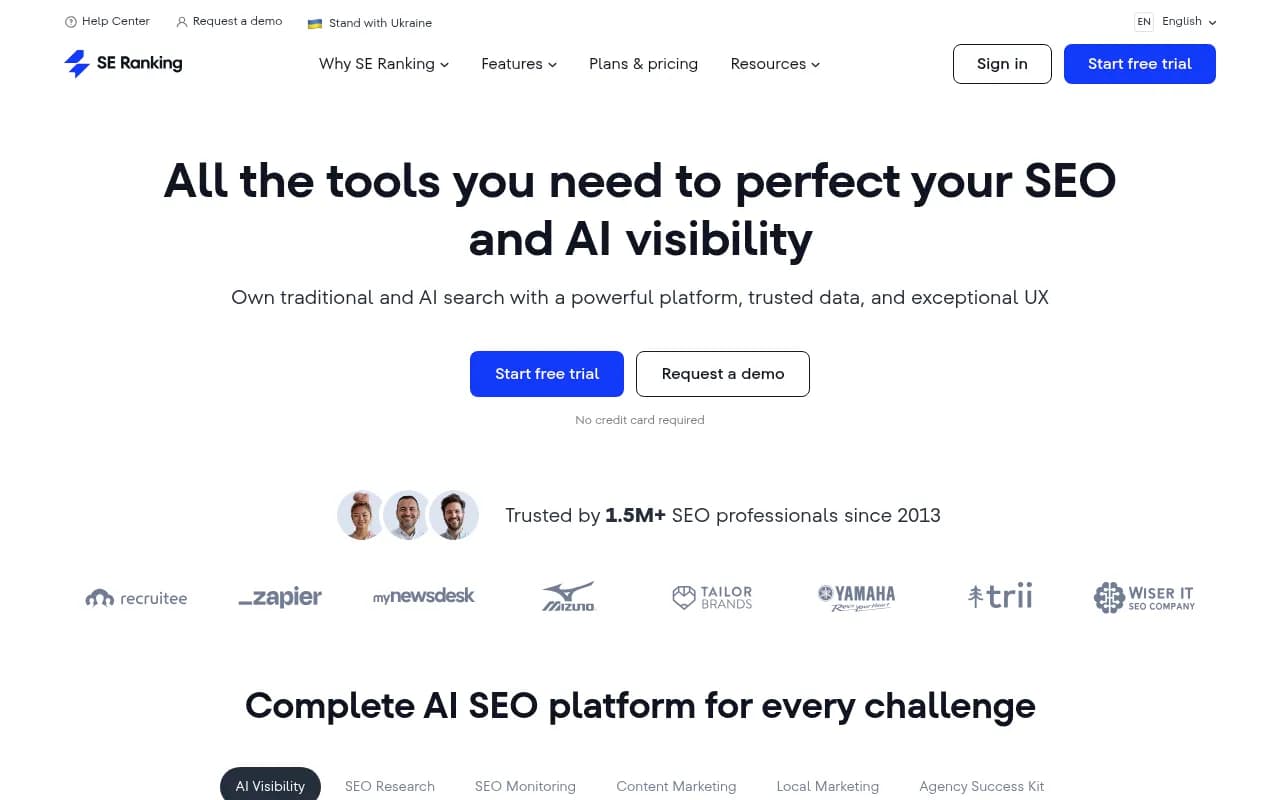
For agencies focused on technical AI crawlability, tools like DarkVisitors are worth a look for understanding which AI bots are hitting client sites. For agencies with enterprise clients who need deep competitive intelligence, AthenaHQ and Search Party are worth evaluating. For agencies that want a more affordable all-in-one SEO plus AI visibility stack, SE Ranking has added AI monitoring capabilities to its traditional SEO platform.

The key question to ask of any platform: does it just show you data, or does it help you do something with it? Most tools in this category are still in the "show you data" phase. The ones that have moved into optimization and content generation are where the real agency value is.
Bottom line
The AI visibility platform market in 2026 is maturing fast, but there's still a wide gap between tools that monitor and tools that optimize. For agencies, that gap matters because your clients aren't paying for dashboards -- they're paying for results.
Promptwatch is the strongest all-around choice for agencies that want to build a real AI visibility service, not just add a reporting line. Profound is the right call for enterprise-focused shops with the budget to match. Otterly.AI and Peec.ai are solid entry points for specific use cases -- budget constraints and multilingual needs, respectively.
Whichever platform you choose, the agencies that figure out how to close the loop from visibility data to content to measurable results will be the ones that can charge for this service in 18 months. The ones that just show clients a monitoring dashboard will find it gets commoditized quickly.