Key takeaways
- The right AI brand monitoring platform depends heavily on your industry: healthcare and finance need compliance certifications (HIPAA, SOC 2), retail needs product-page and shopping-feature tracking, and SaaS needs tight integration with existing content and analytics stacks.
- Product pages now dominate ChatGPT and Google AI Overviews citations (roughly a third of ChatGPT's citations in July 2026), which changes what retail brands should optimize.
- Reddit's share of ChatGPT citations collapsed from around 3.8% to under 1% in a single week in August 2026, a reminder that platform mechanics, not your content, often explain sudden visibility swings.
- Regulated industries should prioritize SOC 2 Type II and, where relevant, HIPAA-compliant vendors; several mainstream AI visibility tools don't offer either.
- No single tool covers everything well. Most serious teams end up stacking a dedicated AI-visibility platform with a traditional listening tool, since Brandwatch and Talkwalker still don't do LLM monitoring as of this year.
Why "AI brand monitoring" means something different per industry
A retailer worrying about whether ChatGPT recommends its products in a shopping card has almost nothing in common with a hospital system worrying about whether Gemini hallucinates a wrong phone number for its urgent care line. Both are "AI brand monitoring." Neither problem is solved by the same tool, or even the same feature set.
This matters more in 2026 than it did a year ago because the AI answer engines themselves have gotten weirder and more industry-specific in how they behave. ChatGPT Search now triggers the site: operator at scale for certain query types, Google AI Overviews and AI Mode have their own citation habits, and shopping features appear and disappear from ChatGPT responses seemingly at OpenAI's discretion. Generic "track my brand mentions" tools miss a lot of this nuance. Industry-aware ones catch it.
Below, I'll go through what actually matters for retail, SaaS, finance, and healthcare teams, and which platforms fit each.
Retail and e-commerce: optimize for product-page citations and shopping features
If you sell physical or digital products, the single biggest shift in 2026 is that AI engines have started citing product pages directly, not just review roundups and listicles. According to Promptwatch's citation-type data, ChatGPT Search cited product pages roughly 32.8% of the time in July 2026, up from about 18% in March, nearly doubling in four months. Google AI Overviews followed the same pattern, with product pages overtaking listicles as the most-cited format in late July.

That's a real signal: your product pages are citation assets now, not just conversion pages. Clean structured data, accurate pricing, current stock status, and clear specs matter for whether an AI engine trusts your page enough to cite it.
The other retail-specific wrinkle is ChatGPT Shopping. Product cards and price comparisons show up on a low single-digit percentage of ChatGPT web-search responses overall, but the rate has swung wildly, roughly doubling overnight in one instance before falling back weeks later. That's OpenAI actively tuning when shopping features appear for a given category. Retail brands need to keep Product schema markup complete and their merchant feed accurate at all times, because the window can open without warning.
For monitoring this specifically, look for platforms with dedicated shopping and ads tracking rather than generic mention counting.

Profound tracks Answer Engine Insights across visibility scoring, share of voice, and citation tracking, and its Agent Analytics distinguishes real AI crawlers from spoofed ones, which is useful for retailers dealing with scraper traffic pretending to be ChatGPT. Pricing starts around $99/month for a single-model Starter plan and jumps to $399/month for Growth, which adds Perplexity and Google AI Overviews.
Promptwatch is worth a look here too, since it runs ChatGPT Shopping and Ads Radar tracking specifically, showing which competitors are bidding on your prompts and how sponsored placements show up alongside organic citations. It also tracks Reddit and YouTube citations, both relevant for retail categories where user reviews and unboxing videos drive AI recommendations.
| Platform | Retail-relevant strength | Entry pricing | Compliance notes |
|---|---|---|---|
| Promptwatch | Shopping/Ads Radar, product-page citation tracking, content agents for fixing gaps | $95/mo (Essential) | Not compliance-focused, general use |
| Profound | Answer Engine Insights, real vs. fake crawler detection | $99/mo (Starter, 1 model) | SOC 2 Type II + HIPAA |
| Semrush AI Visibility Toolkit | Bundled with existing SEO workflow | $99/mo per domain | General |
| Otterly.AI | Budget-friendly for smaller retailers | $29/mo (Lite) | General |
For category-specific research, Promptwatch's data on ChatGPT citation types over the last year is worth bookmarking; it updates monthly and shows how fast the citation mix moves.
SaaS: pair AI-visibility tracking with your existing analytics and content stack
SaaS brand monitoring has a different problem than retail. There's rarely a physical product page to optimize. Instead, buyers are asking AI engines comparison questions ("best X alternative," "X vs Y pricing") and the fight is over which vendor gets cited in those comparison and how-to answers.
Comparison-style citations were still a smaller slice of ChatGPT's mix in July 2026 (around 2.9-3.2%) compared to product pages and listicles, but for B2B SaaS that slice is disproportionately valuable, since it's exactly where purchase decisions happen.
Traditional social listening tools like Brandwatch and Talkwalker are enterprise-grade for social mentions but explicitly don't do LLM monitoring as of this year. That leaves a real gap for SaaS teams who want both. The common pattern is stacking a dedicated AI-visibility tool with a listening platform.
AthenaHQ is popular with SaaS and fintech-adjacent companies (named customers include Coinbase, SoFi, and Twilio) and offers a free Essential tier with 300 credits/month across five models. Its Starter plan runs $295/month for 3,600 credits and eight named engines including AI Mode, Copilot, and Grok. The credit-metering model is worth modeling out before committing, since multi-model prompt checks burn credits fast if you're running frequent monitoring cadences.

Otterly.AI is a lighter, cheaper option for smaller SaaS teams, starting at $29/month for a Lite tier, scaling to $489/month at Premium.
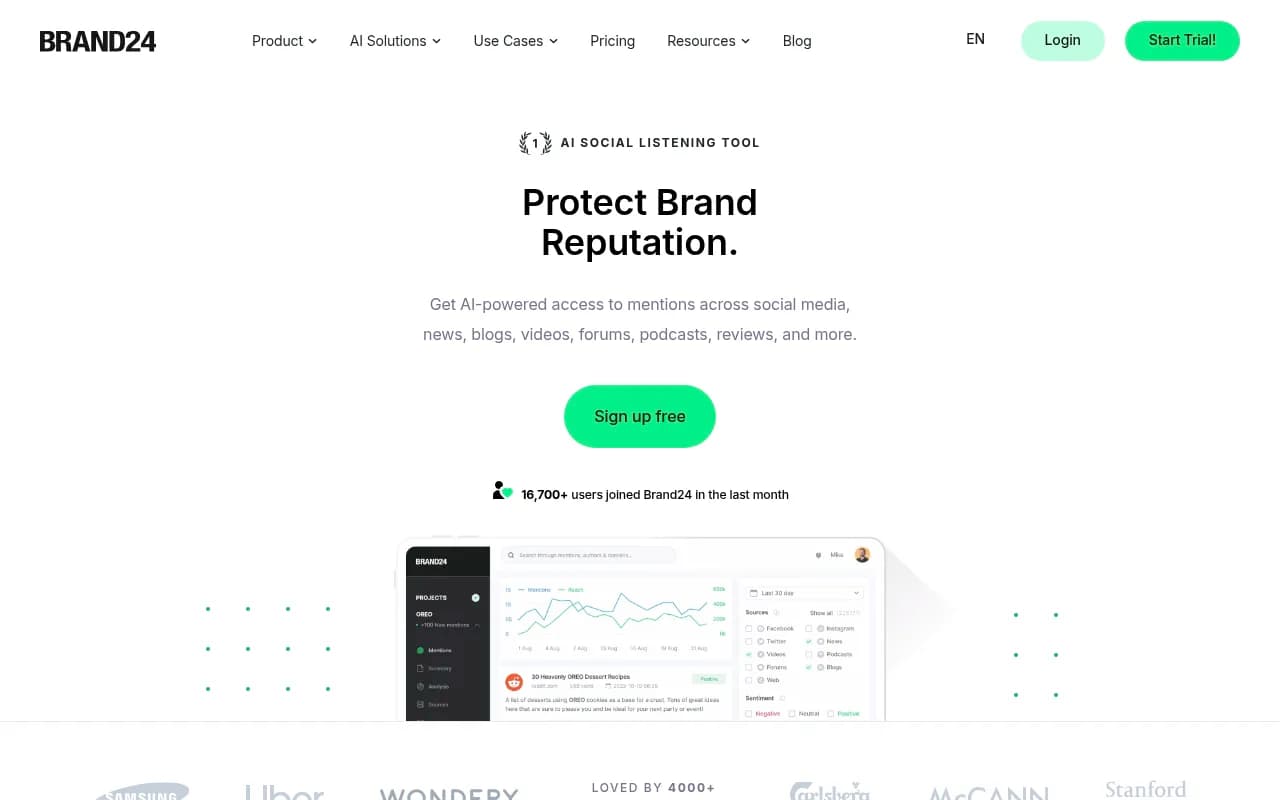
Brand24 is the one traditional listening tool that's added dedicated LLM monitoring, querying ChatGPT, Perplexity, Claude, and Gemini with prompts and analyzing the responses, on top of its usual 25M+ source social listening. That makes it a reasonable single vendor if you want to avoid stacking two tools, though pricing across sources is inconsistent (some list it starting near $149/month annually, others closer to $249/month).
| Platform | SaaS-relevant strength | Entry pricing | Best for |
|---|---|---|---|
| AthenaHQ | Credit-based, 8+ engines, integrations with Shopify/Webflow/GA4 | Free tier, $295/mo Starter | Growth-stage SaaS with technical teams |
| Brand24 | Combines social listening + LLM monitoring in one tool | ~$149-249/mo | Teams that don't want to stack tools |
| Otterly.AI | Lightweight and cheap | $29/mo | Small teams, early-stage SaaS |
| Promptwatch | Content gap analysis, CMS publishing, Agent Chat for querying your own data | $95/mo (Essential) | Teams that want tracking and fixing in one platform |
What differentiates the tools worth paying for from the ones that just count mentions is whether they help you do something about a gap once you find one. Promptwatch's content gap analysis maps your existing pages against what AI engines actually answer, scores the coverage, and generates briefs, then its Content Agents can publish directly to Webflow, Framer, or WordPress. For a SaaS content team already stretched thin, that closes the loop between "here's your gap" and "here's a published fix" without a separate content ops project.
Finance: compliance certifications matter more than feature count
Financial services brands have a narrower shortlist because of compliance requirements. SOC 2 Type II is close to table stakes for any vendor touching financial brand data, and several mainstream tools either don't have it or don't advertise it clearly.
AthenaHQ's SOC 2 Type 2 certification, combined with its named fintech customer base, makes it one of the more credible options for banks and fintechs specifically. Rankfender, which explicitly markets itself by industry vertical, positions its finance offering as "SOC2/GDPR-safe" and cites vendor-reported figures like 69% of consumers using AI for financial research (worth verifying independently rather than taking at face value, since it's a self-reported stat from the vendor's own marketing page).
Scrunch AI is SOC 2 Type II compliant too, and its Enterprise tier adds a live "Agent Experience Platform" that serves a machine-readable version of a site to AI crawlers and agents, relevant for financial institutions dealing with heavy compliance-driven content structures. Core tier runs $250/month for 125 prompts across four LLMs.
The bigger structural point for finance teams: hallucination detection matters more here than almost any other industry. If an AI engine states a wrong interest rate, an outdated fee structure, or misattributes a regulatory status to your brand, that's not just a visibility miss, it's a compliance and trust problem. Tools that only report citation volume without checking factual accuracy of what's being said are measuring the easy thing, not the important one. AthenaHQ's Enterprise tier includes a hallucination and claim-detection feature it calls "Oracle" for exactly this reason.
| Platform | Compliance | Finance-specific feature | Entry pricing |
|---|---|---|---|
| AthenaHQ | SOC 2 Type 2 | "Oracle" hallucination/claim detection | Free tier, $295/mo |
| Scrunch AI | SOC 2 Type II | Agent Experience Platform (machine-readable site for AI crawlers) | $250/mo |
| Rankfender | Markets as SOC2/GDPR-safe | Vertical-specific finance dashboard | Free/$89/$199/$499 tiers |
| Profound | SOC 2 Type II + HIPAA | Real vs. fake crawler detection | $99/mo |
Whichever tool you pick, run a repeated-sampling check before trusting any single snapshot. The same prompt run ten times against the same AI engine can produce different brand presence each time, appearing in seven runs and vanishing in three, so a one-off audit isn't reliable for a regulated brand where accuracy claims carry legal weight.
Healthcare: HIPAA and PHI-aware handling are non-negotiable
Healthcare is the strictest lane here, and it narrows the field considerably. Profound is one of the only platforms offering both SOC 2 Type II and HIPAA compliance together, which matters if any patient-adjacent data touches the monitoring pipeline. That dual certification is part of why it's raised $155 million and reached a reported $1 billion valuation, according to a comparison from LLM Pulse.
Rankfender's healthcare-specific page cites vendor stats like 71% of patients using AI for health information and 88% of healthcare brands having no AI strategy at all. Those numbers are self-reported by the vendor, so treat them as directional rather than gospel, but the underlying pattern (patients increasingly asking ChatGPT and Gemini health questions before calling a provider) tracks with what most healthcare marketing teams are already seeing anecdotally.
Confident AI takes an adjacent angle: it's more LLM-observability focused than pure brand monitoring, but it's built specifically for healthcare, with PHI-aware trace handling under a signed BAA, immutable audit trails, and demographic-sliced quality monitoring. If your concern is less "does ChatGPT mention our hospital" and more "is our AI-powered patient chatbot handling PHI correctly and giving accurate answers across demographics," that's a different, more specialized tool than the brand-visibility platforms covered elsewhere in this guide. Pricing starts with a free tier, Starter at $200/month unlimited seats, Team at $2,000/month.
The entity-misrepresentation risk is sharper in healthcare than anywhere else on this list. AI systems conflating your practice with a competitor, or citing a leadership change or rebrand that's a year out of date, isn't just annoying, it's a patient-safety-adjacent trust problem. Brands not actively monitoring are, unsurprisingly, the ones most likely to be blindsided by this kind of hallucination about themselves.
| Platform | Compliance | Healthcare-specific angle | Entry pricing |
|---|---|---|---|
| Profound | SOC 2 Type II + HIPAA | Dual certification, enterprise scale | $99/mo (Starter) |
| Confident AI | PHI-aware under BAA | LLM-ops focused, demographic-sliced monitoring | Free tier, $200/mo Starter |
| Rankfender | Markets as "HIPAA-aware" | Vertical-specific healthcare dashboard | Free/$89/$199/$499 |
Common mistakes across every industry
A few pitfalls show up regardless of vertical, and they're worth flagging before you sign a contract with any vendor.
First, single-platform monitoring isn't real monitoring anymore. A tool that only checks Google AI Overviews, or only ChatGPT, misses too much of the picture. Coverage across at least ChatGPT, AI Overviews, Perplexity, and Gemini is the realistic 2026 minimum.
Second, watch out for platform mechanics masquerading as content wins or losses. When Promptwatch's data showed Reddit citations collapsing in ChatGPT from roughly 3.8% to under 1% in one week in August 2026, that coincided with an unrelated change to how ChatGPT's query fanout uses the site: operator, not with any brand doing something wrong. If your citation share for a channel drops suddenly, check whether the platform changed before assuming your content strategy failed.
Third, traffic-based metrics undercount real AI visibility. Plenty of AI answers cite or mention a brand without generating a click, so referral-traffic tracking alone will make your AI presence look smaller than it is.
Fourth, watch pricing sprawl. Semrush's AI Visibility Toolkit prices extra domains, extra seats, and prompt-limit increases separately, each at roughly $99/month or $60/month for 50 more prompts, which adds up fast for multi-brand teams. Flatter tiered pricing (Profound, AthenaHQ) is easier to forecast against.
Putting it together
There's no universal winner here, and any guide that claims otherwise is selling something. Retail teams should prioritize product-page and shopping-feature tracking. SaaS teams need comparison-query visibility paired with a way to close content gaps quickly. Finance and healthcare teams should filter for compliance certifications first and features second, since a tool without SOC 2 or HIPAA simply isn't a candidate no matter how good its dashboard looks.
If you want a broader view of the category before committing budget, the GEO software directory at bestgeosoftware.com lists most of the platforms mentioned here side by side, and it's a reasonable second stop after this guide.