Summary
- AI visibility tracking monitors how often and in what context your brand appears in responses from ChatGPT, Claude, Perplexity, and other LLMs -- a critical metric now that millions use AI for product research and recommendations
- The best platforms combine multi-LLM monitoring, competitor benchmarking, sentiment analysis, and content optimization tools to help you close visibility gaps
- Promptwatch stands out as the only platform rated "Leader" across all categories in 2026 comparisons -- it doesn't just show you where you're invisible, it helps you fix it with content gap analysis, AI writing tools, and crawler logs
- Manual tracking (running prompts yourself) is free but doesn't scale; automated tools save hundreds of hours and catch mentions you'd miss
- Start by tracking 20-50 high-value prompts related to your product category, then expand based on what's driving actual traffic and conversions

Why AI visibility tracking matters in 2026
Your SEO rankings don't tell the full story anymore. When someone asks ChatGPT "what's the best project management tool for remote teams," your brand either shows up in that answer or it doesn't. There's no page two. No chance to optimize your way onto the first page next quarter. The LLM either cites you or recommends a competitor.
Google's AI Overviews now appear in nearly half of all searches. ChatGPT usage has exploded past 200 million weekly active users. Perplexity processes over 500 million queries per month. These aren't experimental features -- they're how people find products now.
The shift is brutal for brands that aren't tracking it. One hallucinated fact, one competitor-favoring answer, and the trust evaporates. Traffic drops. Sales stall. And you won't even know why unless you're monitoring what AI platforms are saying about you.
Traditional SEO metrics (rankings, backlinks, domain authority) don't predict AI visibility. LLMs pull from different sources, weight recency differently, and care about structured data and entity relationships in ways Google's algorithm doesn't. You need new metrics: citation frequency, share of voice across prompts, sentiment in AI responses, and which of your pages LLMs are actually reading.
What AI visibility tracking actually measures
AI visibility tools run queries on your behalf across multiple LLMs and log the results. They're checking:
Citation frequency: How often does your brand or website appear in AI-generated answers? If you're tracking 100 prompts and appear in 40 responses, your appearance rate is 40%.
Share of voice: When AI mentions your category, what percentage of those mentions go to you vs competitors? If ChatGPT recommends five CRM tools and yours is always one of them, you own 20% share of voice for that prompt.
Sentiment and context: Is the mention positive, neutral, or negative? Are you recommended as a top choice or listed as an alternative? Does the AI cite specific features or just name-drop you?
Source attribution: Which of your pages is the LLM citing? Your homepage, a specific product page, a blog post? This tells you what content is actually influencing AI responses.
Competitive gaps: Which prompts do competitors appear in but you don't? These are immediate opportunities to create or optimize content.
Trend velocity: Is your visibility improving or declining over time? Sudden drops can signal content issues, negative press, or competitors outmaneuvering you.
The best platforms also track AI crawler activity on your website -- which pages ChatGPT's crawler, Claude's crawler, and others are reading, how often they return, and any errors they encounter. If an LLM can't access your key pages, you won't get cited.
How AI visibility tracking works
Most tools follow a similar process:
-
Prompt library setup: You define a list of queries relevant to your business -- "best email marketing software," "top alternatives to Mailchimp," "how to choose a CRM," etc. Some platforms suggest prompts based on your industry; others let you import from keyword research tools.
-
Automated query execution: The platform runs those prompts daily (or weekly) across ChatGPT, Claude, Perplexity, Gemini, and other LLMs you select. It logs the full response text.
-
Brand mention detection: Natural language processing scans responses for your brand name, competitor names, and related entities. It flags every mention and categorizes it (direct recommendation, passing reference, comparison, etc.).
-
Data aggregation: Results roll up into dashboards showing appearance rates, share of voice, sentiment trends, and competitive benchmarks. You see which prompts you're winning, which you're losing, and where the biggest gaps are.
-
Alerts and reporting: When your visibility drops, a competitor surges, or negative sentiment appears, you get notified. Weekly or monthly reports summarize changes.
Some platforms go further. Promptwatch, for example, includes an AI writing agent that generates content specifically designed to close visibility gaps -- it analyzes which prompts you're missing, what competitors are doing right, and creates articles optimized for AI citation.
Manual tracking vs automated platforms
You can track AI visibility manually. Open ChatGPT, run a prompt, screenshot the response, paste it into a spreadsheet. Repeat for Claude, Perplexity, Gemini. Do it again tomorrow. And the next day.
It's free. It also doesn't scale.
Manual tracking works if you're monitoring 5-10 prompts and only care about ChatGPT. Beyond that, it's a time sink. You'll miss mentions because you didn't think to check a specific phrasing. You won't catch sentiment shifts because you're not logging responses consistently. And you definitely won't benchmark against competitors unless you're willing to spend hours every week running their brand names through every LLM.
Automated platforms handle the grunt work. They run hundreds of prompts daily, log every response, detect brand mentions you'd never catch manually, and surface trends you'd miss in a spreadsheet. The time savings alone justify the cost for most teams.
That said, manual spot-checks are still useful. Run a few high-priority prompts yourself each week to sanity-check what the tools are reporting. LLM responses vary based on user history, location, and model version -- automated tools can't capture every nuance.
Key features to look for in AI visibility tools
Multi-platform coverage
The best tools track at least 8-10 AI platforms: ChatGPT, Claude, Perplexity, Gemini, Google AI Overviews, Bing Chat, Meta AI, and others. Tracking only ChatGPT leaves you blind to how your brand appears in Perplexity (which is huge for research queries) or Google's AI snippets (which still drive search traffic).
Promptwatch monitors 10 platforms including DeepSeek, Grok, and Mistral -- more than most competitors.
Competitor benchmarking
You need to know how you stack up. If your appearance rate is 30%, is that good or bad? Depends on whether competitors are at 50% or 10%. The best tools let you add competitor brands and compare share of voice, sentiment, and visibility trends side by side.
Prompt intelligence
Not all prompts are equal. Some drive thousands of searches per month; others are one-offs. Some are easy to rank for; others are dominated by established brands. Tools that estimate prompt volume and difficulty help you prioritize where to focus.
Promptwatch's query fan-out feature shows how one prompt branches into related sub-queries -- useful for understanding the full scope of a topic.
Content gap analysis
The most valuable feature in any AI visibility tool is showing you exactly what's missing. Which prompts do competitors appear in but you don't? What content do you need to create to close those gaps? Platforms that answer this question turn monitoring into action.
Promptwatch's Answer Gap Analysis is built specifically for this -- it shows which prompts competitors rank for, what content your site is missing, and even generates articles to fill the gaps.
AI crawler logs
If ChatGPT's crawler can't access your site, you won't get cited. Crawler logs show which pages AI bots are reading, how often they return, and any errors they encounter (403s, timeouts, robots.txt blocks). Most competitors don't offer this; Promptwatch does.
Citation and source tracking
When an LLM cites your brand, which page is it pulling from? Your homepage? A blog post? A Reddit thread someone else wrote? Knowing the source helps you double down on what's working and fix what's not.
Sentiment analysis
Brand mentions aren't all positive. If Claude recommends your product but calls it "expensive" or "hard to use," that's a problem. Sentiment tracking flags negative or neutral mentions so you can address them.
Traffic attribution
Visibility is great, but does it drive traffic? The best platforms connect AI mentions to actual website visits -- either through tracking pixels, Google Search Console integration, or server log analysis. This closes the loop between visibility and revenue.
Comparison of top AI visibility tracking platforms
| Platform | Platforms tracked | Starting price | Best for |
|---|---|---|---|
| Promptwatch | 10 (ChatGPT, Claude, Perplexity, Gemini, AI Overviews, Grok, DeepSeek, Mistral, Copilot, Meta AI) | $99/mo | End-to-end optimization (monitoring + content creation + crawler logs) |
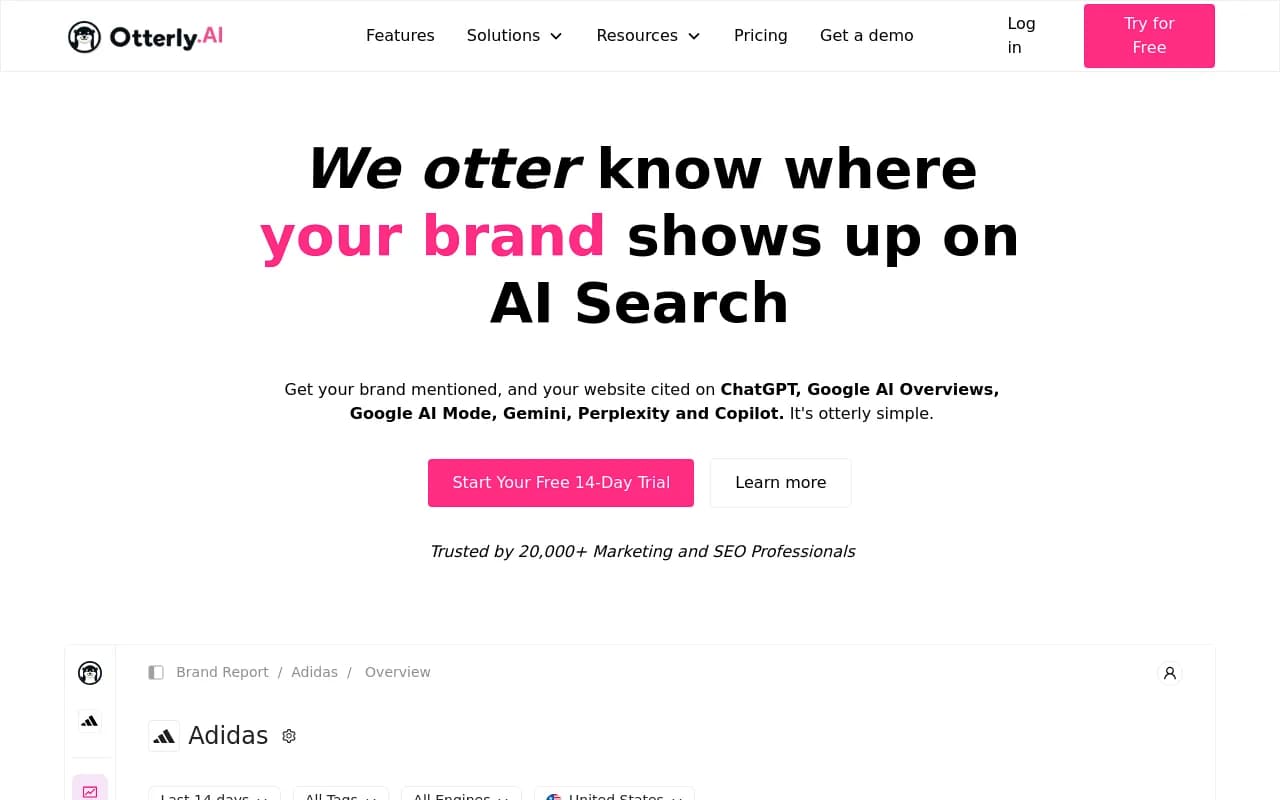
| Otterly.AI | 6 | $49/mo | Budget-conscious teams tracking basic visibility |
| Profound | 8+ | $500+/mo | Enterprise teams and agencies needing white-label reporting |
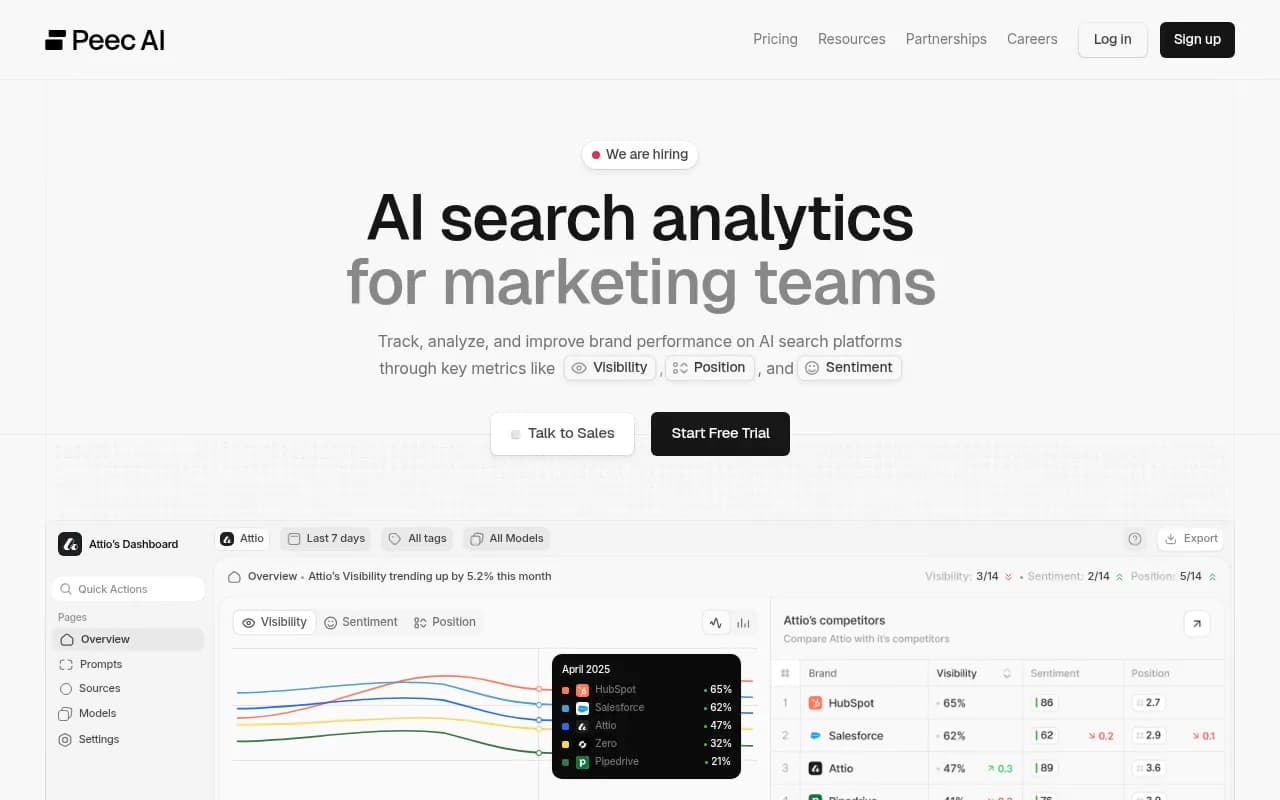
| Peec AI | 7 | $199/mo | Multi-language tracking and international brands |
| ZipTie | 8 | $299/mo | Deep analysis and custom reporting |
| Semrush | 4 | Included in existing plans | Existing Semrush users wanting basic AI tracking |
| Ahrefs Brand Radar | 3 | Included in existing plans | Ahrefs users wanting lightweight AI monitoring |
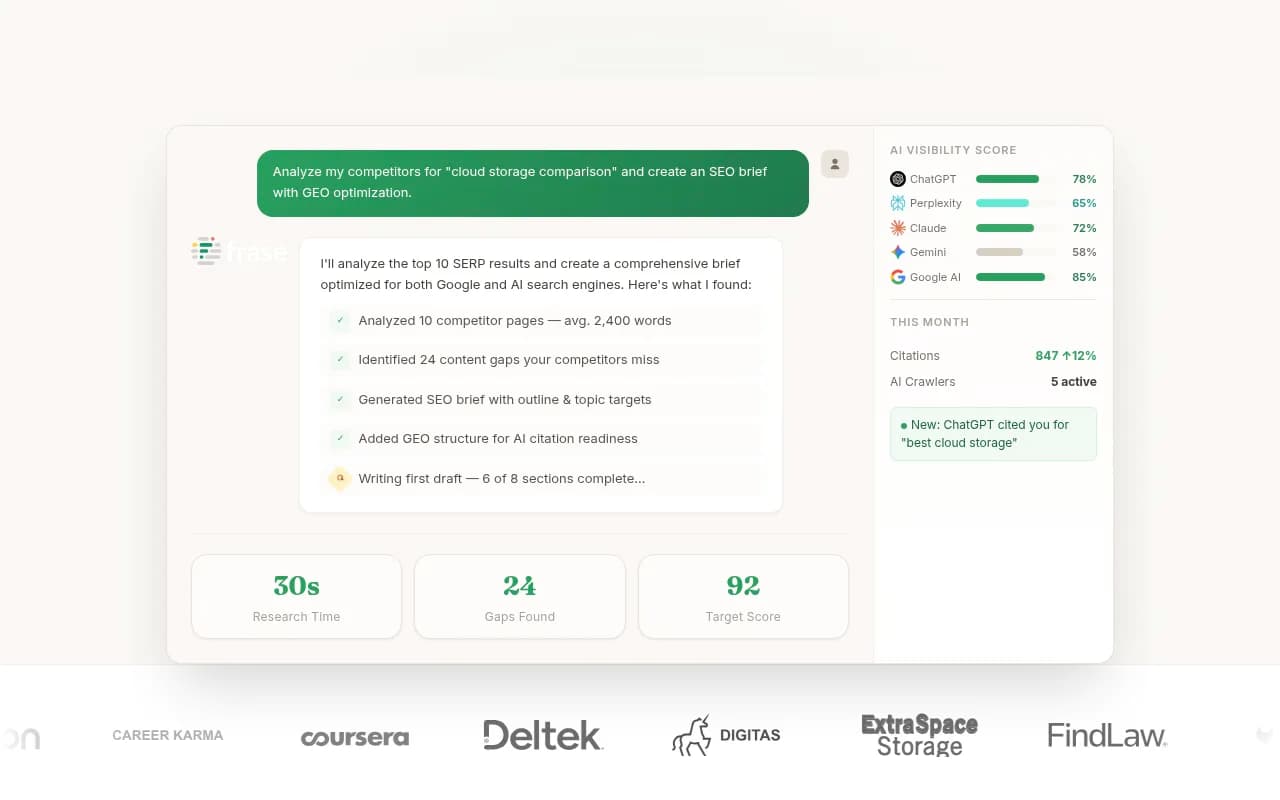
| Frase | 8 | $99/mo | Content teams already using Frase for SEO |

Promptwatch is the only platform rated "Leader" across all categories in 2026 comparisons of 12 GEO tools. The difference: most competitors are monitoring-only dashboards. Promptwatch shows you what's missing, then helps you fix it with content gap analysis, an AI writing agent (880M+ citations analyzed), and crawler logs. It's an optimization platform, not just a tracker.
How to set up AI visibility tracking
Step 1: Define your prompt library
Start with 20-50 prompts that represent how your target customers search. Think product categories ("best CRM software"), comparisons ("Salesforce vs HubSpot"), use cases ("CRM for small businesses"), and alternatives ("alternatives to Salesforce").
Don't guess. Pull prompts from:
- Keyword research tools (Ahrefs, Semrush) -- look for question-based queries
- Google's "People Also Ask" boxes
- Reddit threads in your niche
- Customer support tickets (common questions)
- Sales call transcripts (how prospects describe their problems)
You can always expand later. Start focused.
Step 2: Add competitor brands
Pick 3-5 direct competitors. The tool will track their mentions alongside yours, giving you benchmarks for share of voice and visibility gaps.
Step 3: Set tracking frequency
Daily tracking is ideal for fast-moving categories. Weekly works for slower industries. Most platforms default to daily.
Step 4: Configure alerts
Set up notifications for:
- Sudden drops in appearance rate (10%+ decline week-over-week)
- Negative sentiment mentions
- Competitor surges (they appear in prompts you used to own)
- New high-volume prompts where you're invisible
Step 5: Review and prioritize gaps
Once you have a week of data, look for patterns. Which prompts do competitors dominate? Which are you completely missing? Prioritize based on prompt volume and business impact.
Promptwatch's Answer Gap Analysis automates this -- it shows exactly which prompts competitors rank for but you don't, and what content you need to create.
Step 6: Create or optimize content
For each gap, you need content that answers the prompt better than competitors. This might mean:
- Writing a new blog post targeting that query
- Updating an existing page with more detail, examples, or structured data
- Creating a comparison page ("X vs Y")
- Adding FAQ schema to help LLMs extract answers
Promptwatch's AI writing agent generates articles specifically optimized for AI citation -- it analyzes competitor content, citation data, and prompt intent, then writes articles designed to get cited.
Step 7: Monitor crawler activity
Check your AI crawler logs weekly. Are ChatGPT, Claude, and Perplexity bots accessing your new content? If not, you might have robots.txt blocks, slow page load times, or other technical issues preventing indexing.
Step 8: Track traffic attribution
Connect visibility to actual traffic. Use tracking pixels, Google Search Console, or server logs to see which AI-driven visits convert. This tells you which prompts are worth optimizing for.
Common mistakes to avoid
Tracking too many prompts too soon: Start with 20-50 high-value prompts. You can't optimize for 500 queries at once. Focus wins.
Ignoring sentiment: A mention isn't always good. If Claude calls your product "overpriced" or "buggy," that's worse than no mention. Track sentiment and address negative contexts.
Not benchmarking competitors: Your 30% appearance rate means nothing without context. If competitors are at 60%, you're losing. If they're at 10%, you're winning.
Focusing only on ChatGPT: Perplexity, Claude, and Google AI Overviews matter too. Multi-platform tracking is essential.
Treating this like SEO: AI visibility isn't just about keywords and backlinks. LLMs care about recency, structured data, entity relationships, and content depth in different ways than Google does. You need different tactics.
Not connecting to traffic: Visibility is a vanity metric if it doesn't drive traffic. Always close the loop with attribution.
Waiting for perfect data: LLM responses vary. You'll never have 100% consistent data. Track trends over weeks, not day-to-day fluctuations.
What to do when your visibility drops
Sudden drops happen. A competitor publishes better content. An LLM updates its training data. Negative press surfaces. Here's how to respond:
-
Identify the cause: Which prompts did you lose? Which competitors gained? Did sentiment shift?
-
Check technical issues: Are AI crawlers still accessing your site? Any recent robots.txt changes, site migrations, or downtime?
-
Audit your content: Is it outdated? Missing key details? Poorly structured? Compare to competitor pages that are getting cited.
-
Look for negative signals: New negative reviews, Reddit threads, or press coverage? LLMs pick up on sentiment shifts fast.
-
Create or update content: Write new articles targeting the prompts you lost. Update existing pages with fresh data, examples, and structured markup.
-
Monitor recovery: Track daily for 2-3 weeks to see if visibility rebounds. If not, dig deeper -- you might need more aggressive content changes or technical fixes.
Promptwatch's crawler logs are especially useful here -- they show exactly when AI bots stopped accessing specific pages, which helps pinpoint technical issues.
The future of AI visibility tracking
This market is moving fast. In 2024, most tools were basic scrapers logging ChatGPT responses. By 2026, the leaders have added competitor benchmarking, sentiment analysis, crawler logs, and content optimization.
What's next:
Real-time alerts: Instead of daily batch runs, tools will monitor LLM responses in real-time and alert you within minutes of a visibility drop or negative mention.
Predictive analytics: Platforms will forecast which prompts are gaining volume and recommend content to create before competitors move.
Deeper integration with content workflows: AI visibility tools will connect directly to CMSs, suggesting edits to existing pages and auto-generating drafts for new content.
Voice and video tracking: As AI search expands to voice assistants and video platforms (YouTube summaries, TikTok search), tracking will extend beyond text-based LLMs.
Attribution at scale: Better tracking pixels and server log analysis will connect AI visibility directly to revenue, making ROI measurement as straightforward as Google Analytics.
The brands that start tracking now -- and optimizing for AI visibility -- will own the next wave of search traffic. The ones that wait will be invisible.
Getting started
If you're serious about AI visibility, start with Promptwatch. It's the only platform that combines monitoring, content gap analysis, AI content generation, and crawler logs in one tool. Most competitors stop at monitoring; Promptwatch helps you take action.
For budget-conscious teams, Otterly.AI offers basic tracking at $49/mo. For agencies managing multiple clients, Profound's white-label reporting is worth the premium. For international brands, Peec AI's multi-language support is essential.
But the tool matters less than the habit. Pick a platform, set up tracking, and commit to reviewing data weekly. AI visibility isn't a one-time project -- it's an ongoing optimization loop. The brands that treat it like SEO (consistent effort, data-driven decisions, long-term focus) will dominate AI search in 2026 and beyond.